Fourths of July

Posted on


The Fourth of July has never been one of my favorite holidays. I’ve always tried to enjoy it, but the flag-waving crowds and noise were never fun for me. I saw the fireworks on the Washington mall once, but the fellow behind us kept shooting bottle rockets into my back. Fortunately, they were duds, but it still scared me, and the adrenalin got me in a yelling match with him. I’ve watched the fireworks over the Atlantic Ocean from Virginia Beach, too, but the debris that polluted the water just depressed me. And once, in State College, Pennsylvania, I went with friends out to a field where we hoped the distance would give us a good view without the deafening noise. Instead, an oppressive cloud system held the smoke in and all we saw were a few glimmers through a thick, billowing, brown haze. We coughed and went home. None of it ever seemed worth the trouble.

Mainly, though, I always felt protective of my pets, who were always scared by the noise. And the only Fourth of July that I ever spent in Lewisburg, Pennsylvania, I had cause to worry about more than my own pets. As I sat on the front steps of my house, alone and anticipating my upcoming move from the town I’d so briefly adopted, with my five cats all hiding under beds and sofas inside, I listened as the noisemakers rose into the sky and watched as the colorful starbursts formed over the West Branch of the Susquehanna River across from my house. I did my best to enjoy the sight if not the sound. But then I saw it: a fat, scruffy basset hound lumbering terrified down the street—the middle of the street.

The dog did not move smoothly—it lurched and staggered—but it was moving fast. Every time another crackling bang echoed across the river, it would flail its head back and forth, its long ears flapping like birds in glue traps. I stood up and went to intercept it. Although the streets had emptied for the fireworks, as soon as they were over, people would be speeding home. I needed to stop the dog.

At first, it veered toward the far side of the road, but I could see as I got closer that the dog was old and was flagging fast. I stooped down and spoke calmly to him. “Come,” I said. “Come here.” He collapsed almost immediately in front of me, and I took hold of his worn leather collar.

It was all I could do to get the dog to get up again. He panted and heaved, and his eyes rolled back in his head. I thought he might die on the spot, but finally, after much soothing and coaxing, I got him to move toward the house. As soon as we got to the bottom of my front steps, I realized he would never be able to go up them—the dozen steep steps were much too much for his stubby legs. I also realized from his white muzzle and cataract-fogged eyes that he was not just old, but very old.

About this time, my neighbor and friend Deb came cruising around the corner. She’d come a block over from her house to get a better look at the fireworks reflecting in the river water, but she ended up helping me carry the dog up to my front porch, where he cowered under the wrought-iron patio couch. Deb was much more connected in the community than I was, and she said that she’d find out whose dog it was. In the meantime, I went in and got a bowl of water and a few dry crackers to feed him. He came out from under the couch and wagged his tail once before slurping down the water.

Deb and I noticed that the dog wasn’t in the greatest of shape. His toenails protruded like talons, and his fur had shed itself all over us as we lifted him up the steps. I began to pull off piles of dead hair from his back. Oily and smelly, it was clumped all over his body. He clearly hadn’t been brushed or bathed in months if not years, so I retrieved a brush and a shedding blade and went to work. Deb went off to see if she could find out where he’d come from.

The dog put his head in my lap and enjoyed his brushing. Though he still shook a bit when the fireworks went off, he stretched and rolled over for a belly rub. I brushed until I had a solid pile of fur as big as a twelve-pound cat. He nudged my knee with his nose every time I slowed down. “You haven’t had much attention lately, have you?” I asked him, and he licked my hand.

After a few minutes, Deb showed up with the dog’s owner in tow. The woman seemed thoroughly irritated, though she expressed relief that we’d gotten the dog off the street. In her haste to come and get him, she hadn’t brought a leash, and Deb suggested we at least give her a bit of rope so the dog wouldn’t get spooked by the traffic, both automotive and pedestrian, now streaming away from the fireworks site. And without further ado, the woman dragged the dog down the grass slope beside the front steps and off down the street. It struggled to keep up with her.

Deb trembled as she told me that she’d found a gate wide open from the alley into a dank, bricked townhouse yard filled with feces. On the front porch of the same house, a party was in progress, and when Deb asked if they were missing a basset hound, she got blank stares. Finally, Deb had been motioned inside and had followed the woman through to the back door. “I guess someone forgot to close the gate,” the woman said. “He’s really scared of the fireworks.”

Deb asked gingerly if the dog shouldn’t have been in the house, since it was a mere two blocks from fireworks central. The woman explained with a shrug that it had been a family pet, but that since the kids were grown it “just stays in the back yard.”

Deb and I sat on my front porch with the enormous pile of smelly fur I’d combed off the dog, watching people strolling home after their pleasant celebratory evening and wishing that we could do something for the old basset hound. “They must never even take it round the block for a walk,” she said, speaking from her knowledge as a frequent dog-walker. “I thought I knew all the dogs in the neighborhood. But I’ve never seen that one.” She swore she would check on it again.

We thought about our own pets that had grown old—decrepit, maybe, but never ignored, never neglected the way this dog was. We thought about the menagerie of feral cats we’d been working on rescuing over the past months. We knew there were animals worse off than this one as well as ones better off. But, still, we thought it a shame that its people would consign its aching, old body to a brick courtyard and no human comfort even in times of fear and peril.

It’s difficult to write about animals without sentimentality. And sentimentality is a bugaboo for positive thinkers and realists alike. It’s something I’ll explore more in this blog at some point. But every Fourth of July, I think of that old basset hound floundering down the street in terror, while oblivious people, even his own people, celebrated whatever it was they celebrated—democracy, supposedly, independence, maybe, freedom, perhaps, or just a day off work and an excuse to get drunk and make dangerous noise while other creatures cowered and fled. This habit seems so American. Sometimes I wish our public celebrations of our nationhood would reflect some other, better American qualities.
Laughing ’til You Cry

Posted on

In the general run of my life, I no longer have a lot to cry about. I know now what and who are important to me, and I take care of those things and people at least fairly well. There is always plenty of room for improvement, and there is always plenty of stress, but I’m not in a mess as I often was in my twenties and thirties. I have mellowed, and life is good, as they say.

A couple of weeks ago, Bruce came home after a long day and week at the office. The usual Florida summer weather pattern was setting in, and the dark sky threatened. Bruce often arrives home exhausted by problems at work, and he stretched out on the bed to unwind for a few minutes. I propped myself on a pillow beside him.

Our conversation was desultory. It started with nothing much and ended back around in the same place. We kept wondering what to do with our Friday evening, one of the few we usually take off, but one for which we had no plans. We had both done a lot of running around that week, and, though we kept feeling as though we should do something, neither of us really wanted to. Before we could even begin to rally, the thunder and lightning began. The fat raindrops pelted the skylights and windows. We floated on the bed in a pool of cozy yellow light surrounded by violent wind and blackness.

“What should we do?” Bruce asked. “I can always just go out and get something and bring it back.” I knew he would make the valiant effort, but he sounded tired.

I got up to feed the kitties. He let me rattle in the kitchen, not noticing that I had conceived a plan. While the cats ate, I sliced up a nectarine and an apple, then some cheddar, Gouda, and rosemary goat cheese, and piled it all up on a plate. I brought it back to bed, and said, “Let’s just stay right here. We don’t have to do anything.”

Immediately, I could see the burden of entertainment and provisioning lift from Bruce’s face. We settled in for the evening, just reading, doing a crossword puzzle, playing Angry Birds on the iPad, and talking. The storm rumbled on and the rain pattered down. And we talked, as too often we don’t really have time to do. The room relaxed, and all evening the coziness of being there together with the world held at bay by the weather allowed all our usual irritations to give way to the sensation of closeness.

At one point, one of us mentioned the unsightly three bags of mulch that had sat at the end of our driveway for a year and a half. We were finally getting around to planting the gardenia that we’d been given for our wedding and that had languished for two years in its pot in spite of our best intentions, and we were glad the ugly bags would soon be gone. “No telling what’s underneath those bags by now,” I said.

“Probably your passport,” Bruce answered, referring to the fact that three days before we were supposed to leave for our honeymoon in the U.K., I had realized my passport was missing. There’d been a bit of an ordeal in getting a new one and joining Bruce in Scotland a day late for the start of our honeymoon. The fate of the lost passport remains a mystery.

We’ve had a lot on our plates the past three years–lost passports, brain hemorrhages, and other things–and all of that came pouring out in those moments of relaxation and silliness. I chuckled in response to the idea that the passport could be in one place we certainly hadn’t looked for it. … And then Bruce laughed, and then I started in, and then we couldn’t stop. My cheeks began to ache, and we kept on laughing. We laughed til both of us had to wipe away the tears.

As so often when you laugh til you cry, it was set off by something trivial and absurd, but it tapped into the fact that after the last few crazy years, we were having a lovely, cozy, quiet moment. The oxygen of laughter flooded us, and our bodies had this near-sexual release of laughing and crying at once. It was a great moment, even beautiful, though we won’t put it down in the annals as important.

I haven’t made a study of the phenomenon of laughing til you cry, and experts don’t know much about it. Most times it happens over something trivial and so people don’t remember the details. The specifics of its instances don’t stay with us the way traumas do. But I do think that it often involves the sense of intimacy and closeness that Bruce and I had the other day. It seems to involve a sense of protection from a world outside, the creation of a safe zone for silliness.

I remember only two other specific times laughing until I cried, though I know I have done it many other times, too. One was at a potluck Thanksgiving dinner held one year by my friend Umeeta. It was a gray and unwelcoming November day in Pennsylvania—the kind of weather that makes you want to stay under the covers. And it was a holiday weekend in an abandoned college town. I hardly knew any of the other people there—only Umeeta and, slightly, her girlfriend, Kim. Now I don’t even remember who the other people were. What I remember was that there were six or seven of us, all with the end-of-term hanging over our heads, and that we had a fabulous meal, with not only the traditional American fare, but a wonderful vegetable curry and dal that Umeeta had made. After dinner, we sat around the living room—mostly on the floor because they didn’t have a lot of furniture—and told funny Thanksgiving stories. Then Umeeta put on a Bollywood movie, a tale of frustrated love that rose to quite melodramatic heights. Umeeta has an infectious laugh, and she got us going. And we laughed and laughed until we were all hiccupping and the tears were streaming down our faces. Total strangers, but we had been brought close in that warm living room.

Not long after, when I was still in grad school, I remember laughing with my then-boyfriend, Tad. Tad and I liked each other a lot, but we probably already knew that we weren’t compatible long-term. We spent a lot of time at the house he shared with two roommates and many parties filled with people I mostly didn’t like. In that group, most everything was public, and they shared partners as well as too much information. Tad’s roommate had an ex-girlfriend, still “friend,” who called him every day as she sat naked in her bath and told him all about it. This group of people also probably knew Tad and I weren’t compatible, and they watched us as though we were a TV show, as though they owned Tad (a main character), and I was an interloper (a guest star). But when we would spend a weekend at my townhouse, away from prying eyes, Tad and I really enjoyed each other. Tad was smart and funny and accepting of human foibles, my own included.

One spring weekend, we found ourselves undressed in my second floor bedroom, though it was late in the morning. I loved that bedroom because there was a birch tree right outside the window and when the sun flowed through the leaves as they danced in the breeze, it lit up the bedroom like a flickering river. Tad and I sat on the rug on the floor, examining each other’s bodies, just playing. But when he got to my toes, he exclaimed over how funny my toenails are—little moon-like crescents, he said. My toes have always embarrassed me—they are short and stubby and not at all elegant. But Tad made that all okay—he enjoyed my funny little toes and their even funnier toenails. He sat running his fingers over them and laughing. How could I not laugh, too? We laughed until we gasped and sobbed. Finally, I slapped him on the behind and we went downstairs for some lunch, and I would send him on his way, back to his friends, my enemies.

So maybe there is something also about a sense of a break in the battle, so to speak, about finding a moment of peace and pleasure amid challenges and strife. In the laughter that makes us cry, there is some tension relief. For even now, as mellowed and generally happy as I am, I know that the devil will eventually come through the door again. Bruce and I laughed because he said something amusing, but we laughed til we cried because that humor came up in contrast to a life in which we are often too harried to share some fun. The salty can certainly intensify the sweet.

Here’s “Laugh Till You Cry, Live Till You Die” from the 1976 album Flow Motion by the German band Can.

Gremlins

Posted on

I’ve been thinking about movies that have made me cry, and the oddest, perhaps most unexpected one on the list is Stephen Spielberg’s Gremlins, a “horror comedy” that came out in 1984. My crying over Gremlins became a part of family lore, though I think it’s been forgotten now and maybe should stay that way. I was teased relentlessly for years about it. However, Gremlins certainly makes me recall a time when tears were no stranger and I did not suffer dry eye in the least.

In 1984, I was, in fact, prone to frequent crying. As I look back over my journals from that time, I think that it might have been the worst year of my life. At age 24, I was in a hell of a mess. I had recently graduated from a fancy college with artistic aspirations, but was underemployed as a proofreader in a law firm where the lawyers were not allowed to even eat lunch with the underlings. It was a demeaning place and one where I had nothing in common with anyone. I outlasted three fellow proofreaders—a yakety-yakking young married woman with buck teeth and total self-satisfaction, a 400-pound guy who breathed heavily in our tiny office and licked the edges of his mustache, and a redneck girl who often came in with bruises from her country music–singer boyfriend and regularly snorted cocaine in the office bathroom.

Much to my surprise, I was also having an affair with a married man whose indecision about what to do twisted my life back and forth and round and round. A feminist, I couldn’t believe that I was involved in such a thing, and then one day my father made the unbelievable announcement that he was leaving my mother for another woman after twenty-seven years of marriage. My mother was devastated.

So I had plenty to cry about. But it’s also true that something about Gremlins tapped into my grief and fear, into my sense that something had gone terribly wrong with my life, maybe in the whole world. I remember also crying during that time period as I watched Poco, Little Lost Dog (1977), about a pup trying to find its way home through the desert after a car accident separated him from his people, and Sybil (1976), about a girl with multiple personality disorder caused by her mother’s years of terrible abuse. In all of these movies, some creature, animal, or person faces violence, misunderstanding, and/or loneliness. Perhaps that’s more obvious in Poco and Sybil, but it’s also true in Gremlins.

Gremlins is supposed to be funny, but while I sat in the darkened theater with my married boyfriend, I felt akin to someone in a crowd of people laughing as someone fell on the ice and broke his back, or someone stuck in the corner of a George Grosz painting filled with ugly, bulging faces. The supposedly evil gremlins, for me, retained too much similarity to the cute, cuddly mogwai Gizmo, who, after all, was their source. They were ugly and destructive, but they in no way merited the violence visited on them by the humans in the movie. In the famous kitchen scene, now often deleted, in which the mother of the main character slaughters three gremlins, including cooking one inside a microwave, was just flat out brutal. The movie, of course, was playing on the stories that had recently gone around about ignorant people trying to dry off their wet Chihuahuas and other small pets in microwave ovens, so it invoked a truly terrible and sad phenomenon. Live creatures boil from the inside and then explode when subjected to microwaves. I was horrified that anyone would think this funny, and yet I was in a large room with dozens and dozens of people roaring with laughter.

Already, I identified with the aliens, with those who don’t belong. Already I was worried at the human attitude about all other life forms. Already I knew that, in spite of all my (failed) ideals, I wasn’t any better than the laughing goons around me. Gremlins also taught me in a very odd way about the seriousness of comedy, about the desperation so often thinly veiled in its lines and images.

Go ahead, laugh. It’s sorta funny.

“Give Positive Reviews”

Posted on

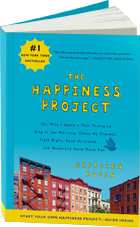
One very popular popularizer of positive psychology (as opposed to academicians like Martin Seligman) is Gretchen Rubin, author of The Happiness Project: On Why I Spent a Year Trying to Sing in the Morning, Clean My Closets, Fight Right, Read Aristotle, and Generally Have More Fun. In her penultimate chapter, one of the goals she sets herself is to “give positive reviews.” It seems to be part of a strategy played out in her final pages to upend possible criticisms of her own book. I’ve really never seen a writer do this so blatantly.

I am not going to obey her, though I want to say that her book was not as bad as I thought it would be. There’s plenty of practical advice in it that’s perfectly good on one level. Rubin even gives the book a veneer of self-criticism here and there, and she doesn’t present herself as perfect. She qualifies things and even notes that “Happiness doesn’t always make you feel happy” (79). I liked that she didn’t sell her intelligence short by being really simplistic, though it can’t be avoided completely in this kind of book. And I truly liked her focus on the ordinary. This is one piece of “stunt nonfiction” that doesn’t take us off to a war zone or an exotic adventure. It’s rooted in the home, which I found appealing. In that way, others truly could use her as an example for their lives if they wanted to, at least in bits and pieces.

Yet, one of the main things that kept slapping me in the face as I read this book is that Gretchen Rubin is basically a very wealthy and well-educated woman who threw her career over to become a housewife with a boatload of resources and time at her fingertips. I don’t want to judge her negatively for that fact, but none of this is presented particularly honestly; rather it is skirted. It’s not that she lies exactly, but nowhere does she mention the fact that her father-in-law is Robert Rubin, former U.S. Secretary of the Treasury and someone reputed to have received more than $126 million in cash and stock during his eight post-government years as an executive at Citigroup. Before he worked in the government, he was a member of the Board and Co-Chairman of Goldman Sachs; lord knows how much money he made there.

To me, this matters. I like to know who I’m taking advice from and how her circumstances are likely to affect the advice she gives.

Not that the Rubins are not good people. Robert Rubin, though a very wealthy man, is a Democrat, and web sources note that one reason he gives for that is that the world is not just and that not everyone has the same opportunities that he had and has. He feels that Democratic social policies contribute to a more fair nation. So, he is interested in social justice, and I appreciate that kind of philosophical generosity in a rich man.

I don’t know if Gretchen shares her father-in-law’s concern. In one odd little aside, she notes that “I … accepted my idiosyncratic reluctance to read any book (or see any play or movie) that centers on the theme of unjust accusation. I was never going to be able to force myself to read Oliver Twist, Othello, To Kill a Mockingbird, Atonement, A Passage to India, Burmese Days, Crime and Punishment, or Arthur and George if I could avoid it—and that was okay” (229-30). Certainly not all of these books are about class and racial injustice, but most of them are. Though Rubin said nothing else on this topic, this one sentence revealed to me a huge willingness for her to ignore whole realms of dire experience and certainly a lack of interest in how the other half lives.

The first thing that made me feel right away that something was wrong in Happiness Project-land was that I couldn’t imagine how anyone would ever have the time to spend on all these little projects that Rubin describes. My god, she wrote a novel in a month (NaNoWriMo style), she kept a resolutions chart; she kept a food diary and a gratitude notebook; she started a new blog that she posted on six days a week, created a huge scrapbook of clippings, established memento file boxes for each year of her children’s lives, self-published several things through lulu.com, and made countless scrapbooks and photo albums for her family members. She also ran multiple reading groups, threw numerous large parties, joined an expensive new gym with a personal trainer, volunteered at the local library and her daughter’s school, cleaned out all the closets in her house, and did her sister’s Christmas shopping for her. To me this did not sound like someone with a day job.

Rubin writes of herself as having made a “career change.” She decided that, in spite of the fact that she graduated from Yale law school and clerked for Sandra Day O’Connor, the practice of law was not her thing, and so she decided to become a writer. Now, this decision for her did not imply near-starvation or long years of struggle. She speaks of working with her agent as though she is dropping off dry cleaning. Anyone could do it. She notes that after she started her blog on the Happiness Project, she was delighted to find that she had made the Technorati Top 5000 without even trying. (Yet somehow she is aware that Technorati exists.) At one point, because her husband has been diagnosed with asymptomatic Hepatitis C, she reads up on organ donation issues and then “joined the board of the New York Organ Donor Network” (291). Just like that. There is no discussion of how her connections influenced these accomplishments or whether her “career” as a writer included living off what she had made as a writer before The Happiness Project became a bestseller.

While this occurred to me in the first half of the book, the real downturn for me was Chapter 7 on “Buy Some Happiness.” This chapter was chock-a-block full of stuff that comes from a wealthy person’s perspective, even if many not-so-wealthy people also buy it. It was also full of the sentiment that although money is not the only thing that gives happiness, it is certainly a good in itself. There is no discussion whatsoever of the corrupting possibilities of money. She does, however, note that money should be spent “wisely” in order to contribute to happiness. “People at every level of income can choose to direct their spending in ways that take them closer to happiness—or not,” she claims (171). She never discusses why they don’t—why, in particular, poor people might make a lot of spending decisions that better-off folk would consider short-sighted and even destructive. This edges very near to a blame-the-victim stance. It was pretty much downhill from there.

One of the most disturbing parts to me had to be when Rubin decides in contemplating spiritual issues to read “memoirs of catastrophe,” mostly those about illness and dying. Her entire response to these memoirs is that they made her recognize how much better her life was than those of the authors or subjects of the books she read. She admits that she feels a little guilty about this, but then moves on by saying that these authors “emphasized the importance of cherishing health and appreciating ordinary life” (202). That may be true, but it still seems to me incumbent on a reader to muster some sympathy for those in terrible situations, and Rubin strikes an odd note at the end of that section when she asserts that “I don’t think these memoirs would cheer me if I’d had more brushes with serious illness” (202). She hasn’t even bothered to understand the genre enough to know how many people are comforted by knowing that they are not alone in hard times. In other words, her rather self-centered reasons for “enjoying” them are the only reasons she can conceive of.

At the end of that same chapter (8), which focuses on the need to “Contemplate the Heavens,” she trots out all the reasons why someone might resist happiness: it’s not a worthy goal (it’s self-indulgent), it is associated with a lack of intellectual rigor (it’s not “cool”), some people use unhappiness as a guilty control mechanism, and some people fear that being happy will tempt fate to bring disaster down on them. She dispatches all these arguments in a mere three and a half pages, which, I must add, she does with very little intellectual rigor. Then she notes the ultimate cause of resistance: “Happiness takes energy and discipline. It is easy to be heavy, etc.” (218).

She reiterates this at the end of Chapter 9, on “Pursue a Passion,” when she encounters a naysayer who quotes John Stuart Mill as saying, “Ask yourself whether you are happy, and you cease to be so.” She dismisses this idea in exactly sixteen lines. And she concludes, “you must make the effort to take steps toward happiness” (233-34). I think about the happiness that has flooded me at completely unexpected moments, and I wonder. But there is no serious self-questioning here.

In Chapter 10, “Pay Attention,” she decides that the traditional Buddhist koans aren’t for her, but that she has some quotes that can serve the same function for her. This is a very funny section because none of her “koans” are koans at all. She spends more time contemplating the meaning of Samuel Johnson’s “He who would bring home the wealth of the Indies, must carry the wealth of the Indies with him” than she did Mill’s statement at the end of the previous chapter. Her interpretation of this statement, however, is no deeper than her dismissal of the other. All it means to her is that happiness inheres purely in the individual and not in circumstances.

In the section of Chapter 10 already mentioned above, on giving positive reviews, she notes repeatedly that it is easier to give negative ones. While some of the assertions she makes in the book about happiness are supported, at least marginally, by some scientific studies, she gives absolutely no evidence for the claim, repeated numerous times in the last few chapters, that it is easier to be negative. I myself have to say that I find writing this kind of review, where I try to be thoughtful and fair about saying even critical things, far more challenging for me than simply writing, “Oh, what a cute book. It’s so true.” I work hard for a fair and balanced critical mind, and most of the intellectuals, writers, and scholars that I know do, too.

These last few chapters of the book are filled with material seemingly designed to dismiss criticisms that Rubin seems aware may come up. Perhaps the funniest of these is that she spends numerous passages quoting from people who have posted on her blog to the effect of how much her blog helped them. How could this handful of readers of her blog be wrong? She even quotes her sister and her husband to prove that she’s become a happier and therefore better person over her year of effort. I mean, would you quote your sister or husband as proof of anything? That’s like someone in a creative writing workshop telling everyone that his mother liked his story so it must be good.

However, if the bestseller status of Rubin’s work is any indication, this strategy seems to have worked, much to my chagrin. She’s now working on a Happiness Project for children. I can’t wait to get those kids in classes I teach. It might make me cry.

Really, it’s not that I don’t want people to be happy, but I just can’t believe that this is the way. It leaves too many other important values in the dust.

The Dollmaker

Posted on

This Tuesday, I will take a break from the weekly song posts and talk about a book that makes me cry. My friend Anna had mentioned on Facebook a few weeks back a big, weep-inducing Victorian novel she loved, and it brought to mind my own literary crying experiences. If you have any to offer, let me know.

It was a very seventies chair, the one I sat in while I read and cried over Harriet Simpson Arnow’s novel The Dollmaker. The chair was huge and low-slung, was upholstered with lime green ribbed velvet, and had an ottoman the size of a swimming platform. It was a chair that thoroughly enveloped its occupant, or occupants, as it was possible for two to sit together in it quite comfortably, even non-lovers. It was the greatest place for reading I’ve ever known.

The chair and my middle-class, suburban, 1970s life contrasted sharply with the poverty-ridden, rural and then urban, 1940s world of The Dollmaker. Yet much of the novel was set in my beloved Appalachian Mountains, and Arnow’s descriptions of the piney smell and caressing air resonated with me. She had the place down. When the main character, Gertie, packs up her kids and moves to Detroit, where her husband has found war-time factory work, I felt the dislocation along with her. After all, my family had moved several times during my childhood, and I had my own sense of dislocation.

Gertie is tough as nails. In the opening scene of the novel, she is racing to a clinic on a mule with one of her children, who is so ill with congestion that he is near choking to death on mucus. Finally, she stops and cuts a hole in his windpipe so he will survive til she gets him to a doctor.

Gertie, however, is also an artist who sells out. She is a whittler, but once in the city, she turns her craft to cheap and simple results that she can sell for extra income. No reader could fault her for this, as she’s contributing to the survival of her family, but I felt the pain of her compromises. I came to see that art is not created in a vacuum and that talent does not always come to full fruition.

What made me sob over this book, though, was the character of Cassie Marie. (I later named a cat after her.) One of Gertie’s children, she is lovely and imaginative and dreamy–and ill-equipped for the big city slums. She dies, of course, in one of the most harrowing scenes I’ve ever read anywhere in literature, run over by a train while pursuing her imaginary friend, Callie Lou. Both the mother, desperately and futilely trying to get her to the hospital and save her, and the daughter, lost to a brutal world she doesn’t belong in, are tragic to the core. I still identify with Cassie Marie in a world where there seem to be fewer and fewer places where the dreamy and impractical can survive, much less belong. Gertie could adapt; Cassie Marie could not.

It may be that now in my life, I feel more like a combination of Gertie’s determination and toughness and Cassie’s diffuse enchantment, but I sometimes wonder if in fighting for survival I have given up too much of my whimsy and day-dreaming. I also feel for so many of my students, the “creative types” who don’t want to become part of the corporate machine, but who find few other avenues open in the narrowing trends of our work world. The Dollmaker taught me some of my first lessons in the challenges of a creative life without wealth.

The Father of Positive Psychology Isn’t Stupid

Posted on

It’s hard to approach an entire field of study in a blog post, and positive psychology is no exception. I hope that over time and multiple posts I can clarify why I find some of its assumptions so disturbing, even though I no doubt attempt to put many of their recommendations into practice myself. It’s practically unavoidable since positive psychology has become so pervasive in our culture in recent years.

However, one thing that happens with any kind of popularizing movement for complex theories is that the ideas get oversimplified, often even dumbed down, denuded of any kind of subtlety that might make them useful. In fact, in the hands of popularizers, such theories often become tools for brow-beating non-adherents and take on cult-like tones.

Martin Seligman, credited with being the founder of positive psychology and a professor at the University of Pennsylvania, started publishing about optimism in the early 1990s. It seems that he grew tired of treating depression and wanted instead to prevent it. In 2002, he published Authentic Happiness, which became a bestseller and rallying cry for the growing minions of positive psychology followers. He still maintains a website with that title that claims “almost 1,975,000 users from around the world.”

Nonetheless, a recent New York Times article now quotes Seligman as saying he regrets this title and is ameliorating his stance on happiness somewhat. I could be completely cynical about this development. For one thing, Seligman has titled his new book Flourish, which seems just as potentially brow-beating as “authentic happiness.” For another, he has a new acronym that seems designed for the over-simplifying satisfaction of the minions. PERMA stands for Positive emotion, Engagement, Relationships, Meaning, and Accomplishment. Some of this has clearly been developed in response to critics of positive psychology who noted that people don’t always behave in ways to achieve happiness and that happiness isn’t the only good.

One of the things about positive psychology that has always bothered me is that it seems to abandon the ill and the poor. It has been much celebrated for moving away from the treatment of pathological conditions to an embrace of higher fulfillment. This is all well and good for neurotic upper-middle-class and well-off people (of which I am admittedly one, too), but it turns its back on a whole host of people who really need help. That Seligman chose to focus his practice on those with the best health insurance and the flushest wallets doesn’t strike me as an accident. Maybe he himself was just depressed by the deeply mentally ill, which is entirely understandable. Many in the general medical field have done just the same, and we have a proliferation of “health care” that is about Botox and cosmetic surgery. On one hand, there’s nothing wrong with this; on another, I thought the goal of medicine was to relieve suffering.

So I’m glad that Seligman is re-incorporating some other values along with “positive emotion.” Scientists must always move forward and respond to legitimate criticism of and gaps in their work, and it’s to his credit that he is doing so. But I also can’t help but notice that Seligman is changing his tune at a time when the economy is dreadful and fewer people are likely to accept the panacea that techniques to achieve simple happiness are the be all and end all. More of us are face to face with people who didn’t deserve to lose their jobs and their homes and whose optimism couldn’t protect them. In a down economy, it’s less likely that your positive emotions will be enough to get you what you want.

At least Seligman is in touch with the reality of this economy. He is at least adapting his marketing plan accordingly. Let’s hope it’s a more substantive reconsideration than just that.

Imagine

Posted on

Many songs evoke tears based on a narrative basis–the lyrics tell a sad tale of woe or heartbreak–or a visceral basis–the “modulations in pitch, intensity, tempo, and rhythm” connect to our primitive sense of different types of expressive movement (“Why Does Music Make Us Feel?”). But John Lennon’s “Imagine” is a truly great song partly because it also evokes emotion on an intellectual basis. It is sad precisely because it is about an ideal that humanity never achieves. If I ever have a day when it’s hard to bring tears to my eyes, all I need do is listen to this one.

Of course, the song is also loaded with the tragic death of John Lennon himself, and nowadays with our nostalgia for more hopeful times, times when in spite of the horrors of the Vietnam War and social upheaval, a large swath of the population believed that positive social change and greater social justice were possible, even at our fingertips.

Noting that there are scads of YouTube versions of this song, I surmised that this hope is still alive. However, as I sorted through the versions and read the comments attached to many of them, I was horrified. The tendency of internet comment functions to attract nastiness was on hugely ironic display with many fights over interpretations and proper use of the song, whether soldiers themselves are good or evil, whether John Lennon was great or not, whether Mark David Chapman was evil or not, whether or not the song is anti-Christian, etc. etc. etc., all with plenty of vitriol. One guy on one site finally said, “Hey, the point of the song is to quit fighting!!!”

A Beautiful Day with Health Insurance

Posted on

November 14, 2010, was a beautiful Sunday, and I talked my husband into taking a bike ride with me. In Florida, where we live, November is filled with clear air and sunshine. Hurricane season is a quickly fading memory, and yet it’s not cold enough to require even a sweater. Bruce and I rode to the end of a nearby bike trail, stopped for water and for me to check my blood sugar, then headed back. As we crested a bridge over a road, I suddenly felt pain like I’ve never experienced before. It was like nails being pounded in all over my head.

Bruce could tell that something was wrong, but he thought I was just dehydrated. “Stop and have some water,” he said.

“If I stop,” I told him. “I won’t be starting again.” I knew it was really, really bad, but it never occurred to me to call 911. We crept slowly another mile and a half home. As soon as I stopped and took my helmet off, however, I felt as though I’d been scalped. I put my hand up, expecting the blood to be running down the back of my head. Then I began vomiting. We went to the ER.

The ER folks were indifferent, assuming I was just another case of food poisoning or stomach virus. Later, the neuro techs would tell me that ERs are terrible with neuro cases. But with a little help from my endocrinologist, and some insistence from me, we managed to get seen fairly quickly. The ER doc asked me how my pain compared to having my hand slammed in a car door. Worse, I said, far, far worse. His smile fell just a bit.

The initial CT scan showed bleeding in the brain, and the doc transformed from cavalier to grim. When he gave this news to my husband and me, I knew I might die. That’s what a brain hemorrhage meant to me. The only person I knew who’d had one was the young brother of a high school friend of mine, who had survived all kinds of surgeries and treatments for other health problems and finally had been given a clean bill of health, only to drop dead of a brain hemorrhage as a teenager. I told myself that had been nearly thirty years ago, but my husband had tears in his eyes, and the nurses were prepping me for a trip to the main hospital on a helicopter. The pain would not stop. As they wheeled me out and put me in the helicopter, I looked up at the now-night sky and a gorgeous moon. I asked La Luna to let me live. Then they put the ear protectors on me and off we went, flying through the dark on what seemed a big Vibra-bed.

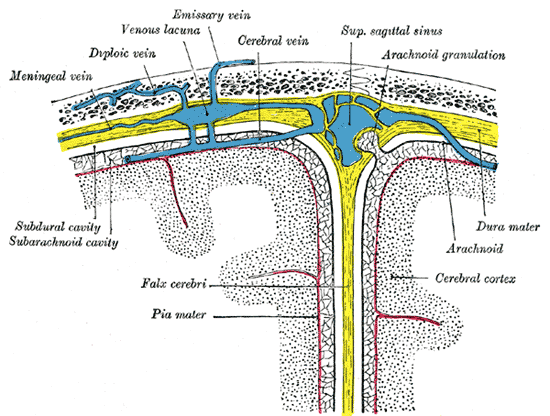
Within a few hours, we knew that, although I wasn’t completely out of danger, I had a better chance than most of being okay. The first angiogram revealed what they thought was a “benign perimesencephalic sub-arachnoid hemorrhage.” SAHs kill 40-50% of people who have them, but the type I’d had meant that they found no large aneurysm waiting to kill me, just some unexplained bleeding near the brain stem in between the pia and arachnoid membranes that surround the brain. The initial diagnosis was correct, and although I spent ten days in the hospital being re-tested and monitored for complications, and nearly a month on anti-seizure and anti-stroke medication, I escaped unscathed except for the ten pounds I gained lying around on the couch for a month.

The hospital where I stayed is a Seventh Day Adventist hospital. They were wonderful to me. The food was awful, but the nurses and doctors were attentive and caring and kind and seemed to have a real sense of mission. I felt throughout that I was very well taken care of. (And I am not always so sanguine about health care I receive.)

But one of the nurse’s aides mentioned to me that God must have some plan for my future, that I must have survived this terrible ordeal for a reason. A few days after getting out of the hospital, I went to my regular G.P. for a check-up, and his nurse told me about her sister’s brain hemorrhage. She survived, but suffered some irreparable brain damage. The nurse noted, however, that it “had brought her back to God,” and for that she was grateful. “If it had to happen to bring her back to God,” she said, “then it had to happen.”

This is the Everything Happens for a Reason stipulation of much of the positive psychology movement as well as much evangelical Christianity. I don’t believe it for a minute. While many who spout this sort of thing do so with good intentions, the implications are radically unjust: that those who die have nothing left to live for, and that we get what we deserve in terms of our health. This is the underpinning of arguments against health-care-system reform in this country these days, and it is hogwash. A 2009 Harvard University study showed that 45,000 Americans die each year from lack of health insurance and that Americans under age 65 have a 40% higher chance of dying if they don’t have health insurance. I will say it over and over: the poor are not poor because they deserve it, and the ill are not ill (generally speaking) because they have brought it on themselves. What is more, the rich are not rich because they are smarter and worked harder than everyone else, and the healthy are not morally superior, no matter how well it serves them to delude themselves into thinking so.

I was lucky that I had the kind of brain hemorrhage I had, and that my husband and I had the good sense to seek medical help. I was lucky to be well enough employed that I had health insurance that assured my treatment and didn’t leave me with more than $100,000 of debt. That’s all.

I do believe, however, that this terrible ordeal intensified my appreciation for life. I may be able to make use of that intensification to achieve more or be more considerate of loved ones, even of myself. Without the pain, without the fright, I might have muddled on for a few more years without examining the triviality of my daily obsessions. I might not have made time for who I really am, but stayed busy trying to meet others’ expectations.

Illness is a rallying call to appreciate the extent of one’s good health, whatever that may be. It puts us on notice that life really is short. Without the experience of pain, I might not appreciate all these pain-free days I’ve had since. The same goes for pretty much all of the polar opposites that we talk about: wealth and poverty, friendship and loneliness, and so on. And it is one of the main reasons why I believe that “happiness” cannot exist without sadness, nor joy without sorrow. I believe that we should not insulate ourselves against the world of hurt that is out there. I’m not saying to seek out pain for its own sake (that’s masochism), but to remember, to care, to keep in mind that having and not having are not matters of mere deserving, no matter how lucky we may be today.

It’s a Beautiful Day

Posted on

U2’s song is generally happy and upbeat, but it’s an example for me of how personal associations can account for at least part of the emotional attachments and reactions we have to songs. This song is one I heard a lot a few years ago in indoor cycling classes at the Y. I had recently moved to Florida and was in a new life over my head. I was being bullied at work and facing the truth about some less-than-ideal career choices. I was lonely in a strange city. But I was also still in a phase where I believed I could do anything I set myself to do. When “It’s a Beautiful Day” would come on toward the end of a spin class, I would sprint to the finish, strong.

So, with the encouragement of the greatest spin teacher in the world, a fellow who went by the nickname of Z, I decided I would train for an outdoor charity bike ride. Z’s business sponsored races, and he encouraged us to get out of the dark room and ride real bikes outdoors. I knew I couldn’t realistically race, but I could ride. So I signed up to do 50 miles for the American Diabetes Association’s Tour de Cure.

This was pretty momentous for me. Although I have always been active, I have never been athletic. I don’t believe I’ve ever competed in a sporting event. Oh, that’s not true. I won a red ribbon in a horse show once when I was twelve or thirteen. There are many people with Type 1 diabetes who do compete and who are athletic, but for me the illness itself was always enough of a physical challenge. I rode horses, I jogged, I walked, I hiked, I practiced yoga, I even lifted weights to stay in shape, but I never took it a step further.

Z inspired me to do so, and a couple of my indoor cycling pals signed up for the ride as well. One of my graduate students signed up. My old friend Sally, who is a real athlete, decided to come down from Maryland and ride with me. I “trained” for several months, which included many long weekend rides with my then-boyfriend, now-husband. It was a great time for me—all the support, the sense of accomplishing something new even though middle aged, the power of being fit, and the drawing attention to a good cause.

The day of the race dawned chilly and windy, and I was filled with doubts that I could do it. Who was I kidding? I was terrified of traffic, and this ride wound through country towns outside of Orlando, filled with barking dogs and intermittent traffic, stop lights and unclear turns. The people managing the race were completely uninterested in the fact that they had a diabetic riding for diabetes—and it was clear that most of the people riding did it for the riding not the cause and that it was a macho culture. Perhaps worst, the snacks provided along the way were cheap and disgusting—dry cookies and brown bananas—and I knew that I’d have low blood sugars.

But we all persevered. I nearly fell off the bike once at a stop light where I forgot my feet were clipped to the pedals. My blood sugar did reach a low point of 55, and I had to ride on, shaking and sucking on a juice box. And Sally decided that the 100 miles she’d signed up for were too much. But we all made it to the finish, where better snacks and massages awaited us. It was a triumphant day.

Unfortunately, within a few weeks I’d developed a painful condition called adhesive capsulitis or frozen shoulder. Months of medical mistreatment and long, sleepless nights of pain later, I was a walking zombie and as out of shape as I’d ever been. In the three years since, I have seen orthopedists, osteopaths, physical therapists, and medical massage therapists. And I finally found my way to swimming, which always helps loosen up my permanently stiff shoulders. I have continued to exercise, but only off and on, never as steadfastly as in my training phase.

So when I hear “It’s a Beautiful Day” now I am reminded of that great season in my life, but also that I no longer am there. Sometimes it makes me feel terribly old, as though I’ll never be in such good condition again. I can get a tear in my eye thinking about the regret implicit in “Don’t let it slip away” and the over-compensation in “What you don’t have, you don’t need it now, What you don’t know, you feel somehow.”

But I also get tears of determination in my eyes. One of the great things about Z as a teacher was that he recognized the challenges we each faced. To me, he would always say, “Roney, you’re an animal. You never give up.” And he would tell me that it wasn’t triumph that mattered, but coming back again and again even though I’m not the perfect athlete and never will be.

Hubris and Art

Posted on

Maybe “hubris” is too strong a word. But the recent tragic and avoidable death of a former colleague has made me think about how we see ourselves as creative people. There’s a lot of baggage that comes with being a musician or an artist or a writer, at least in the popular image. It’s baggage that drags many people down. While I love Janis Joplin’s music, I don’t love that she died of a heroin overdose at the age of 27.

My former colleague died in a single-car accident when she lost control on a freeway. Her car was a convertible with the top down, and she was not wearing a seatbelt. She was thrown from the car when it hit a guard rail. Just a few days earlier, I’d had a conversation with a woman who’d had an eerily similar accident, but who’d been wearing a seatbelt and survived without injury. Neither car had flipped.

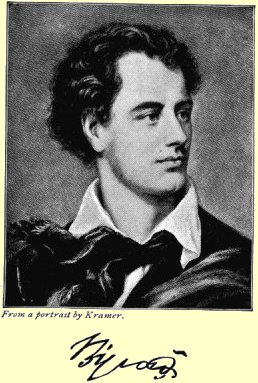
Last year I taught a course for Creative Writing students called Mad, Bad, and Dangerous: Images and Roles of Writers in Society. One of my purposes in teaching the course was to try to address the enormous mythology that surrounds artists of all types. Based on the prototype of Lord Byron–and the wit of Lady Catherine, who called him “mad, bad, and dangerous to know”—we tend to believe that writers and other artists have to be at least a little bit crazy and all the better to be bat-shit crazy. Crazy = creative in this formula. The idea goes back to the Greeks.

What surprised me was how completely unwilling many of my students were to even contemplate that this might not have to be true. I plied them with studies that demonstrate that the connection between creativity and mental illness is minor at most, and that many other factors are far more important in terms of what creates a writer (such as reading a lot). I asked them to read essays by famous, mentally well-adjusted authors. We read about how “blandness” is an aesthetic value in Chinese culture and how the role of artists in that society is different than in ours. They didn’t care. I knew the myth was powerful, but I hadn’t realized that even information and alternative models wouldn’t quell it.

So many of us have an image of ourselves as rebels and daredevils. And there is a kind of truth in it in that we need to be willing to take certain kinds of risks, at least intellectually and financially.

It is also necessary for writers and artists to have a healthy dollop of ego in our personalities. Without it, we would never have the nerve to go for it, to assert that we have something important enough to say for others to listen, and for us to survive the constant rejection and criticism that is always a part of a writer’s life. Frequently, that ego becomes defensive and overwrought in the face of so many fears and difficulties. And because another of our cultural myths is that artistic production is the result of genius, writers frequently begin to find it necessary to believe in their own invincibility, superiority, and exceptional nature. To put it crudely–and I just can’t think of a more apt term–it’s a mind-fuck.

What this too often leads to is a kind of bravado that involves drinking too much, taking drugs, acting irresponsibly and selfishly in the context of friends and family and self, and all manner of other wild behaviors. These habits by no means belong strictly to the arts, but in the arts we justify them with phrases like, “Genius takes its toll” or “Artists are crazy,” followed by sighs and eye-rolls. Everyone else who acts like this is just a jerk with problems, but we’re supposed to live on the edge. We are de-legitimized if we don’t.

Maybe this seems like an odd complaint, considering that my blog is about increasing intensity of feelings and not being vanilla and fake. Part of what I feel, however, is that, based on living this exaggerated if not false image, many of us in the writing world are losing touch with the real intensity of what it means to be creative and artistic. I even sometimes find in my students—and others— more of a desire to “be a writer” with all that implies about celebrity and lifestyle than to actually perfect their writing. The writing world is reaching a point where we will soon have our own Paris Hiltons. That may be inevitable, but let’s remember that writers and artists and musicians are distributed along the personality spectrum. Yes, some of us have mental health issues, but we don’t need to celebrate that. And no doubt there is some value in having a wild streak. Even I claim one. But we don’t need to drive each other further into stereotypes that end up killing us.