Author Archives: Lisa Roney

Hallelujah

Posted on

A beautiful song for the third anniversary of my marriage to Bruce. This “Hallelujah” was written by Leonard Cohen, whom I posted about just the other day, and is sung here by kd lang, who Bruce and I saw in concert here in Orlando last Sunday.

So many thoughts—

One reason why this song is perfect for today is that Bruce, like lang and Cohen, is a Canadian. “Canadian content” is one of our short-hand phrases for pointing that out—the distance from which we came together.

Another reason is that the love of people our age is complicated. Just this morning, I woke up with a low blood sugar and burst into tears over anxiety about our upcoming trip to Berlin—all my fears of not being able to keep up because of the arthritis in my foot and needing to rummage around in his friends’ kitchen for low-blood-sugar juice in the middle of the night and of my stomach getting upset over unfamiliar foods… Bruce and I had to talk it all out, and I told him after I realized what day it is that maybe I should wish him an unhappy anniversary. But, no, he loves me—and I love him—in spite of all the flaws of our human condition. “All the perfect and broken Hallelujahs have an equal value,” Cohen is quoted as saying about the song, and that seems appropriate today, even though I would not call my love a cold or broken hallelujah. Quite the contrary.

But even the kd lang concert the other night gave me much food for thought. Beyond the beauty of lang’s voice and the sheer pleasure of the concert, I have to note that it was not particularly well attended. Bruce and I—and no telling how many others—had gotten free tickets in a last-minute promotion, which was no doubt inspired by poor ticket sales. The Hard Rock Café concert space was even so only about 2/3 full, and I felt bad about this. Lang gave a terrific performance, and I know that non-sellout shows must be a standard feature of the musician’s life, but it was hard for me to believe that someone as distinguished as kd lang hadn’t filled the place up.

Bruce noted that there’s really no great way to keep up with events going on in Orlando, and several friends commented later that they, alas, had not realized she would be here. We ourselves had missed a John Prine concert just a few days earlier in spite of the fact that I’m his fan on Facebook and would have loved to be there. (I first saw him in concert in about 1977, and perhaps we should label him with “Appalachian content” to also indicate the different roots Bruce and I have.) It’s just hard to keep up, and we are distracted from our “entertainment” options, even the profound ones, by our work.

Such is the unpredictable and accidental nature of fame, art, love, and human life. Today, I am grateful to be experiencing all that together with him.

Memorial Day and Maya Lin

Posted on

Most of the time, our remembrances of those who have fought in wars are characterized by respect for bravery and sacrifice and ambivalence about the existence of these wars in the first place. I don’t know whether it’s actually true that previous generations didn’t feel quite so much ambivalence, though that is the story we are told: World War I and World War II were seen as “necessary” and “moral,” whereas once the United States launched itself into Vietnam, and, more recently, the Middle East, our government has had less clear and lofty purposes.

In the U.S., civilians have been sheltered for a long, long time from the brutal day-to-day realities of war. We haven’t had an official war on U.S. soil since the Civil War ended in 1865, and nearly eighty years had already passed when the Japanese bombed Pearl Harbor in 1941 and then landed troops in the Aleutian Islands the following summer. Seventy years have now passed since then, with only 9/11 as a major attack on U.S. soil.

But, as Edna St. Vincent Millay once noted in an untitled poem, “Peace / Is the temporary beautiful ignorance that War / Somewhere progresses.”

Indeed, much of the world is caught up in war on any given day.

In my own family, on this day, we honor the memory of my grandfather, Robert Kelly Roney, Jr., who fought was sent to North Africa, then Europe, during World War II and came home full of shrapnel that remained in his body for the duration of his life. He did not often tell the story of his shrapnel, at least not to me. In our family, the women were “protected” from these details.

On the other hand, he would sometimes tell the story of the deceit and betrayal that he experienced at home before his service and after his return from the battlefield in the figure of his father-in-law and employer, Edgar, more commonly referred to in the Southern way by the initials E.A.. While R.K. was gone to the front, E.A.’s vegetable canning factory was investigated for nefarious practices. As part of the “war effort,” the canning company provided a certain portion of its goods to the military—to be shipped overseas as rations or used in bases to feed training soldiers. My grandfather had managed the factory before his departure, and it appalled him to later learn that his father-in-law had established the practice of sending cans filled with water, devoid of food.

R.K. would shake his head when he told this story, and you could always see his amazement at the idea that a soldier in the field might open one of these cans hungry, perhaps very hungry, and remain that way. As a veteran himself, he felt this at a personal level. It was as if his own father-in-law had left him to starve on the battlefield.

Perhaps that was precisely what E.A. hoped—that somehow R.K. would see a familiar can label in the mess hall or trenches and then find nothing. The two of them had been in conflict for some time—over a woman. I didn’t understand the implications of the story for many years, but many’s the time that R.K. would tell us the tale of how, one night as he worked late in the office of the plant, pouring over the books, his pencil rolled off the desk. He leaned down to the floor to retrieve it when a bullet smashed through the window and whirred over his head.

“It must have been just a warning,” he would grin at my brother and me, “because it was only the one shot. But I lay on the floor for quite some time waiting for more.”

We would gasp at the excitement of it, never fully comprehending the breadth and depth of the story. The canning factory would burn to the ground in time to make the investigation about the empty cans moot, my grandfather would suspect insurance-fraud arson by his father-in-law, my grandfather and great-grandfather would part ways, and my grandparents’ marriage would break irrevocably and forever apart.

My grandfather would nod at us and warn us about the wars at home, but not about the wars overseas. Later, when my brother grew up, they would share some war story sessions, but not me. I was left with the domestic discord.

Perhaps that is one reason why the story of Maya Lin’s Vietnam War Memorial so stirred me when I was a young woman studying art in college. It’s hard to imagine now the uproar that greeted the news when her design, selected as the best from the 1,442 submissions, was revealed to have been created by a 21-year-old female—one of Asian descent and one still an undergraduate student (albeit at Yale). By now much of the ugly outrage, though mentioned, has been sanitized in writings about the memorial, but in the early 1980s—both after the design selection was revealed and after the memorial was built and opened to public view in 1982—the memorial stood to harsh criticism, racist and sexist commentary, and a deep questioning of what the purpose of a war memorial is.

Perhaps most importantly, several veterans groups spoke out to the effect that the memorial constituted one more insult to their service in a war that the nation had ultimately turned against. Instead of honoring the dead, they felt that its underground structure indicated shame and an attempt to erase their honorable service. (This video is clearly a student project, and flawed, but contains one of the best overviews I could find and the second half shows some footage of the vitriol and misunderstanding to which Lin and her design were subjected.) This was the cause of the inclusion of the more traditional figurative statue that stands behind and off to the side of the Wall memorial. The Three Soldiers statue was added to appease those who wanted a more “heroic” monument. Even that became a battle, as its proponents insisted it should be placed above Lin’s Wall, at its apex, which would have completely defeated her artistic vision of a wound in the earth that would represent the solemnity of the loss of soldiers’ lives. Fortunately, Lin prevailed.

By the time The Three Soldiers was completed and unveiled in 1984, and the Vietnam Women’s Memorial in 1993, they had taken on an appropriate secondary role. Maya Lin’s work of landscape art had won over almost all who experienced it first-hand, and it has over the years evoked the most amazing response of any war memorial on earth.

I will never forget my first visit to the Wall, shortly after its installation. I remember approaching it along a sidewalk through the park setting of the Mall, past the Washington Monument and through the peaceful green of the trees and grass. Gradually, I went down the long, sloping walk. At first, it felt simply as though I were passing a short retaining wall, but then I was down in the vee itself, the noises of the city dropping away to silence, the wall rising above me, the names shocking in their specificity, my face reflected back at me from the shining, black granite, the names imprinted on my face.

Even then, there were already offerings placed near these specific soldiers’ names. Even then, people searched for the names of their loved ones and caressed them when they found them. Even then, people wept over these names, and took rubbings of the names to take home. Even then people felt more connected to this memorial than to any of the stately ones scattered nearby and towering over the pathways and picnics. This memorial took my breath away. I felt as though I myself had died and was being buried along with every one of the men and women listed there.

The Wall taught the country that it was not the individual veterans who should be held accountable for any war, whether a just or unjust one. It changed our discourse about war and its effects, it publicly personalized the act of memorialization, forced us to face the complexities of a national politics reliant on a background of war. It did a lot, perhaps more than any other single piece of art in the contemporary world, while at the same time demonstrating clearly that gender and ethnicity (and even youthfulness) were not determinative of power or understanding. Alas, it could not also bring about the end of the institution of war itself.

May we all honor those who have served, while at the same time supporting efforts to find another way of negotiating our world.

* * *

It’s difficult to find a good video online that summarizes the impact of Maya Lin’s Vietnam War Memorial. The one I featured above is from the 25th anniversary of the memorial. There also exists a good full-length documentary, Maya Lin: A Strong Clear Vision, directed by Freida Lee Mock and released in 1994.

This video uses some clips from that film to talk about a PBS veterans storytelling project.

Here, there’s a pastiche of several parts of Maya Lin: A Strong Clear Vision, with great commentary on the memorial. Goes on to discuss other memorials that Lin has designed, including the Civil Rights Memorial.

This one is a tour through the memorial site on a very cold day. Not professionally made, but a good overview if you’ve never been there. It’s even interesting that the wind, so annoying in the early moments, dies down as the camera enters the deeper part of the memorial, clearly demonstrating its quieting effect.

The offerings left at the memorial are discussed here.

Three Pentagon-sponsored videos that relate to the memorial:
Part 1: about the history and effect of the memorial
Part 2: about veterans who embraced the memorial by designing an offering of a specially made Harley-Davidson motorcycle
Part 3: about schoolchildren visiting the memorial in recent years

A veteran describes the effect of the memorial, as well as Footnote’s development of a program to document veteran stories.

“Poetry” by Pablo Neruda

Posted on

Poetry

And it was at that age … Poetry arrived
in search of me. I don’t know, I don’t know where
it came from, from winter or a river.
I don’t know how or when,
no they were not voices, they were not
words, nor silence,
but from a street I was summoned,
from the branches of night,
abruptly from the others,
among violent fires
or returning alone,
there I was without a face
and it touched me.

I did not know what to say, my mouth
had no way
with names,
my eyes were blind,
and something started in my soul,
fever or forgotten wings,
and I made my own way,
deciphering
that fire,
and I wrote the first faint line,
faint, without substance, pure
nonsense,
pure wisdom
of someone who knows nothing,
and suddenly I saw
the heavens
unfastened
and open,
planets,
palpitating plantations,
shadow perforated,
riddled
with arrows, fire and flowers,
the winding night, the universe.

And I, infinitesimal being,
drunk with the great starry
void,
likeness, image of
mystery,
felt myself a pure part
of the abyss,
I wheeled with the stars,
my heart broke loose on the wind.

(Translated by Alistair Reid)

I have borrowed the text of this poem from PoemHunter.com.

Rita Dove, Marjorie Perloff, and the Failure of Success

Posted on

The “Poem Tree,” carved in England by Joseph Tubbs in the 1840s.

I apologize for the length of this post, my longest one yet. Sometimes it takes longer to examine what’s underneath an argument than to make one in the first place. As long as this post is, I kept it relatively short by focusing on this latest attack on Rita Dove’s anthology rather than Helen Vendler’s earlier one in the New York Review of Books. Dove very handily dealt with Vendler already and she chose to address primarily the racism and mischaracterization exhibited by Vendler, rather than another subject that Vendler veils even more than Perloff but one they both must see as another key culprit in the inclusion of the “many, rather than, few” poets: the MFA program and the presence of creative writers within the academy. Scholars have lost this battle, and creative writing is now well established in academia, so it seems that subject has sunk just below the surface. But it is never far below, and I believe we still need to address it directly.

Everybody Is a Poet

You know something is really wrong when someone mourns the success of a field she purports to love. Maybe love is the wrong word, so let me rephrase. You know something is really wrong when someone mourns the success of a field she has made her life’s work. The first line of Marjorie Perloff’s recent “Poetry on the Brink” in the Boston Review is “What happens to poetry when everybody is a poet?”

First, you would think that all lovers of literature and the arts would be jubilantly celebrating in the streets. I mean, my god, the novel may be dead, and support for the arts may be at an all-time low, but EVERYBODY has become a poet!!! How grand and unexpected an outcome is that?

But, no, according to Perloff, the popularity of poetry is a bad thing that ensures its mediocrity, or, as she puts it, “moderation and safety.”

Now, let me back up a minute. Is it true even that everybody is a poet these days? Obviously, in any literal sense of the word “everybody,” this is ridiculously untrue. Perloff bases her sense that everyone is now a poet on numbers provided in a lecture by poet and University of Georgia professor Jed Rasula: colleges and universities now employ 1,800 faculty in graduate programs, and that is only at the 177 graduate-degree-offering ones of the 458 institutions that teach creative writing, which “swells” the number of faculty teaching creative writing (now not just poetry) to 20,000. OMG, in a nation of 312 million, there are 20,000 employed teacher-writers. At least, thank god, their teaching keeps them busy a lot of the time, so they aren’t writing even more poems.

However, my next-door neighbors on either side don’t write poetry: the nurse, the retired engineer, the paralegal, and the fellow who owns a car dealership. None of them write poetry, and as far as I know, none of them read it either. When my undergraduates arrive in our introductory creative writing classrooms here at UCF, most of them have never read a poem by a living poet, and, though some of them may have written shortened lines of anguish in their online journals, or even in a notebook they keep under their pillows, they do not consider themselves poets. Their mothers, fathers, sisters, brothers, and aunts don’t write poems, and the first time they venture to call some words they’ve written down a poem, they don’t feel safe at all. That is even more generally true for the F-school elementary students and the ex-cons and the nursing home residents that my friend Terry encounters in the Literary Arts Partnership she directs.

This is not to say that I don’t sometimes grow exhausted by the number of would-be writers I encounter in everyday life. Just about every week I do meet someone who wants to be a writer. The first I recall was a psychology professor who ran a fellowship program I was in during grad school—he became very insulted when I declined to read his novel manuscript. Then there was a stranger in a meditation class I took, who brought me rafts of poetry that I didn’t have the time or inclination to read. My hair dresser wants to write, as does the wife of a physician I worked with in the medical humanities. The Buddhist monk who ran the meditation retreat I attended a few weeks ago is working on a book. Every freaking doctor or nurse seems to want to write a book, except my next-door neighbor. (The plethora of medical writers is a post for another day.) At least once a semester, I get an email from a random person who has found my faculty website and who hopes that I will “edit” his or her manuscript for him or her for free, out of a “love of writing.” I don’t do it, but this is not out of any sense that none of these people has a story worth telling or a poem worth shaping. It is not out of a sense that they shouldn’t be trying to write. I celebrate their attempts, though it’s beyond my capacity to help them all, just as I imagine a doctor or a lawyer recognizes the legitimate health and legal concerns of many in the population without offering to treat or represent them all.

I’m also from a family of writers, some professional, some not, and I can say with certainty that the richness of that background has led me where I am today—not a famous writer, perhaps not even a particularly memorable one, but one who makes her living by the word. The many writers in my family—from my great-grandfather the journalist who published two books of natural history through my grandmother with her religious verses through my amateur-novelist parents (both of them!) and my long-time blogger brother—have not detracted from my own modest accomplishments, but made them possible.

Perhaps it is for that reason that I don’t think that a large number of poets in society is a bad thing, to the extent we even do have a large number of poets. I think, in fact, that it makes the likelihood of great poetry emerging out of the plethora of mediocrity all the greater. Even if most of the poetry today is basically compost, it creates a rich soil for a much wider possibility of poets.

I would like to point out, in fact, that even with the numbers that Rasula cites, we are talking about 0.0064% of the population making a living as writer-teachers. Hardly everybody, even if we trust his numbers, and I’m not sure if I trust the numbers of someone who equates 0.0064% with “everybody.”

That teeny-tiny percentage also includes writers who write primarily in genres other than poetry, but it doesn’t include the many published writers (especially those many in literary journalism and genre fiction) who don’t also support themselves by teaching. It isn’t those independent writers, however, that concern Perloff and Rasula, only writers who also try to survive the academic gauntlet and are thereby rendered “safe” and predictable as writers.

Note that Perloff is not arguing against the kinds of standards that she seems to think force creative writers in academia to become safe and mediocre. She is not suggesting that tenure for such writers in academia should be judged in some way other than the number of awards they’ve won or the number of poems they have published in journals any more than she is arguing that scholars of American literature should be judged by a standard other than the number of awards they’ve won or the number of articles they’ve published in academic journals, in spite of the fact that the readership of scholarly journals of criticism is lower and the percentage of work accepted also generally higher than in most creative writing journals. She is simply arguing that not so many of these writers should exist.

She is also not arguing that academia has produced a corrupted uniformity and mediocrity in literary criticism, which, if the logic holds, would also be the result of the tenure and publication process therein. Perhaps we should entertain the idea that all critics are dulled by academia and need to make their way as reviewers. There are certainly those in our state legislatures these days who aren’t sure that our public universities need so many of them.

Can you imagine a physician coming out with a public statement decrying the general population’s attempts to eat better or exercise or get vaccinations? Can you imagine a lawyer who would discourage folks from using an inexpensive online will-document or living-will service if they couldn’t afford a private attorney? Can you imagine a doctor noting that nurses are valueless just because they have R.N. degrees instead of M.D.s?

It strikes me as very strange indeed for someone like Marjorie Perloff—professor emerita at Stanford and the author of numerous books and articles from the academic press—to imply that the academic environment corrupts poetry. Jed Rasula, too—a full professor at the University of Georgia, whose publication career includes both scholarly work and a couple of books of small poetry from small presses—seems to have benefitted from the support of academia. (This is a point I will come back to later.)

The Ivory Tower, this one a castle built c. 1780s in Neath, Wales, and no doubt fought over until a ruin.

The Struggle Over Academic Territory

People, this is not about “everybody” becoming a writer. It’s a power-struggle over academic territory. Reading between the lines, what I find in Perloff’s lament are the following:

1) The idea that if you can’t be somewhere as illustrious as she is, then you shouldn’t be messing with poetry. If fewer people did it, then discussions of poetry would remain “lively and engaging debates about the nature of poetry and poetics,” as she thinks they were in the 1960s, even in the 1980s. (I don’t recall the former, of course, but the latter seems to me to have been just as full of territorialism.) Maybe it is okay to democratize engineering, but not poetry. It should still be an elite endeavor, protected from popularity and the masses of would-be writers.

2) The idea that the kind of poetry that Perloff promotes—“language” or “experimental” poetry—is the only truly innovative kind, even though that type of poetry is more linked to the institutions of learning that support it than any other kind. Though it is academia that she thinks supports a mediocre poetry, the poetry that has a better chance of popular success and survival outside of academia is, in fact, the “lyric” poetry that she finds so abhorrent. It is not Jed Rasula or even Charles Bernstein that sells poems outside of a narrow academic audience, but the likes of Billy Collins or, yes, Rita Dove, who comes in for such a beating from Perloff.

3) So, it’s not that Perloff doesn’t think there should be writers in academia or that academia should not support some writers. It’s that somehow academia isn’t only or primarily supporting the more “elite” kind of poetry that she supports—that is, poetry that has its roots in theory and intellectual ideas about language as opposed to what she considers banal imagery and feeling.

4) In other words, Perloff is doing what academics do, especially in times like these when resources are shrinking—she is conducting a turf war, an argument about what should be taught in the academy, and she is arguing for the styles she personally favors. Period.

The truth about this is that most (and I don’t mean all) “language” or “experimental” or “Conceptual” poets come out of a scholarly background. They came to writing via literary history and theory. There is absolutely nothing wrong with that, and most writers I know have nothing against the pursuit of this kind of writing by those drawn to it. However, the resentment that exists in English departments between the scholarly (PhD) people and the creative writer (MFA) types abounds. It always has. I guess, alas, it always will. The likes of Marjorie Perloff cannot be satisfied unless literary theory and intellectual debates about the nature of language come to dominate the creative writing parts of English departments. They do not see the success of creative writing (as it currently exists) as part of a shared success of the field of English studies, though I think they should, especially during times when many elements of our political world would like to eliminate the study of the humanities almost entirely. Instead, the rise of MFA and undergraduate creative writing programs threatens their hegemony and dominance.

The cover of one of my great-grandfather’s books, Rhymes, Roughly Rendered by T. J. Campbell, 1902.

The Place I Speak From

I feel I can legitimately speak to this because of my own liminality, not to mention my own lack of importance. I have an MFA in creative writing, and I have a PhD in American literature (a regular English PhD, not one with a creative-writing dissertation and a few extra lit courses). I even did one of my comprehensive exams on the subject of literary theory. I feel a great appreciation for and protectiveness of both of these veins of study, though it is true that my career has focused on creative writing. But you just don’t get MFA faculty attacking the very existence of the scholarly study of literature the way you get scholars attacking the creative writing endeavor. A few snide comments, sure, but mostly defensive ones. Occasionally these rise to invective, as in my former MFA mentor, the inestimable (and, for the record, entirely “experimental”) Paul West referring to scholars as “corpse-fuckers.” But nothing like the continual, in-print, organized, and elaborate attack on the existence of mere writers in the academy. Our muddling along as untheorized observers of the world, illuminators of the “small epiphany,” and explorers of intimate sensitivities is often (though thankfully not always) anathema to some (but thankfully not all) of our scholarly colleagues.

Trust me, I see many problems in the arena of academic creative writing. I am nauseated by the insularity of the prizes, the clubbyness of professional organizations, the back-scratching that so often is what leads to publication. I despair over the continued sexism and white dominance in spite of the “identity politics” that Perloff thinks produces only slight variation. (See, for example, evidence in the VIDA count and a recent report by Fairness & Accuracy in Reporting.) I could write expose after expose, rant after rant, bitch-fest after bitch-fest about the limits and bad advice that have been imposed on me and those I know within the tenure system, not to mention the disintegrating publishing industry.

Instead, I end up reading over and over again these disses against MFA programs, from within the academy, sometimes even from within MFA programs themselves..

I think of a conversation I had with my neurologist a few weeks ago, after it became clear that he had originally misdiagnosed a problem I was having. I like him—he had made the referral to the Mayo Clinic that finally resulted in a different diagnosis, because he recognized his own uncertainty, and he was modestly apologetic. “Sometimes,” he said, “I wish I were an orthopedist. I could say, ‘Oh, you have a broken bone.’ It’s clear and direct. Neurology is more complicated.” Maybe an orthopedist would disagree with this characterization, but seldom would one of these specialists be enough of a foolish ass to aver that the other kind shouldn’t exist.

Yet just that kind of thing is common in English departments and in online and print publications that are responsible for carrying on discussion of our literary culture.
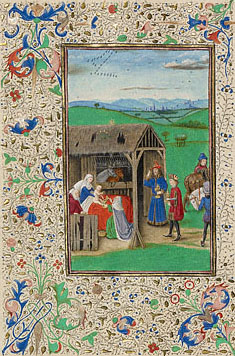
The Adoration of the Magi by the Master of the Llangattock Epiphany from the 1450s, back when epiphanies could be large.

Perloff’s Complaints About Contemporary Poets

In this case, I find the following a selection of questionable assertions in the first half of Perloff’s essay:

* In Perloff’s outline of the three characteristics of contemporary poetry of which she disapproves, she notes “irregular lines of free verse, with little or no emphasis on the construction of the line itself.” This is an outlandish claim, and I know of no poets who think or teach little to nothing about lineation. How can she even say that? Of course, she bothers to give exactly no evidence or example. Free verse, of course, means that lineation must be constantly and individually attended to, not formulaic.

* She claims that another characteristic is “graphic imagery or even extravagant metaphor.” The adjectives here, of course, are simply a matter of taste and debate, so what she is objecting to is the foregrounding of imagery and metaphor in themselves, which are indeed key elements of most poetry. If one takes out the adjectives, one sees that Perloff must, then, be arguing against their use. Go ahead, I want to say, see where that gets you.

* What it gets us to is the third characteristic that Perloff dislikes, the “expression of a profound thought or small epiphany” that I mentioned before. Usually, Perloff notes, this is “based on a particular memory, designating the lyric speaker as a particularly sensitive person who really feels the pain, whether of our imperialist wars in the Middle East or of late capitalism or of some personal tragedy such as the death of a loved one.” I suppose Perloff would rather us celebrate or forget those things. At least, they are so trivial as to be beneath her. And it is here that Perloff really begins to show her own imperialist tendencies, but more on that in a minute.

* Perloff also claims that “[w]hereas scholars gain cultural capital as they move up the academic ladder and can—by the time they become full professors—feel relatively comfortable in their careers, poets are always being displaced by younger poets.” This statement made me laugh out loud. First, as so often with this article, I think that the fabric here contains only the thinnest thread of truth. If Marjorie Perloff doesn’t think she bears any threat from younger scholars, then she should be careful about how many times she hails the 1960s and the 1980s as a fabulously superior time to ours. Granted, perhaps it is so that youthful sexiness is more vaunted by the commercial publishing industry where creative writers hope to place their work than by the university presses that publish the scholars. Indeed, author photos do not hold the same sway in the scholarly world as in the creative. Indeed, even when a creative writer places a book with a large publisher, if sales are not meteoric, it may get harder to publish subsequent books, whereas scholarly presses accept a very modest definition of popularity and will often therefore continue to publish a scholar who is hardly a bestseller. But this is one thing that poets (as opposed to novelists and creative nonfiction writers) have in common with the scholarly writers—modest expectations of sales of books has led to long careers. Donald Hall, who Perloff mentions, for instance, has published 22 books of poems (plus numerous books of biography, short fiction, memoirs, and textbooks) since 1952, the most recent in 2011. Robert Pack has published 15 books of poetry and 6 of prose since 1955, with again the most recent in 2011. Perloff disproves her own remarks in this regard, perhaps out of some sense that poets should not ever become full professors. I hate to break it to her, but they do with regularity these days. If their publishing challenges are so much greater for them than the scholars, all the more reason to admire them.

* Perloff cites this insecurity in aging poets’ careers not as a lament, but as an excuse to note that they write the same basic thing over and over again in their books, that “somehow the fourth book, no better or worse than the previous ones, gets less attention.” “Ezra Pound’s ‘Make it New’ has come to refer,” Perloff sorrows, “not to a set of new poems, but to the poet who is known to have written them.” Ironies abound here.

Perhaps paramount is the utter repetitive nature of Marjorie Perloff’s work itself or that of almost any scholar in academia today, where we are trained not to be generalists (for better or for worse). Perloff has commented on an impressive array of modernist poets’ work and she has pounded in a variety of ways about the banality of lyric forms of poetry, but does her work really range more widely than that of most contemporary poets? Does her focus on the rhythmic and metrical, on the language aspects of modern and post-modern poetry really encompass that much wider a world view or strategy?

But, also, Perloff cites Ezra Pound’s “Make it New” as a rebuke to current poets for not being innovative enough and then goes on to note that statements about emerging hybrids between experimental and narrative poetry “don’t quite carry conviction” because “’an avant-garde mandate’ is one that defies the status quo and hence cannot incorporate it.” I know that Perloff has read Pound, and I am sure that she knows her Pound far better than I do. But we all also know that rebellion from the status quo and reverence for the forms and insights of the past were both key to Pound’s work. Perloff contrasts Whitman, Williams, and Ginsberg (those committed to “the emotional spectra of lived existence”) with Pound’s “collage mode.” So it seems to me that Perloff confounds two issues here: 1) age and tradition and 2) “feeling” versus “collage,” the latter meaning text sources of inspiration.

Any given poem and its construction beforehand is a struggle between all these forces or, perhaps, on a good day, a beautiful dance between them. This does not, as Perloff insists, mean that the choices are arbitrary or that they have nothing to do with the historical moment or the cultural context. Individually, they certainly do. But that does not mean that they cannot all coexist with the field of poetry or even within a single poet. It is not a war where there need be a battle to the death.
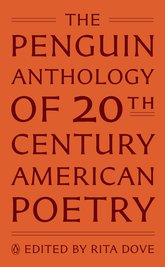
The cover of Rita Dove’s anthology.

The Meat: Perloff’s Complaints About Rita Dove’s Anthology

After this, Perloff gets to what it is that seems to have recently set her off: the publication of the new Penguin Anthology of 20th Century American Poetry, edited by Rita Dove. A long chastisement follows, in which Perloff takes issue with the omission of Random House poets that Dove and Penguin chose not to include because of prohibitive copyright costs. Dove has recently explained this decision in an AWP Writer’s Chronicle article, as well as in the introduction of the new anthology, but Perloff is not buying it and places the blame firmly on Penguin. “How,” she asks, “could a leading publisher such as Penguin fail to get publication rights for materials so central to a book’s purpose?” She does not mention that Dove has indeed explained this quite fully in print elsewhere.

Aside from whose fault the omissions are, this issue is a dodge that allows Perloff to critique the selections Dove has made, as well as her sense of literary history. Perloff claims that “one evidently wants to read her anthology not to learn about American poetry of the twentieth century but about her likes and dislikes.” In other words, Dove’s tastes are not adequate for the job, at least not in Perloff’s view, because Dove has not made the same selections that Perloff would have made.

At least not past the modernist era—Perloff notes that “however individual and intuitive Dove’s judgments on contemporary poetry, her Modernist canon… is more or less everybody’s Modernist canon.” Here is where Marjorie really begins to sound old. Here is where she returns to her earlier hint that she mourns the loss of a simpler time when everyone supposedly held a consensus about who the great poets were. She notes that before World War II everyone agreed on what the canon was. Alas, however, “the lack of consensus about the poetry of the postwar decades has led not, as one might have hoped, to a cheerful pluralism animated by noisy critical debate about the nature of lyric, but to the curious closure exemplified by the Dove anthology.”

Her lament about what Dove includes is then exemplified by Natasha Trethewey’s poem “Hot Combs.” Perhaps the oddest thing about Perloff’s reading of this poem is that, based on Trethewey’s own mixed-race heritage, Perloff assumes that the narrator of the poem is the poet herself. She complains that the poem, with its “easy conclusion that beauty is born of suffering, would seem to place this poem somewhere in the 1960s or ‘70s” but that it was published in 2000. Yet, Trethewey is known for combining her own personal experience with historical settings, including in her 2002 book Bellocq’s Ophelia, about a fictional prostitute living in the early 1900s. Perloff seems to willfully misread or oversimplify her reading of Trethewey’s poem.

But Perloff also makes another strange move here. She claims that “Hot Combs” exemplifies the three typical (and inadequate) characteristics she has noted above in the mediocre contemporary lyric poetry she is criticizing (no attention to line or word per se, prose syntax filled with imagery and metaphor, and the presence of a small epiphany. But only one of the the numbered list she gives in attacking this poem matches her list above in her second paragraph. Instead, she lists: 1) a present-time stimulus, 2) a memory, and 3) an epiphany (only this one matches). She does mention “prose syntax” and she insults Trethewey’s diction by putting “literary” in quotation marks before reciting a few of her descriptive phrases. But there is no coherence to the argument here. It’s just that Perloff doesn’t like this particular poem.
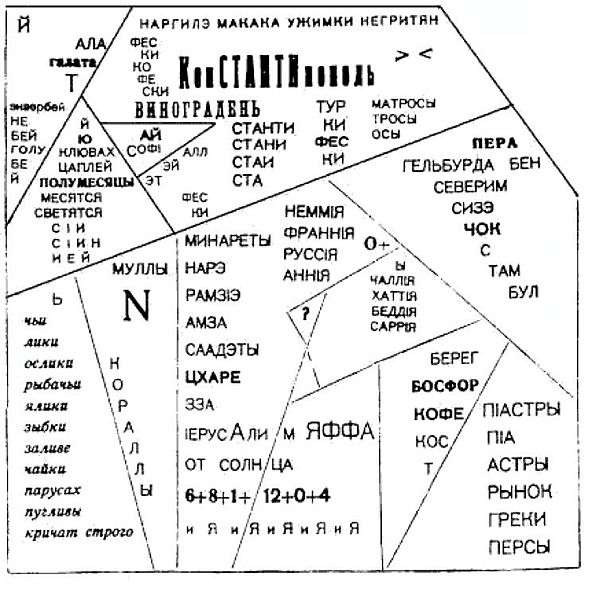
An example of “experimental” concrete poetry by Vasily Kameysky, 1914.

Perloff Turns to Supporting the Few

In the second half of her essay, Perloff goes on to write a manifesto about “a growing group of poets who are rejecting the status quo” with “what is now called Conceptualism.” The phrase “what is now called” seems to me to imply that she is simply talking about a different kind of status quo or tradition—in a direct line from the “language” and “experimental” poets of the past several decades. It also strikes me that somehow the fact that this is a “growing” group is used here to legitimize these poets, whereas the increasing size of the group of lyric poets somehow delegitimizes them. Go figure.

Perloff notes that the “main complaint against Conceptual writing is that the reliance on other people’s words negates the essence of lyric poetry.” She goes on to restate that Conceptual poetry is accused of having “no unique emotional input,” and that the question asked about it is, “If the words used are not my own, how can I convey the true voice of feeling unique to lyric?” As usual, Perloff doesn’t cite any examples of this argument, and perhaps it is true that some people have said this kind of thing. But most poets, even the lyric poets that Perloff seems to think are utterly stupid, are not that naïve. They don’t claim that the words they use have never been used before, and they often pay homage to other poets in their work. In fact, they often themselves produce mash-ups, and many of the literary magazines that Perloff suggest contribute to a uniform mediocrity send out calls for poems that do just that (For instance, here’s one from Crazyhorse: Cross-Off Contest). It is part of the conversation that is literature, no matter the style.

Perloff then asserts that the musicality used by John Cage in his re-working of Allen Ginsberg’s Howl is “absent in most contemporary poetry,” a slam that literally stuns me. She chooses one example “at random” (I doubt it) that she then turns into prose and notes that Cage’s poem “cannot be turned into prose” because of its “very formatting.” Well, really, I could turn it into prose, but, given that the Cage lines are further from usual prose syntax than the lines she quotes from Dove’s anthology, is Perloff really suggesting that prose can have no musicality? And has she read the same contemporary poetry that I have? Plenty of it is musical and rhythmic, and if some of it is less so, why should poetry have to conform to a formula of musicality any more than a formula of tripartite “observation—triggering memory—insight” or the 14-line form of a sonnet?

For example, these few lines from “The Golden Shovel,” written by a young poet I’ve recently discovered, Terrance Hayes:

When I am so small Da’s sock covers my arm, we
cruise at twilight until we find the place the real

men lean, bloodshot and translucent with cool.
His smile is a gold-plated incantation as we

drift by women on bar stools, with nothing left
in them but approachlessness. This is a school

I do not know yet. But the cue sticks mean we
are rubbed by light, smooth as wood, the lurk

of smoke thinned to song. We won’t be out late.
Standing in the middle of the street last night we

watched the moonlit lawns and a neighbor strike
his son in the face. A shadow knocked straight.

[from Lighthead, Penguin, 2010]

To describe this work, and work like it, as having no musicality requires an unimaginably deaf ear. I know Marjorie Perloff cannot have such a deaf ear. So why does she make such an enormous, vague, insupportable claim? She seems to me to be grasping at some kind of legitimacy for poetry she feels is unappreciated, and she goes on to analyze the work of four poets she likes.

Death is a common subject in many styles: The Death of Henry VII represented in a medieval miniature.

Perloff’s Four Poets

First, she discusses That This by Susan Howe, who she notes was not included in Dove’s anthology but who nonetheless “would not call herself a Conceptual poet.” In addition, Howe’s book focuses on the sudden death of Howe’s husband, Peter Hare, that subject matter of “personal tragedy” that Perloff earlier criticized in lyric poetry. The difference is that Howe reconstructs her poems out of fragments from other sources.

Don’t get me wrong—Howe’s work sounds fascinating to me, and I fully plan on looking it up. Perloff is at her best when she writes passionately in support of work that she finds interesting. She convinces me that Howe’s work is worth a look.

* Likewise with another set of poems that Perloff analyzes in some depth—from another poet she characterizes as “not primarily a Conceptualist”—Srikanth Reddy’s re-working of the memoirs of former Nazi and president of Austria Kurt Waldheim into a work Reddy calls Voyager. And again Reddy seems to partake of a subject matter that Perloff has criticized—sensitivity of feeling about “our imperialist wars.” Reddy’s work is different not just because he has re-worked an earlier source, but because his poems are “free of all moralizing or invective on the poet’s part.” I understand that there are shades here, but I am not sure how Reddy’s “critique” of Waldheim’s hypocrisy and of “political mendacity in general” is free of moralizing. His project and its outcomes seem inherently (and appropriately) moralizing to me.

Both of these books also sounds as though they need to be seen in their entireties—in book form—to be fully understood and appreciated, something that it’s difficult to present in an anthology. Perloff even says this herself: “Like Howe’s” book, Reddy’s “has to be understood as a poetic book rather than a book of individual poems.” How, then, would she suggest that Dove anthologize them?

* Recognizing this issue, Perloff then turns to recent short work by Charles Bernstein. Bernstein, she notes, has been criticized for becoming “easier” in his more recent work, but she argues that the trickiness of assessing Bernstein’s tone in such lines as the following renders his work still compelling:

No, never, I’ll never stop loving you
Not till my heart beats its last
And even then in my words and my songs
I will love you all over again

Bernstein, Perloff notes, is posing the question of “how to come to terms with this embarrassing bathos.” That makes the bathos interesting, though, of course, it is not an excuse that is allowed the “status quo” poets that she criticizes.

* Perloff’s last example of a poet she deems worthy is Peter Gizzi, who has written a collection called Threshold Songs “in response to a series of deaths—his mother’s, his brother’s, one of his closest friends—so overwhelming they can hardly be processed.” Again, because it “avoids the unsayable by its appropriation of other voices,” Perloff believes that Gizzi has written a more legitimate series of poems about his own personal tragedies than people who write more directly from their experience.
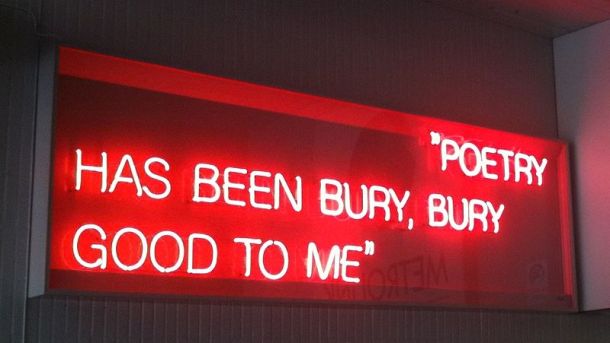
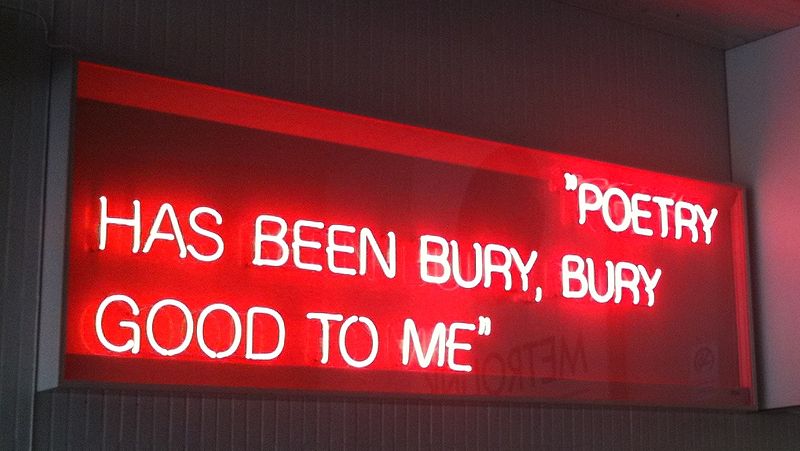
Ron Stillman’s neon sculpture “From Northern Soul (Bury Neon),” Greater Manchester, England, 2011.

Concluding the Inconclusive

Perloff ends her essay rather suddenly by noting that, “Increasingly, the ‘true voice of feeling’ is the one you discover with an inspired, if sometimes accidental click.”

Honestly, I don’t even know what she means by this last statement. Does she mean poets themselves or readers of poetry? And, while I guess she’s been making the case for a particular mash-up strategy of writing, she seems to have lost the point of arguing against the tradition of lyric poetry. Surely, she doesn’t mean that the only legitimate way to write poetry is to re-write other texts?

And for someone who is here to champion hard-core experimental and Conceptual work, Perloff has now given us examples from two people who don’t consider themselves Conceptualists and two examples of Conceptualists, one who has softened the Conceptual line around his work, and another who has taken up the lyric subject of his own personal tragedy. Does she really believe, then, that hybridity is impossible and an unconvincing storyline as she asserted early in the essay when she briefly mentioned Cole Swensen and David St. John’s anthology, American Hybrid? Her own examples seem to me to prove its healthy existence.

I do, however, agree that, as Perloff states early on, “Formal choices are never without ideological implications.” I believe that Perloff’s choices certainly have them, and that her ideology most clearly supports an elite of the elite. Writers and readers of poetry are quite an elite all on their own, and when you sift out the grandmother-amateur-poets, they are even moreso. But Perloff seems to me determined that poetry will also remain shuttered from lived experience, centered in the halls of intellectual academe, and upper crust, if not essentially white and male (Reddy, of Indian descent, attended Harvard and the University of Iowa). She does not celebrate the vernacular found in poetry she would call unmusical, nor in the actual experience of loss or suffering, only in sublimated versions. A poetry based in the middle class or the working class must be anathema to her, just as any but the most intellectualized ideas about poetry are.

I want to make clear that I do not think that debates about quality are not relevant or appropriate. But what I see in Perloff’s essay is fundamentally a grasping to preserve the values of a time long past—a pre-World War II era when scholars defined quality, when poets themselves were largely excluded from the academy, before they had infiltrated it in creative writing programs and had begun to find the platform to assert their own definitions of quality that were often at odds with their more theoretical scholarly colleagues. Perloff notes indignantly that Rita Dove’s anthology “depends not on … its capacity to satisfyingly delineate a poetic canon or make some claim about the nature of poetry in a certain time or place—but on the prestige of its editor.” It seems outrageous to her that Dove is “prestigious” in spite of her 13 books.

It is entirely possible that Dove has made selections for this anthology based more on a creative writing sensibility and pedagogy than that of a scholarly literary one. Indeed, the delineation of a canon or the examination of the cultural and historical aspects of poetry is often not the focus in creative writing courses, though creative writing students are always required to take numerous literature courses in which they are. It is also true that creative writing pedagogy and traditions often function with a more idiosyncratic and artisanal model of teaching and learning than do scholarly ones. Perloff clearly believes that this is wrong-headed, as do many in the scholarly literary field, and she insults these methods by stating that she wonders if the intended audience of Dove’s anthology is “junior high students.” It is true that creative writing pedagogy in the wrong hands can be too easy and indulgent, but in the right ones it can be rigorously powerful and empowering. There are many variables that contribute to particular outcomes. I just wish that Perloff would admit that what she is doing is longing for a time before creative writers per se had a place at the table of deciding what poetry has merit. She wishes it were only the scholars and the few scholar-poets who had the kind of “prestige” that Dove now shares.

If Dove has constructed an anthology suited to her own reading and teaching preferences, what is wrong with that? Is it not the same method that Perloff herself uses when she edits anthologies and decides what works she will include on syllabi? As Rasula notes, in academia, we are trained to be “specialists,” and Perloff herself is not asked to teach courses in the Victorian novel. I can fairly safely assume that she has never included a Rita Dove poem on her syllabus in spite of the fact that Dove has published more books and has been more widely read than some of the post-modernist poets that Perloff favors. It is probably true that most poets teaching in academia weight their teaching toward the lyric, and even poets in that tradition (such as Carolyn Forché) have worked to open it beyond the personal to a more political consciousness. But these poets have asked that the door be opened, not that another door be closed.

The second half of Perloff’s essay, though not particularly logically consistent, nonetheless serves a valuable purpose: supporting four poets whose work she finds compelling. I am all for that.

Yet I must point out that Peter Gizzi is a full professor of English at the University of Massachusetts Amherst, Charles Bernstein a named professor of English at the University of Pennsylvania, Srikanth Reddy an assistant professor of English at the University of Chicago, and Susan Howe retired as a named chair at the University of Buffalo (formerly SUNY Buffalo). Of the four poets that she mentions early on that she feels were neglected in Dove’s anthology—Harryette Mullen, Will Alexander, C. S. Giscombe, and John Yau—all but one has a full professorship at a prestigious university, and even the one (Alexander) has taught in several places while making the choice to remain in his native L.A. All of them, in spite of some of their and Perloff’s protests, have successful careers legitimized within the very academy Perloff wants to blame otherwise for the mediocrity of contemporary poetry. They are all also writers whose work is deeply connected to the scholarly, theoretical, and historical tradition.

Academic historians and theoreticians of music and the visual arts can’t so easily cast out the practitioners of music and art—their media require a different kind of technical facility than the scholars have. But when the medium of art is language, too often the scholars don’t believe they need anyone but themselves.

And this turns me again back to the first half of Perloff’s essay, which seems to me an unacceptable diatribe about MFA programs in creative writing and the influence of academia on poetry, that is, on poets within academia who do not toe her rarefied intellectual line. I do believe that we can debate the merits of specific poems—and the Trethewey poem that Perloff critiques will likely never be one of my favorites. I agree that we can debate what the most important elements are in poetry, too. But this kind of hand-waving, overgeneralized dismissal of MFA programs and lyric poetry is less than we deserve from our well-known public intellectuals in the field. I am a relative nobody, with no doubt a less lofty education and certainly fewer credentials on which to stand than Perloff and her Harvard and Berkeley cronies, and even I can think beyond this.

We need to celebrate in the streets—and in print–the rise of creative writing’s popularity in the public imagination and in our colleges and universities, or else we really could end up dancing on the grave of poetry one day soon. Just about 99.9936% of the population may not even notice.

So Long, Marianne

Posted on

Leonard Cohen was in Toronto recently to accept the Glenn Gould Prize, and I heard his son, Adam, talking on CBC Radio about the event, where he’d also performed a couple of songs in his father’s honor, including this Cohen classic, “So Long, Marianne.”

Though there’s a bit of that insider clubbiness evident in the interview, and an inane comment by host Jian Ghomeshi about the “sexy” nature of Cohen’s songs, there are some wonderful comments about Cohen and his priorities, and Adam Cohen is articulate about some aspects of his father’s artistry. He also does a great job playing his own version of “So Long, Marianne” and one of his own recent songs, “Like a Man.” Beautiful stuff. (Ghomeshi himself is smarter here in his brief introductory essay about Cohen’s receipt of the award and the value of poetry.)

Here’s the entire twenty-six-minute interview with Adam Cohen, and below a few comments that seem especially relevant to my themes here.

On why Cohen doesn’t usually accept awards (he declined the Governor General’s Award, but accepted this one out of respect for Glenn Gould):

“This is a guy who is not interested in self-congratulation, certainly not publicly.”

“Outside of true and genuine humility, not some act, not some artifice, not some social device, outside of an aversion to the self-congratualtory aspect of awards, his interest is art. His focus, his devotion, his life… I mean, what distinguishes him and delineates him from so many others is precisely his commitment to the work and not the vanity, not the social status.”

On Leonard Cohen’s “most unlikely and delicious, triumphant come-back,”… “this return to the public eye in the highest of forms” and the fact that he is “more pertinent than he’s ever been before”:

“We’re living in what is, for the first time, collectively what is regarded as an impoverished time for the arts. I think that there has been a staggering collapse in the social value of what we think of as the arts. My Volvo was broken into, and they didn’t take the twenty-five CDs that were in the front seat. They took my car seat, my kid’s car seat. And what was more upsetting to me was that they didn’t take all these fantastic CDs, and it was such an emblem of the lack of esteem for music and the arts. It’s not downloading; downloading, pirating, has always happened. When I was a kid and you were a kid, we taped stuff off the radio on a cassette. So that’s not the problem. The problem is a dip in the cultural value of music and of the arts. And my father is part of a group in this incredibly splintered culture that we’re in—where there is no more consensus, there is no more Ed Sullivan, there is no more Tower Records. There is just this fractured civilization, everyone looking in their hopeless little screens. And what my father represents is a person standing in this one category that is unanimously regarded as the golden era, the people that produced Dylan, Van Morrison, Joni Mitchell, Neil Young, my father, and several others, and there he is standing on the heap of his work in this sort of apocalyptic, cynical time, and he’s like this bastion of truth. He’s weathered the storm. And I think it’s because of the poverty of the land.”

I don’t accept these last comments completely at face value, and I will take up this issue of fragmentation and its threats and opportunities in another post soon. But today, the melancholy strains of Leonard Cohen (and Adam) seem right to simply honor and celebrate.

Cameo: A Little Life

Posted on

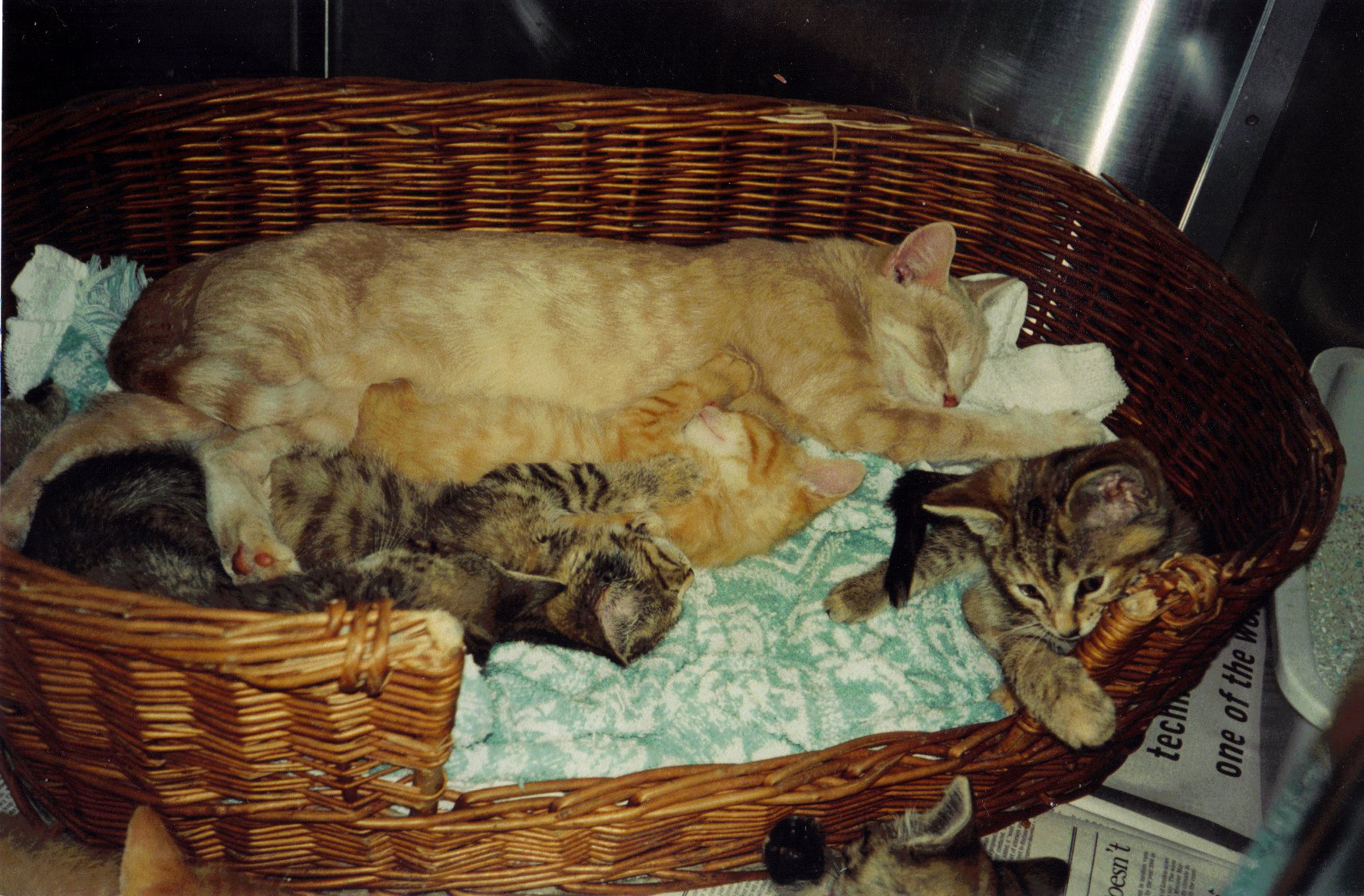
“Candy” and her kittens, 1997.

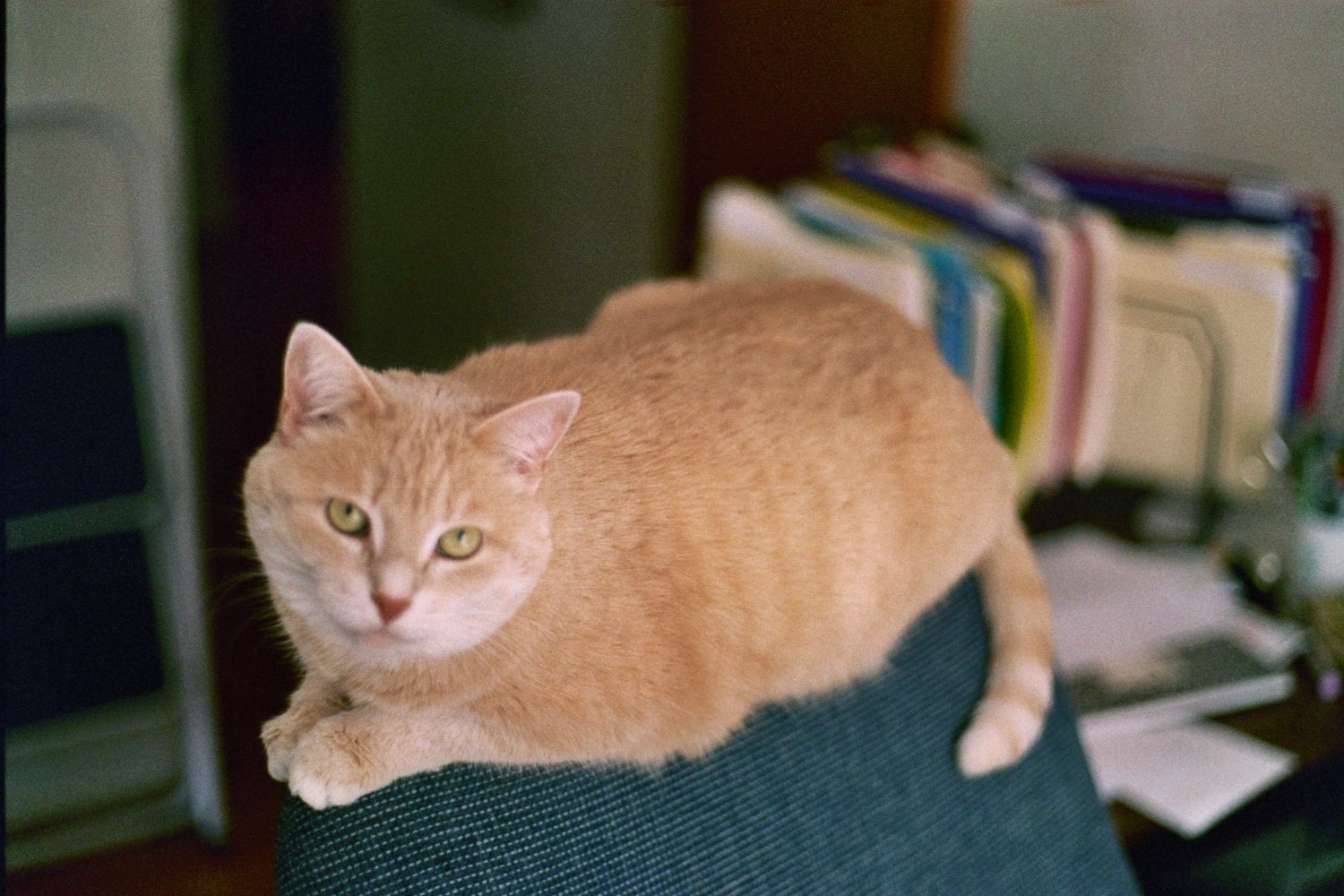
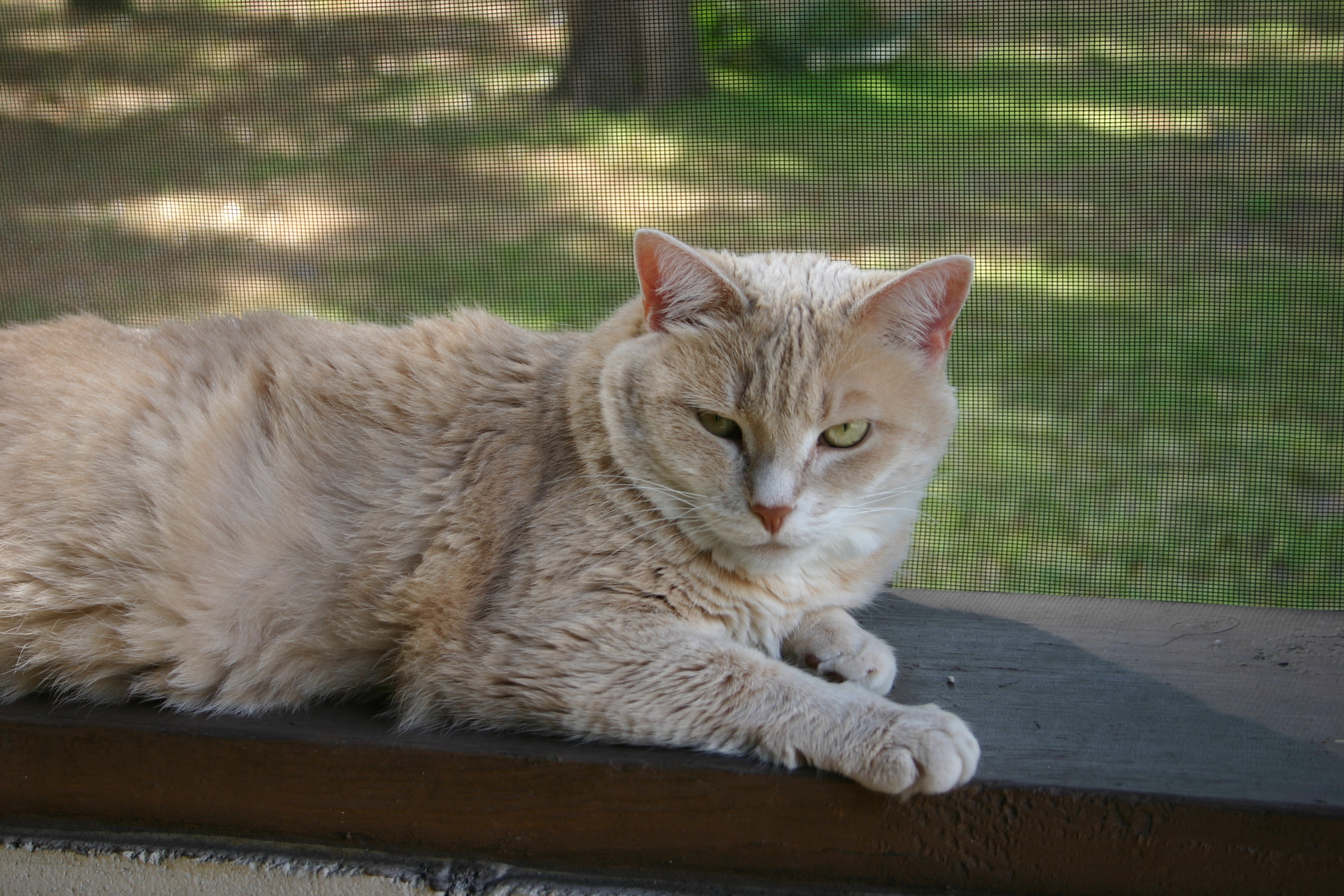
It was not exactly love at first sight. I adopted Cameo because no one else would. She had been adopted twice from Centre County PAWS, the animal rescue organization where I volunteered, and then she’d been “returned” because she scratched people. When any of us took her out of her cage, she would get all excited—would purr and roll around on the floor, bright-eyed, or would run around attacking every toy in sight, ecstatic. When playtime was over, however, and we’d go to put her back in her cage, she would cling, hiss, and claw us viciously. Who could blame her? She had come into the shelter a teenage mother—a tiny little thing with seven kittens. She had been in the cage for nearly nine months with those doggone kittens, waiting while all of them grew up and went off to homes. You could see the accusation of injustice in her eyes.

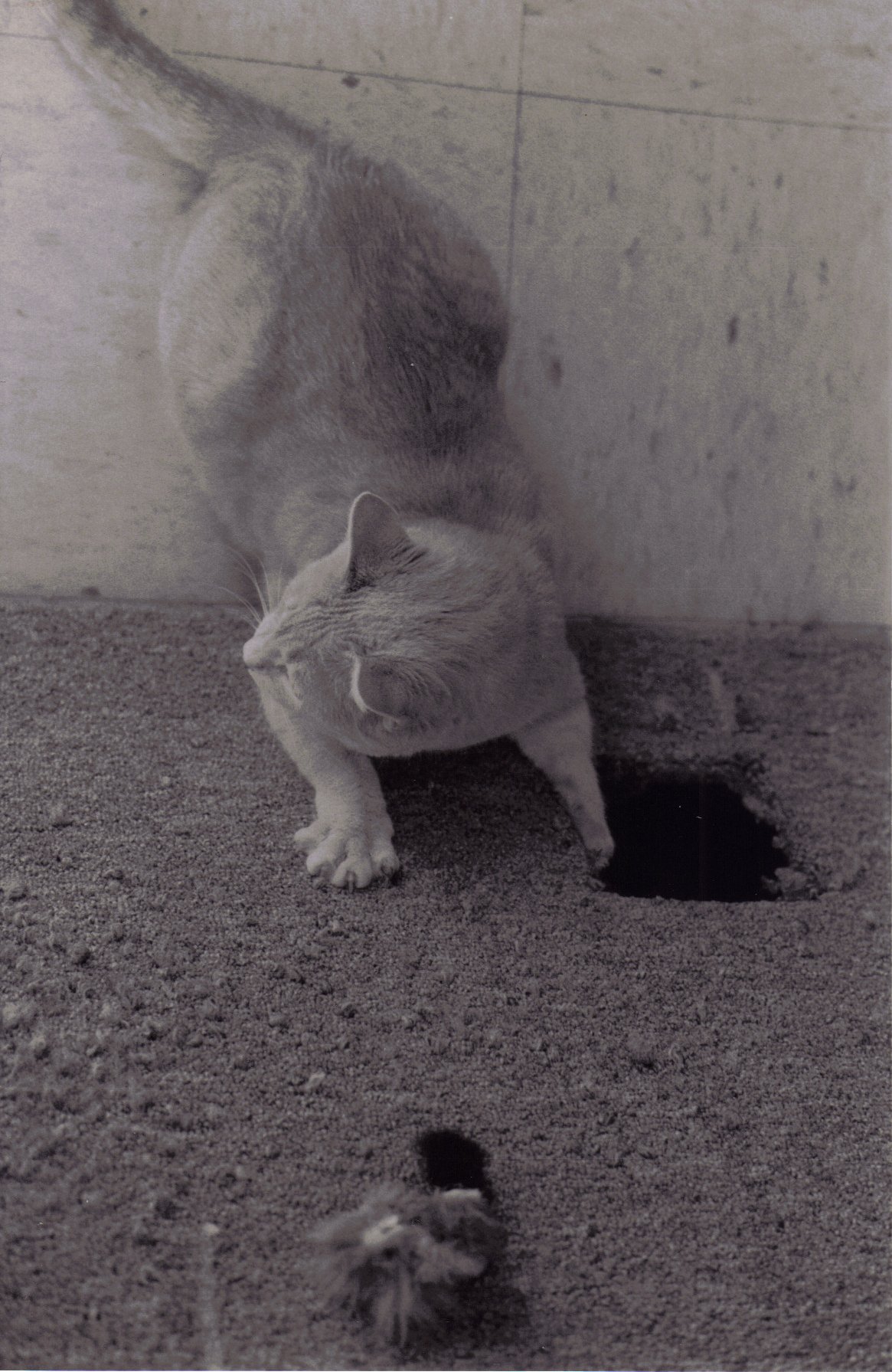
Candy out of her cage, 1998.

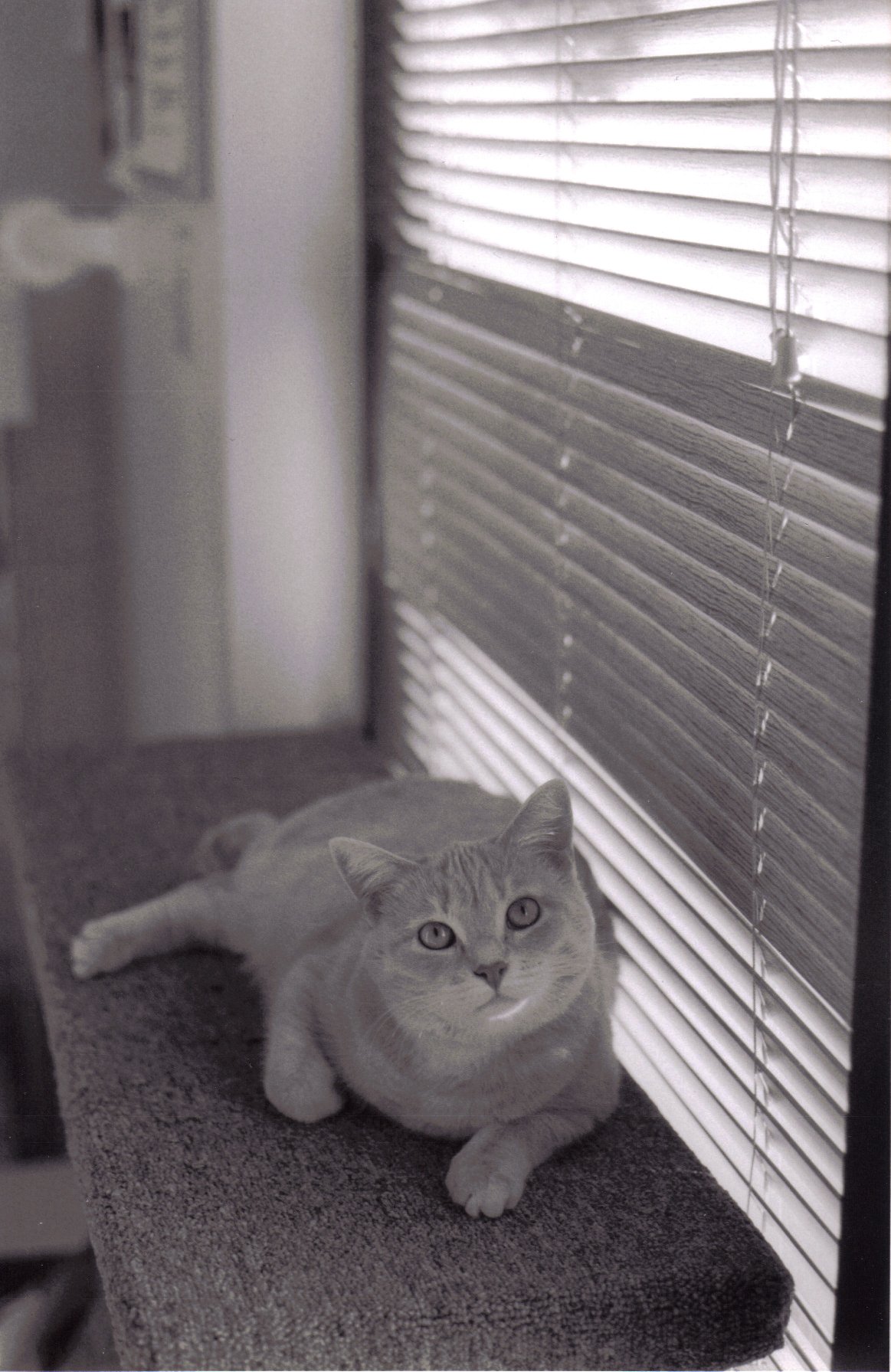
The look of accusation, 1998.

I had also discovered that one volunteer—a local optometrist who later admitted that he wasn’t really a cat person and that he’d volunteered only in order to meet women—had been man-handling her by putting on thick leather gloves, holding her down, and roughly trimming her toenails. Of all the cats I’ve ever had, she was the only one whose claws I could never trim at home. One vet had to sedate her in order to do it. This gradually got a little better, but she was a sensitive soul with a long memory.

After I’d lost my old cat, Stella, I knew the time had come for young cat blood in my house, and I picked out two gangly teenage kittens—their shelter names were Boots and Snowy, and they would become Jupiter Boots and Maya Lin. I knew, though, that I would take Candy, too, because otherwise she was destined to live in one of the outdoor colonies that one of our volunteers kept, but where life was not comfy. I also knew that she’d have to have a new name. Candy—an awful name under any circumstances—certainly didn’t suit her, though it would return in the nickname Candy Cane Tail because the end of her tail was almost always bent. She never relaxed enough for it to straighten, not until the very end. Hyper-vigilance was one of her prime characteristics.

Candy Cane Tail.

It’s an odd thing to adopt a cat you don’t particularly want. And it changed my view of what relationships with animals are about, at least a little bit. It became not about my love for her, but about her love for me.

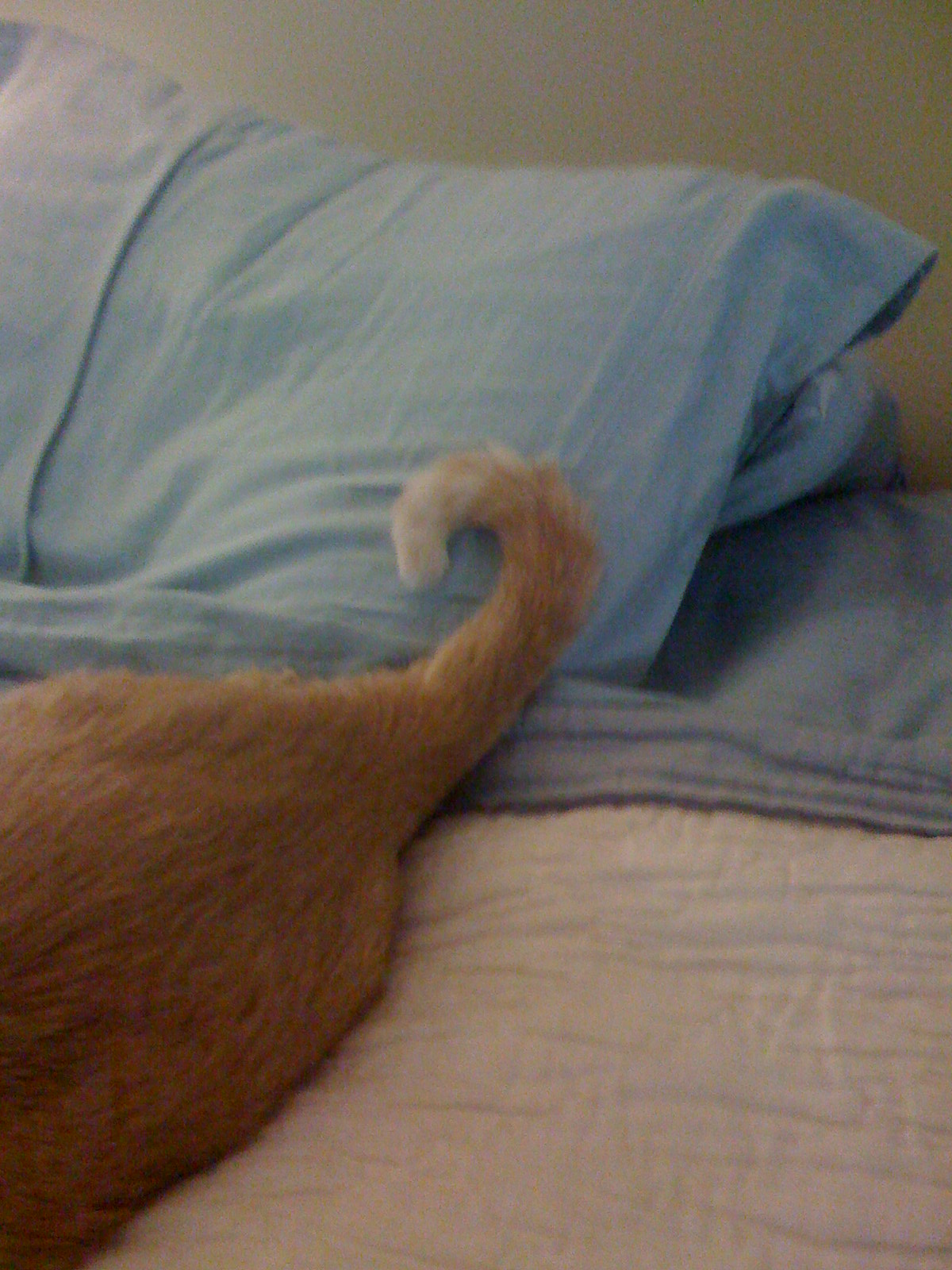
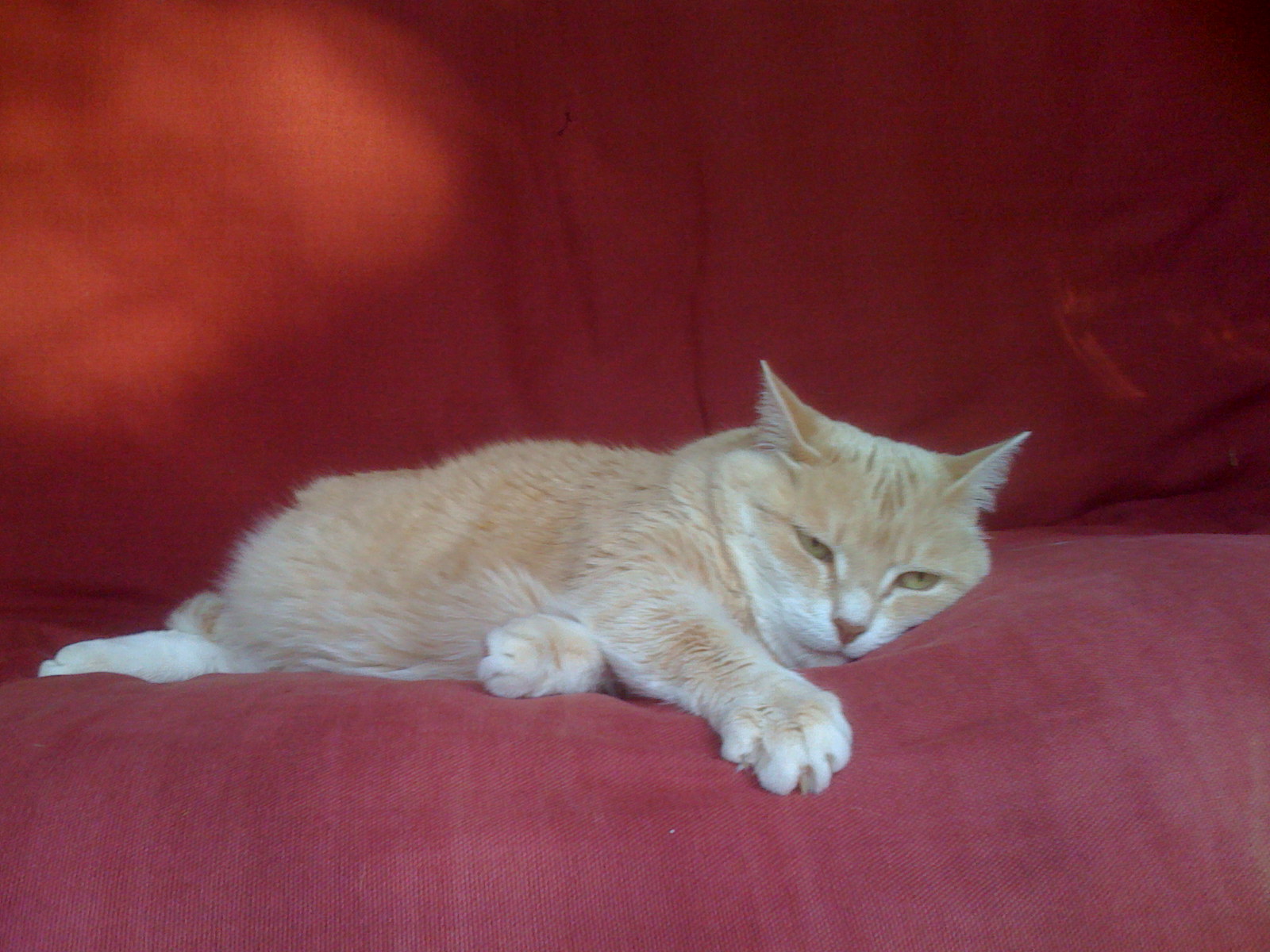
Cammie loved me. There is no doubt in my mind of that. She was my cat, a one-woman cat who, as Bruce always says, was a Sartrean. She believed that hell is other cats. What she thought of most humans wasn’t much nicer. But she loved me. Sometimes she had a funny way of showing it, but she loved me.

The day that I took her and Jupiter and Maya home from PAWS, Cammie followed me around like a puppy. (One of her nicknames was Puppy Cat.) She would not let me out of her sight. While Jupiter and Maya hid under the bureau in my study, huddled together for animal warmth in their strange, new setting, Cammie sat at my feet, followed me when I moved from room to room, and purred her head off. I had never known of a cat to purr while in motion, but she did it. “Thank you, thank you, thank you,” she purred, her little body shaking with the effort. She somehow knew that I would never take her back to the shelter, no matter how many times she unleashed her claws across my arm or leg.

And I never would. At one point, however, I did consider having her de-clawed even though I am anti-de-clawing on principle. By the time I moved to Florida from Pennsylvania, I had five cats and was down-sizing. In the new rental house, the cats had less space and fewer windowsills and hiding places. The proximity and lack of privacy stressed her out, and Cammie took to slashing me across the leg whenever I would walk by her. She would curl up on my lap only to turn suddenly and sink her claws into my arm. I was constantly bloodied. I located an animal behaviorist at the University of Florida, who came down for a visit. She never saw Cameo, though she took pictures of the other four and we talked about what to do with my little monster-under-the-bed. De-clawing, she said, would probably only turn Cameo into a biter.

So, instead, I learned to pay attention to very small clues. If Cammie’s tail or ears twitched, I quit petting her or backed away. The behaviorist explained that Cammie’s problem was primarily petting aggression—a not uncommon phenomenon where cats get overly excited by the petting that they crave. She told me that the best approach was probably just to make sure to watch even the subtlest communications and always make sure that Cammie had her way. And so I watched and Cammie prevailed. Eventually, we regained our trust of each other and she ceased to shred my arms.

She remained the most opinionated creature I’ve ever known—and contrary. Bruce eventually took to “imitating” her. Whenever I would lean down and ask her a question—“Are you a good girl?” he would say in his Cammie voice, “No.” “Will you swallow your pill?” “No.” “Will you eat your supper?” “No.” “Who’s my baby?” “No.”

Bruce imitating Cammie’s no:

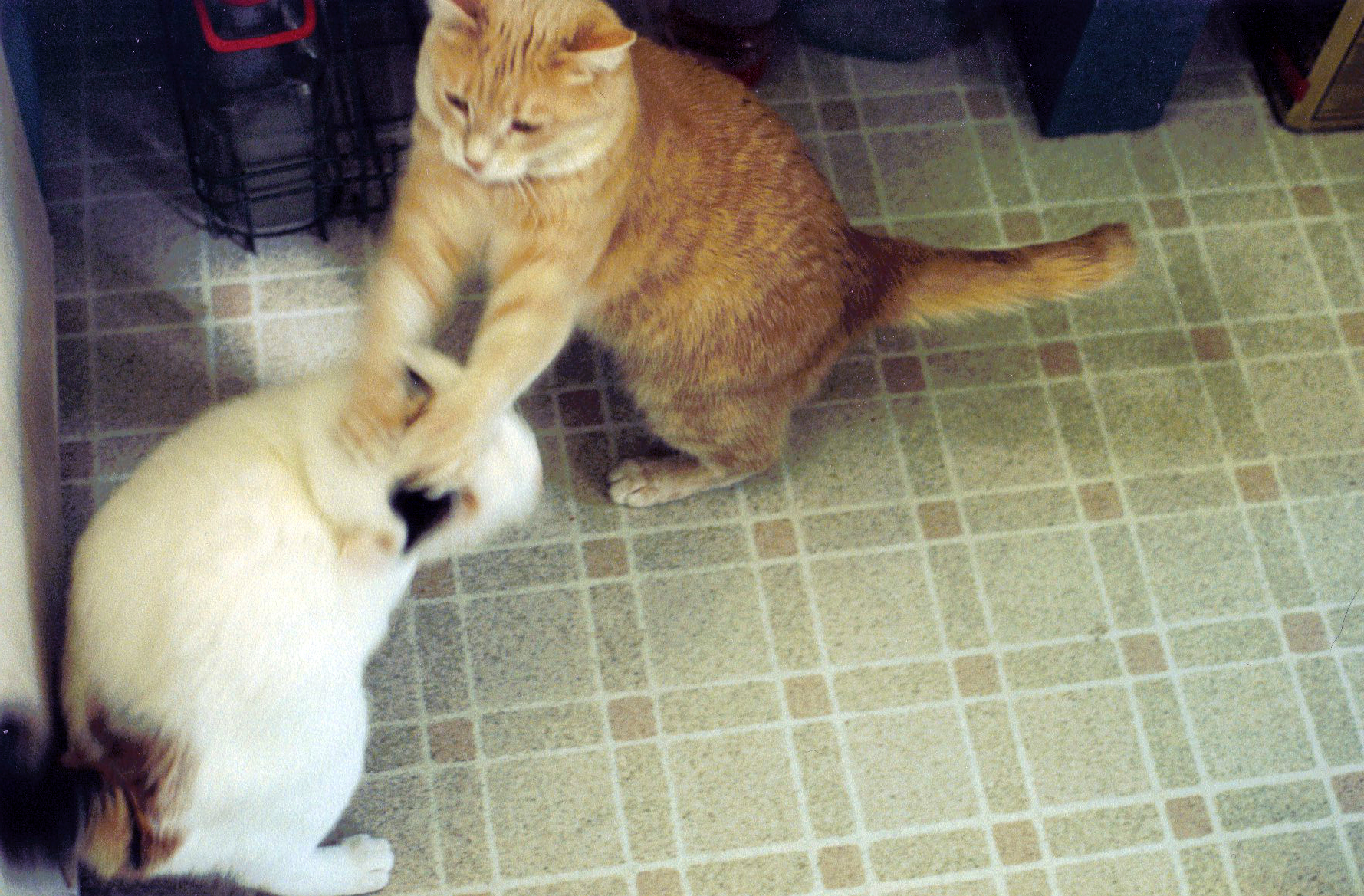
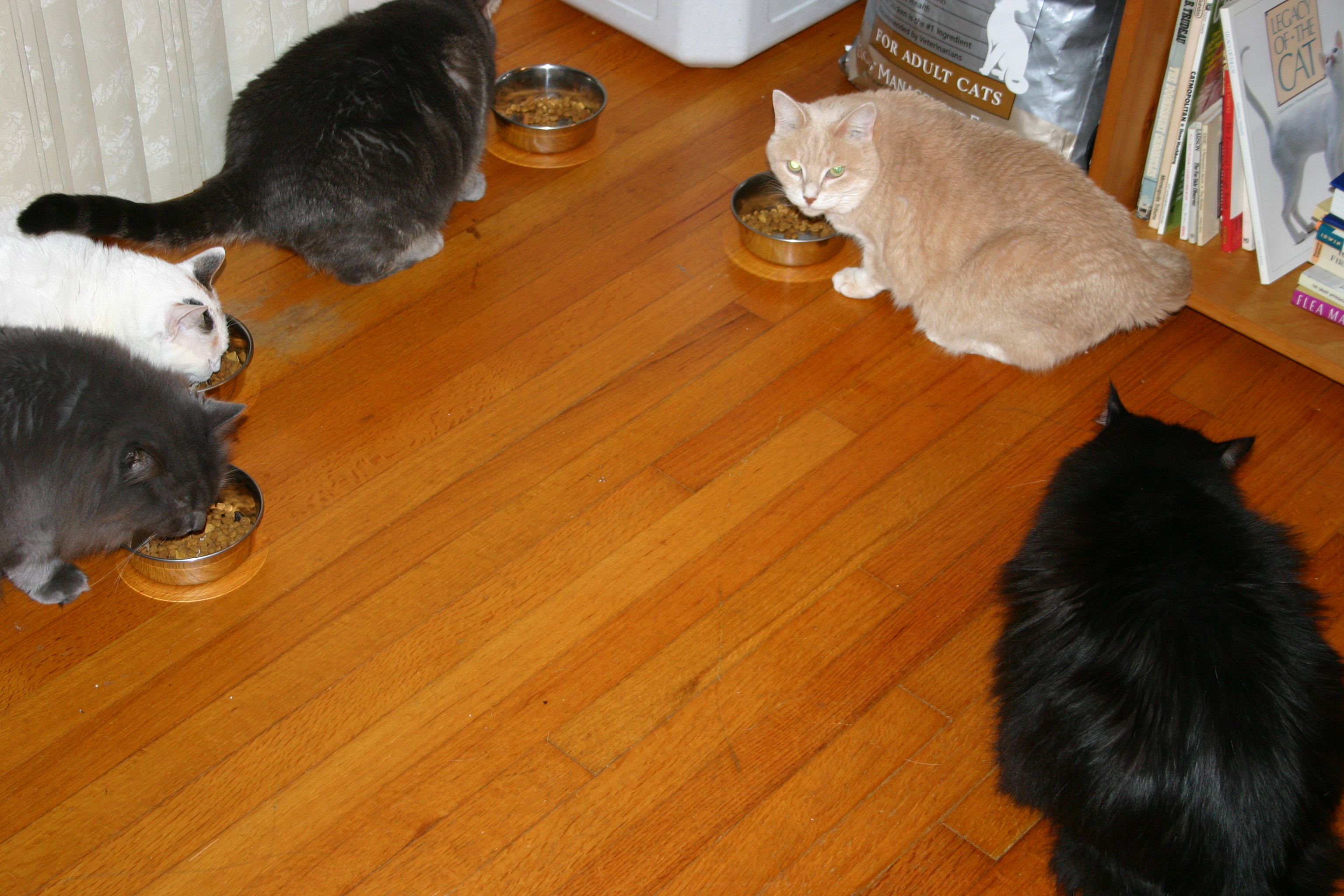
And she was never averse to a fight. If she was in the bedroom and two of the other cats started to hiss and swat in the living room, she would come running to join in. Whack, whack, whack. Smacking things was one of her greatest pleasures. Every night at dinnertime, she would whack first Maya and, after Maya was gone, Kollwitz. She loved to buffet the flaps of open boxes, and she loved to wallop repeatedly at the windows and sliding glass doors. She just knew that she could dig through them to the other side. We noted that she had a bit of OCD.

Whacking Maya, 1999.

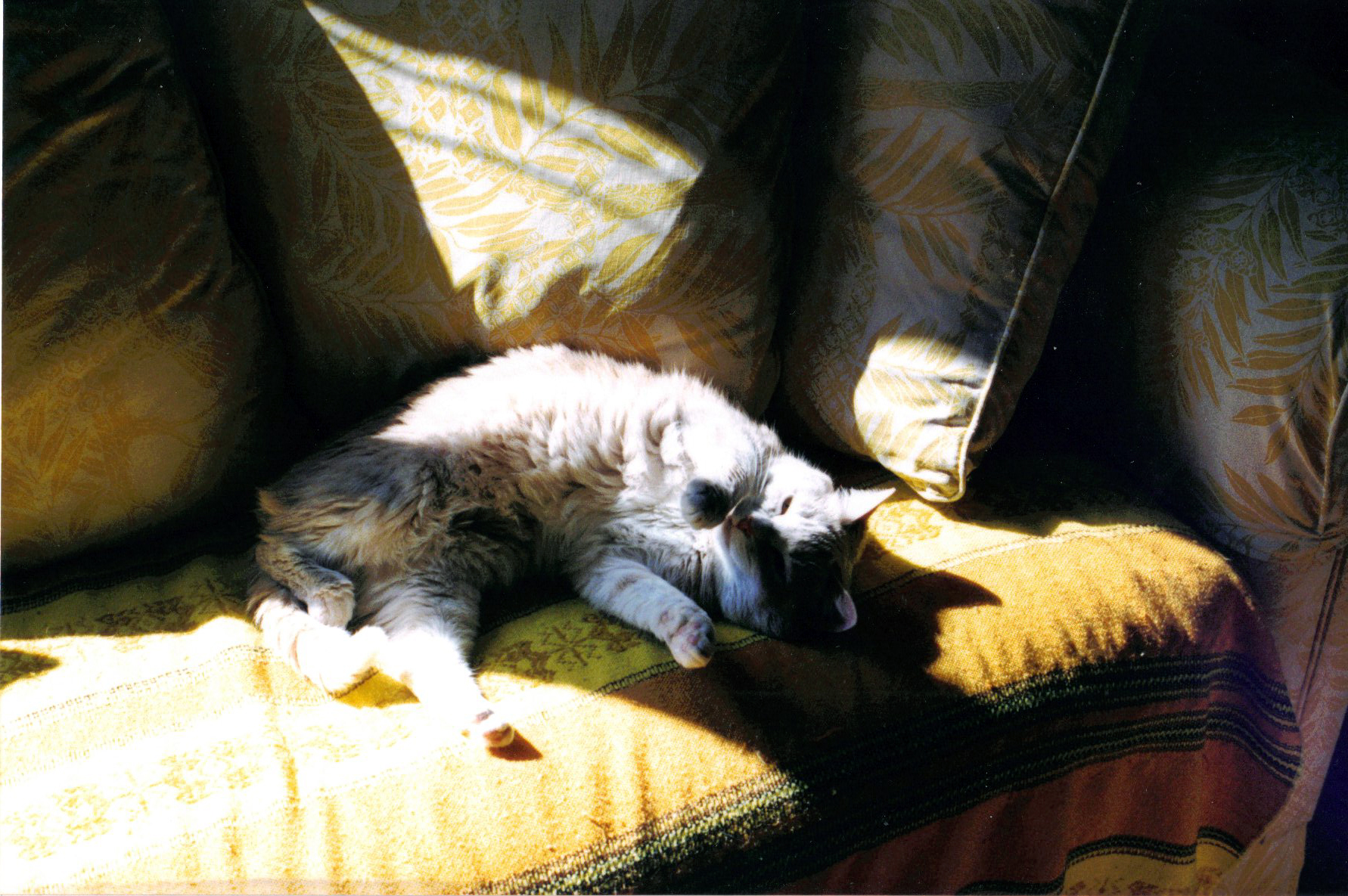
She was, however, the softest cat I’ve ever touched. For years, of course, I was not allowed to touch that downy belly—even though one of her cute habits was to roll around on the bed or the sofa in greeting, as if she meant for me to give her a belly scratch. That was not what she meant, she made plain with her teeth and claws, but eventually I developed a sneaky way of experiencing her softness. She loved to be picked up and perched on my shoulder, where she would latch on as tightly as any koala bear, claws sunk through my clothes. In this position, I could get by with massaging her soft parts and rubbing her chin, as well as pulling her ears back as I stroked her silky head. When she had something to hold on to, she loved being petted.

The dangerous, tempting belly, 2001.

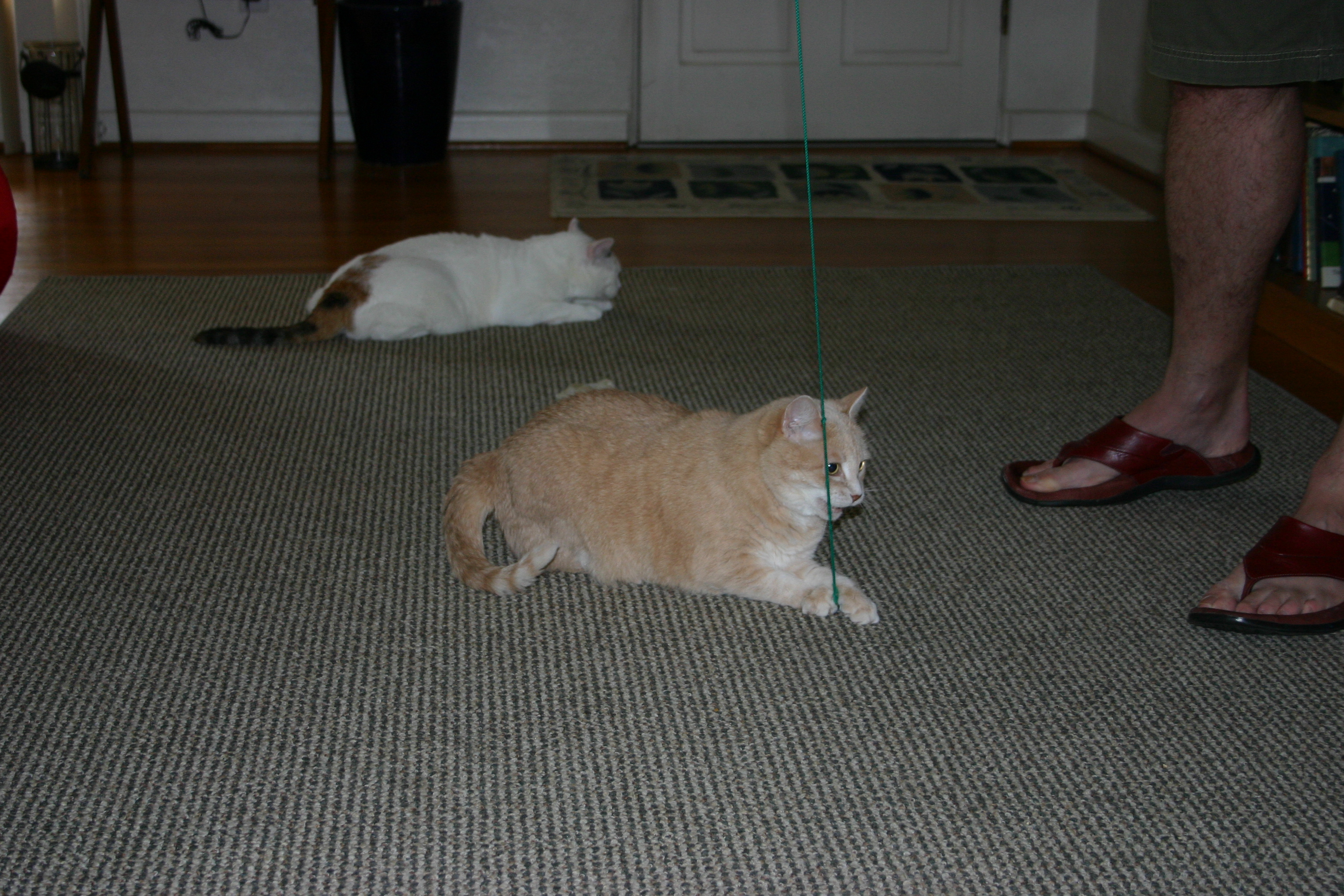
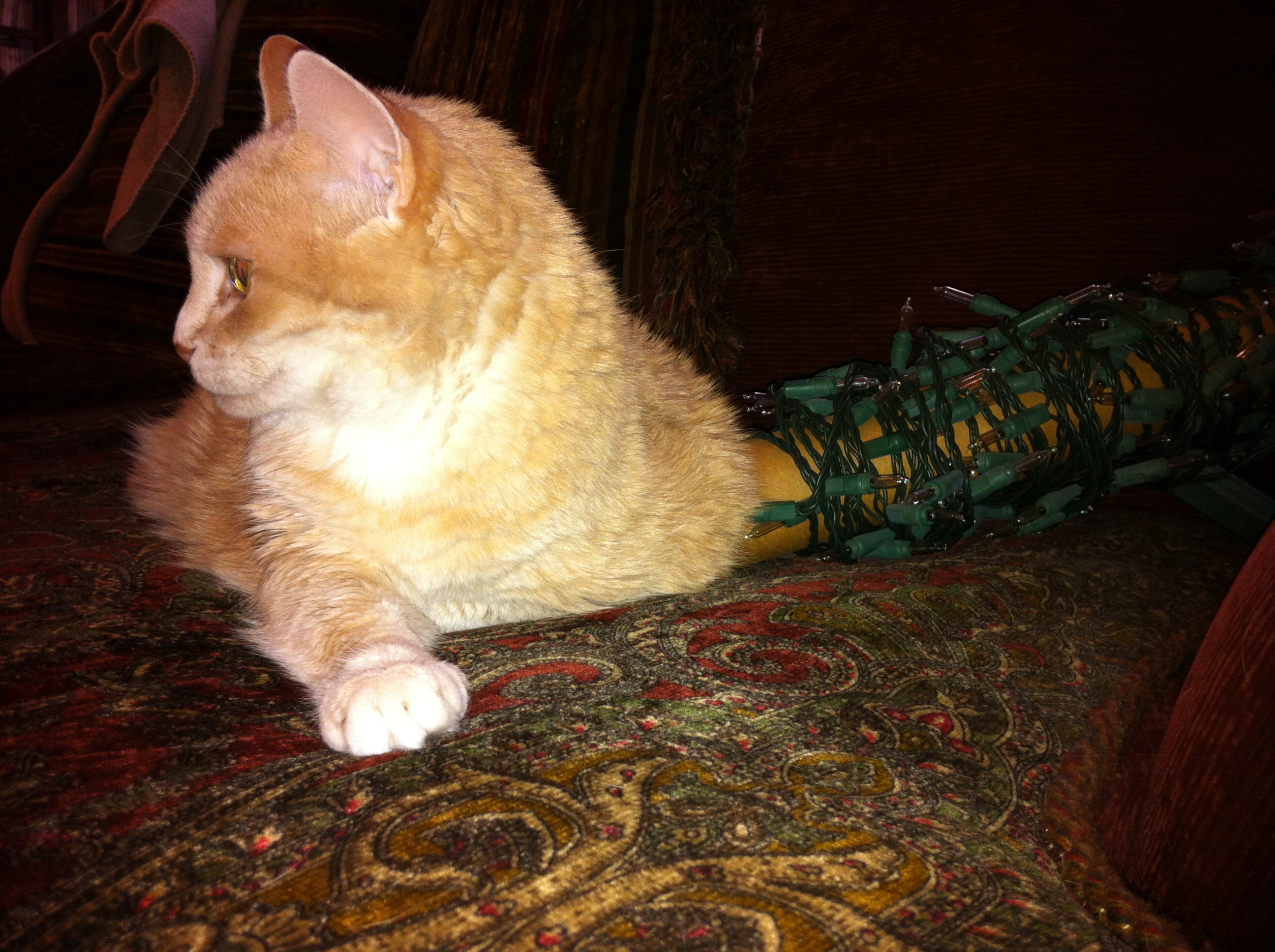
She also loved to play. Though she was well over a year old when I took her home, she played like a kitten. She played with such vehemence that her eyes would dilate and she would run up and down the living room until she panted. Later I would learn that she had a heart murmur that probably contributed to her high heart and breathing rates, but all I knew for years was that the other cats would have to wait until she lay off to the side panting, still watching the feathers-on-a-string as though it were the most fascinating object in the world. Even into her old age, she had the habit of sitting on top of toys to claim them. One of her last holidays, she decided during the decorating of the tree that the Christmas lights belonged to her. She grasped the tube on which they were coiled, and she got that possessive look in her eyes. “Can I have those?” I asked. “No,” she answered. Bruce said she was a bit like the seagulls in Finding Nemo. “Mine,” was another of her favorite messages.

Playing with vehemence, 2006.

These Christmas lights are mine, 2010.

She not only took possession of more cat beds, she also accumulated nicknames like no other pet I’ve ever had. When I’d adopted her, I’d found it difficult to replace “Candy” with another name, partly because she already knew and responded to the sounds. At the time, I had a hard time coming up with something similar-sounding that suited her. Cameo fit the bill because of her beautiful dilute orange tabby color. But perhaps I’d already gotten into the habit of tossing around possibilities. Or perhaps it was just that the many nicknames indicated something about the complexities of her personality. Cammie was the most obvious, but another early one, in response to her playing passions, was Kamikaze Cat—she threw herself off pieces of furniture and around the room after a toy with complete abandon and disregard for her own safety. Similarly, Camyl-amyl-nitrite referred to the chemical name for poppers, famous for increasing heart rate on the club scene. But we also played with the other C words we know—by the time Bruce came around I more frequently called her Campbell (one of my family names) or Camel (my favorite nickname because when mad, she could flatten her ears, open her mouth, growling, and spit as vociferously as any angry camel). Bruce added many more—Camelot-Cam-a-little, Camrose (for the town where he used to live), Cam-shaft, and Cama-Lama-Ding-Dong. I was fond of calling her Cream Puff and Pumpkin.

She also came to be known around here as the Kramer of cats, after the Seinfeld character, for her habit of bursting through doors, especially the bathroom door every time anyone went in to use the facilities. If a door was closed, she would just bonk her head on it repeatedly, waiting for a crack she could widen. She could push a door so hard it would bang against the far wall. Her enthusiasm and kookiness were hard to contain. The explosive “k” and “p” sounds were our favorites for her.

But she also inspired me to call her “a little baggage,” a word with a meaning seldom used and that seemed just right for her—a pert, playful young woman or girl, but often used disparagingly or offensively with implications of prostitution or bad reputation. She was a cat that begged for teasing, and we teased her with our terms. “Are you my little baggage?” I would ask. “No,” she would say.

My little baggage, 2009.

Camel ailed the last four or so years of her life. She took beta blockers for her heart murmur, but she had also developed arthritis in her hips that made it difficult for her to pass her poo comfortably. At the end, we found out that she had also probably been suffering from inflammatory bowel disease (not to be mistaken for the much less serious irritable bowel syndrome), a condition that sometimes responds to treatment and sometimes doesn’t. We nursed her through one terrible crisis, and we had a couple of very good weeks after that, but she had her good days and her bad days, with the bad days increasingly common. The way that I knew it was time to say good-bye was that I could no longer comfort her. I picked her up in her distress and, instead of clinging to me as she usually did, she just whimpered and pulled away. The pain had gotten to be too much.

Because Cammie was so difficult, and because our relationship emerged more from what she felt than what I felt, I think that she helped me prepare for the emotional life of marriage. She didn’t teach me how to be in love, or how to be swept up in my own needs or feelings for another person, but how to compromise, how to share space with another separate creature, how to think about someone else’s needs beyond the obvious. She was not always an apparently pleasant cat to have around—but I will say that over the years I grew to love her a great deal. I knew it already, but she taught me concretely that love doesn’t have to be a Hallmark card, and it’s certainly not a one-way street.

If I asked her if she agreed, I’m sure she’d say, “No.” But then she would curl up on my tummy and say, “Mine.”

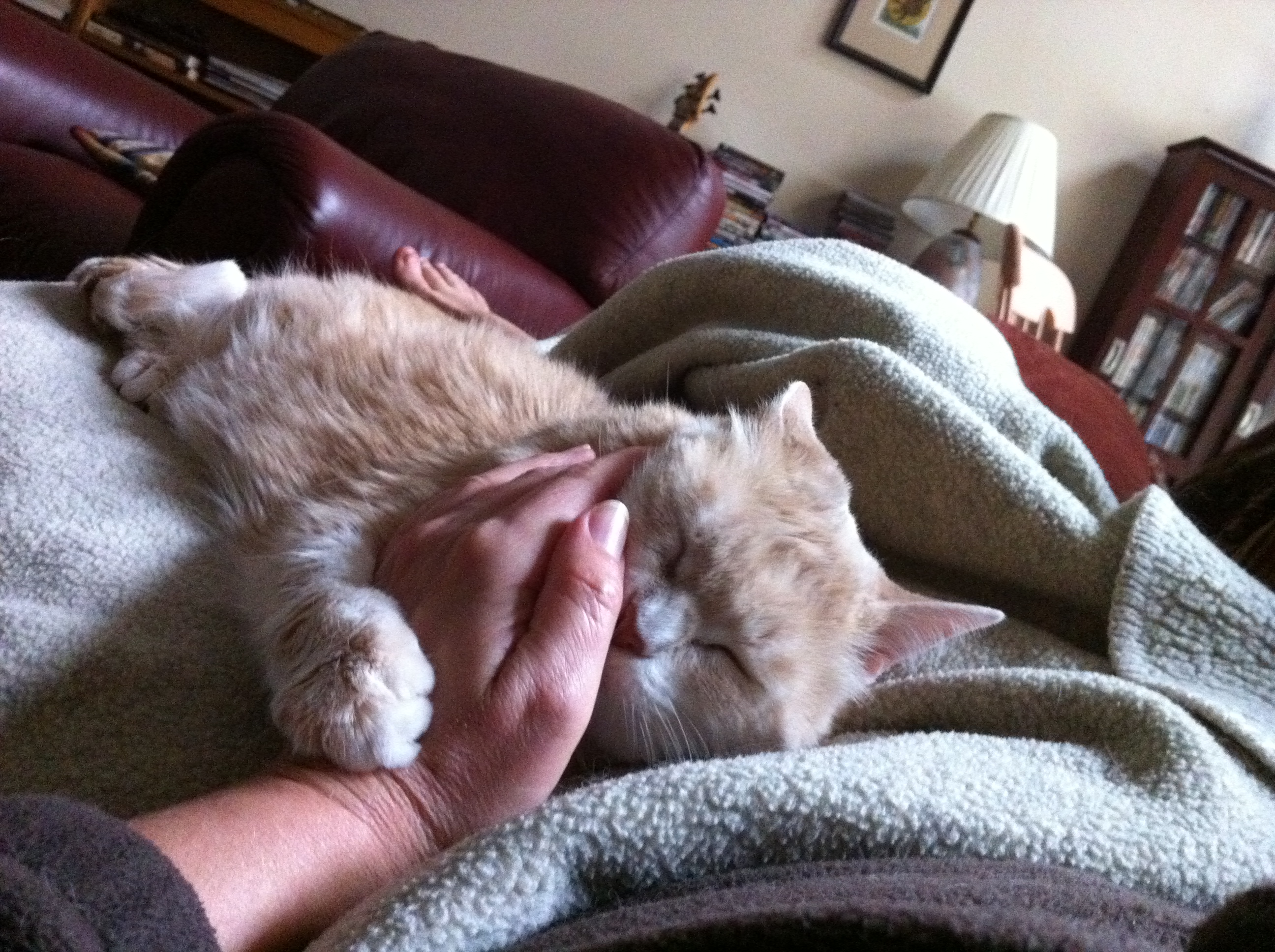
“Mine,” 2012.

Cammie always had to have the most space, 2005.

Watching over everything, 2007.

In the study, Puppy Cat keeps me company, 2009.

“Are you coming in off the porch?” “No.”

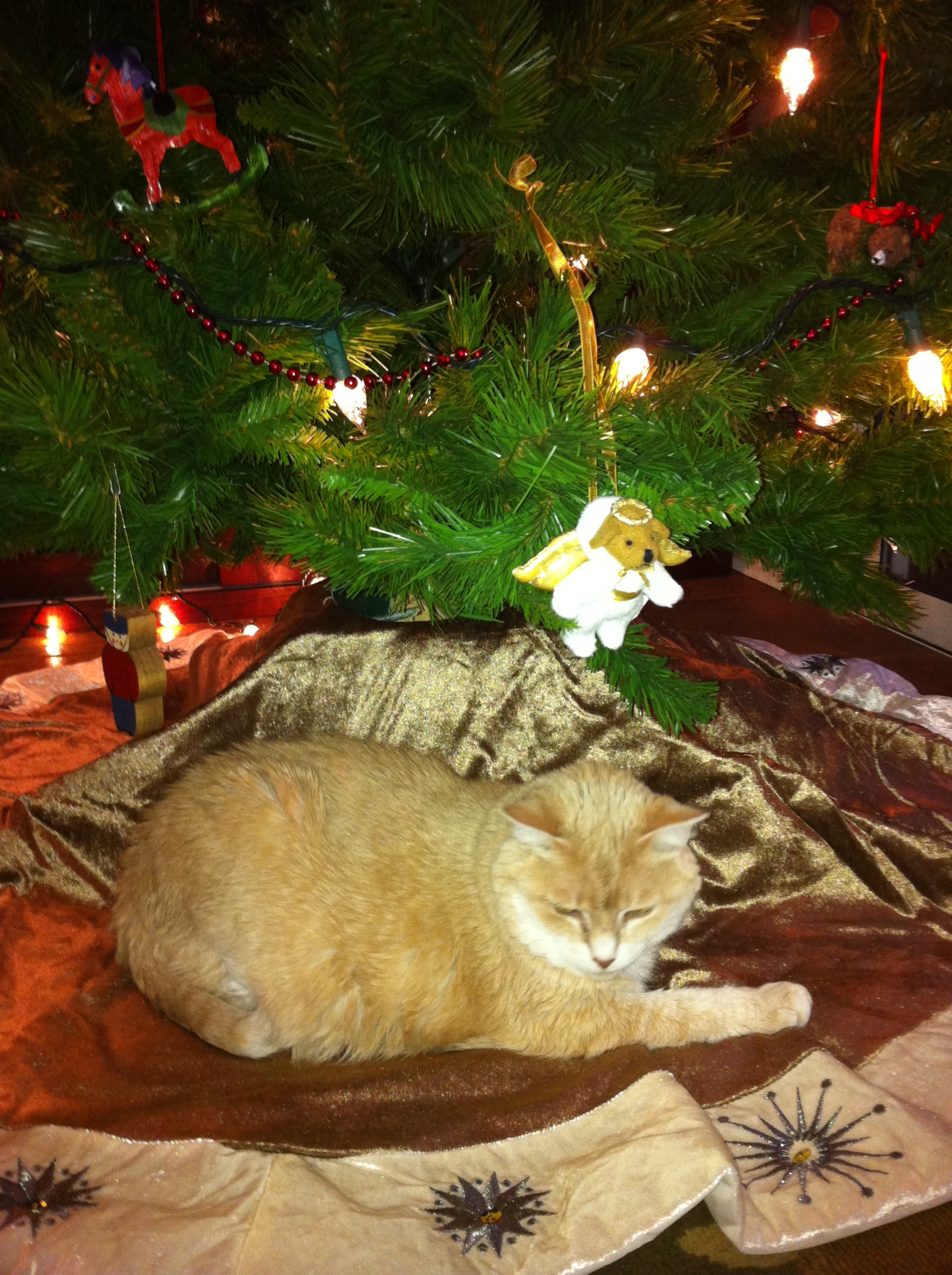
Sitting under the teddy-bear angel Christmas ornament. Next she will take it off the tree and kick it.

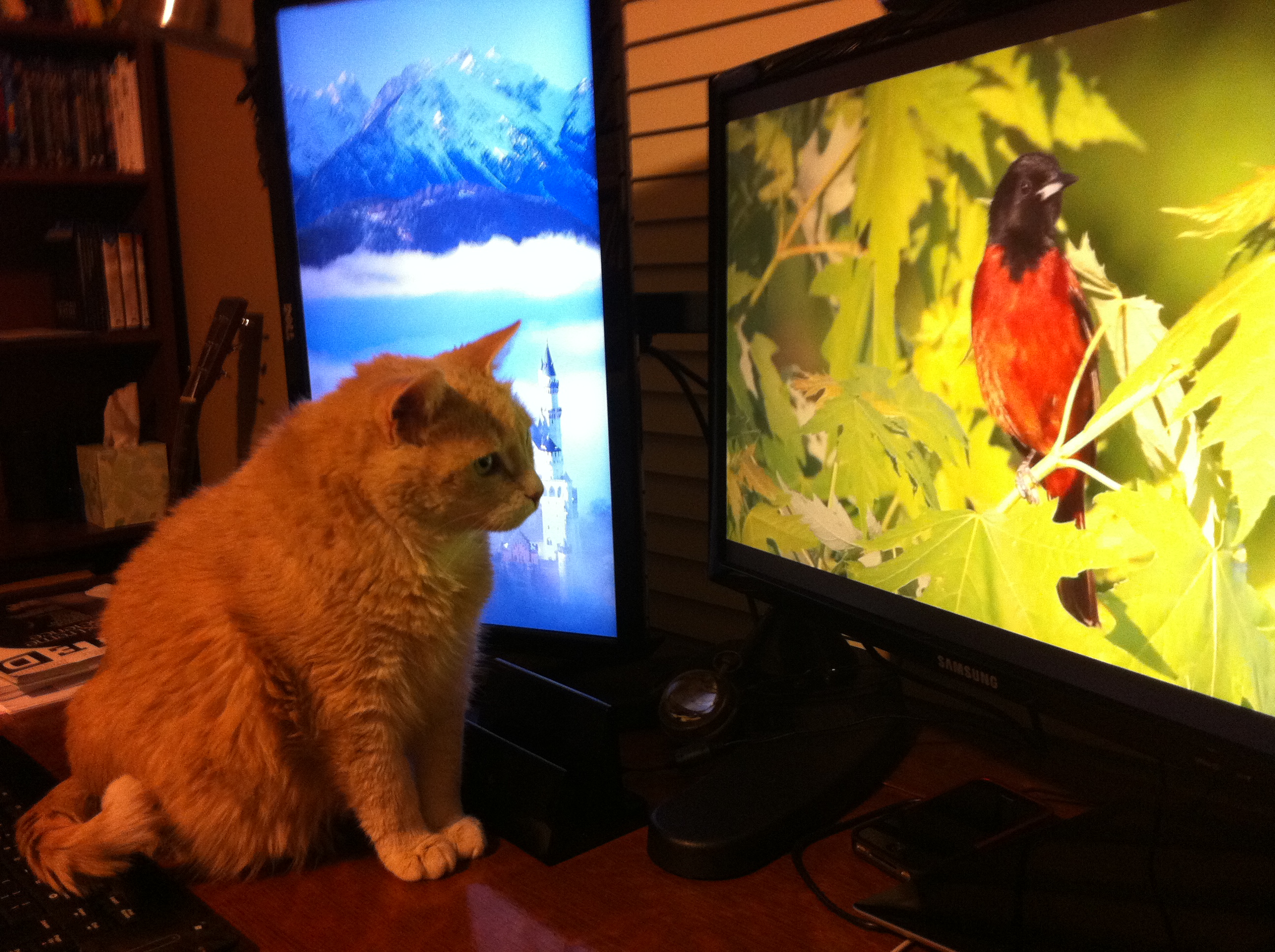
Watching birds on the computer, or TV for cats, 2011.

My all-time favorite picture of her.

Maurice Sendak

Posted on

Over the past few days, Maurice Sendak’s name and many accolades in his honor have been on the air and in print due to his death on Tuesday at the age of 83. I don’t have much to add to those surveys of his life and career, so I will link to a few of them below.

But I can add that, though I hadn’t dwelled on Sendak in years, he was a great influence on me, and I was in the very large camp of enthusiasts about his work. The New York Times obituary notes that his “books were essential ingredients of childhood for the generation born after 1960 or thereabouts, and in turn for their children,” and I was one of those children (born exactly in 1960). For many long years–long after I moved on from story-hour childhood–I had a Sendak poster on my wall—the one with Max swinging from the trees with his monster friends. I still have it tucked away somewhere, those nightmares and dreams of childhood put away but not forgotten.

It strikes me, too, that Sendak was a person after my own heart and in keeping with the themes of this blog. He was indeed a Joyous Crybaby, one who brought the sorrows of children into the light and made it okay, even imperative, to acknowledge them. It’s hard to imagine how it is that so many children have loved this quality in his work for so many years and yet so many adults have grown up to retreat into a hyper-cheerful denial with their memories of childhood’s insights buried all too far in the closet. Sendak believed in the “rightness of children’s perceptions,” and he has often noted how the demons of his own childhood—the Great Depression, World War II and the Holocaust, the kidnapping of the Lindberg baby, and his own experience of measles, pneumonia, and scarlet fever at a young age—did not go unnoticed in his own psyche. If, as Sendak’s work has always asserted, children can and do face the demons in their world, shouldn’t adults be able to acknowledge their existence, too?

Sendak was a touchstone of genuine emotion. He will be sorely missed.

Washington Post (contains numerous good links to other commentary)

New York Times

NPR’s Fresh Air

An Encounter with Buddhist Meditation

Posted on

In my ongoing quest for understanding about the life of the feelings, yesterday I attended a half-day event on “Dealing with Destructive Emotions.” Now, this was not some egregiously awful, dumbed-down positive psychology event, but a “meditation workshop” led by Dr. Barry Kerzin, personal physician of the Dalai Lama and a Buddhist monk.

I had had the pleasure of joining a group that took Dr. Kerzin to dinner on a previous visit to UCF last April, and I found him charming, compassionate, and intelligent. He had been particularly kind to me in that vulnerable time after my brain hemorrhage—that time when some people were so very kind and others showed their cruelty and indifference so clearly. I also know and admire the two organizers of the event, both of whom are leaving UCF for better positions elsewhere, and I wanted to support their final efforts here.

In addition, though I’m not a Buddhist and I can’t even claim to be all that knowledgeable, I was motivated to attend because I find much appealing in the Buddhist approach to happiness. I’ve posted before about the Buddhist concept of self-compassion, and there are other ways in which I think the Buddhists have it right. For one, they readily acknowledge that suffering is also a part of life, and they refrain from the blame that so many purveyors of popularized positive psychology allow themselves to indulge in.

For instance, in the talk I link to above, Dr. Kerzin cites a study about women with breast cancer and happiness. What’s different about this from so many of the kinds of “if you’re happier you will be healthier and live longer” assertions is that Kerzin notes not that the happier patients who lived longer were somehow innately more happy as persons (and therefore superior), but that they received tender loving care and that it was this compassion that contributed to their happiness and better health outcomes.

I think this is a radically important difference. In Buddhist thinking, we are responsible for helping ourselves be happier, but we are just as called upon to help other people. That mutuality and interdependence is key to keeping the search for happiness from becoming a weapon against those less fortunate than oneself. This kind of nuance distinguishes many Buddhist teachings from a lot of junk positive psychology, and so I feel myself more open to its strivings for a better world.

But I also attended with some apprehension based on my own make-up as a human being. As I put it to my husband yesterday, my pathology is such that group hugs just make me feel more alone and alienated than almost anything else. I am squeamish about crowds of all sorts, and the most common of types—the roaring audience of the sporting event or the rock concert—I find downright revolting, terrifying, really. Even a lecture given and a meditation practice led by someone I find intelligent and compelling can make me feel queasy in a large-group setting. When everyone else is sharing life-affirming togetherness, I usually feel more and more as though I don’t belong anywhere. So, I went with my mind as far open to that sort of thing as I could pry it, though I knew I would find myself uncomfortable. I assured myself that I nonetheless would be able to use it as a point of useful contemplation. Everything, as they say, is grist.

The day was divided into three segments, one before lunch and two after lunch. Each hour, Dr. Kerzin would talk for a while, take questions, and then lead a brief meditation.

In the opening session, Dr. Kerzin talked for quite a bit about where he had recently traveled, where he was traveling next, and the few days he had spent on a silent retreat near Deland, writing, reading, and kayaking. He talked a bit about his encounter on the St. John’s River with an alligator, which he would touch upon throughout the talk.

What I noticed right away was my own destructive impatience. I wanted Dr. Kerzin to start getting to the point, to give me something that I could take away from this talk. He wasn’t, after all, talking in any way about how to deal with destructive emotions, but about the pleasures and challenges of his lifestyle.

After a while, he transitioned into talking about the way that Buddhism defines “destructive emotions” or kleshas in Sanskrit. (He gave us Tibetan terms as well, but I could not venture to spell those.) He spoke of the three roots of these kleshas—anger, desire, and distorted ignorance—from which negative feelings arise. This all seemed obvious to me—of course, while I understand the need to define things clearly, I felt I knew what destructive emotions are, including the ones I was having in that moment. I wanted not to define them, but to work on “dealing with” them.

By the end of the day, I would realize, of course, that in itself this was a productive lesson for me. As the day went on, it dawned on me how utterly exhausted I would be by giving a program that lasted so many hours, especially one where my presence and wisdom might be sources of expected sustenance for so many. And yet, Dr. Kerzin did not show signs of exhaustion or stress. The slow pace of his talk, rather, allowed a relaxed approach that might help prevent burn-out. I will think much more about this as I return to teaching next year with a desire not to kill myself with frenzied overwork.

Kerzin’s entire first segment, it seems to me now, was about sticking with things and how you can do that in spite of impatience. He noted several times the Dalai Lama’s fondness for saying, “Never give up,” and he went through a long and rather elaborate description of various phases of awareness and practice—at first, you may have an intellectual understanding, and only later will that become felt or experienced. You start with an awareness that there’s another possible way of responding other than getting angry, and from the brief “sigh of relief” that can give, you keep trying and move on to being able to laugh at appearances, then to a point when “love boils up” and the conflictual appearances subside.

As I sat in the ballroom, I contemplated a task that faces me today—calling the health insurance company and the hospital about bills that I’ve been receiving and don’t understand. If there is one thing that sends me into a rage, it is dealing with the medical world in our bureaucratized and profit-motivated system. The last time I talked with someone in the billing department at the hospital and he kept repeating, “That’s our policy,” I ended up calling him a drone. He got all insulted and told me he was a human being. I told him he didn’t act like one. It was a terrible impasse all around. We’ll see if I can do better today, because one thing is certain, and it’s that my fury about this system does me no good on a daily basis. I need to transform that fury into larger action rather than letting it eat me up or letting it make me mean.

At one point, as in the video above, Kerzin asked the audience if there was anyone who had let go of all of his or her anger. There were actually a couple of people who raised their hands. Perhaps it was then I began to feel alienated. How can anyone claim that? I felt suddenly as though I were in a room of poseurs, fake Buddhas. I can’t even imagine what it would be like to have no anger left in me, only what it is like to keep trying to let go of it. Probably, if I’m honest, I’m not even fully convinced that I should let go of all of it.

Kerzin ended the first session by taking some questions and then leading us in a five-minute meditation, starting and ending with a toll of a chime, in which we were to empty our minds and concentrate only on our breathing. Once, years ago, when I regularly practiced yoga, I could sometimes do this. Lately, I can only observe as the thoughts fly in and out of my brain like so many pieces of confetti. If meditation could produce a panic attack, I’m a likely candidate these days.

Once dismissed for lunch, I discovered my blood sugar was a low 63, and I stumbled out onto the empty campus and found a vending machine. No doubt the low affected my responses, and I hoped I’d feel better later on. I had told myself that I would go to the library over the hour-and-a-half-long lunch period, but it was closed for semester break, and so I sat on a bench and enjoyed the sunshine until the ants started biting my ankles.

As I watched two middle-school-aged boys playing in the fountain, I contemplated Kerzin’s talk. I was grateful at his nuance. It seemed to me that some of the audience questions had been agenda-driven and tended toward the oversimplifications that so offend me. Kerzin always made important distinctions. “Anger,” he noted, “needs to be distinguished from strength and courage and passion. The problem with anger is that its motivation is harm or revenge, even directed at oneself.”

“Fear,” he noted, on the other hand, “can in itself be sensible.” When you face an alligator, he noted, some fear is a correct response and can keep you alive. “Fear becomes a problem when it becomes habitual anxiety that doesn’t serve to remove you from the danger.”

Dr. Kerzin started the afternoon sessions with reminders once again to be patient and to be gentle with ourselves and others. Once again, he made a distinction important to me: If you ever think you’ve “got it,” he said, you are falling into a trap, the trap of arrogance. He emphasized the lack of right answers and formulas.

He posed the question of how it is that distorted ignorance appears and noted that it’s built in to the assumptions we live with and are born into. Then he used an acronym—PPI—for permanent, partless, and independent. Leisurely, he discussed how people assume these qualities for themselves and other things in the world.

Another destructive emotion invaded me at this point… I felt a little bored. Certainly, on an intellectual basis, I have understood a world that is ever-changing, multi-faceted, and interdependent for a long time. True that I often don’t experience it that way, and in that ballroom I felt atomistic as can be. But this wasn’t introducing me to new concepts.

I felt relieved when we moved on to the practice of a new meditation—that he called “tonglen”—where you breathe in the sorrow or pain (of one person or animal or a group or opened to the general sorrow of the world), and then transform it on the out breath to healing love to alleviate that suffering. It was striking to me throughout the day that Dr. Kerzin included animals as sentient beings, especially because I was once again very worried about my elderly cat, who had done so well over the past couple of weeks but who has now taken another down turn. I was grateful to be able to focus my meditation at least in part on my little cat.

After this second meditation, while we took a short break, I also thought about how it is that I am a practice person rather than an intellectual one. This, of course, is always a factor in academia and one of the reasons why I seldom feel truly at home there. Academia is a traditionally scholarly place, and scholars are oriented toward concepts and ideas, whereas artists of various stripes are oriented toward practice.

This led me to thinking about myself in the context of a large lecture hall full of people. I feel so fortunate to teach the generally small and often truly intimate creative writing courses that I teach. For some in the ballroom yesterday, there was a sense of closeness and sharing encouraged by Dr. Kerzin, but because I am so used to the much more intimate workshop setting, it continued to feel rather abstract and distant to me. This made me grateful for the usual practice of which I’m a part, and reinforced once again my sense of the value and specialness of that method. There are workshops that do unfortunately become the site of intimate brutalization, but for the most part I think the creative writing workshop is a primary location of exploration and sharing of human qualities. When Kerzin mentioned how in his study with his Buddhist teachers, there was often a lot of laughter, I thought of my workshops.

The last hour of the day, Dr. Kerzin mostly took questions from the audience. Several people seemed to me again to have come with agendas—to show off their knowledge, to question him about Taoist principles (not his area), to demonstrate to this wise man how good they were. One even seemed to have that good old positive psychology agenda. I had heard him during the break talking about studies that supposedly showed that people could affect reality with the strength of their thoughts. He asked about the Buddhist precept that “nothing exists.”

Dr. Kerzin gently corrected him. The Buddha, he noted, taught that nothing exists in itself, but he also taught that there is a reality behind the common reality based on experience. The way that we commonly perceive things may be an illusion, but a belief that nothing exists at all would be considered nihilism, and is not a tenet of most kinds of Buddhism. (See also, the third paragraph in the Second Dharmachakra here.) This is another one of those oversimplifications that tend to infest people’s thinking, and I was grateful he pointed that out.

We ended the day with a walking meditation, in which we all stood, found a spot in the room and began walking as slowly as possible, paying attention to the way our feet moved and touched the carpet. This was delightfully new for me. Sitting meditation was always hard for my fluttering mind, but recently has also become physically hard for me with my back aches. Many of the yoga practices I used to do to work on my sense of balance (such as the tree pose), I simply can’t hold now. Even walking itself has sometimes become painful with my arthritic foot.

I found it amazingly challenging to walk so slowly, and it proved a great balance exercise. It also was easy on my foot, as the slowness prevented any pounding of my bones on the floor. Perhaps it was also true for me that the activity helped calm and focus my mind, so that I felt more meditative than I usually ever accomplish sitting.

Besides, as the featured video below will show, it’s wacky to do in close proximity to others, and I am always glad to greet the wacky. Finally, I enjoyed all the other people in the room, their various and varied bodies moving around the space, encountering each other and yet not colliding, all of us doing the best we could do at this deceptively simple task.

It was a good way to end the day, and I came home with plenty to think about and the empty spaces in my head in which to do so.

I enjoyed the walking meditation so much, I’ll include links to a few more videos about it in addition to the one below.

Minimalist instructions (1 minute, 40 seconds)
Calming verbal instructions with pretty pictures (3:12)
Monk Thich Nhat Hanh demonstrating and discussing walking meditation (5:44)
Longer step-by-step instructions (10:00)
Perky, Westernized instructions (2:49 plus ad)

Cracked.Com on Crazy Cat Ladies

Posted on

I’ve been stretched to my limits the past couple of weeks, even though I have been spared the final grading stress and have skipped out on attendance at graduations and reunions. So, today, I really needed a laugh til you cry episode of crying, and, fortunately, Bruce greeted me with Cracked.com’s “8 Books That Prove Cat Lovers Are Insane” first thing this morning.

In my search for the genuine, it is good to be reminded that even the genuine can be far from helpful, and even the completely ersatz can be wonderfully whacky. In contemplating how to write about animals intelligently, it’s also great to have some examples of what not to do…. Except, except, they all seem to be having so much fun.

Don’t forget page 2. The wigs are to die for.

I just want you to know that this is not the kind of writing about pets I ever hope to do, much as I love it.

Beware the Enthymeme!

Posted on

It's bad enough to debate complex issues in slogans, but even worse when the slogans so cheerfully lie.

In Florida, as in many states, there are a variety of license plate designs for car owners to choose from. I always think that these, like bumper stickers, are a strange way to express oneself, though I’ve been known to slap a bumper sticker on my car now and then. Last presidential election cycle, I had two Obama stickers stolen off my car, and I have a long-term one that says, “Please don’t breed or buy while shelter pets die. Opt to adopt.” Other than one time when a friend at first thought it protested the breeding of humans and was an insult to his parenthood, that one has been uncontroversial. At least as far as I know. And I guess that’s the joy of broadcasting one’s opinions this way. Unless you meet up with a crazy person who will bash into your vehicle, you are safe from argument.

One of the popular license plates around here is a yellow one with red crayon-like boy and girl figures that imply they were drawn by a child and that says “Choose Life.”

It might be an okay message if it really meant what it says. Of course, most of those who sport this license plate don’t actually mean that. What they mean is that they would rather force every pregnant woman to bring any pregnancy to term. What they mean is not “choose life,” but “choose to support laws and organizations that offer no choice to women.” And, as this Slate article reports, “the legislation in most states [that have these plates] expressly provides that any program offering referrals or even discussing the option of abortion is barred from funding.” In other words, these plates support lack of choice, not a choice.

There is an odd way in which the language gets twisted like this. Of course, progressives and liberals do it too, but what I notice lately is the way that Republicans and right-wingers do this all the freaking time. No doubt, we are gearing up for a maelstrom of misused language in this coming election season.

What I also notice is that progressives have a hard time correcting these misuses of language. I guess they don’t want to be accused of nit-picking about semantics or something like that. But the use of language is one of the most important things we can pay attention to. This is one of the things that rhetorical analysis is good for, and it pains me that so many can get through high school and freshman comp and even four or more years of college and still not be able to understand the manipulations of language to which they are subject on a daily basis.

I will never forget one of my early teaching experiences, when I was laboring as a freshman-composition TA at Penn State during the fall of 1991. At the same time, playing out in the media, were the Senate confirmation hearings for Supreme Court nominee Clarence Thomas. Anita Hill, who had worked as his assistant some years earlier, arrived on the scene with her testimony about Thomas sexually harassing her.

Hill’s testimony lasted only a few hours, but the discussion of it went on for weeks and months, even years. The issue even resurfaced in 2010, when Clarence Thomas’s wife called Anita Hill and suggested she should apologize.

In spite of the fact that Hill subjected herself to a polygraph test that indicated her testimony was honest, whereas Thomas refused a polygraph, and in spite of another woman’s affidavit that she had received similar treatment, Hill’s testimony was vehemently called into question. And one of the prime reasons people gave for their disbelief was that Hill had continued to work for Thomas rather than quitting her job, had in fact even worked for him at a second position after the time during which she said he harassed her. This line of discussion had been begun during her Senate testimony when Republican senators Arlen Specter and Orrin Hatch strove quite clearly to discredit her. (The entire hearings are available via C-Span. About half-way through Day 1, Part 3, Specter grills her about why she continued to work for Thomas).

This discussion nagged at me and nagged at me. Finally one day when I was set to teach the enthymeme, I realized why. Dully, I had been writing a traditional enthymeme lesson (that had been provided to us new TAs) on the chalkboard:

Johnathan lives in Japan.
Johnathan speaks Japanese.

And then out to the side the missing link: People who live in Japan speak Japanese.

In a fit of inspiration, I erased it and wrote instead:

Anita Hill claims she was sexually harassed by Clarence Thomas.
She’s probably lying.

“How many of you agree with this?” I asked. More than half the class raised their hands, most of the men and a few of the women.

For the next half hour, we explored the possible unstated assumptions behind the conclusion. The students eventually had to admit that the basic assumption they were making was that women should always put their “purity” above their careers. Certainly, that was the assumption that the all-male panel of senators who had grilled Hill clearly made. If this were not true, there might be a host of other priorities that Hill would put before quitting her job to escape Thomas’s advances and inappropriate comments.

Once we teased these assumptions out into the open, there were very few students (maybe only one) in the class who agreed with the statement that women should always put their “purity” over their career advancement. Most of them found themselves confronted with an assumption they didn’t agree with but that they had allowed to underpin their opinions on a matter of national importance.

A few of the young women in class began to make the connection to their own experience. “Oh, yeah,” one said, “I have a manager who is so offensive—he always stares at us waitresses too much and puts his hands on us whenever he can—but I haven’t quit my job! We all just ignore him. And it’s a nothing job.” Every female in the class could cite at least one instance of sexual harassment that she had let slide. We agreed that none of us would quit a job over it unless there was actual threat of rape or a high level of severity and directness in the harassment, but that this did not erase the fact of the harassment. It was a daily part of our collective lives.

By the end of class, because they could understand why Anita Hill might have stayed in her job in spite of harassment, they no longer deemed her a liar. I will never forget their mouths hanging open in disbelief at what they had been duped into repeating from the media to friends and family members. They rushed off after class to correct themselves. Thomas, of course, had already been approved as a Supreme Court justice.

I wonder about this kind of thing in the media. It seems to me that both the “neutral” media and the progressive factions do too little to correct this kind of blatantly stupid and unsupported claim. They do too little to monitor the use of language in blatantly deceptive ways. Some, including, of course, FOX News, are notorious for participating in this kind of ridiculous bias themselves (several examples here and one here that’s particularly about twisting of language). Lately, even our senators and representatives have felt free to make utterly false and ridiculous claims, and later to say they didn’t mean them as factual or to insist on defending their mischaracterizations. Only in these most blatant of examples are they called out on it.

For instance, in response to an email I sent to Florida Governor Rick Scott’s ridiculous decision to sign off on establishment of a new (unneeded) state university in Florida, I received a reply containing this statement: “Governor Scott’s top priority this legislative session was adding $1.06 billion in new funding for K-12 education.” First, nothing in Scott’s email responded to the subject I had addressed. And second, this is bull. Scott has been ballyhooing his great increase in state funding for K-12 education this year, after he cut $1.3 billion last year. A few reporters note toward the end of their articles that Scott’s budget doesn’t even replace what he has previously cut, but the headlines mostly remain that he is raising the budget. (Notice that this blogger put a more accurate headline on the same article published with an innocuous-sounding headline in the Palm Coast Observer. But, hey, at least the reporter mentions the facts.)

I believe that these twisted uses of language are one of the reasons why our society has become so divided and discussions so disharmonious. I think that we need to do all we can every time we hear these false uses of language to stop them in their tracks, even if it means making conversation halting. The fact is that it’s one thing to disagree about the substance of things and another for someone to lie in order to exaggerate our disagreements.

There are many examples, but I have gone on long enough. Today’s exhortation, again in support of so many friends who are ending long semesters of teaching freshman comp (and other courses that attempt to teach critical thinking), is: REMEMBER THE ENTHYMEME! Talk about the enthymeme. Pick apart the enthymeme.