Gone for Good

Posted on

Morphine’s “Gone for Good” is the saddest little break-up song I think I’ve ever heard. The finality of it is so total.

I have to admit that the song doesn’t affect me quite as much now that I’m a happily married person. There’s a sting that is taken out of previous losses in the promise made between two people to stay together through thick and thin. Yet I think it wise to remember that kind of devastation and sorrow, even when we are happily married. None of us, even married people, are truly safe from potential loss of love.

Today is my second wedding anniversary. I waited a long time to get married at the age of 49. I went through numerous relationships that “Gone for Good” could be describing. In celebrating my marriage to my husband, I will remember them, at least for a moment, for a couple of reasons. First, to help me appreciate what I have now and to keep in mind the luck and perseverance it took to get here. And also to guard against the lack of attention that can allow even deep love to disappear. My happiness today is built on the understanding that I forged through all of those other people, now gone for good.
First Tears

Posted on

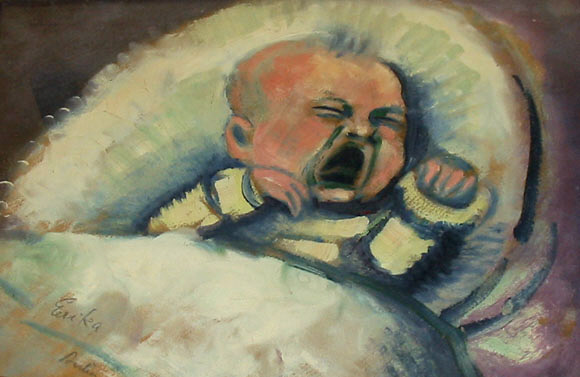
We usually think that babies are born crying. And for most of us this was undoubtedly true. Some of this stems from the tradition of doctors slapping babies on the behind to start or confirm their breathing, and the need for this was augmented by the introduction of drugs to alleviate the pain of a woman giving birth. The advent of chloroform for this purpose in the 1800s and the use of the “twilight sleep” of morphine and scopolamine in the 1950s, 60s, and 70s (perhaps even the use of epidurals now) led to an increased risk that a baby might not otherwise breathe properly because some of the drugs often got into the baby’s system as well as the mother’s. Today it’s more likely that a baby will be vigorously rubbed with a towel than held upside down by the ankles and whacked on the bottom.

Since the 1970s, various takes on natural childbirth have attempted to make the birthing process less traumatic for the baby as well as the mother. These include creating atmospheres that are dim, warm, and quiet, and leaving the umbilical cord attached a little longer so that the baby can still get oxygen that way and make a more gradual transition to air-filled lungs. There are even those who give birth in water, supposedly easing the transition from the fluid-filled womb. Sometimes babies grunt and growl or simply gasp rather than crying, and as long as the baby is pinkly oxygenated and breathing deeply to fill all the little newly inflated alveoli in the lungs, it’s perfectly healthy.

Even today, though, most babies cry at birth. Some even cry before they are quite out of the womb, perhaps giving credence to the idea that traveling down the birth canal in itself is uncomfortable. Other theories of why babies cry involve the startling experience of encountering cooler temperatures, noise, and light. Some note that babies’ crying is their first communication that something is wrong–at least that they are cold, and maybe also scared of all the hubbub. Our first method of communication is definitely crying, and it is the prime way that infants get what they need.

“Crying doesn’t indicate that you’re weak. Since birth, it has always been a sign that you’re alive.” –Anonymous

The Meadow Mouse

Posted on

Today is the birthday of poet Theodore Roethke, who chronicled the natural world and his own loneliness for many years. This poem combines those two themes and reaches a kind of connection to the larger world that we might call empathy.

The Meadow Mouse

1

In a shoe box stuffed in an old nylon stocking
Sleeps the baby mouse I found in the meadow,
Where he trembled and shook beneath a stick
Till I caught him up by the tail and brought him in,
Cradled in my hand,
A little quaker, the whole body of him trembling,
His absurd whiskers sticking out like a cartoon-mouse,
His feet like small leaves,
Little lizard-feet,
Whitish and spread wide when he tried to struggle away,
Wriggling like a minuscule puppy.

Now he’s eaten his three kinds of cheese and drunk from his
bottle-cap watering-trough–
So much he just lies in one corner,
His tail curled under him, his belly big
As his head; his bat-like ears
Twitching, tilting toward the least sound.

Do I imagine he no longer trembles
When I come close to him?
He seems no longer to tremble.

2

But this morning the shoe-box house on the back porch is empty.
Where has he gone, my meadow mouse,
My thumb of a child that nuzzled in my palm? —
To run under the hawk’s wing,
Under the eye of the great owl watching from the elm-tree,
To live by courtesy of the shrike, the snake, the tom-cat.

I think of the nestling fallen into the deep grass,
The turtle gasping in the dusty rubble of the highway,
The paralytic stunned in the tub, and the water rising,–
All things innocent, hapless, forsaken.

Little Green

Posted on

Some of the common wisdom about music’s ability to evoke emotions is that it’s highly associated with our personal lives. So, it has always been somewhat surprising to me how moved I’ve been over the years by Joni Mitchell’s “Little Green.” I’ve never had a baby, much less given one up for adoption. I suppose I have been left in the lurch by numerous “non-conformers,” but this song also gives us access to a more general sense of regret. There’s the inevitability of sorrow, even if there will also be crocuses, icicles, and birthday clothes. It demonstrates for me, too, the difficulty of social change and upheaval. We usually think of the sixties as this great time, but there were many forgotten individual traumas in all of that.

Joni Mitchell’s song is autobiographical–she gave a daughter up for adoption in 1965 before her career got off the ground. They were reunited in 1997.

I’m not going to outline all the possible comparisons between Joni Mitchell’s out-of-wedlock child and Casey Anthony’s. It’s perhaps grotesque just to mention them in the same post. But I suppose we now all wish that Caylee’s mother had put her up for adoption as she at one point told a friend she wanted to do. There are different kinds of griefs.

Casey Anthony and the Ick Factor

Posted on

Since this is weird Florida week, I just have to say something about the Casey Anthony trial. For any people who live with their heads under rocks, Anthony is soon to be on trial in Orange County for the murder of her two-year-old daughter, Caylee, in June of 2008. If there’s any story that should bring tears to our eyes, it’s one of a mother killing her own child. Or a father, though we are more used to male violence.

This particular story, however, has come instead to feel close to slapstick or some kind of satirical humor. The list of the tawdry and bizarre episodes has gone on and on. There was the mustachioed bail bondsman swooping  in from California in his cowboy hat, and, now, some “mitigation expert” who divorced her husband to marry a death row inmate showing up as part of the defense team. There’s the medical examiner with her own TV show. There are the anguished but mouthy grandparents, and the trashy photos of Casey Anthony partying, even after her child was “missing.” Everyone involved seems to have hired not only lawyers, but also publicists and PR experts. The grandparents are seeking to trademark the phrase “Justice for Caylee” to prevent sales of souvenirs.

Ever coyly smiling, Casey Anthony comes across as a narcissistic villain. By now it’s well established that she was a thief, check kiter, and pathological liar, and her bad behavior has been thoroughly trotted out and labeled. “Monster” is a favorite. Recently, Anthony’s lawyer was overheard telling her she was behaving like a two-year-old. He had found, perhaps, the perfect insult. I wonder if she feared for her life since it seems she killed her daughter for merely being a two-year-old and in the way.

I know it’s a stretch, but the whole thing has seemed to me as sensationalist as much genre fiction and Lifetime TV. I can no longer feel much of anything about it because of… well, because of the ICK FACTOR. I don’t respond well to melodrama—its manipulations are usually so obvious that I end up just not believing in them. For some people, though, this level of melodrama seems to increase feelings—we have certainly seen an outpouring of tears, anger, threats, and disgust, as well as an alternate passion about Casey Anthony’s right to be “a mother with a social life.” That this latter seems to have involved the mother chloroforming her child and locking her in the trunk of the car doesn’t seem to get through to those people, and the fact that Casey herself, sociopathic personality and all, is a pathetic tragedy even if she killed her child doesn’t seem to get through to the angry ones.

As a writer, I spend a lot of time thinking about access to emotions—how to evoke them, how to depict them honestly rather than manipulatively. Whenever things start to fall into black and white categories, I know something has gone seriously wrong and moved into the land of lies. Maybe that’s why I find something suspicious, not only about Casey Anthony, but also about all the “outrage” and “grieving.” It has become mania, obsession, and posturing, and it doesn’t feel like genuine emotion to me. It feels manufactured. And the fascination with the tawdry details feels too much like Casey’s own participation in a drug-, alcohol-, sex-, tattoo- and fantasy-fueled escape from her own real life. That Casey Anthony thought that whoring around and getting blitzed constituted “the good life” (a tattoo she got after her child was dead) seems like an eerie parallel to people’s enthrallment with Twilight.

It all smacks of bad fiction. Unfortunately the death of this little girl is all too real. I try to remember that small, hard fact.

The Glades Knows: Florida Is Weird

Posted on

I suppose it’s a sign of my TV-watching desperation how excited I am about the beginning of Season 2 of The Glades on A&E June 5. It doesn’t make me cry, and, of course, it is TV, so any genuineness can be only relative. But I like it because it’s actually filmed in Florida. In the first season, we got a lot of swamp and golf courses, some orange trees and swimming pools, and one hurricane. It really does look like Florida… because it is Florida! Even though a lot of the sets are in a warehouse… As I said, only so genuine. But it is even partly about just how weird Florida is, and Florida is demonstrably and truly weird.

But back to The Glades, which is quirky in other ways, too. It’s a crime comedy, for one thing, and the main character’s personality is caustic. In the first episode, Jim Longworth keeps telling his new partner what a bad cop he is, and he eventually catches his partner in murder. So a guy we thought was set up to be a constant by first show’s end was gone.

I also like the fact that there’s a kid who is a real character, not just some background contrast to all the evil of the crime world the way the kids and families are in so many earnest procedurals. I get very tired of the message that the only people you can count on are the ones you work with. (I mean, really.) And the message that families are just problems in the background. So the foregrounding of a family situation seems good to me.

And, by the end of the first season, the longing between Jim and his love interest, the married-to-a-convict Callie, has been consummated. How refreshing! The Hollywood tradition of season after season of the main couple staring chastely into each others’ eyes is broken. The main character’s love interest cheats on her husband, and it’s not something we condemn her for because the situation is complicated. Good and evil are all entwined. It will be interesting to see what happens next. Of course, they are bringing her husband home from prison. Maybe that will be tear- or at least cringe-worthy.

Callie’s husband, Ray, by the way, is played with the perfect Southern redneck demeanor by Alabama native Clayne Crawford. He was good as pure evil in his recent 24 role, and he’s even more perfect here with a creepy possessive gentleness with just a bit of threat around the edges. He totally reminds me of real violent felons I’ve met. (Just kidding.)

Not Easy

Posted on

Yesterday I had a naturally weepy day. At first I didn’t know why, but I realized it had to do with a dream I’d had about the dead body of someone I knew recently killed in a car accident. One of these days I’m going to post some lighter entries, but yesterday I was feeling in touch with the risk that life is, how it can end at any time, how we live on that edge, how temporary it all is.

In November of last year I had a brain hemorrhage and could have died. Luckily, I didn’t, but lately death has seemed closer. One person’s near-death experience is just that, while another’s edges over into death itself. The distinction seems so tiny and which side we’re on such a matter of chance. And it’s difficult to hold on to valuable perspective that the proximity gives, perhaps because we tend to flee in fear of the unknown.

My friend Don Stap wrote a poem that speaks to this. It was originally published in The Northwest Review Winter 2010. Thanks to the author for permission to post here.

Not Easy

Not easy to not go back, to remain
in the moment of crisis, that clarity:

my crooked smile, my slurred speech.
Not easy. I’m not going back,

I said over and over one day on the porch,
tears and all, and then wrote it

down to read each morning as if
the ineluctable years between long ago

and now were less or more than the two
clocks I keep in my room so

from any angle I can see how many minutes
are mine–as if it matters that sometimes

I turn their small faces to the wall.
And yesterday, when I was away

but had not left it behind,
I sat on the embankment by the water,

a quiet place, mares’ tails in the high blue,
and when I wasn’t looking for anything

there in front of me was a honeybee,
small golden blimp, floating from tickweed

to tickweed, one flower to the next
with no apparent pattern, no method,

and I wondered how,
in the constancy of his randomness,

how did he know where he had been
and where he had yet to go?

Weeping Willow

Posted on

Why do you weep, dear willow? Your branch it hangs so low.
Could it be you know a secret that other trees don’t know?

“Why Do You Weep Dear Willow,” written by Lynn Davis and Gona Blakenship, and recorded by the Carter Sisters and Chet Atkins in 1949, is a country-bluegrass ballad about a dead mother. It warns of the mistake of taking one’s mother’s love for granted. So, it seems appropriate coming right after Mother’s Day.

In the song, the willow, rooted to the ground and protective of the mother’s grave, understands things that the roaming child has missed. It always makes me think about lost relationships, not so much with my mother, as she’s too tenacious for that (!), but others who have gone missing in my life over the years.

It also makes me think about the relationship between knowledge and empathy. We often turn away from bad news because… well, we can, and it is often unpleasant. Sometimes the griefs of the world can seem overwhelming, and since Adam and Eve, we have had an ambivalent attitude about knowledge. Yet without it, we cannot connect to other humans for we cannot empathize.

It has often been pointed out to me that the music that I like tends toward the rough and ready, and I guess that has to do with my desire for the genuine, and it’s true that most packaged singers create in me not admiration, but revulsion. Still, I’ll get to the arias eventually.

Here’s an available version of “Why Do You Weep Dear Willow” by Carl Story and the Rambling Mountaineers. Be forewarned: this is hardcore bluegrass, and you shouldn’t listen unless you can abide the wailing. Sometimes, though, some wailing does the heart good.

Freedom Rides of 1961

Posted on

I watched Oprah the other night. And in other entries I will come back to Oprah because in a way the idea for this blog began to grow with my discomfort with Oprah’s obsession with positive psychology. I love Oprah, don’t get me wrong. But on the positive psychology issues, I think she’s lost her mind.

Night before last, Oprah did her soon-to-end show about the Freedom Rides of 1961. This week is the fiftieth anniversary of their beginning. The early Civil Rights era is certainly always something that can bring a tear to my eye, and so I watched. I plan to watch the PBS documentary that will air on May 16.

I was born in Memphis, Tennessee, in 1960, so I don’t remember the Freedom Rides. My parents over the years lectured my brother and me about the evils of racism and segregation, about Schwerner, Chaney, and Goodman, about Emmett Till, about the Birmingham Church bombing, about the assassination of Martin Luther King, Jr. I grew up breathing that air. My mother would drive us down past the Lorraine Motel, long before it became a museum, and tell us about the shame of being a white person in Memphis.

My parents were not “radicals” and they did not participate in events like the Freedom Rides. By 1961, they had two young children and mainly watched as the major events played out, working to support their family, changing diapers, cooking meals. They were a different, quieter kind of activist in that both of them became educators and supported the aspirations and dreams of children and college students of all races for many long years. They had been raised on “Red, and yellow, black and white, we are all God’s children in his sight.” They believed it.

As I watched Oprah rotate through her numerous Freedom Rider interviews, I thought about her tears and my own. When I think about that era of U.S. history, I cry out of a sense of joy that things have changed, even if not enough. I cry out of sorrow and horror that things could have been the way they were, that so many individuals had to suffer needlessly for so long. I cry because I had a little white friend in Memphis in the sixties whose mother actually used the N-word. And because a few years later in Knoxville, I had a black school friend, Suzette, who would not come to my house to play. I cry because in Knoxville, I was one of very few white children who did not boycott school when busing for desegregation began. Otherwise I might never have played hopscotch with Suzette.

Of course, I can’t be sure why Oprah cried. She mentioned growing up in racist Mississippi, and so she certainly has painful memories of her own. But she also noted that the Freedom Riders indicate how much individuals can do to change things. I suppose I shouldn’t object to a note of triumphalism about the Civil Rights movement. It is well deserved, and it’s absolutely true that brave individuals stood their ground. I’m not sure that anything similar could happen today. Perhaps we do use the internet to make some changes in the world. But as was implicit in Oprah’s exhortation, there is no longer a sense of optimism among the young. And who can blame them?

One of the people on Oprah’s show was an elderly white gentleman who had attacked the Freedom Riders, there to express his regret. He noted that the young black man he’d been beating had told him that the Riders were there out of love, not hate, and would not fight back. Quite the contrast to the violent world of 9/11 and the violent reaction to it.

The End of bin Laden

Posted on

Bin Laden, I do not weep for you.

But tears do come to my eyes when I see crowds of cheering, jeering people roaming the streets of D.C. and New York City. I don’t think it wise or good to celebrate the death of any human (or animal, or tree, for that matter), no matter how evil. It seems like cursing oneself. Vengeance, I want to say, belongs to the Lord. Judge not, I want to say, that ye shall not be judged. It’s odd for me to turn to Bible quotes, but there is something elemental about all this.

Beloved New York, so harmed, so damaged. We turn to anger when we are maimed, and bin Laden hurt us badly.

I remember 9/11 with as much clarity as the sky exhibited that day. It struck us all as horrifying how the beauty of the weather contrasted with the destruction we saw on TV, with the smoke billowing into the blue, blue heavens. I was new to Lewisburg, my cable wasn’t connected yet, and I sat in my new neighbor’s bedroom and watched it unfold on the only tiny TV she had.

Then I went to campus and found that the father of one of my students was most certainly dead at the World Trade Center (he was) and that the brother of another might be (he wasn’t, only missing for two days). My student whose hometown was Shanksville came in pale and trembling and said he was headed home to his parents. I told him that it might be better to stay put and call instead. We all had people in New York that we couldn’t reach, but the phones were still working in Shanksville.

There was no shortage of tears that day. Sorrow had not turned yet to anger.

I sent my students out to write about the day, to take a close look around at everything that had already begun to change. “It will be different after this,” I told them, “and even though it has already changed, we are closer to how it’s been now than we will be again. Write it down to remember how it was before.” It gave them something to do.

“Peace,” Edna St. Vincent Millay once wrote, “is the temporary, beautiful ignorance that war somewhere progresses.”