My Head! My Head?

Posted on

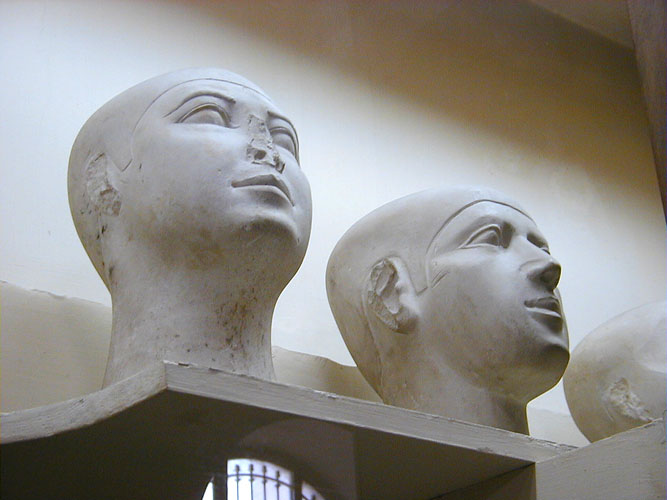
Ancient Egyptian reserve heads are theorized to have been made to replace a person's damaged head. I like that idea. See http://educators.mfa.org/galleries/slide_create/744?page=11.

We’ve all heard of anniversary syndrome—that creeping feeling you get when a date on the calendar approaches that used to be important or on which some terrible event took place. We may not even realize that the date on which someone died is looming—we don’t keep track of those on our calendars the way we do birthdays—but our bodies remember. We feel sick, we get headaches, we may just be in a bad mood, jumpy or weepy.

I am always amazed at what the body remembers and how it is so likely to respond to the past right in the present.

A couple of weeks ago, Bruce and I were rushing around getting ready to go somewhere. I’d been standing at our bathroom vanity valiantly attempting to style and blow-dry my hair, something I’m terrible at and that takes me an absurd amount of concentration. Unbeknownst to me, Bruce had opened the top door of the cabinet next to me, and when I turned with some haste to go back in the bedroom and finish getting dressed, I hit my head on the cabinet door.

It hurt, true, and I was annoyed at him for leaving the door open, but neither of those things should have led to the shriek I let out. I grasped my head and staggered to the bed, where I leaned forward, moaning and screaming. When Bruce tried to comfort me and apologize, I would have none of it, but continued rocking forward and back, holding my head. Tears poured from my eyes, streamed down my cheeks, and dripped off my chin. I couldn’t catch my breath I was keening so hard. I reminded myself of the widow Emilie loudly grieving her husband’s death in Bergman’s Fanny and Alexander. I went on and on.

The whole thing was ridiculous. But then I realized that this was the first sudden pain I’d had in my head since the brain hemorrhage. I was re-experiencing the terror of that event without the seriousness that had made me stay in control during the real thing. After a few more gulps of air, I calmed down and stood upright and went looking for Bruce, who had fled to the garage. When I explained my reaction, he hugged me. We agreed the short episode had been a little like being lost in a really scary funhouse—that was me in the mirror, but it was hard to recognize her.

Afterward, I felt the same kind of relief I’d had when I’d learned that my brain hemorrhage would probably not kill me—as if my body were lighter and warmer than before, almost floating. In a few short minutes, I flashed through a month’s worth of emotional phases. And I came again to my resolutions to focus on what’s really important to me. Maybe that’s one thing anniversary syndrome is good for.

Stone Reader

Posted on

I’m getting ready to head up to Vermont for a week-long writing retreat. The fellow running my workshop asked us to bring along any questions we have on our minds, and this has intensified for me some issues I’ve been trying to sort out for myself since last November after my near-death experience. My questions may go beyond what my workshop leader has in mind, but I’ll likely raise them anyway.

One of them is: What does it mean to be a writer? How can I balance between what originated in me as a profound passion for its own sake and the kind of careerism that surrounds me?

In recent years, I’ve become a bit disillusioned. Some of this is no doubt sour grapes based upon poor career decisions I’ve made and the sheer difficulty of maintaining a literary publishing practice. It has never been easy to have a calling to be a literary writer. I remember reading Ted Solotaroff’s essay “Writing in the Cold” years ago. Starting with the fact that so many young writers disappear from the magazines and journals after promising beginnings, he outlines some of the challenges writers face in keeping going.

Solotaroff wrote that essay in the 1980s, and I wonder what he would make of the challenges literary writers face today. Even though Solotaroff noted the winnowing of promising writers, he had not faced a world in which a writer’s career need be instantaneously successful (as opposed to building a following over years) or risk perishing. He wasn’t talking about a world in which writers were expected to fit writing their next novel in between Twittering, Facebooking, and blogging their way into the hearts of millions in order to get that book published. When he wrote “Writing in the Cold,” he didn’t need to address the crumbling of the publishing industry in the face of online amusements, the near-complete dominance of genre fiction in publishing, even the encroachment of genre into an academia that has become almost as corporate as the publishing world.

I was reminded of how different things are today when I watched Stone Reader, a documentary film that came out in 2002. It’s a wonderful film that tracks a guy, Mark Moskowitz, who finally reads a book he bought in 1972 but never got around to reading. Like the New York Times reviewer who first inspired him to buy it, he thinks it’s a masterpiece and sets out to read everything the author, Dow Mossman, has ever written. He can find nothing else.

So, like one of Solotaroff’s promising young writers, this one vanished from the publishing scene. The filmmaker sets out to find him and ask him why he hasn’t published anything else. Along the way he talks to various professional readers including the original book reviewer, the author’s faculty advisor at the University of Iowa Writer’s Workshop, a book editor, even the famous literary critic Leslie Fiedler. In some ways, it is a book focused on reading—even the trailer notes that the film is “for anyone who has ever loved a book.”

But by the end, the film also becomes about the tenuous lives of writers. It’s a film that made me cry about the loss of talent and promise that is so common. I cried for all of us who have published only one book, and for all those talented writers who never even get that far.

Another aspect, however, might be even sadder to me, and that is the depiction of a world of conversation about books and writing that I believe is disappearing. (The NEA also believes this.) One of the negatives of Stone Reader is that everyone Moskowitz interviews is an old, white guy. It’s one sign of the antiquated nature of a passion for books. One of these men is one of my former professors at Penn State, who attended Iowa about the same time Dow Mossman did. I was rapt as I listened to Bob Downs talk about writing, about his career. Even though it’s only been about fifteen years since I finished my MFA, I felt as though I was going back in time to a completely different era, a lost world. While I’m not sorry that the literary world is more diverse now, I am sorry that it has lost a shared sense of the sacred nature of literature, of the higher, non-commercial purposes of art. We still had it in the early 1990s, and you can hear it in the old guys in the film, but I wish I would encounter more of in the literary world these days. When I do find it, in a few friends, we keep it under wraps. We should no doubt be schmoozing instead.

Not Sexy, Just Crazy

Posted on

Probably every single person who reads this will have made use of at least some of positive psychology’s tenets and recommendations at some point or another: visualize success, believe in yourself, take charge of your life, think good thoughts and good things will come. All fine to a point.

When it comes to discussions of health and illness, though, this makes me crazy. Not sexy, just plain crazy. Yes, there is much we can do to positively affect our health. No, we cannot cure illnesses with positive attitudes and wheat grass, not unless they are psychosomatic.

One of the purveyors of the idea that we can cure ourselves and defy illness is a woman named Kris Carr of Crazy, Sexy Cancer fame. This woman is a charlatan, and yet she has been trotted out by all kinds of experts as an example of a cancer patient who cured herself with her positive attitude and alternative therapies including a vegan diet. She started off with a documentary film about herself and followed that with three Crazy, Sexy Cancer books. She has become a New York Times bestseller, lectured at universities and medical schools, and, I presume, made a killing. She has a huge following as a cancer lifestyle guru.

On Carr’s website she calls her illness merely “a rare and incurable stage 4 cancer.” This sounds dire indeed and is the one and only credential that has given her the right to tell millions how to live. Yet, after the original film, we find in her work very little discussion of the cancer she has: epithelioid hemangio-endothelioma. Her focus is all on nutrition, yoga, support groups, and can-do attitude. However, H.E.A.R.D., a support group for this and other vascular cancers, notes on its webpage that, due to the variable rate of tumor growth in this cancer, “Some cases are totally asymptomatic (no adverse symptoms) for more than 15 or 20 years,” and “some cases … have been known to go into spontaneous remission.”

I don’t mean to say that receiving such a diagnosis would not be daunting and that it wasn’t a meaningful moment in Kris Carr’s life. I don’t object to her writing or making films about her experience. I have done so about my own illness experience, and I have read many truly wonderful and insightful memoirs about people’s illness and disability experiences. It is quite true that illness can be a wake-up call and can affect the life choices we make.

But for her to claim that she cured her own cancer, and for her to note that, “I created the ultimate blueprint for a healthy and happy life, and I want to share my secrets with fabulous you!” is a grotesque trickery. Her blueprint for life dumbs down illness experience and panders to the desperate masses over any kind of integrity and truth-telling. In the film, her own father tells her that he caused her cancer by putting stress on her during high school. Who can take this seriously? It is magical thinking, no matter that there are even physicians, supposed men and women of science, who participate in it.

The variable progression of Kris Carr’s disease has little if anything to do with whether or not someone takes up a macrobiotic diet and takes to meditating. It is simply a variation in the disease. If I can find this out with a few Google searches, why don’t the journalists and physicians who promote this woman bother? How can they not know that this woman is a sham? Or do they know and simply decide that her “positive” message is more important than what ails her or doesn’t? Why would that sort of misrepresentation seem worthwhile to them?

We have a strong social impetus these days to believe stories like this. It’s all part of a highly scripted “reality” TV that has nothing to do with real life and that casts us into a highly social Darwinian universe. Maybe it’s one thing when it has to do with the supposedly democratic selection of the next American Idol. Even when it’s the loonies in Landmark Forum convincing people to pay to be told that they create their own destiny, I can laugh and roll my eyes. The ideas that we live in a meritocracy and that talent rises magically to the top over the advantages of power and wealth seem to be part of the American fabric. I’m used to that.

But when they start talking about health that way, I get angry. Barbara Ehrenreich has noted about her own experience with breast cancer how she became disturbed by the constant celebration of survivors, as though they were somehow better people than the ones who died. David Rackoff, after a second type of cancer before age 50, published Half Empty with an anti-positive psychology twist, and noted, “It is the duty of society to take care of its individuals, plain and simple. We will never be healthier than our sickest member.” Years ago, in a wonderful book called Teratologies, Jackie Stacey noted how the discourse around cancer was designed to make people feel responsible for their own illnesses. As far back as 1978, Susan Sontag’s Illness as Metaphor noted how the discourses around cancer often harm patients further. So, I am not alone, but we are shouted down by the people who want us to believe that it’s all a matter of will power and positive thinking.

I have to keep repeating this to believe that it’s true: in the U.S., people believe that if you are sick it is your own damn fault. If you can’t cure your own cancer with yoga and spinach, then there’s something wrong with your character as a human being, not just your body. If you can’t cure your diabetes (my illness) with herbs and exercise, then you are weak. If you have cancer, you must have brought it on yourself. If you are obese, it is because you are lazy and worthless.

Part of this has to do with our desire to understand causation. Think of the biopic Erin Brokovich and how the title character set out to uncover the poisoning of a California community by Pacific Gas & Electric. The Chromium 6 they had allowed to leak into the ground water had caused rampant cancer. Think of Terry Tempest Williams’ Refuge that outlines the increased risks of cancer to those living in Utah when the A-bombs were tested. Even in terms of responsibility that has a personal (as opposed to corporate and governmental) element, think about cigarette smoking: the National Cancer Institute attributes 440,000 premature deaths a year to lung cancer and other diseases caused by smoking. There are indeed cases where blame can be cast legitimately, though in the case of individuals that may not be a helpful strategy.

One U.K. study I read, for instance, conducted on cardiac patients, showed that many of them blamed themselves for their illness, said they got what they deserved based on their bad smoking and eating habits. They even avoided medical care because of fear that doctors would be disgusted by or dismissive of them and would blame them further. Perhaps most telling, the study found that these attitudes were more common among the economically disadvantaged.

When Kris Carr suggests that you interview your doctor as you would someone you were hiring at your corporation, she breezes over the fact that many health care plans don’t allow such options. I’m all for patients being active participants in their own care, but those who don’t have top-of-the-line insurance and a ton of money in the bank can’t turn their cancer into a full-time “self-transformation” project.

Nor does her story point out that what has turned many cancers into survivable illnesses is not mainly the lifestyle stuff she promotes, but actual new or newly refined detection techniques, medical treatments, and drugs. In the hands of positivity health gurus, causation becomes a twisted story of personal overcoming.

Part of the reason we are so drawn to the overcomers among us may also be that illness has become more complicated, more long and drawn out, more chronic, the causes more complicated. With the advent of antibiotics and vaccines in the 1940s, and the development of effective vaccines in the 1950s and 60s, many long-term lethal scourges—TB, polio, mumps, measles, smallpox, chickenpox—were knocked so far back as to become almost irrelevant in most people’s lives. Nowadays the raging (yet identifiable) germ that comes out of nowhere is a rarity, and contemporary illnesses stem from vague and multiple sources. And they have more variable outcomes. The doctor has no simple cure, so the cure is put on the shoulders of the ill.

Chronically ill people also can be a long-term burden. I myself have been living with Type 1 diabetes for nearly 40 years. It’s understandable that people around me get tired of taking care of me. I get tired of taking care of myself. My illness won’t end until I’m dead, and that could be another 40 years down the road. Recently, in my different kind of medical experience—a brain hemorrhage that fortunately turned out to be benign—I had cause to think about the different kind of care I was getting. The attitude toward this acute illness was heroic and sympathetic—I got round the clock care, myriad expensive tests, a plethora of support from friends and family. But the chronic illness gets boring.

The cost of treating a major illness, whether acute or chronic, is enormous in our current medical system. (My own recent brain event cost well past $100,000, and I and my insurance providers have spent thousands on my diabetes, too.) People who are ill sometimes can’t work or otherwise contribute economically. Sometimes they can’t support themselves. As far back as 1951 (in The Social System), Talcott Parsons pointed out that because of the “privileges” of the sick role, ill people also have the “obligation” to try to get well as quickly as possible, even though Parsons notes they are not held responsible for their condition.

Also because of these privileges, there are many scam artists of an even greater severity than Kris Carr. Every now and then someone without any diagnosis whatsoever is discovered claiming (usually) cancer and putting on a show to borrow money from family and friends and collect donations in public places, including on the web. In an ironic twist, many of these, including Ashley Anne Kirilow, Ann Crall, and Dina Leone, have now been labeled as having mental illnesses rather than physical ones and are still considered in need of help.

And since the ill take so much from the healthy in the way of financial support, emotional succor, and attention, we want them to get better in miraculous ways. If we believe that people can visualize themselves healthy, then there’s a theoretical way for everyone to improve their lives. There is no limit on health—not based on wealth, not based on health insurance availability, not based on health insurers paying for needed treatments, not based on chance.

There are even many so-called political progressives who believe that we are individually in control of our health (and by association to blame if it goes bad), and I wonder how they can fail to see the radical-right implications of that. Oprah Winfrey, one of the biggest promulgators of positive psychology (and one of Kris Carr’s promoters) has also conceived of herself as a crusader for social justice. For Oprah, it seems to be all about “empowerment”—giving people tools for improving their lives. Yet, she doesn’t seem to see that taken to an extreme the implication is that if an individual can’t triumph over illness it’s a personal failure. In other words, it’s a blame-the-victim stance that doesn’t take into account the myriad circumstances that can contribute to failure. I have a great deal of respect for Oprah—anyone who could keep the country reading books for so long has my admiration—but this aspect of her storyline is a huge disappointment to me.

The crux of the fundamentally conservative layer of assumptions in positive psychology is the delusional belief that we humans can control our own fates, not just to some extent, but virtually completely. Perhaps in a world where more and more seems beyond our control, it’s understandable that some people need to feel as though we can determine at least our own bodily fates. And no doubt it’s good to do what we can do for ourselves—I exercise regularly and eat fresh foods, too. But to be a true “liberal,” even just to be a person who is not living in a dream world, we need to remember that, do what we can, illness will come. The body does not last forever. People do not always get what they deserve. It would behoove us not to condemn the truly ill and not to celebrate those who turn their triumph over illness into a claim of personal achievement.

I wish that instead, we could offer support and encouragement to ill people without offering snake oil. I wish that tales of overcoming could be tempered with honoring those who don’t overcome. I wish that the media in our culture would practice some responsibility and not promote shallow, pretty people who have turned illness not so much into insight, but into a business opportunity.

I would rather stand with the people who have died of cancer instead of remaining in spontaneous remission for seven years with no sign of a symptom anywhere. I stand with those vomiting into the basin from their chemo, who don’t look so great with their hair falling out in clumps from the brutal treatments that will extend their lives. I stand with the ones who make meaning out of their experiences and appreciate the good days they have even though they know that cancer is not a gift, that even if a person with cancer sometimes can be sexy, the disease itself never is.
From “How It Adds Up”

Posted on

This is an excerpt from Tony Hoagland’s poem “How It Adds Up” (from What Narcissism Means to Me, Graywolf Press, 2003). This is a lovely poem about the delicacy of happiness and about the beauty of what is created by being human even when you’re not happy.

Happiness, Joe says, is a wild red flower
		plucked from a river of lava
and held aloft on a tightrope
		strung between two scrawny trees
above a canyon
		in a manic-depressive windstorm.

Don’t drop it, Don’t drop it, Don’t drop it—,
And when you do, you will keep looking for it
everywhere, for years,
while right behind you,
the footprints you are leaving

will look like notes
				of a crazy song.

Sugar Love and Sugar-Free Love

Posted on

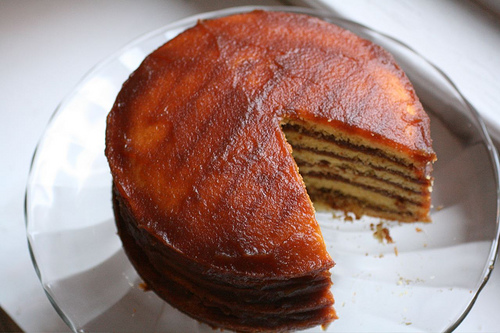
Apple Stack Cake from http://www.thebittenword.com

When I was eleven, going on twelve, I was diagnosed with Type I diabetes. In the hospital for a week, I cried a number of times over this diagnosis—usually when my family members had gone home and I was alone in the sterile room. I didn’t cry over what probably should have given me pause—that diabetes is a life-threatening illness with frequent gruesome complications like blindness, gangrene and subsequent amputation, heart disease, and kidney failure. All of that had not sunk in yet.

I cried for two reasons—I was going to have to take shots every day, and the doctors and nurses had told me that I’d never be able to eat sweets again. That this last was not really true never occurred to me. The medical staff said it, so I believed it.

If you’re not part of the Southern culture, it may be hard to understand how embedded sweets are in expressions of love in that culture, particularly familial love. Both of my grandmothers, and later my step-grandmother, as well, were famous cooks. Sweets were an ineluctable part of every holiday celebration. Giving up sweets in this culture was as hard as an alcoholic giving up booze.

Ironically, I had only just reached an age where two of the main products of my grandmothers’ cooking appealed to me. As a younger child, I’d been averse to the tickly, chewy texture of coconut and so I had not loved the high white coconut cake with divinity icing made by my Grandmother Meek every year or the more unusual jam spice cake with nut-, raisin-, and coconut-studded yellow frosting (known as amalgamation cake) that Grandmother Roney made.

These two cakes were as finicky as I was, and every year there was breath-holding over whether or not they would turn out “just right.” The divinity icing had to be made under just the right climactic conditions, and my grandmother beat it by hand with a wire whip on an oval, white platter for what seemed like hours on end. She would not use an electric mixer because it wouldn’t give her just the right feel for the texture. The cake layers themselves would grow dry if not moistened with just the right amount of coconut juice. The amalgamation cake was every bit as complicated. The thick, jam-imbued layers would fall if any sudden vibration hit the oven at the wrong time, and the icing had to be boiled to just the right consistency. No one but my Grandmother Roney knew all of the secret ingredients. Only years and many failed attempts on my father’s part later, did she confess to him that he should include some oil of cinnamon and oil of clove in the batter.

I myself preferred what seemed like the simpler offerings: dried apple stack cake and prune cake with caramel icing. (Later retitled “caramel plum cake,” the latter became much more popular.) These were also family recipes, but my mother had taken on the baking of them. The prune cake batter made a simple Bundt-style cake, and usually the hand-made caramel icing was the only difficulty. I would watch my mother melt the butter in a cast-iron skillet, add the corn syrup and buttermilk, and stir the foam constantly until it browned. It was hard to get the texture just right, so that it would pour, but not pour right off the sides of the cake. I will still swear that that homemade caramel icing is one of the best things in the world, hands down.

Dried apple stack cake was an East Tennessee tradition, from my Grandmother Meek’s background. But she and my grandfather had established their adult lives in West Tennessee, where dried apples of the right variety were hard to get. So my mother would go to the downtown Knoxville farmer’s market in the fall to get the right kind of apples. These had to be dried outside—by the sun—not in some dehydrator. This was the only thing that would give them the deep maroon color and deep flavor best for the cake. Usually they were sold by little, old country ladies as wizened as the apples themselves, ladies who said, “You’uns’ll like them apples,” and who would count out change with their gnarled brown fingers. On our way home from the farmer’s market, my mother always had that air of deep satisfaction, as though she had everything she needed. My mother had also perfected the recipe by making the tea cake layers thinner and thinner, until instead of five or six layers her cake had twelve. It had become a torte. It would melt in your mouth.

Because the stack cake was already made from a naturally sweet fruit that I was “allowed” to have in modest quantities, and because the tea cakes weren’t very sweet to begin with, it was the easiest one to be adapted for my new diabetic needs. My mother took to cutting back the sugar in the tea cakes even further and stirring artificial sweetener instead of sugar into the apples as they simmered in the big pot on the stove. The result was almost as good as the real thing, and a dollop of unsweetened whipped cream made it a real treat.

And this is what can bring tears to my eyes now—thinking about how all of these women, inculcated and habituated as they were in sugar-as-love, took to adapting things for me and making me special treats for the holidays that I was “allowed” to have.

My Grandmother Roney, a complete sugar addict herself, felt most sorry for me. On top of my mother altering the stack cake recipe, Grandmother Roney adapted cookie recipes and made me Chex mix every year (back before it was available in bags at the grocery store). She took to making spiced pecans, too. My Grandmother Meek took to brewing a pitcher of her famous iced tea “unsweet.” Even my step-grandmother, Billie, took to making me sugar-free boiled custard every holiday we visited . It was made with gelatin and rather lumpy, but its artificially sweet creamy flavor made me feel included when everyone was sipping cups of the real thing.

This, too, was also a Southern characteristic: determination to adapt to circumstances. My grandmothers had it in spades, and my mother and step-grandmother still do. And they gave some of that to me, too, along with all their sugar love and their all-important sugar-free love.

The photo of the apple stack cake is compliments of www.TheBittenWord.com, a food blog that’s also listed in my links. And I’ve also linked to some authentic recipes that approximate the ones I’m talking about. But I’m not giving out the secret family ones! That would be heresy.

Like Water for Chocolate

Posted on

In the book and film Like Water for Chocolate (written by Laura Esquivel, then made into a film in 1992), Tita has cried in her mother’s womb whenever her mother chopped onions, and is born on a flood of her own tears right in the kitchen. Tita becomes a great chef, and she ends up using the food she cooks to communicate with her would-be love, Pedro. Tita’s mother has refused to let Pedro marry her youngest daughter, who by tradition must remain single to care for her mother in old age. So Pedro has married Tita’s older sister in order to be close to Tita.

It’s a story of cruel power in the form of Tita’s mother and repressed longing in the form of Tita and her two sisters, none of whom do well under the aegis of tradition. Married to Pedro, Rosaura lives in misery with a husband who fathers two children but doesn’t love her; Gertrudis ends up abandoned in a brothel (thought she later returns triumphant, having overthrown tradition and become a Revolutionary general herself); Tita sneaks around with Pedro and ultimately is rejoined with him, but their long-frustrated passion kills them. Set during the Mexican Revolution, this story is an allegory about the ills of the power in the hands of the few.

What’s special about it is that the food that Tita prepares has magical powers. The wedding cake she is forced to make for her sister and Pedro, and into which she has wept, makes the guests themselves weep and then vomit. The quail in rose petal sauce that she prepares later inflames the lust of everyone at the table.

This book and movie connect us to sometimes mystical but almost always genuine power of real food to affect our emotions. I say “real” food not out of some snobbery, but because I don’t think it’s always true about corporatized or pre-packaged food.

There are exceptions. Years ago at Penn State, I taught a course called Women and the American Experience. Because the course was gen ed, I took a kinder, gentler approach to feminism—the students collected oral histories from women they knew and at the end of the term we had a potluck where all 60 students were to bring food made from a recipe passed down from the women in the family. One young woman brought an Entenmann’s packaged coffee cake. She was visibly upset and said that for years her family had believed her grandmother had gotten up at the crack of dawn on Christmas and made the traditional coffee cake by hand. After she’d badgered her grandmother repeatedly for the recipe, she had finally admitted that it had been store-bought all these years and just heated up with some fresh confectioner’s sugar icing drizzled over it. I couldn’t have planned it better as a commentary on how women have coped. Oppression, whether that grandmother’s or Tita’s, can often be dealt with in ways we don’t expect. And food has been a major tool over the decades.

There’s a better video excerpt (http://www.videosurf.com/video/como-agua-para-chocolate-02-like-water-for-chocolate-mpg-1260700044), but it won’t embed, so here’s the rose petal scene (with awful dubbing):

Good-bye to a Man I Never Heard of

Posted on

Jerry Ragovoy died this week. I had never heard of him, but he was the co-author of my anthem for this blog, “Cry Baby.” Using the name Norman Meade, he wrote it with Bert Berns for soul and R&B singer Garnet Mimms in 1963. Janis Joplin recorded the song shortly before her death in 1970. “Get It While You Can” is also a Ragovoy song, as is “Time Is on My Side,” made famous by the Rolling Stones. He also produced one of my all-time favorite albums, Bonnie Raitt’s Streetlights. He was the kind of guy who had a stellar career behind the headlines. In 2008, the British label Ace recognized his importance with a retrospective CD, The Jerry Ragovoy Story: Time Is on My Side, 1953-2003, which inspired NPR to review his career. I’m going to order it.

Here’s the Garnet Mimms and the Enchanters version of “Cry Baby.” There’s another one on YouTube without the cheesy pictures, but the sound quality is better on this one. What a great voice Ragovoy recognized, and what a great tune he wrote.

Landmark Forum

Posted on

Not long after I arrived in Central Florida, a young woman I’d met in YMCA indoor cycling classes attempted to recruit me into Landmark Forum. Not everyone who partakes of positive psychology would give much credence to Landmark Forum, but to me it became a symbol of what positive psychology could do when taken to extremes.

Kathy and her husband, Angel, were very friendly. They always chatted me up before class, and they acted familiar with a lot of other people in the room. They seemed genuinely interested—always asking me about myself and sharing cheerful tid-bits from their marriage. They talked about a wide range of friends, and they seemed always to have a busy social schedule. I thought they were great, and I thought that maybe making friends in Orlando was going to be easier than I’d thought.

I was new in the area, had no family or friends nearby to speak of, was a single woman past the age of forty, had a rather serious chronic illness, had poured most of my energy into my career, and was discovering that in spite of moving several hundred miles for my new job it wasn’t going to be an ideal employment situation. I suppose that I looked like easy pickings to Kathy. I would disappoint her terribly.

One day in spin class, Kathy asked if I’d like to go to a movie one evening with her and Angel and a friend of theirs. “A guy friend,” Kathy said, wiggling her eyebrows. “What kind of man do you like?” she asked.

Ever skeptical of the fix-up, especially by someone who only knew the outline of my life, I tried to wriggle out of it. But she mentioned it again a few days later, and again after that. “He’s a really great guy,” she told me. “Very smart and together.”

So I went. From the first moment that I met them at the theater, the mis-match became apparent. I’d worn some very comfortable semi-hippie skirt with lots of bangles; he was wearing a starched shirt with cufflinks and the most preppie pair of loafers I’d ever seen. I had never had a friend, much less a lover, who wore cufflinks on a casual movie outing. It should have been a sign to me that Kathy was trying too hard, but I laughed it off as a mere mistake.

Some days later, Kathy invited me to come to a “meeting.” She said she belonged to an organization that had really helped her achieve her life goals and that she wanted to share this opportunity with me. My first creepy feeling arose, but I had never heard of anything like Landmark Forum, and she wouldn’t tell me at first the name of her organization. She said that it was an “educational” organization that sponsored workshops to help people quit sabotaging themselves.

Over the weeks, Kathy told me more of her own personal story—how she had been in a dead-end relationship, living with her boyfriend but never committing to marriage, and how through this group she had managed to give up the old guy and marry Angel. “Angel was in the group?” I asked. Yes, she told me. She had met him there, and they had married within a few weeks of meeting. She had broken out of a “no good” relationship of seven years’ length in order to do so. She looked at me. Her stare implied that I could do this, too, and mentioned that the movie fellow was an avid seminar leader. “Marriage was part of my goal,” she said with a shrug. She and Angel had also been encouraged to quit their “dead-end” jobs and start their own business, though it was unclear exactly what that business would be. Later, Kathy would ask me to recommend students go to her “journaling” class, and she had a website as a “personal consultant.”

I began to watch Kathy and Angel more closely. Though they came to spin classes together, they didn’t usually sit on adjoining bikes—instead, Kathy always sat next to me, and Angel seemed to be working on a fellow across the room. Sometimes, he would sit on a bike on the other side of me, and he would chime in on how right Kathy was. I had to admit that Angel seemed less into the proselytizing, and, though Kathy would always tease him it sometimes had an edge. I could see that she already didn’t think he was as good as she was at whatever it was they were doing.

The invitations continued, and I continued to decline. Kathy spread her invitations more widely to others in the class, and finally one day she handed out small slips of paper that included directions to the next introductory meeting—proudly labeled as “Free!”—that also included in small print the name of the organization.

I went home straight away and looked it up on the internet. What I found shocked me: personal accounts of brainwashing and verbal abuse at meetings of more than a hundred people at a time, and even stories of lives destroyed. Participants were required to recruit, and many spent long hours doing so; if they weren’t successful, they were reprimanded, but if they brought new members into the fold they were rewarded financially with discounts on further seminars. The seminars were often held in isolated office parks and lasted long hours with little chance to eat, drink, or use the restroom. “Homework” kept participants up late and deprived them of sleep. One woman recounted how her brother had cut off all contact with family and former friends, quit his job, and become destitute because he had invested so heavily in the expensive series of seminars that teach that you are the master of your own fate.

Some of these accounts have been taken down, perhaps because Landmark Forum has a habit of suing anyone who maligns them, especially those who refer to them as a cult, and I’ve been surprised by the only tentatively critical nature of most journalistic accounts now on the internet, though there are still many anonymous negative postings on blogs and the like. LF has also built an enormous web presence, so that its own sites fill the first pages of any search.

Even the Landmark Forum’s own website, however, would have been by itself enough to give me pause. Any organization that claims that “what we think of as reality, which includes an objective world that exists independent of us” is a “myth” is going to send me running. Especially when it notes that part of the seminar’s purpose is to upend those “myths” and teach us “that we no longer need to be confined to living within this limited range.” That’s post-structuralism without any sense of the regulative discourses in which we all function and that are probably as inescapable as any old-fashioned reality. In other words, it’s delusional.

It was after I read these things that Kathy got very aggressive with me. The next time she asked me to go to a meeting, I told her that I’d looked up the organization and that it didn’t sound right for me. I told her I respected the fact that it might help her, but that I knew myself well, and public humiliation would not bring around a breakthrough for me. When she pushed further, I asked her what the qualifications of those conducting these seminars were and whether they had psychology Ph.D.s. I explained that I’m a person who believes that credentials matter. She said simply that they were internally trained. I told her that with my Type 1 diabetes, it would be dangerous for me to go to an event where access to food was limited and where I’d be discouraged from taking breaks to check my blood sugar. She scoffed.

“I’m just not that kind of person,” I reiterated, getting tired. “I’m stubborn and I’m not willing to go through that kind of program.”

“And how’s that working for you?” she said, squinting into my face. She repeated herself two or three times.

It was then I realized that she and Angel had seen me, not as a potential friend, but as a failure with a desperate longing for change. That was a prerequisite to being a real candidate for Landmark Forum, and something—my single status, my illness, whatever—had marked me as that failure to them. I suppose they saw no particular shame in this, since they had been this way too, before. But I felt my spine stiffen.

“You have me all wrong,” I told her.

After that, Kathy and Angel would still say hello, but they never chose the cycles next to mine, and they never asked me how I was. I had certainly been manipulated and used in romantic relationships before, but I had never had someone pretend to be my friend in such a calculated and false way. Adjusting to life in Orlando wouldn’t be easier than anticipated after all. If you were me, actual friendships would have to grow, not spring fully formed from nothing. If you were me, it would just be real life, without the fantasy and self-delusion. I’m happy with that.

Bridge Over Troubled Water

Posted on

When I was young—and I mean pre-teen—my friends and I worshipped Simon & Garfunkel. We called their songbook our “bible,” and listened to them all the time. Why we were such moody children I’ve no idea, but I still love S&G like nothing else, and I miss the straightforward friendships of childhood.

“Bridge Over Troubled Water” isn’t my favorite S&G song—it would have to compete with “The Boxer” and “Homeward Bound,” both of which I really love more. But “Bridge Over Troubled Water” reminds me of that particular set of friends that I met in 5th grade and who I thought would always be my closest friends. I couldn’t imagine life without them. They and their horses and dogs and cats and the many, many allegorical stories we wrote together certainly contributed to the person I am today.

I first made friends with Mouse and Barndoor, who are sisters. We were also friends with a girl named Bee, and after I moved across the state another girl named Maggot joined the crew. My nickname was Sa, but my little icon was a drawing of a smiling saw. We each had a cutesy icon that always accompanied our signatures in our many letters. Today I suppose we would have avatars. But back then, we sent letters with wax seals and elaborate news. We all saw each other for weeks in the summer, and our parents trundled us back and forth across the state of Tennessee for these visits. I rode the Greyhound bus by myself.

I haven’t seen any of these women in years. I heard a rumor once that Bee is dead, and I haven’t been able to find her anywhere on the internet. I might be able to get in touch with her brother, now a Hollywood producer, and ask him: Death or marriage? How did she disappear so completely? But I don’t want to ask him painful questions, and he might not even remember me.

Maggot has become a physician like her father and lives near my mother in a completely different state than where we grew up. Maybe some time when I’m visiting, I will look her up.

It’s Mouse and Barndoor who haunt me, though. I loved them so much. From what I understand Barndoor has fared the better of the two, though her older sister dominated their childhood and was always more popular. Barndoor and I had in common that younger-sibling thing. I tried to stay in touch, but Barndoor was standoffish. I think she couldn’t wait to get away from her childhood. The facts I know are that Barndoor went through a short phase of evangelical Christianity, married and divorced very young, became a nurse, and at latest news was married to a “little person.”

Mouse, on the other hand, took all her potential and moved to New York City where she was a paralegal and then married a wealthy heir and became addicted to drugs. For years, I had no clue what was going on. She entered a master’s program in anthropology but didn’t finish it. She quit working. She volunteered at a senior center but then didn’t any more. I would plan to be in New York and see her and her husband, but she would call and cancel at the last minute. Sometimes this would be dramatic: they’d be in a cab on the way to meet me, and she would call and say she was terribly ill and had to go home. It was always her stomach, and her mother had died of a sudden stomach illness when we were teenagers, so I thought she just associated me with that painful memory.

When I was back home in Knoxville, I’d go to see their dad. Max (I had given up his nickname—Muck—as I got older) lived eccentrically—for a while on a houseboat, always with numerous cats and dogs and their barely contained (or not contained) mess. I would perch on the cleanest corner of a kitchen chair, and we would talk over the latest photos of Mouse and Barndoor on his refrigerator. After he was diagnosed with Type 2 diabetes, we talked about blood sugars, and I tried to encourage him to get better medical care, as his clearly wasn’t good. Finally, he told me that Mouse had been in rehab after rehab, but that her wealthy husband had given up on her and moved out. I saw him one last time in a nursing home, after his leg had been amputated.

With Mouse, I followed with calls and cards, with brochures about programs to help women re-enter the work force, with one or two visits that actually happened. We talked about her dog and my cats. We talked about my work and her dreams. I thought I might be able to be her bridge over troubled water. But eventually, Max died and Mouse became unreachable. Nothing ever got better for long, and I got tired. I gave up, though I still mail an occasional birthday card and hope against hope that she has found her way.

I also still have a tiny cross-stitch pillow that hangs on a doorknob, which she sent me after one of my flurries of support. It says, “Old friends are the best friends.”

Crime for Crime

Posted on

In a week when most of us in the U.S. are called upon to celebrate our freedom, just a reminder that the United States has the highest incarceration rate of any country in the world.

By 2009, 2,284,913 people were in prison in the U.S. That is approximately 1 in every 135 people. Many or most of these people are incarcerated for non-violent crimes like drug possession and immigration violations. These numbers have continued to rise even as violent crime rates have dropped.

By 2009, 7,225,800 people were either in prison or jail or on probation or parole, or 1 in every 32 people. Read that again. When I mentioned it to my husband, he said, “Really? Maybe you should double-check that.” I did. Yes, 1 in every 32 people.

Wow.

That might not be 1 in 32 of the people I know, or that you know, but that just means that in some neighborhoods, it’s 1 in 10, or 1 in 5, or every single adult in sight.

These numbers should make us cry. They are a great shame to us all.

And that’s another thing: all the money that goes into our prison system does not go into education. By 2008, in five states, prison expenditures had already surpassed those for education, and across the country as a whole prison budget growth far exceeds education budget growth. Lack of education is, of course, one of the strongest factors in someone choosing a life of crime. It’s a vicious cycle.

Justice is not color blind. In 2009, rates of incarceration were: 706 of every 100,000 white males, 1,822 per 100,000 Hispanic males, and 4,749 per 100,000 of non-Hispanic black males.

In October 2010, there were 3,242 prisoners on death row in the U.S. Execution rates have been steadily dropping from their 1999 high (of 98 executions) because DNA evidence has been used to exonerate so many death row inmates and so the infallibility of convictions has been called into question. Still, 46 people were executed in 2010 and 25 so far in 2011.

Casey Anthony, however, was declared not guilty even of manslaughter in the death of her child this week. DNA and its representation on TV detective shows has apparently made people believe that a strong circumstantial case is never good enough. That this woman will go free while many people rot in jail for being caught with a little marijuana is incredible indeed. I do believe that the prosecution focused not enough on the fact that Caylee died under Casey’s care (implying gross negligence) when they chose to try to prove premeditation and get the death penalty. The death penalty is not a good idea, even when its distractions get someone off. Period.

For a long time, I believed, contrary to my general progressive liberalism, that there could conceivably be times when the death penalty was warranted. But after considering the racial prejudices apparent in the death row statistics, and those exonerated by DNA, and the fallibility of much eye-witness testimony, not to mention the high financial burden of death penalty appeals, I changed my mind. Ani DiFranco helped me do so with this song, “Crime for Crime.”

Information from the Center for Economic and Policy Research, the U.S. Bureau of Justice Statistics a and b, the U.S. Census Bureau, the Pew Charitable Trusts, the International Centre for Prison Studies, and the Death Penalty Information Center. There is some slight variation in numbers depending on exactly how counts are made and which prisoners are included (pre-trial vs. convicted, etc.)