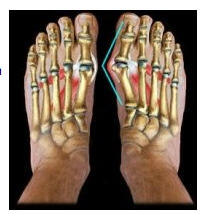
Sometimes Pain Is Telling You Something


A few weeks ago I missed my plane to Vermont. I arrived at the airport an hour and a half before my flight, but it took me 45 minutes to check my bag (though I already had a boarding pass) and another 45 at security. In spite of the fact that I told the security folks that I was going to miss my flight, they insisted on taking me aside and testing my insulin pump for explosive residue. I ended up racing down the terminal in a pair of flimsy sandals definitely not designed for running, and I missed the flight anyway.

I’ve had some serious foot pain since, and I found out a couple of weeks ago that this stems from an inflammation in my foot caused by the beginning stages of arthritis exacerbated by my dash down the terminal. The doc showed me the X-rays, and the joints in my middle toe of my right foot no longer line up. I am in the process of buying a lot of new well-padded shoes, and I’ll probably have to accommodate this condition for the rest of my life.

Bummer. I was pretty annoyed with the airline and TSA for putting me in this predicament, but then I realized that at least the pain they caused me got me to the podiatrist before I ignored this condition any further.

I thought back to last fall when I was teaching my 100-student course one night a week and would end up being on my feet for a good, solid four or more hours every Thursday evening, usually after an already long day of crisscrossing campus to other classes and going up and down four flights of bare concrete stairs to my office. I would often be in terrific pain when I got home, but didn’t pay much attention. Too much else to think about.

I’m grateful for another even more important aspect of this pain in my feet, and that is… well, that I feel pain. You see, diabetics often lose feeling in their feet because of nerve damage caused by the disease. The good news is that I don’t have neuropathy; I can still feel my feet and pain in my feet. Otherwise, I might develop a truly horrible condition common to diabetics. (And let me warn you, don’t check out the links unless you have a strong stomach and won’t hate me for inflicting this on you.) This condition, Charcot joint, might start with small orthopedic changes like the ones I have, but many diabetics end up with severely degraded and fragmented joints and even wounds from the rubbing of their malformed bones in their shoes. They may not feel anything happening in their feet until it is too late to do much about it. This is one of the causes of diabetes-related foot amputations. I have lived almost my entire life with some dread of this kind of thing.

So, while I’m certainly not happy to have this arthritis diagnosis, I am also grateful to my body for its functional nerves, and I’m glad I found out in time to stabilize my feet and treat them better. This is just one example of how we should pay attention to our pain rather than dismissing or ignoring it. Whether emotional or physical, it is often trying to tell us something we need very much to know.

Motivations

Last Thursday, I cross-posted my tenure-related musing on Daily Kos. It has since been picked up by the new blog of the American Association of University Professors (AAUP), Academe. There has been a lot of great discussion, here on joyouscrybaby and already on Daily Kos.

All writers want readers, right?

It is great to enter the realm of public debate, but I have to admit that I also find it a little terrifying. I recently said to my husband, “What was I thinking becoming a writer? The entire premise of being a writer is that you want to be famous. I am so not a fame-hound.” It is not that way with doctors and lawyers and graphic designers and so forth. Some gain notoriety, but it isn’t the point of their work. It really shouldn’t be the point of a writer’s work either, but often it seems that it becomes that way. I have been struggling with this issue as I pass mid-life not famous. I haven’t stopped writing, but how do I value my own work under these circumstances? My blog has been partly about exploring what I care about more than lines on my c.v.

In addition, one of those who commented on Thursday’s blog eventually accused me of greed because I make somewhat more than the median annual salary in the U.S. It’s a ludicrous accusation, but I’ve been thinking a lot about my motivations in the past week.

So it was with eagerness that I watched this 10-minute video called “The Surprising Truth About What Motivates Us” that a person posted in response to the blog post on Daily Kos. It’s an animation based on a speech by Daniel Pink, a bestselling author on the subject of work, and is part of a project of Britain’s RSA (the Royal Society of Arts, Manufactures and Commerce). Take the time to watch–it’s cool. Academia has operated (as least ideally) for a long time on the principles that Pink notes. It’s too bad that these ideas are catching on in the private sector at a time when they are under attack in university life.

Florida Governor Rick Scott Takes Aim at Tenure

Margaret Haley, an early supporter of rights for female teachers, including decent pay and job security.


I am a tenured associate professor at one of the largest (though, let me emphasize, not one of the highest ranked) public universities in the U.S. How can I explain why it is that this often makes me want to cry?

Don’t get me wrong. I love my work, and, although I am not an academic superstar, I’ve done reasonably well. In economic times when so many are losing jobs, my job is relatively secure. The work that I do has pleasant and meaningful aspects that I value, in spite of sometimes snake-pit politics and bureaucratic burdens that often make it very difficult to focus on the things that are actually my job.

However, the future of public higher education, and especially in my area of the humanities, is truly in question. Even though more than half of all Americans attend at least some college courses, and 30% over age 25 have a bachelor’s or higher degree, what we do in academia and the value of it is still largely misunderstood by the public. When the governor of the state of Texas can blithely call for higher education reforms that include “treating students as ‘customers,’ judging faculty by how many students they teach and how those students rate them, and de-emphasizing research that doesn’t produce an immediate financial return,” it becomes clear that our future is in the hands of people who either don’t know what they are talking about or harbor a truly vile and anti-intellectual agenda. Or both.

There are many angles on higher ed and its issues, and I hope to be able to sort some of these out in the blog in coming posts. But today I am inspired by yesterday’s article in the Orlando Sentinel that reported on Florida Governor Rick Scott’s agenda for the coming year, in particular his desire to abolish tenure for public university employees. (He’s already done it in K-12 education.)

Tenure is often resented by people outside the college and university system–because they don’t have it, after all, and therefore it’s unfair that anyone does. The largest complaint about tenure by the general public seems to be that it protects lazy and low-quality teachers. The laziness issue I will have to give its own separate post because it is one of the most offensive and false of all these claims. But part of that is the idea that tenure keeps in place bad employees.

This is an absurd claim on many levels. First, to become a tenured professor at any college or university requires years of investment. At numerous points along the way, those who are bad at what they do are drummed out of the system: they can fail to get into a graduate program; they can fail courses, which, unlike in undergrad programs, gets them booted in fairly short order; they can fail to complete language and other degree requirements; they can fail to finish or defend successfully their thesis or dissertation work; they can fail to get a tenure-track job or any job at all; they can work temporary jobs for a number of years, moving from place to place; and they can fail, after six years at a tenure-track job, to get tenure. If the system has not identified and excluded the poor quality work by this point, then something else is wrong with the system, not tenure.

In addition, the public perception of tenure is that it’s virtually impossible to be fired if you have it. That is simply not true. If a university has cause to fire a tenured person, then the university can do so. If a faculty member doesn’t show up for classes or turn in grades, if he or she behaves in unacceptable or unprofessional ways, if a faculty member violates ethics codes–or for numerous other reasons–a faculty member may certainly still be fired. Granted, it’s harder to fire a tenured as opposed to an untenured faculty member and requires a long process of documentation rather than an arbitrary decision by an administrator. Granted, it doesn’t happen very often. But maybe this has more to do with the fact that most tenured professors have already run the gauntlet mentioned above and have spent at least 9 to12 years on probation (in grad school and earning tenure) before becoming tenured than with the fact that it’s too easy for them.

There are many other reasons why tenure is important to the healthy functioning of colleges and universities, but I’m only going to mention one other here today—and that is the traditionally cited protection of faculty with unpopular or controversial ideas, aka academic freedom. Tenure was designed to protect faculty from arbitrary complaints by parents, students, and administrators who otherwise might paralyze their teaching and life-choice options. It’s only been around for about 100 years, and, I might add, it’s the 100 years when someone other than white men of a certain conservative bent could reach for the intellectual life. It prevented, among other things, administrators from firing female faculty members who married or got pregnant.

Many in the right wing these days claim that tenure, however, rather than protecting a diversity of ideas and opinions, now is a screen behind which liberal prerogative is preserved. From what I can see in the articles I’ve read, they don’t cite any real evidence for this except that professors are notoriously liberal. How it is that tenure produces this supposed effect, I’ve no idea, but it is certainly true that tenure prevents conservative politicians from exerting pressure on university administrators to just fire professors whose politics the politicians don’t like. And this is exactly why we need tenure right now.

I feel certain that if some radical right politicians have their way, and if they manage to make arbitrary, without-cause firing of faculty possible, they will create an atmosphere in which faculty will become fearful to speak their minds honestly and in which they will be punished if they rise above their fear.

Frequently, these men who speak out against tenure (they’re usually men) have spent some time in academia themselves, but have since moved on to business or conservative think-tanks for their employment. I don’t have access to the details of these changes in their lives, of course, but one of two things seems to have happened: either a) they didn’t get tenure and were thus excluded from further academic life, or b) they decided that the benefits of an academic career were not enough to offset the relatively low pay-scale and demands of the work. Either way, they are out for the blood of those who have made different choices and had different successes than they have had. Their goal is complete eradication of protections of any sort for faculty and the imposition of non-academic standards for academic work.

If I’m being alarmist, and the goal in abolishing tenure is not to clean house based on a political agenda, then the fact is that abolishing it would likely have very little effect at all. Perhaps some increased costs as faculty constantly seek to move to better positions and universities take on increased supervision, expanded evaluation tasks even for long-term faculty, and constant interviewing for new faculty. Mostly, though, we would keep doing what we do.

However, my fear is acute. It’s bad enough as it is right now. Much university funding already comes from private sources and cooperative efforts with private businesses abound. As it is, that’s often a mutually beneficial thing. But if these people get their way, public higher education will become even more a servant of private business interests, not designed for the public good.

People, private industry has one goal: profit. It and its CEOs do not have your best interest at heart. That is one reason why running universities like businesses is a bad idea.

eHarmony and Cats

A couple of weeks ago, a grad student of mine, Jaclyn E., posted on Facebook that amazon.com was selling a Cats 2011 Wall Calendar for $25,007.20. She thought it was a little overpriced. A friend of hers said that maybe this person would buy it.

I had a good laugh. This is exactly the kind of person we fear being when we cry. Of course, another layer of complication is added by the fact that this woman is not Debbie at all but an actress named Cara Hartmann showing off her skills. Still, we all know the type in real life. And we don’t want to be her. She would not get a whole lot of dates with this video, except with people who wanted to take advantage of her.

So, maybe a part of thinking about the benefits of crying must necessarily involve when not to cry. I’m accumulating a list of problems and aspects of sentimentality, and certainly one of them is inappropriateness.

But perhaps the most disturbing aspect of this is how easy it is to participate in derision. I mean, after all, this persona (if not the person behind it) deserves it. Right?

Your Flag Decal Won’t Get You into Heaven Anymore


This week’s last anti-war song is by one of my old favorites, John Prine—it’s about flags as “Makeshift Patriot” is about flags, but from about as different a source as you will find. And this one comes to us from the 1970s, with the implicit question attached of why humans never seem to learn about war.

This is also a funny song. I’ve been self-conscious lately about my earnestness, how obnoxious it can be. Granted, the week of 9/11 is not the time to throw caution to the wind and try to be funny. But humor does return, as reported by both Studio 360 and WYNC. There is a strong relationship between tragedy and comedy. Even Freud knew that jokes are serious business. Ha ha.

Makeshift Patriot

I generally have more sympathy for journalists than this Sage Francis song shows, and I mourn the current shrinkage of quality reporting in the world, but I do recall my own shock at the news coverage vitriol in the weeks and months after 9/11. Sometimes I would remark upon what I considered the inappropriate words used by journalists and the way that they failed to question the simplistic (and as it turns out false) rhetoric of George Bush and his minions. I was reminded of Toni Morrison’s words in her 1993 Nobel Prize acceptance speech: “[T]ongue-suicide … is common among the infantile heads of state and power merchants whose evacuated language leaves them with no access to what is left of their human instincts, for they speak only to those who obey, or in order to force obedience.”

“The systematic looting of language,” she goes on, “can be recognized by the tendency of its users to forgo its nuanced, complex, mid-wifery properties, replacing them with menace and subjugation.” This kind of language, she notes, “does more than represent violence; it is violence.”

Let us watch out for that, always. It is something we can do in our daily lives: listen and stop ourselves when we are caught up in “the language that drinks blood, laps vulnerabilities, tucks its fascist boots under crinolines of respectability and patriotism as it moves relentlessly toward the bottom line and the bottomed-out mind.”

P.S. My use of this version of the Sage Francis song video does not represent support for the 911debunkers blog.

Tuesday Morning

It seems a particularly relevant morning to revisit Melissa Etheridge’s song honoring Mark Bingham, one of the four men who are given credit for bringing down Flight 93 in rural Pennsylvania so it wouldn’t make it to the Pentagon. Mark Bingham was a gay man.

This morning we try to recover from last night’s GOP Tea Party debate in Tampa. Richard Adams of the Guardian provides a merciful summary for those of us unable to stomach watching it. You can scroll down to 8:00 p.m. when the debate actually starts. Gay rights were not discussed at all, as those won’t really become an issue until a Republican faces a Democrat. But we should all know that the Republican position on the issue hasn’t changed much since the 1950s.

Perhaps the most revealing moment of the debate came when CNN’s Wolf Blitzer asked candidate Ron Paul who should pay for the hospital care of an uninsured man suddenly critically ill. When Paul hedged, Blitzer asked if he should just be allowed to die. Several members of the audience yelled, “Yes!” There’s a brief video of the exchange here.

These people scare me way more than Al Qaeda.

Where Is the Love?

This is the Black Eyed Peas’ peace anthem, and it’s simple in its chorus, but one of the things I like about it is how it acknowledges the tangle of complexities we live with.

Where is the love?
I don’t know.
Where is the truth?
I don’t know.

When New York Had Her Heart Broke (9/11)

I have a friend whose birthday is 9/11. She and I have talked about how odd that is—to never be able to celebrate, as least not in public, the occasion of one’s birth. It becomes almost a secret. I want to tell her that we should never feel ashamed of being born, just as no one should feel ashamed of dying. So, happy birthday to my friend.

There is, however, both nothing and too much that one can say about the tenth anniversary of the 9/11 terrorist attacks on the World Trade Center and the Pentagon. I’ve already given the outlines of my experience of that day in this blog on the occasion of Bin Laden’s death. Saying anything today seems to me to take nerve, but it is probably nerve we need to have.

Philip Metres gives a good account of these conflicting impulses of silence and expression that face us over any such horrific event in his Huff Post article, “The Poetry of 9/11 and Its Aftermath.” His article also includes several poems related to 9/11, including Martín Espada’s beautiful “Alabanza: In Praise of Local 100,” which ends with “Music is all we have.”

So for the next few days, I’ll post a song a day related to 9/11 and the dispiriting politics that have followed in the decade since. Just as George Bush squandered the world’s sympathy in his false claims of “weapons of mass destruction” and an ill-advised declaration of war on Iraq, our entire nation has squandered the feeling of brotherly love and egalitarian concern for each other that followed the attacks. Ten years after the 9/11 tragedy, that is a daily sorrow.

The New Yorker’s 20 Under 40

Medieval man at writing desk; from Rodwell, G. F.: “South by East: Notes of Travel in Southern Europe” (1877). Public domain in the U.S.A.


Continuing on a theme of work this week, but closer to home, I’m thinking about layers of privilege. We think of class distinctions as being between people who work in factory, construction, and other menial jobs versus those who are in professions and managerial roles. But there are many class distinctions within the professions as well.

Recently, for a project I’m working on, I’ve been reading author biographies, and I revisited The New Yorker’s “20 Under 40” issue published in June of 2010. The New Yorker publishes a summer fiction issue every year, and last year they chose to feature their top writers under the age of 40.

On the surface, the list is a paragon of progressive balance. Gone are the all-male, all-white lists of a few decades ago. A full half of the list is comprised of women, and there are 6 non-whites on the list. A variety of white ethnicities and persuasions are included, including at least 3 Jews. Several are immigrants or barely second-generation Americans. At first, the list looks like an ideal of the Melting Pot. Yet, poke a little bit and privilege raises its head again.

Of their 44 college/university degree admissions (a few of their degrees went unfinished), only 5 of them came from public universities other than the University of Iowa. These 5 degrees were: a pre-med degree at Peking University in China for someone who went on to get two master’s degrees from Iowa (an MS in immunology and an MFA); a bachelor’s degree from Eastern Connecticut for someone who went on to two graduate degrees at Johns Hopkins and Yale; a bachelor’s degree from the University of Florida for someone who went on to go to medical school at Eastern Virginia, study at Harvard Divinity, and finally receive an MFA at Iowa; and two MFAs, one from University of California Irvine and one from Hunter College of the City University of New York. There were 6 MFAs from the Iowa Writer’s Workshop.

Of the 20 young writers, at least 4 have either studied medicine or at some point been on a science track in preparation for studying medicine. Two of them have MD degrees. (Three of them have fathers who are doctors.)

I think the best advice I could give to those wanting to be creative writers is: attend Ivy League institutions, get an MFA from the University of Iowa, or become a physician. Unfortunately, you can’t choose your father’s profession.

Not that all of those who get degrees from Ivy League universities or Iowa or who study medicine go on such meteoric rises to fame as writers. And not that no one with a more modest educational pedigree ever succeeds. But statistically those things seem to improve someone’s odds significantly. I am happy to say that UCF (where I teach) has just sent its first undergrad on to the MFA program at Columbia.

However, perhaps, as I suspect, the key statistical factor for success is being born into privilege and/or to families that are highly educated and well-connected.

Of course, there are a couple of sort-of exceptions on the list—Philipp Meyer claims to have been raised in a “working-class neighborhood” by a father who was an “electrician turned college biology instructor” and a mother who was an “artist.” Wells Tower’s parents were both teachers, and ZZ Packer has noted that her father owned a bar and her mother worked in a clerical or administrative job for the Social Security Administration, and that her opportunities came in a school program that recruited minority students into top universities.

A few others seem to be fairly elusive about their backgrounds—there were 4 of the 20 for whom I couldn’t find any specific or only vague accounts of their parents’ professions in an internet scan, though their elite schooling is front and center in bios. It’s hard to know whether that information gap comes from a mere focus on professionalism, as I’m sure many would assert, or if there’s also something else at work—a working-class shame or a desire not to acknowledge a background of privilege, especially when a writer’s work focuses on poverty like that of C. E. Morgan and Dinaw Mengestu. The latter, for instance, notes that his father worked for Caterpillar immediately after immigrating from Ethiopia, but not what he did there or what later jobs he had when, as Mengestu notes, his family moved to Chicago to pursue “middle-class comfort” and where he attended an elite Roman Catholic high school. Salvatore Scibona says that his parents didn’t have the money to pay for his college, but not what they did for a living. For those who will not be specific about their lives or who are cryptic, it’s impossible to know.

As a sideline, it’s also indicative of something that even when these young writers mention their fathers’ careers, they often don’t mention any career for their mothers. So, I found careers for 16 to 17 fathers/grandfathers, but only 10 for mothers. There may still be a large housewife factor for the mothers of prominent writers.

There’s a strong cultural belief that our country is a meritocracy, and I’m sure that a lot of people would explain all of this by noting that these young writers simply have more talent and drive than other young writers. Not only is admission to The New Yorker a practice that must select from the best, so is admission to these elite universities. I certainly do agree that they are a highly talented group, and I’m a fan of some of their writing. I’ll never forget reading Nicole Krauss’s “From the Desk of Daniel Varsky” in Harper’s in 2007—I thought it was the best thing by far and away that I had read in any of the big magazines in years, maybe ever.

But I also laughed out loud when reading an article about her in New York magazine (“Bio Hazards”) that talks about the trials of her being married to another hot young writer, Jonathan Safran Foer, receiving a six-figure advance on her second and third novels, living in a multi-million-dollar brownstone, and the privilege of her early life. “But what of it?” the article’s author, Boris Kachka, writes. “Authors through the ages have been well-off and well connected.” He goes on to note that Krauss thinks that “the writer’s biography” is “irrelevant at best.”

People, this is like white people saying that color doesn’t matter. Privilege is only irrelevant if you have it.

I won’t even get into how good-looking all these young writers are, especially the women.

But I will note that I am planning to expand my reading in regard to these issues. Perhaps I will even read B. R. Myers’s A Reader’s Manifesto, perhaps even The Communist Manifesto to which its title refers. Myers’s goal is to promote genre fiction over elite literary work, and there is nothing I despise more than the lurid fantasy novels that my students seem to love so much or the turgid prose and sexist characters in so much science fiction. I have no idea how to reconcile all these conflicts—I love literary fiction and nonfiction and poetry, I teach it to my students, and it’s where my heart is, but I’m starting to think that in the lower end of the creative writing world—itself a very privileged place by some standards, and where I live—maybe it makes sense to also advise my students to turn to genre writing, barring premier grad school options or medical school. It’s the place where our students, especially our MFA students, might actually have a chance. At UCF, we have even a couple of faculty members who write genre fiction. The idea of this shift makes my skin crawl, but I may be a snob in beggar’s clothing.

The New Yorker’s 20 Under 40

Chimamanda Ngozi Adichie
Father: statistics prof at University of Nigeria
Mother: University registrar
bachelor’s communications/political science, Eastern Connecticut State U
MFA Johns Hopkins
MA (African studies) Yale

Cris Adrian
Father: airline pilot
Mother: ?
bachelor’s English University of FL
MD Eastern VA Medical School
studied Harvard Divinity School
MFA Iowa

Daniel Alarcon
[immigrated from Peru age 3]
Father: physician
Mother: physician
bachelor’s anthropology Columbia
MFA Iowa

David Bezmozgis
[immigrated from Latvia to Canada age 6]
Father: ?
Mother: ?
bachelor’s English McGill
MFA University Southern California

Joshua Ferris
Father: stockbroker for Prudential, investment company owner
Mother: ?
bachelor’s English & Philosophy Iowa
MFA UC Irvine

Jonathan Safran Foer
Father: lawyer
Mother: president of public relations company
bachelor’s philosophy Princeton University
[no MFA but did undergrad thesis with Joyce Carol Oates]

Nell Freudenberger
[her wedding announcement lists John Lithgow as her godfather]
Father: TV screenplay writer
Mother: ? [career not listed in wedding announcement, though groom’s mother’s is]
bachelor’s Harvard University
MFA New York University

Rivka Galchen
Father: professor of meteorology
Mother: computer programmer at National Severe Storms Laboratory
bachelor’s English Princeton University
MD Mount Sinai School of Medicine
MFA Columbia University

Nicole Krauss
Grandfather: Ran Tel Aviv branch of Bulova
“the isolated splendor of her Bauhaus childhood home”, garden designed by “an Olmsted”
Father: orthopedic surgeon
Mother: ?
bachelor’s English/creative writing Stanford University
MA art history Oxford University/Courtauld Institute

Yiyun Li
[“grew up in a two-room apartment in Beijing with her mother, father, grandfather, and sister”; parents don’t speak English; immigrated to U.S. age 24]
Father: physicist
Mother: teacher
bachelor’s science Peking University
MS immunology Iowa
MFA Iowa

Dinaw Mengestu
[born in Ethiopia; immigrated to Peoria (later Forest Park, IL) at age 2]
Father: worked for Ethiopian Airlines, then worked at Caterpillar factory headquarters (“hope of rising to middle-class comfort”)
Mother: ?
attended “elite Roman Catholic high school”
bachelor’s English Georgetown University
MFA Columbia University

Philipp Meyer
[grew up in “working class” neighborhood]
Father: electrician/college biology instructor
Mother: artist
bachelor’s English Cornell University
no MFA, but fellowship at Michener Center for Writers in Austin

C.E. Morgan
[writes about working class people, but is secretive about her past]
Father: ?
Mother: ?
bachelor’s voice Berea College [“a tuition-free labor college for students from poor and working-class backgrounds in Appalachia”]
master’s Harvard Divinity School

Tea Obreht
[born in Yugoslavia, moved to Cyprus & Cairo following grandfather’s job at age 7, then to U.S. at age 12 or 13]
Grandfather: aviation engineer
Father: not mentioned
Mother: ?
bachelor’s University of Southern California
MFA Cornell University

ZZ Packer
Father: bar & lounge owner
Mother: worked for Social Security Administration
BA Yale University
MA Johns Hopkins University
MFA Iowa
Stegner Fellowship Standford University

Karen Russell
[notes that she finished her MFA with a lot of student debt]
Father: Vietnam veteran
Mother: real estate attorney
bachelor’s Northwestern University
MFA Columbia University

Salvatore Scibona
[claims to have been working class, parents wouldn’t have money to send him to college]
Father: ?
Mother: ?
bachelor’s St. John’s College, New Mexico
MFA Iowa

Gary Shteyngart
born in Leningrad
Father: engineer in a LOMO camera factory
Mother: pianist
bachelor’s Oberlin College
MFA Hunter College of CUNY

Sarah Shun-Lien Bynum
Father: academic physician
Mother: ?
bachelor’s Brown University
MFA Iowa

Wells Tower
Father: teacher
Mother: teacher
BA anthropology & sociology Wesleyan University
MFA Columbia University