Category Archives: Politics & Current Events

Sandusky and the Democratic Need to Speak Out

You might not think that the Penn State child abuse scandal and Occupy Wall Street have much in common. But maybe I can explain why I will celebrate OWS every day until they are smashed completely by those who don’t want to hear it. It’s not just because they have a point, but also that they are willing to make it.

I spent 14 years in State College, Pennsylvania, first working at Penn State and then earning two graduate degrees there. I never met Jerry Sandusky, met Joe Paterno only once briefly, and only met Graham Spanier a handful of times, though I worked for his wife as a research assistant for a year and sometimes filed papers in their presidential home.

In spite of many claims circulating these days, a devotion to football is not required for membership in the Penn State community. I attended one football game in all my years there, and I left at half time, though I was sitting on the fifty-yard line in the company of a member of the Board of Trustees who was much older and more important than me. This latter was a situation chock full of a low-level sexual harassment that I managed to deflect, but I remember how it felt to say no to a person vastly more powerful than me. Maybe those connections cause me to want to comment on the recent scandal, or maybe it’s just my status as a human being.

Certainly the internet has been lit up with outrage about Jerry Sandusky’s behavior and about possible cover-ups that occurred in the Penn State football program and beyond. I participate fully in some of this outrage—we should assuredly feel it when any child (or adult, for that matter) is sexually assaulted —much less numerous ones over years. Certainly we should expect that all people who witness such a situation, directly or indirectly, should find it worth their trouble to do all in their power to stop it.

But when we expect the latter, we are hoping for people to break an ingrained habit that we usually approve of and take for granted in other situations, a habit that is generally rewarded. Granted, a crime, particularly of a heinous nature, should call for the setting aside of politeness and self-interest. But why is it that so often it doesn’t?

When, in fact, was the last time that you or I looked the other way and didn’t speak up in the face of an injustice, wrong, or lie? Probably yesterday if not today. So I agree that much with neoconservative columnist David Brooks’s recent opinion. I don’t, however, believe it’s because we’re all just inevitably sinful. As Daily Kos blogger Frederick Clarkson pointed out, that’s a dodge. Instead, I believe that, especially in many of our places of employment, we are trained in an anti-democratic obedience that is a hard habit to break. It takes a lot to rehabilitate Pitt bulls that are trained to fight; most humane associations euthanize them rather than ever expect them to recover. Like Pitt bulls trained to fight, people trained to be yes-men and yes-women have a hard time overcoming the pattern.

I also agree with much of what Michael Berube said recently in the New York Times about the Paternos’ academic heritage remaining intact. I wonder, however, whether greater faculty involvement in the governance of Penn State would have made a huge difference, as he claims. Faculty are not fundamentally different from anyone else, and they are no strangers to politics that favor yes-men and yes-women. Faculty are no strangers to pumping up numbers for the image of a program when the reality is not so keen. Faculty are no strangers to unfair practices, and many faculty have never spoken out about even the less drastic (and less risky-to-reveal) wrongs they might witness in their daily work. What Berube suggests would only help this kind of situation if it were one in which faculty themselves did not have to fear repercussions from those more powerful than they.

This is by no means exclusive to universities with football programs. Even though laws that protect them somewhat have been on the rise since the late 1980s, whistleblowers from all walks of life report the high price they often have to pay for their honesty, even when the behavior they report is criminal. (Just type “whistleblowers pay a price” into Google for 2,960,000 hits. Or read this other New York Times column by Alina Tugend who traces psychological research into why this is.) People lose their jobs, entire careers, their marriages, their homes, sometimes even end up on welfare waiting for cases to be resolved. Even in a best case scenario, people who blow the whistle look forward to years of punishment.

There’s another complication here as well, and I finally figured this one out after reading Sara Ganim’s Patriot-News account of conflicting testimony about reported incidents with Sandusky. The article does a great job of laying out all the different indications there were that something seriously wrong was going on. Yet, I didn’t quite agree with its last statement that, “everyone cannot be telling the truth.”

What the litany of reports reminded me of was the Space Shuttle Challenger disaster in 1986 and the reports by the Rogers Commission that came out afterward analyzing how on earth NASA could have launched a mission with a combination of factors almost certain to bring the ship down and kill its seven crew members.

When I was a graduate teaching assistant at Penn State, in fact, we used the Space Shuttle Challenger as a prime example in composition classes of why clear and honest communication is important. We used it as a case study of how communication can go wrong. Engineers knew that the Challenger was likely to fail, but the authoritarian culture of NASA and the media pressure due to the inclusion of schoolteacher Christa McAuliffe on the flight made those engineers afraid to assert what they knew in no uncertain terms. As the warnings went up the chain of command, they were repeatedly weakened until they became completely vague euphemisms that did not indicate the extent of the danger. Thus, the fatal decision to launch in spite of low temperatures for which the O-rings had never been tested and were unable to hold.

Here’s how the evolution happened at Penn State, as well laid out by the Patriot-News article:

McQueary: anal rape.
Paterno: something of a sexual nature.
Schultz: inappropriately grabbing of the young boy’s genitals.
Curley: inappropriate conduct or horsing around.
Spanier: conduct that made someone uncomfortable.
Raykovitz: a ban on bringing kids to the locker room.

It’s like a game of Telephone, only the scrambling isn’t random; rather, the message remains coherent, just weaker and weaker.

It is also, Tracy Clark-Flory notes on Alternet (originally Salon), very common for child sexual abuse to be overlooked, ignored, or covered up. By no means are McQueary, Curley, Schultz, Paterno, and Spanier alone in their inability or unwillingness to face up to what was going on.

None of that excuses what happened at Penn State, either the abuse perpetrated by Sandusky or the failure to stop it by others. It does, however, make surprise about it somewhat disingenuous.

And, in spite of my disagreement with David Brooks’s “original sin” kind of thinking, it also means that one of the many places we should look in the aftermath is within ourselves. We can hope that each of us would have the decency to stop and report far and wide such events and suffer the counter-accusations, the damage or complete destruction of our own careers, and the necessarily long, perhaps public, involvement in attempts to rectify something dirty and disturbing. I hope for myself personally that I would have the nerve, and I think I would. Still, while most of us may not be sick or criminal in the vein of Sandusky, we are a lot more like the others than we would like to admit.

So it disturbs me that most of the “attempts to heal” that I’ve seen focus on this false question, “How could it happen?” rather than “How can I prepare myself never to fail in this way?” Externalizing all the blame is inappropriate. We need instead to create different habits in ourselves: habits of telling the truth and speaking out.

Even when we have perfectly good reasons for speaking out, we may be discouraged from doing so. There are kinds of damage less than losing an entire career. There is damage that isn’t even as clear as pepper spray in the face of a protester.

I myself was told by an administrator at my university that in order to make my way in the face of certain manipulative and back-stabbing behavior I just need to get more “strategic” myself. I told him I would rather fail completely than become devious and dishonest. And there’s a very good chance that I will fail by a certain set of standards. In some ways I already have.

Recently a colleague of mine in another place has been sidelined from a program she developed precisely because she criticized the performance of a senior-level administrator for some serious errors. Now an additional faculty member has been added to help further the program and, now that there’s potentially someone else to run it, that senior administrator is saying that she won’t approve of the next phase (investing the resources to create an international center likely to have some renown) unless my colleague be excluded from having anything to do with the program she created. All because the administrator doesn’t like this person.

I also have an acquaintance who was sexually assaulted by an employee of the college where she worked. Because there was no “proof” the institution refused to act on her complaint, and her colleagues wanted her to shut up about it so as not to damage the institution’s reputation. She became—in my eyes, undeservedly—a pariah and eventually left for another, lesser job.

None of these situations is as clear as the issue of speaking out about a child being raped, of course. But I do believe that those of us who are in the habit of speaking out about lesser wrongs are more likely to speak out about greater wrongs. We know how to bear the anger. Some know how to withstand the pepper spray and tear gas.

The trouble is, of course, that it’s very hard to tell the difference between a truth-teller and a mere trouble-maker or even an asshole. For those of us who are not complete corporate or university sell-outs—yes-men and -women who have consciously prioritized getting ahead—the main quandary is how to create the habits in ourselves of telling the truth without becoming simply obnoxious.

We all know the types that everyone avoids, whose sense of what is wrong in the world may be paranoid or self-serving or just plain crazy. We know the ones who are just angry all the time and who will lash out at anyone with an accusation.

In order to try to prevent my own corruption in this regard, I have to always remember that other people see things differently and have a perfect right to do so, that I should say what I think but be ready for the (sometimes legitimate) push-back, and that I will never, ever be popular. Even accepting all that is no guarantee I won’t end up either fudging the truth sometime to get ahead or obsessing about something others see differently. All of us can only try to remain aware.

Beyond myself, I grieve a societal structure that is based to such an extent on a false meritocracy. The belief that greatness necessarily rises to the top poisons a lot of our professional interactions. This, too, is a difficult issue for me. As a teacher, I do indeed want my students to grant me the respect and authority accorded by my education and experience. Fundamentally, though, I don’t want anyone to think they are ultimately inferior or superior to me. I squirm within a university hierarchy in which individuals are expected to show constant deference to those in higher positions and where any questioning, no matter how polite, is considered disrespectful.

Hierarchies are based in the idea that some people are superior to others. This should be in a limited and role-based way at best. But too often, the skinny woman just thinks she’s a better person than the fat one. Too often, people believe that the wealthy deserve it. Too often, the boss sees himself as having a God-ordained entitlement. And in situations like the one in which Michael McQueary witnessed his “superior” doing something terrible, he responded with the assumption that others were in charge, others were responsible, others knew better than he did. We are asked to respond this way almost all the time.

On the other hand, I have in my mind’s eye an image of Myles Horton, one of the co-founders of the Highlander Folk School in East Tennessee that became a training ground for labor and Civil Rights leaders in the 1940s and continues social justice work today. Horton came to speak at my undergrad institution in Minnesota one spring in the early 1980s, an old man who still had a lot to say. I was dating a boy who was interested in Horton’s politics, but I went to see him partly because I was homesick for the gentle rising East Tennessee spring while I sat in a snowbound Minnesota April. He kindly spoke to me about the mud and the unfurling of the bright green, baby leaves and the redbud blossoms, and then he turned to the larger audience and announced, “Democracy is not efficient.”

There is a way of thinking about democracy that means “equal opportunity” to scramble to the “top” with those at the top necessarily defined as deserving. And there is another way to think about democracy, which is that no matter where on the ladder one is, one is an equal as a human being and has rights. Though there is no party or political persuasion that is without its spin, euphemism, power dynamics, even sexual misconduct, I lean left because I think the left’s vision of democracy is closer to the latter than the former definition.

No, democracy is not efficient. If all the managers, administrators, and bosses in the world had to listen and respect others, it might be a boatload of extra work for them. I watch, in fact, as my husband tries to chair a department this way, and it’s hard. He comes home exhausted by the sometimes heated arguments of his department members. I always tell him that they are truly better off because people are willing to put it out there, in contrast to my own department, where it is all under the surface and uglier for it. So, that’s not an easy prospect. But deep and abiding democratic values, practiced daily, might be the best bet against silences that harm and kill.
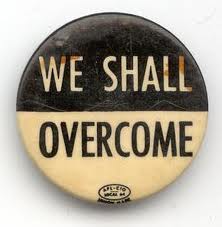
The Civil Rights anthem "We Shall Overcome" was first popularized at the Highlander Folk School.

Surprise!

A French tarot card


I have a tendency to believe in chance over direct and linear divine intervention. Maybe they are different ways of talking about the same thing.

But just last night I was bemoaning to Bruce how we have ended up where we are socially and politically today, and how I can’t believe that we could arrive at this situation after the sixties, the seventies, and even the eighties and nineties. So much for progress (though I have to admit I was always suspicious of that idea). I wondered aloud if the 9/11 terrorists have, after all, succeeded in their goal in destroying any semblance of shared values in this country and of emboldening the devil of hate.

Bruce and I were talking about the letter sent by Governor Rick Scott to university officials all over the state of Florida requesting—no, demanding—certain “information” about various courses of study. On the surface, like so many things, it looks not unreasonable. But there are two things disturbing about it: first, most departments and other units at state universities have never had a budget or staff to collect this kind of extensive data, which Scott demanded in one month. More disturbing is the fact that Scott’s letter doesn’t just make it clear what he intends; rather, he has assumed that we will all fall in line with his intention, and the mission he intends to force is that of vocational training for our students. I have nothing against job-production, and higher education is key in that effort, but to define it as the main or only mission for universities is scary. And changing the game on faculty and administrators everywhere without even saying that’s what you are doing—just slipping it in—is downright imperialist.

Another one of my tendencies is to careen downhill like a snowball collecting snow. Last night, the horrors of being an educator in Florida these days picked up my more personal dissatisfactions with my work and employment situation. At one point I said to Bruce these exact words: “I never imagined my life would turn out like this.” (I know, big violin.)

In the wee hours of the morning, when my insomnia becomes the provider of quiet reading time, I was therefore extra delighted to find this passage in Pascal Bruckner’s Perpetual Euphoria, which I’m also delighted to still be reading. Unlike so many books about happiness that I read, and so many of the books published now in the U.S., it is actually taking me days and days to read instead of a few hours. It has substance and breadth. I thought I would wait to mention it again until I was finished, but this coincidence (or divine intervention—take your pick) was just too good to pass up.

And chance goes beyond the juxtaposition of last night’s conversation with this morning’s reading. I discovered this book by sheer chance, not by some plan of information-gathering related to the subject of this blog (though I have been doing that). No, I was working on another project, a proposed textbook, and was thinking about Paul Auster in relation to a discussion of memory and memoir. When I looked at my decades-old lesson plans about Auster, I found a quote from the introduction to The Invention of Solitude that I had copied out. It was by Pascal Bruckner, and I wondered who the heck he was since the name was unfamiliar and he’s definitely not one of the literary creative writing insiders in the U.S. So I looked him up, and as chance has it, his book on happiness was just translated and published in English earlier this year. That’s what we call serendipity.

Lost illusions: since the Romantic period, they have been frequently contrasted with the heroic dreams of youth. Life is supposed to follow an inevitable itinerary from hope to disenchantment, a perpetual entropy. However, it is possible to oppose to this commonplace of dashed hopes another model: that of the blessed surprise, illusions rediscovered. The world of dreams, contrary to what is usually said, is poor and mean, whereas reality, as soon as we begin to explore it, virtually suffocates us with its abundance and diversity. “I call spiritual intoxication,” said Ruysbroek, a Flemish mystic of the Renaissance, “the state in which pleasure transcends the possibilities desire had envisaged.” To the principle of anteriority, which judges life in relation to a program, we must oppose the principle of exteriority: the world infinitely surpasses my ideas and expectations, and we have to get beyond them to begin loving it. It is not the world that is disappointing, it is the chimeras that shackle our minds. Answered prayers are dreary: there is something very profound in the wisdom that warns us never to find what we are seeking. “Preserve me from what I want,” keep me from living in the Golden Age, the garden of wishes fulfilled.

There is nothing sadder than a future that resembles what we had imagined. We are disappointed when our wishes coincide with what we are experiencing, whereas it is especially moving to see our expectations diverted by particular incidents. (The literature of happiness is usually a disabused literature: hopes have either been betrayed or, more disturbingly, fulfilled, and desire satisfied, that is, killed.) Pleasure arises more from a project repeatedly thwarted and turned in a different direction than from a realized desire. While boredom is always associated with equilibrium, joyous overflow occurs when the imagination has to yield to the greater marvels of the real: “I had to choose between the hammer and the bell; what I remember now is mainly the sound they made” (Victor Segalen). Every inspiring life is both an achievement and a defeat, that is, a marvelous disappointment when what happens is not what one desired, and one becomes sensitive to everything that makes life opulent, fervent, and captious. The defeat of an illusion always opens the door to miracles.

Americans Who Tell the Truth

Shetterly's portrait of Janice Murikitani, community activist and poet

“Americans Who Tell the Truth” is a portrait project by the painter Robert Shetterly. He’s moved from more famous truth-tellers to more recent and less well known ones, but all the portraits share a moving intensity and clarity. The website is fascinating to peruse, with reproductions of the portraits, quotes from each subject, and biographies that summarize their background and reasons for their inclusion in the exhibit.

Shetterly notes, “A democracy, whose leaders and media do not try to tell the people the truth, is a democracy in name only. If the consent of voters is gained through fear and lies, America is neither good nor great. Nor is it America.” His website adds, “Whether or not you agree with a particular subject’s point of view, each is an attempt to create dialogue that will help us figure out which truths we value most as citizens in a democracy.”

To Politic or Not to Politic

Photo by Daniel Schwen via Wikimedia Commons.

That is the question. Truly, I am not much good at it.

On Monday I made a rather veiled post because I couldn’t yet deal directly with my Sunday. Even now my mind reels with a bunch of different things that came up and that I thought in response to the situation. The situation was this: on Sunday, I spent two hours on an airplane being attacked by three men for my politics. Trust me, I didn’t start it, but the only way for me to survive the conversation was… well, to persevere.

The least active of these men was an airplane pilot (flying for free as a perk of his job, I might add). He immediately launched a speech about how he home-schools his children because the public schools in Florida are questionable, but how he moved here because it was an inexpensive place to raise his family. Go figure. He promptly turned over and pretended to sleep, but then later woke up and told us what the “facts” are.

Between me and the pilot was a divorced businessman with two engineering degrees and an MBA who brow-beat me throughout the flight, frequently citing statistics I know aren’t true and for which he had no source, telling me that numbers are all we have, and frequently returning to the “fact” that money is everything that’s important. (Not to Jebus! I wanted to say.) He started the conversation by telling me that he disagreed with home schooling and whispering into my ear about his disrespect for the pilot; his only child attends a prestigious private school, and he relocated in order be close to whatever school his son wanted to attend. I tried to fight the good fight.

All the while I was getting glares from the beefy redneck in a green sports-logo shirt in the row in front of us. It became clear that were there not a seat and several people between us, he would have physically attacked me. Instead he waited until the end of the flight to yell at me about how he’d had to listen to me all through the flight, that I was a “damn typical liberal thinker.” I tried to tell him that it wasn’t me who started the conversation, but I couldn’t get a word in. Steam was practically coming out of his ears. It occurred to me that what I should tell him was that he really, really shouldn’t wear that shiny color of green, that it really made his red face look as though it would explode. Not at all flattering.

But, seriously, it’s no fun to be attacked. And it’s disturbing to live in a world where some people not only disagree with you, but truly believe that you have no right to exist and would kill you if they could get away with it.

This is one of the huge differences between the left and the right, at least so I tell myself. I believe these men have a right to exist. They manipulate through one dodge after another, they claim authority and superiority, they believe their bad luck is someone else’s fault but that they deserve and have earned every bit of good luck that has come their way. It makes me insane, but I try to acknowledge their right to exist. I may despair of them, and I may be outraged by them, and I may even plot about things that could change their minds. But I do not wish to wipe them off the face of the earth the way they wish it so on me.

There was nothing I could say, though, and there never will be. In their minds I don’t have a right to exist and my difference of opinion is not something to be queried or examined, just something to be derided.

I know it’s nothing new to anyone, but it still makes me sad that we have become a nation where people can’t hear each other and where the arguments have become so irrational that it’s impossible to get through. There almost seems to be no such thing as the “facts” as spin doctors massage numbers and statisticians twist results this way and that. I kept trying to tell the businessman that his facts didn’t sound much like my facts, but he was unwilling to consider anything other than that my facts were wrong.

This man had a veneer of education and politeness. But our conversation on healthcare soon demonstrated how in danger I really was near him. First, he brought healthcare up. As soon, however, as it became clear that I know a thing or two about healthcare, he told me that I was changing the subject from the economy to healthcare. Second, when I told him that the U.S. is the only developed nation in the world that doesn’t have some kind of government-sponsored health care and that my husband, a Canadian, is typically devoted to government-backed healthcare, he said that he knew some Canadians that had fled to the U.S. for healthcare. I told him that I suspected he was reporting from what the right says, not from personal experience, and that even if a few grow disaffected (no system is perfect and Canada has its share of right-wingers) the majority of Canadians are devoted. But when I tried to tell him that I know several individuals who have had terrible times due to lack of basic healthcare here in the U.S., he said dismissively that individual stories mean nothing.

When the individual stories are his, when the statistics support his argument, then they are valid; otherwise, they aren’t. And he doesn’t quibble about the particular truths. Instead he claims that each method of my argument is bad even though he’s just attempted the same method.

Shudder. But it got even worse. “Look, he told me, we all want people to have a roof over their heads, to have enough to eat, and to be taken care of when they’re ill.” He acted all socially concerned. But when I asked him how that was to be if we didn’t have government-mandated healthcare, he refused to answer. Instead, he leapt on exemptions. He clearly knew nothing specific about this, but he said that Congress should have the plan everyone had to have. I said that maybe we had found a point of agreement, but that Congress had pursued a plan that has a lot of unevenness instead of universal socialized medicine run by the state. The latter, I said, would never pass because of people like him. So the private profit industry remains, for better or worse. “So you’d rather have a universal system?” I asked him.

You’d have thought I put his hand to the stove burner. “Just don’t ever ask me to pay for someone else’s healthcare,” he spat out, showing his first sign of agitation.

“So, you’re one of those debate audience types,” I asked, “who would vote just to let the injured or ill die if they don’t have private insurance?”

He couldn’t bring himself to say that. He said everyone should receive care. “How?” I said. “Do you mean that charities should cover it or what?”

“Healthcare is not a right,” he said.

“To you it’s not,” I said. “To me, it should be. To most of the governments in the developed world it is a right.”

“It’s not!” he said. “Those people have made bad choices. Don’t hold those places up as examples.”

“So you would just let those people die?” I asked. “By the way,” I said, “the U.S. has the highest per capita expenditure on healthcare and we have a terrible record on life span.”

“It’s not a right,” he said.

“If it’s not a right,” I said, “then you mean you would just let people die?”

It could have gone on this way for ever. I really wanted to let go, to stop it, but I just felt that would seem like defeat, and I wasn’t willing to be defeated.

Thank Jebus for the landing of planes. After that I only had to deal with the redneck guy accusing me of being selfish because I temporarily moved forward to get my fragile bag out of the overhead bin where I’d been forced to locate it several seats away from mine after all the gentlemen had shoved me aside to grab up all the nearby space.

This is crazy and incoherent. Sorry. It hasn’t been long enough. It replays like a bad dream. Others wisely tell me not to talk with these people. But it saddens me to live in this world, split.

Diving into the Wreck


I’ve done it again, by accident this time. I’ve dived into the wreck of our time. It’s cast me back to my first discovery of the disaster of embedded sexism (and by association racism), and of Adrienne Rich’s wonderful poem “Diving into the Wreck.” That poem and the collection of poems named after it, which I discovered so many years ago, is still more than relevant and is much needed today, when we are still so often submerged in “myths/in which/our names do not appear.” It always amazes me that these angry white men can go on and on about “entitlements” when what they’re so angry about is the loss of their “birthright” of male, white dominance. Thank goodness some men have grown up and gotten on with it. And thank goodness that women like Adrienne Rich showed that “We are, I am, you are/by cowardice or courage/the one who find our way/back to this scene.” We are the one.

The Revealing Weirdness That Is Facebook

Occupy Wall Street protest, by David Shankbone.

Sometimes the most innocent of comments can activate the wildest responses on Facebook. Yesterday one of my friends, a fellow traveler in academia, posted a harmless, humorous comment about a student of his who had sent the “best excuse ever” for missing class: s/he was in jail in New York after being arrested at the Occupy Wall Street protests.

Now, there are many ways of responding. A couple of people voted in favor of this student’s activism. But one wily and experienced fellow college teacher posted a cagey comment about how his excuse of being at a previous era’s protest had fallen on deaf ears all those many years ago. He pointedly didn’t say whether he’d actually been there or not. It was entirely possible to question a) whether this is indeed a good excuse for missing class, b) what such a student’s motivations might be for heading into protest—care about the issues or general rabblerousing, or c) whether or not the student was actually at the protest in New York or just faking an excuse. Us wily and experienced teacher types have seen it all.

But there was a thread of discussion that became disturbing. My friend who originally posted said they kept the hate up all evening. It eventually became so disturbing that he sent a note of apology and took the whole thread down. So there’s a good bit of it I haven’t seen. What I did see was four posts that took a dive away from known reality so far as to give me chills.

The first of these responders, someone I happen to also know slightly, noted that she wondered what would happen if this student spent as much time and energy on work as opposed to protests. She asserted that if so the student would have a good work life. I was shocked and horrified, as this was a person who once aspired to graduate work and qualifications for college teaching. Fortunately, she didn’t go that route, as I see from this one comment that she would be making a lot of negative and false assumptions about students under her purview.

There quickly followed three more nasty remarks by people I don’t know and never heard of. One of them responded sarcastically that this student “must be Greek,” showing at least a sense of humor if not particular knowledge of the dire economic situation in Greece. The other two posted long diatribes against these “whiny” people—one made nasty assumptions about someone able to afford to fly to New York and stay in an expensive city while protesting bad economics; the other claimed that these people don’t know what work is, have never contributed to their country, and live with their parents as free-loaders.

My jaw dropped. I posted two short comments—one about my support for the practice of protests and the association between a society where no one can afford to protest and a state of slavery, and the other about the fact that these folks were jumping to huge conclusions about someone they don’t know anything about.

I’m sorry I missed the rest of the thread, even though I surmise from my friend’s apology to me that they probably dragged me over the coals. I don’t care. Someone has to honestly point out that these people are reacting to something entirely off-camera. My friend never told us more than that he had a student who claimed to be at the Occupy Wall Street protest.

He did not tell us (and probably doesn’t know himself at this point) whether that student has a job, works hard at his or her job, was properly rewarded for working hard or worked hard for nothing, flew to New York or hitched a ride with someone else, stayed in a hotel or camped on some cockroach crawly floor in some cheapo Brooklyn apartment of a friend, has a lot of money or made economic sacrifices to go, knows what work is (i.e., has worked in whatever jobs this person would define as real work), is a veteran of the Iraq war or not, has contributed to a family’s failing income and lives at home, lives independently alone or with roommates… or anything else about this person.

It is truly astounding that people would read all that into someone’s mere presence at a protest. They unfolded one factoid into an array of negative (and probably false) stereotypes. It is the kind of over-generalized thinking promoted by the right-wing media and websites. It is a pre-programmed response not based on reality at all.

I can’t speak for the student that my friend mentioned on Facebook, and I can’t speak for all the protestors, or even for every plank of their cause. What I can say is that the small handful of people I am acquainted with who have participated in the Occupy Wall Street protests are some of the smartest, hardest-working former students I’ve ever had, students who pulled themselves up by applying to and getting in and working like mad at superior graduate schools in New York City. They are the former students who were ideal in both their work ethics and their concern for social justice. They know exactly what work is, whether it is for a wage or for the benefit of art or the understanding of other people. They excelled in every way in school and didn’t let their modest beginnings thwart them. They contribute their brilliance and their labor to our country every day, and they are fighting to make sure that their contributions to this country won’t stop at minimum-wage mindless jobs at McDonalds.

But as my mother used to say, “Information cannot argue with a closed mind.” It is hard to know what to do when so many minds are so slammed shut. Knock, knock, we say. But we don’t even get a “Who’s there?” Just violent, fearful, misplaced sputtering.

Motivations

Last Thursday, I cross-posted my tenure-related musing on Daily Kos. It has since been picked up by the new blog of the American Association of University Professors (AAUP), Academe. There has been a lot of great discussion, here on joyouscrybaby and already on Daily Kos.

All writers want readers, right?

It is great to enter the realm of public debate, but I have to admit that I also find it a little terrifying. I recently said to my husband, “What was I thinking becoming a writer? The entire premise of being a writer is that you want to be famous. I am so not a fame-hound.” It is not that way with doctors and lawyers and graphic designers and so forth. Some gain notoriety, but it isn’t the point of their work. It really shouldn’t be the point of a writer’s work either, but often it seems that it becomes that way. I have been struggling with this issue as I pass mid-life not famous. I haven’t stopped writing, but how do I value my own work under these circumstances? My blog has been partly about exploring what I care about more than lines on my c.v.

In addition, one of those who commented on Thursday’s blog eventually accused me of greed because I make somewhat more than the median annual salary in the U.S. It’s a ludicrous accusation, but I’ve been thinking a lot about my motivations in the past week.

So it was with eagerness that I watched this 10-minute video called “The Surprising Truth About What Motivates Us” that a person posted in response to the blog post on Daily Kos. It’s an animation based on a speech by Daniel Pink, a bestselling author on the subject of work, and is part of a project of Britain’s RSA (the Royal Society of Arts, Manufactures and Commerce). Take the time to watch–it’s cool. Academia has operated (as least ideally) for a long time on the principles that Pink notes. It’s too bad that these ideas are catching on in the private sector at a time when they are under attack in university life.

Florida Governor Rick Scott Takes Aim at Tenure

Margaret Haley, an early supporter of rights for female teachers, including decent pay and job security.


I am a tenured associate professor at one of the largest (though, let me emphasize, not one of the highest ranked) public universities in the U.S. How can I explain why it is that this often makes me want to cry?

Don’t get me wrong. I love my work, and, although I am not an academic superstar, I’ve done reasonably well. In economic times when so many are losing jobs, my job is relatively secure. The work that I do has pleasant and meaningful aspects that I value, in spite of sometimes snake-pit politics and bureaucratic burdens that often make it very difficult to focus on the things that are actually my job.

However, the future of public higher education, and especially in my area of the humanities, is truly in question. Even though more than half of all Americans attend at least some college courses, and 30% over age 25 have a bachelor’s or higher degree, what we do in academia and the value of it is still largely misunderstood by the public. When the governor of the state of Texas can blithely call for higher education reforms that include “treating students as ‘customers,’ judging faculty by how many students they teach and how those students rate them, and de-emphasizing research that doesn’t produce an immediate financial return,” it becomes clear that our future is in the hands of people who either don’t know what they are talking about or harbor a truly vile and anti-intellectual agenda. Or both.

There are many angles on higher ed and its issues, and I hope to be able to sort some of these out in the blog in coming posts. But today I am inspired by yesterday’s article in the Orlando Sentinel that reported on Florida Governor Rick Scott’s agenda for the coming year, in particular his desire to abolish tenure for public university employees. (He’s already done it in K-12 education.)

Tenure is often resented by people outside the college and university system–because they don’t have it, after all, and therefore it’s unfair that anyone does. The largest complaint about tenure by the general public seems to be that it protects lazy and low-quality teachers. The laziness issue I will have to give its own separate post because it is one of the most offensive and false of all these claims. But part of that is the idea that tenure keeps in place bad employees.

This is an absurd claim on many levels. First, to become a tenured professor at any college or university requires years of investment. At numerous points along the way, those who are bad at what they do are drummed out of the system: they can fail to get into a graduate program; they can fail courses, which, unlike in undergrad programs, gets them booted in fairly short order; they can fail to complete language and other degree requirements; they can fail to finish or defend successfully their thesis or dissertation work; they can fail to get a tenure-track job or any job at all; they can work temporary jobs for a number of years, moving from place to place; and they can fail, after six years at a tenure-track job, to get tenure. If the system has not identified and excluded the poor quality work by this point, then something else is wrong with the system, not tenure.

In addition, the public perception of tenure is that it’s virtually impossible to be fired if you have it. That is simply not true. If a university has cause to fire a tenured person, then the university can do so. If a faculty member doesn’t show up for classes or turn in grades, if he or she behaves in unacceptable or unprofessional ways, if a faculty member violates ethics codes–or for numerous other reasons–a faculty member may certainly still be fired. Granted, it’s harder to fire a tenured as opposed to an untenured faculty member and requires a long process of documentation rather than an arbitrary decision by an administrator. Granted, it doesn’t happen very often. But maybe this has more to do with the fact that most tenured professors have already run the gauntlet mentioned above and have spent at least 9 to12 years on probation (in grad school and earning tenure) before becoming tenured than with the fact that it’s too easy for them.

There are many other reasons why tenure is important to the healthy functioning of colleges and universities, but I’m only going to mention one other here today—and that is the traditionally cited protection of faculty with unpopular or controversial ideas, aka academic freedom. Tenure was designed to protect faculty from arbitrary complaints by parents, students, and administrators who otherwise might paralyze their teaching and life-choice options. It’s only been around for about 100 years, and, I might add, it’s the 100 years when someone other than white men of a certain conservative bent could reach for the intellectual life. It prevented, among other things, administrators from firing female faculty members who married or got pregnant.

Many in the right wing these days claim that tenure, however, rather than protecting a diversity of ideas and opinions, now is a screen behind which liberal prerogative is preserved. From what I can see in the articles I’ve read, they don’t cite any real evidence for this except that professors are notoriously liberal. How it is that tenure produces this supposed effect, I’ve no idea, but it is certainly true that tenure prevents conservative politicians from exerting pressure on university administrators to just fire professors whose politics the politicians don’t like. And this is exactly why we need tenure right now.

I feel certain that if some radical right politicians have their way, and if they manage to make arbitrary, without-cause firing of faculty possible, they will create an atmosphere in which faculty will become fearful to speak their minds honestly and in which they will be punished if they rise above their fear.

Frequently, these men who speak out against tenure (they’re usually men) have spent some time in academia themselves, but have since moved on to business or conservative think-tanks for their employment. I don’t have access to the details of these changes in their lives, of course, but one of two things seems to have happened: either a) they didn’t get tenure and were thus excluded from further academic life, or b) they decided that the benefits of an academic career were not enough to offset the relatively low pay-scale and demands of the work. Either way, they are out for the blood of those who have made different choices and had different successes than they have had. Their goal is complete eradication of protections of any sort for faculty and the imposition of non-academic standards for academic work.

If I’m being alarmist, and the goal in abolishing tenure is not to clean house based on a political agenda, then the fact is that abolishing it would likely have very little effect at all. Perhaps some increased costs as faculty constantly seek to move to better positions and universities take on increased supervision, expanded evaluation tasks even for long-term faculty, and constant interviewing for new faculty. Mostly, though, we would keep doing what we do.

However, my fear is acute. It’s bad enough as it is right now. Much university funding already comes from private sources and cooperative efforts with private businesses abound. As it is, that’s often a mutually beneficial thing. But if these people get their way, public higher education will become even more a servant of private business interests, not designed for the public good.

People, private industry has one goal: profit. It and its CEOs do not have your best interest at heart. That is one reason why running universities like businesses is a bad idea.

Your Flag Decal Won’t Get You into Heaven Anymore


This week’s last anti-war song is by one of my old favorites, John Prine—it’s about flags as “Makeshift Patriot” is about flags, but from about as different a source as you will find. And this one comes to us from the 1970s, with the implicit question attached of why humans never seem to learn about war.

This is also a funny song. I’ve been self-conscious lately about my earnestness, how obnoxious it can be. Granted, the week of 9/11 is not the time to throw caution to the wind and try to be funny. But humor does return, as reported by both Studio 360 and WYNC. There is a strong relationship between tragedy and comedy. Even Freud knew that jokes are serious business. Ha ha.

Makeshift Patriot

I generally have more sympathy for journalists than this Sage Francis song shows, and I mourn the current shrinkage of quality reporting in the world, but I do recall my own shock at the news coverage vitriol in the weeks and months after 9/11. Sometimes I would remark upon what I considered the inappropriate words used by journalists and the way that they failed to question the simplistic (and as it turns out false) rhetoric of George Bush and his minions. I was reminded of Toni Morrison’s words in her 1993 Nobel Prize acceptance speech: “[T]ongue-suicide … is common among the infantile heads of state and power merchants whose evacuated language leaves them with no access to what is left of their human instincts, for they speak only to those who obey, or in order to force obedience.”

“The systematic looting of language,” she goes on, “can be recognized by the tendency of its users to forgo its nuanced, complex, mid-wifery properties, replacing them with menace and subjugation.” This kind of language, she notes, “does more than represent violence; it is violence.”

Let us watch out for that, always. It is something we can do in our daily lives: listen and stop ourselves when we are caught up in “the language that drinks blood, laps vulnerabilities, tucks its fascist boots under crinolines of respectability and patriotism as it moves relentlessly toward the bottom line and the bottomed-out mind.”

P.S. My use of this version of the Sage Francis song video does not represent support for the 911debunkers blog.