Category Archives: Politics & Current Events

T. S. Eliot’s “The Waste Land” and My Garden

Posted on

The glories of spicy jatropha contrast with T. S. Eliot's cruelest April.

I’ve had cause the past days and weeks to think a lot about life and death and resurrection. My little old cat marshals on, happy at the same time that she is not perfectly healthy. It’s been a lot of work getting her through her recent crisis, and we don’t know whether she has lymphoma, which will kill her in a matter of weeks, or inflammatory bowel disease, with which she could live on for quite some time. All we can know right now is that for the time being she jumps up on my lap for a cuddle and she rolls around on the patio bricks in the sunshine.

Early spring sunshine in Florida is incomparable. This is the time of year to be here.

With the help of a couple of wonderful gardeners last week, Bruce and I also finally took steps to make the yard beautiful—we replaced the dead grass in the front with shade-loving camellias, crepe myrtle, impatiens, and lorapetalum. We (or rather Lois and Allan) ripped out and relocated (some of) the overgrown ligustrum, put an herb garden in the side yard, and filled in our formerly sunken area by the patio with a butterfly- and hummingbird-friendly rim of firebushes, spicy jatropha (seen above), plumbago, shrimp plants, and tea olives. The confederate jasmine I planted last year is in full, fragrant bloom, and the gardenia that Pat gave us for our wedding three years ago is budding. I have been reveling in it.

And so it is that I was reminded of T. S. Eliot’s most famous line, “April is the cruelest month.” I think that April has this reputation for cruelty for many reasons. I used to always think about it during Pennsylvania Aprils—the alternation of snow and new green plants trying to poke through the muddy ground, the ice that would so often fall from the sky and kill those new green shoots—those were cruel weather days indeed, and days that could easily remind a person of the vicissitudes and unpredictability and fragility of life.

Here in Florida, we don’t really have that kind of cruelty, though, of course, we have the threat of hurricanes half the year (and their occasional massive actual destruction), and we have the suffocating heat and humidity all summer long that create our own upside-down indoor season. The way the flowers blossom so riotously all year round, however, often gives us the delusion down here that life is never-ending.

But we have to remember that the resurrection that so many celebrate at Easter entails death. A former student sent me a message asking if I would like to adopt a stray cat she found. The answer is “not right now,” but the timing points out to me that eventually my old kitties will all be gone, and they will make way for new kitties. The same is true of all of us, even for the Nobel Prize winners such as Eliot, and lately I have been experiencing this fact more concretely than usual. Not because I’m near death, but because I have been enjoying life so much and letting go of my desire to be immortal.

So much of our usual human endeavor (but perhaps especially if we are writers, artists, or intellectuals of some kind) is an attempt to be immortal. This comes in different forms, from having children to making ourselves important or indispensable at work somehow. Sometimes it comes in the form of grasping for fame or notoriety. Sometimes people even see beyond the surface fame to a desire to create something lasting in the way of art. Sometimes we have a desire to change things beyond ourselves, to have a positive effect on a culture that seems unhinged. These efforts sometimes result in good work, and I don’t mean to castigate anyone for making them. Certainly I haven’t entirely stopped myself. I’m just in a different place, at least mentally, right now.

I am finding it enough just to be. I know, cluck, cluck, this should be too simple.

Last night I heard Cameo the cat chirping and mewling low in the dining room. At first I thought this was a symptom—she might be in pain or distress of some sort or about to throw up—and I leapt up to go see what was wrong, as I have so many times in the past few weeks. But as I stood, she came running into the living room and put a small dark object on the rug in front of me. I bent down and poked it, the largest dead spider I had seen in years.

Cameo the cat had been hunting. I couldn’t believe it. She’s never been a big hunter to begin with, and I certainly wouldn’t expect it in her current state of health. But she had made the most of some accidental opportunity, and she’d brought me the proverbial cat gift. I praised her and petted her and apologized for taking the spider away (I certainly didn’t want her to eat it).

I feel silly and trivial for the small, domestic frame of my life these days. I feel retrograde and haus frau–like. Yet it is not that I have forgotten about the larger world or the social, political, and intellectual issues of our day. In fact, when I got out Eliot’s famous poem because of its first line, one of the things that struck me was how prophetic it is. If Eliot thought that the first decades of the twentieth century were fragmented and confusing and grim and showing signs of cultural decline, what would he think of the first decades of the twenty-first century?

What would he think of the strength of our anti-intellectualism, the put-downs of the “reality-based community” that Bruce mentioned in his guest post last week? What would he think of the dominance of the short-short form of fiction and nonfiction (which I adore like everyone else), or the impatience with reading that even writers show so often (which I despair of)? What would he make of the fact that, though I love poetry, I hesitated before taking the time to read his entire long, allusion-filled, complex, five-part poem?

I paused, but I then took the time to read it. Then I listened to it on a compilation of YouTube videos (all of these feature T. S. Eliot reading, except part IV, which is the voice of Ted Hughes). And I don’t mean to blame anyone else who doesn’t take the time. I’m on sabbatical, after all, and taking the time is what it’s for. But even a short dip into listening is a good thing.

I. The Burial of the Dead (with the overall epigram) 5:07 minutes
II. A Game of Chess 5:29 minutes
III. The Fire Sermon 8:05 minutes
IV. Death by Water (read by Ted Hughes) 48 seconds
V. What the Thunder Said 6:30 minutes

Art, I believe, takes time, and that has to be okay. I wish it were as easy to make that claim for politics—that it could get beyond the sound-bite, beyond the knee-jerk, beyond the name-calling, beyond the superficial answers that answer nothing. However, the mass scale of politics is a challenge to any slow unfurling or contemplation. Would that it were not so and that “The Waste Land” were not indeed still so relevant. Would that the call to peace in its last line were more optimistic and less wishful thinking.

Eliot’s poem builds to that end with a reference to Dante’s Arnaut—“I … who weep and go singing; contrite I see my past folly, and joyful I see before me the day I hope for.” Though interpretations of Eliot’s poem vary widely in terms of the lack or presence of hope, I believe it leaves us with the inevitability of both. A grim outlook does not disavow hope. And at least sometimes the greatest activity can be disguised by a quiet and self-contained demeanor, the greatest complexity in paying attention to the smallest things.

In other words, spring will happen with all its implications. I like feeling my eyes open to it as well as my mind. I like hearing T. S. Eliot’s nasal and weary voice—and Ted Hughes’s more gravelly and pleasant one—marching out the syllables. I like observing how unflawed their delivery is—how neither ever trips over a word. You can tell that they have spent a lot of time memorizing and reciting poems. They did that instead of playing Scrabble on the iPhone, no doubt.

Ah, these choices about how we spend our short time.

Faking Authenticity

Posted on

German philosopher Theodor W. Adorno, by Leandro Gonzalez de Leon.

In my continuing effort to bring a variety of voices to this blog, I give you another guest post, this one a philosophical contemplation about “authenticity.” This post dovetails nicely with the one I did a couple of weeks ago on “Devious Discretion.” Bruce always makes sure I take a more careful look at things than I ordinarily might. That’s one of the reasons I married him.

–L

* * *

Faking Authenticity

by Bruce B. Janz

The raison d’etre oft this blog is not just to chronicle the ways that we cry, title notwithstanding. The point is to think about genuine emotion in an ersatz world. Put more succinctly, the point is authenticity.

Now, this is an idea that’s come under a lot of scrutiny. Put simply, a lot of people aren’t sure that such a thing is possible. Others aren’t sure it’s desirable. And still others aren’t sure that we’d even be able to know it if we saw it. It seems like an idea from a different time, one where we had a clear sense of what was real and what wasn’t, and the ability to have faith that some things are true and others aren’t.

I guess the slide started in philosophy. Theodor Adorno wrote The Jargon of Authenticity, a critical work on the philosophy of existentialists like Martin Buber, Martin Heidegger, Karl Jaspers, and others (and, for you philosophical purists, I’m aware that it’s debatable that any of those figures can be called existentialists). Adorno was a critical theorist, steeped in Western Marxist thought, and he was troubled by any philosophy that would short-circuit the search for the social causes of problems. He thought that the term was used to abstract away from the material conditions of the world, and make us think that the solution to our problems came from introspection. To be “authentic”, after all, meant to be true to yourself, and a psychological interpretation of that might suggest that you just have to look inside (or, appeal to a higher power), to figure out who that self was, and you could then be true to it. Any thought that you are the product of your world was lost with this talk.

That took hold, for a lot of people. Culturally, you can see both of these trends side by side. We are regularly encouraged to know ourselves, to unleash the true self within, to put ourselves in situations that will show our real selves. We look for the windows into our souls. Emotion is, in fact, a major candidate for such a window. Intellect is suspect, but your feelings won’t lead you wrong. Just get in touch with those, and you’ll know who you are.

At the same time, in philosophy and elsewhere in culture, there’s also suspicion about this real, true “self”. Adorno’s skepticism took hold, or maybe it was his sense that our problems needed something more than that old version of authenticity, the search for the true self that ignored our material and social world. He was not an old-style Marxist who thought that all we had to do was come to class consciousness by understanding our material alienation, and all would be well. Like the other critical theorists, he recognized that a great deal of our alienation came symbolically and culturally. He and the other critical theorists wanted to account for the problem of Nazi Germany, specifically, the question of why people who had clearly been under great economic stress since WWI, but who also had great art and culture during that time, could have turned to Hitler as an answer to their problems. Hitler offered authenticity – Blut und Boden, blood and soil, that captured the imagination and gave Germans a birthright in a place. The trouble was, this was all a sham, and authenticity just got manipulated, to disastrous ends. Adorno and the others saw that propaganda and culture had been used effectively to create a compelling but false version of reality. Authenticity, it turned out, could be faked.

Fast forward to our time. It’s not the same time as Adorno’s. At the end of the day, in Adorno’s time, there was still a sense that there was a truth at the bottom of everything. Propaganda disguised, distorted, misdirected, and inverted reality, but there was still a reality to do all that to. And then, The Left® invented postmodernism, or so the story goes. According to most of the world, this was the view that there is no reality, everything is just what you want it to be, everything was therefore relative, and so there could be no such thing as authenticity. Never mind that that depiction has little to do with what postmodernism actually is (or was), it was the version that caught the public imagination.

Now, The Right® was initially horrified at this. To the extent that The Right® was identified with conservatism (and, that is an equation that is debatable), there was a sense that the true authentic person was exactly the thing that was to be conserved. The “traditional family” was the location of that authentic person. The authentic person had character attributes stemming from inside of him/her. The authentic person was guided by a higher hand and holy rules. The authentic person was truly free, and that person’s interactions, in the form of market activity, formed the basis of all our social institutions, our prosperity, and all that is good about the world.

And then something interesting happened. The Right® realized that postmodernism might actually be useful. Ron Suskind reported, during the Bush presidency, the quintessential statement of this view:

The aide said that guys like me were “in what we call the reality-based community,” which he defined as people who “believe that solutions emerge from your judicious study of discernible reality.” … “That’s not the way the world really works anymore,” he continued. “We’re an empire now, and when we act, we create our own reality. And while you’re studying that reality—judiciously, as you will—we’ll act again, creating other new realities, which you can study too, and that’s how things will sort out. We’re history’s actors…and you, all of you, will be left to just study what we do.”

The “guys like me” were The Left®, who had previously been identified with postmodernism, but who were now seen as simply weak-willed. In an almost Nietzschean move, the speaker (later identified as Karl Rove) established that authenticity was a virtue of the weak, not of the strong.

So, whereas Adorno was suspicious of authenticity because he thought it disguised the real causes of people’s alienation from the world, Rove rejected authenticity because it held the empire back from creating its own reality. Adorno thought that authenticity stood in the way of truly making the world a better place, whereas Rove thought that it stood in the way of the empire asserting its power and achieving its goals.

Of course, Rove said that in 2004. And a lot has happened since then. We have a candidate in the Republican primary who latched onto authenticity as a prime virtue (Santorum), and another for whom authenticity seems to be about as deep as an Etch-A-Sketch drawing (Romney). But we also have the Tea Party, the Occupy movement, and the Ron Paul phenomenon, all of which trade in a desire for truth and reality in government (having said that, they differ deeply on what that truth and reality is, and seem differently inclined to taking empirical or scientific evidence seriously). Everyone on The Right® trips over themselves to cater to the most extreme elements of their movement, in hopes of showing their authenticity bona fides. After all, if a little capitalism is good, lots must be better. If a little military activity is good, lots must be better. More = better = truly authentic. It’s what a real Republican has come to mean.

People clearly desire something authentic, in politics, in life, everywhere. We want to know what people “really” think, what the “real” best decision is in shopping, in life, in everything. Whereas once we could tell the difference between reality and artifice or presentation, now we can’t. We can’t even buy a mattress or a piece of clothing anymore, because we can’t know how to compare anything. A lot of people feel like they are free-floating.

So, messages of authenticity are attractive. I wondered, months ago, why Santorum wasn’t doing better than he was. It was clear that he was projecting authenticity, and that he most likely really believed what he was saying. Now he’s in contention, and is the darling of the more=better=authentic crowd. But just like Adorno realized a long time ago, authenticity can be faked. The one doing the faking may even buy his own schtick, but it doesn’t make it true. There are some pretty good clues as to when it’s being faked. If it requires that we privilege some over others, it’s probably fake. If it requires that a particular group be vilified, it’s probably fake. If it means that you can willfully distort the other side, it’s fake. If it means that you can ignore science, create your own science, or pick and choose what science fits your version of the world and what doesn’t, it’s probably fake.

Is there a place for authenticity anymore? I think so, but not as a cover for the real conditions people live in, and not as a political calculation. It has to be something other than that. That impulse people feel, in both the Tea Party and the Occupy movement, there’s something to it. Even though the answers may be problematic (in the Tea Party, almost invariably, and in the Occupy movement, at least sometimes), the inarticulate question of the heart is still there. What’s real? What can enable me to go forward? How can we feel ok about who we are? Do we have to live with this gut-wrenching fear that the future will be a disaster, because of what we are doing today? These are all, in one way or other, questions about authenticity. We just haven’t yet found the way to ask these so that they won’t lead opportunists and ideologues to use them against us.

A prime example of fake authenticity--the posed, costumed cowboy pic complete with ties and suit coats. (Click on the pic for further explanation.) Bruce thinks these guys look a lot like Romney, Paul, Gingrich, and Santorum. That's Mitt, Ron, Newt, and Ricky to you.

Coffee Shop Consequences

Posted on

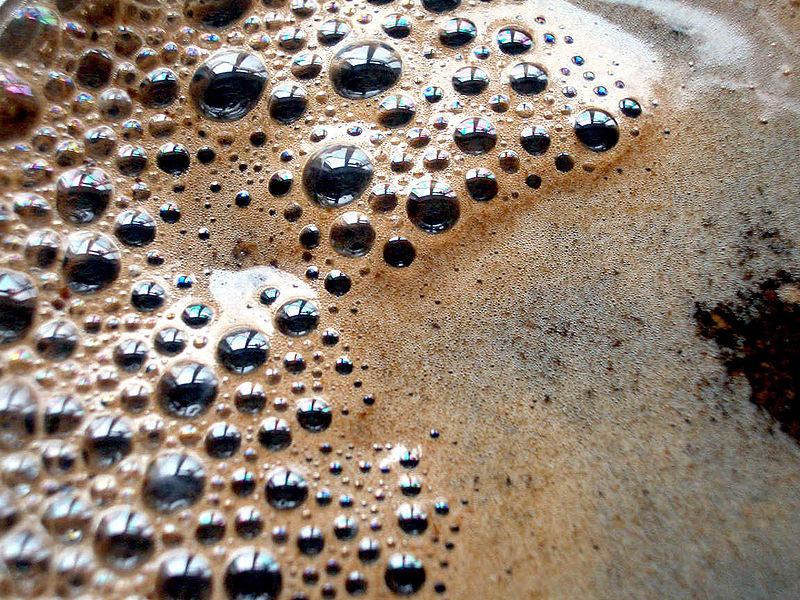
I like my decaf coffee as strong as any caffeine-lover.

I’m about to offend some of you addicts: coffee addicts in particular. I put it this way because what I want to say is that caffeine is a drug, and it’s a drug whose consequences are mightily ignored. I had reason to contemplate this fact yesterday because I went into a coffee shop.

The man behind the counter was about my age—the hair drawn back into a pony tail had grayed, and wrinkles crisscrossed his forehead and cheeks. When I entered through the back door (from the parking lot), he was seated at a large sink washing plates. He looked up sideways at me, but didn’t move. The recognition that passed over his face wasn’t real recognition, just typing. Immediately, I could see he didn’t like me.

Mind you, I had never been in this coffee shop before. I knew of it from my students, who sometimes spoke of its open-mic nights and artsy vibe. The only reason I had stopped there was because it sat directly between the hardware store, where I had gone to buy some plant potting supplies after my haircut appointment, and the hospital medical plaza, where I was due in an hour for an MRI, another MRI.

While I stood waiting, I glanced around the dingy interior. A young man sat behind me at a table, tapping into his laptop, a knit cap pulled down over his head in spite of the 85-degree day. A young couple sat holding hands on one of the sofas in the open area up front, a laptop on the coffee table in front of them, their intensity focused between the three of them. In an upholstered chair, another young man sat with his back to the counter; I couldn’t see his face, but he, too, was young and seemed to be reading, his hair sticking up with gel around his cranium as though very excited about the ideas he encountered. But he slumped in the chair, one leg thrust out as though barely able to hold him up. Bright mid-afternoon light streamed through the front windows, picking up every crumb and smear on the filthy floor. I didn’t mind. I have worked in many a dirty restaurant in the past. All I wanted was a peaceful place to pass half an hour or so, reading the book I’d brought along for this very possibility of a time gap.

Finally, the aging hipster stood up, wiped his hands across his apron and asked me, “What can I get you?”

“A medium decaf latte, with skim if you have it,” I said.

He moved over to the espresso machine. “What size?”

“Medium,” I said. I liked that Austin’s menu board used small, medium, and large instead of the deceptive and silly tall, grande, and venti.

“You said decaf, right?”

“Yes,” I said, and then because the barista response is so predictable, I tried to make light of my request. “You don’t want to see me on caffeine.” I wiggled my fingers in the air.

He did not smile. Sometimes they do and sometimes they don’t. But I was starting to get worried. I mean, I was the brain patient, and my short-term memory seemed better than his.

“What kind of milk do you want? We have whole, half and half, two percent, soy, and skim.”

“Skim is good,” I said.

I tried not to stare as he moved around the space, tamping the coffee and turning the levers, so I looked back out the front window as a kid wheeled off on a bicycle. When I turned back, the guy was putting the whole milk back in the fridge. I decided to let it go.

Then he asked if I wanted whipped cream. A little surprised—since when is whipped cream part of a latte?—I shook my head and said no emphatically. He poured the last of the milk with its top of foam into the cup, then lifted a plastic bottle and squirted Hershey’s chocolate syrup all over the top before I could say a word. Who puts chocolate syrup on a latte? My god, I thought, he must have a lot of those little girl customers to whom coffee drink means sugar drink.

I gave the man my five-dollar bill, then transferred the change into his huge and stuffed tip jar. Briefly I contemplated the ridiculousness of this current coffee fad. We’ve all gotten used to the idea that these large sums are worth it to get exactly what we want in a cup of coffee.

However, I at least seldom get exactly what I want in a cup of coffee at a coffee shop, and I am vowing now to give it up pretty much entirely. If I have to meet someone at a coffee shop, I will order something else. Because I am very tired of baristas giving me caffeinated coffee when I order decaf. And I am tired of the attitude that also sometimes comes with such a request. Still, I would rather have the put-down attitude and get my decaf than have the silent but disobedient person who chuckles as he gives me a drug that my body cannot handle.

One barista even asked me once why I bothered if I was going to have decaf. Usually I am mild in my response—after all, these people have my coffee in their hands—but what I always want to say is, “Can’t you see that the person who orders decaf is the one that really loves coffee? All I want it for is the flavor. You caffeine drinkers are simply using it as a vehicle for your stimulant. Why not just take it in a pill if that’s your motivation for drinking coffee?”

I am a genuine coffee lover. I love the smell of it, I love the taste of it, the darker the better. Unless I drink the occasional latte, I drink it black as I can get it. I seek out French roast or at least Italian when buying it for home use, though it can be hard to find. I virtually never add sugar to it.

Yet, over and over and over and over, these macho little baristas (who are indeed always skinny) turn up their twitchy noses and their stubbled chins at me, and treat me like I’m some sort of inferior being for asking for decaf.

Maybe they find an excuse to treat every mature person this way. I forgive them over and over and over again for being young. I was young once myself, and in my waitressing days, there were numerous times when I would pour a decaf refill from the regular pot. But I only did it in an emergency—when the decaf pot had run dry. True, I didn’t fully understand the importance of the request, but I never sneered. Still, sometimes I tell myself that every time I get a cup of caffeinated coffee it’s just karmic justice. But I’ve paid those dues enough now, and I’m over it. And there’s no excuse for a middle-aged barista acting this way. The coffee world has supposedly opened up in the past decade, and the idea is that there’s a wider variety available and more understanding about coffee.

However, no one wants to hear much about the destructive nature of caffeine or admit it by providing someone a decaf. Smokers love smokers, and caffeine junkies love caffeine junkies. Mind you, I have nothing against caffeine junkies—unlike smokers, their addiction doesn’t waft over into my nostrils. Unlike over-drinkers, they don’t wreck cars and kill people.

Or maybe they do. We’re all familiar with the upside of caffeine consumption—the alertness and fatigue-fighting aspects that seem to apply to both cognition and physical activity. But there are downsides, too. The Mayo Clinic website reports that in addition to the usual side-effects of insomnia, nervousness, restlessness, and irritability, more than 500-600 milligrams of caffeine (about two Starbucks tall coffees) a day can produce stomach problems, fast heartbeat, and muscle tremors. Jack James of the National University of Ireland, Galway, notes (about halfway through this interview) that blood pressure changes from caffeine consumption may be a major factor in cardiovascular disease. A whole host of studies note the bad along with the good in caffeine consumption:

* Good news, bad news
* Fitness benefits and risks
* Be cautious
* Negative may outweigh any positive
* Cognitive impact is mixed

You’ll note that all of these studies rely on an understanding of how much caffeine is consumed, and if you’re curious for yourself, here are some tools for gauging your own intake:

* The Caffeine Database
* Center for Science in the Public Interest caffeine chart
* Starbucks caffeine information

Of course, as with any drug, people’s reactions to caffeine vary enormously based on an individual’s sensitivity. Caffeine is associated with panic attacks, and studies have clearly shown this association, especially for those prone to panic attacks or major depression. But even some in healthy control groups reacted to caffeine with panic attacks or anxiety, whereas none did without caffeine.

And, though not prone to panic attacks or major depression, I’m one of those people who is sensitive to caffeine. Even one cup can make my hands shake and, later, will most assuredly keep me awake all night, no matter how exhausted and strung out I am. This is what happened to me yesterday.

I sat down with my cuppa in Austin’s and opened my book in pleasurable anticipation of my hour of reading. The music blaring from the speakers distracted me a little, but again I felt good-humored about the off-key adenoidal voice, amateurish strumming, and angry-young-man lyrics. “Everyone is interesting but you,” sang the adolescent, who then spat out several expletives. I decided it was the nastiest acoustic music I had ever heard, and it amused me no end that this placid coffee house in one of the wealthiest neighborhoods of Orlando ebbed and flowed with such anger. It went on song after song, and I wondered if the recording featured some local singer, or even the barista himself. It was so bad I had to wonder.

My lack of suitability for this place also flowed over me with the music. I was too old, had no tattoos or body piercings, and was wearing light-colored cotton and sandals. My difference didn’t really matter to me, but soon enough I would think it merited punishment from the coffee tsar. I sat back and turned the pages in my book.

Then my fingers started to feel a little panicky.

Now, an MRI is not an experience to relish. Before yesterday, I’d already had two in the previous 16 months, and I wasn’t really looking forward to another hour in the noise chamber with my head in the tight frame and my eyes shut to prevent claustrophobia, trying to keep my mind busy with thoughts of words, and glasses of wine, and the smell of jasmine on the breeze. So I thought I was just getting nervous about that. Eventually I closed up my book, tossed the cup with its last bit of chocolate syrup and milk foam in the trash, and headed for the hospital, leaving the grunge scene behind.

The MRI was uneventful except inside me. I struggled to hold still as I had never done before. I could feel my fingers and toes wiggle slightly as though they belonged to a different person than me. Half way through, the technician pulled me out of the tube in order to inject me with a contrast dye, and I asked him if I could please please move my hands just a tiny bit.

“As long as you don’t move your head,” he said. It was almost a relief when he pulled my hand over to the side and flexed it back and forth, tied the strip of rubber around my wrist, then slid the needle into the vein above my metacarpals.

During the second set of scans, I found myself holding my breath in order to try to stay still. When I let my breath out, I felt the air rush past my philtrum, tickling me in agonizing fashion. “Be still,” I thought, “and dream of Jean-Dominique Bauby.” It might cause some people panic to think of something like locked-in syndrome when inside an MRI machine, but the experience inevitably makes me think about what I would do if I couldn’t move forever. I try to think about the centrality of my mind to the life I live. I wonder about staying in my mind forever.

Finally, the technician extracted me from the machine. Even after just an hour, I was stiff and took a few minutes to shift around and stand up. I was very happy to get into my regular clothes and walk down the hall and out into the now waning sunshine and to drive home to my dinner.

It wasn’t until midnight that I fully realized the barista had given me caffeinated coffee. In typical fashion, I simply couldn’t unwind and get drowsy. I was tired, exhausted even, from the hour of assaultive noise in the machine and the long day of now-distant work before that. I had watched mind-numbingly dumb TV for two hours, and I expected to sail away into slumber readily. The past three weeks had been some of my best sleep nights in several years. All the work that my husband and I had been doing to help me sleep had been working.

But, no. I tossed, I turned, I played game after game of Scrabble on the iPhone. I turned the phone off and counted backwards from a thousand. I got down to one and started back up, trying to count by threes so some concentration would be required. Bruce sighed and turned over again.

Then it hit me.

“The bastard,” I said out loud.

“Wha?” Bruce roused from his sleep briefly.

“That bastard gave me caffeinated coffee!”

Eventually I got out of bed, took a Tylenol PM, went to the spare bed on the other side of the house so I wouldn’t disturb Bruce any further, cursing the Austin coffee man in one fluid tirade. I felt almost as though I’d been slipped a mickey or doped with rufies.

I gave up caffeine years ago during graduate school because I noticed not only that it kept me from sleeping well, but that it made me irritable and easily annoyed. It made me say things I didn’t mean or that I shouldn’t have said even when I had thought them. Once, at the over-caffeinated end of a long semester, I told a fellow grad student that I hoped I never had another class with her. She’d been characterized by snide asides and had given the most idiotic presentation I’d ever heard in a graduate seminar, but there was no point in me being mean to her. Later, I apologized, but I knew in the immediate aftermath that I had to give up the drug.

All these years later, I wonder if anyone could devise a study that would look into the social cost of caffeine. Sometimes I’m so astounded by the rampant aggression around me—that anger that seems to be bubbling right under the surface so much of the time—that I feel the only rational explanation is that caffeine is making everyone crazy. I think about the Romans and their lead pipes and cooking vessels perhaps being a contributing factor to the downfall of their civilization. While the lead poisoning theory remains unproven and under continuing investigation, I can’t help but think sometimes that I am caught in the midst of a decline in our society that seems to have some chemical basis.

One report in the Washington Times notes that “the rise of coffee parallels the rise of the Internet” and that because of our increasingly connected world and the demands of “economic turmoil in a hypercompetitive global economy,” we “need caffeine… more than ever.” It also notes the increasing concerns about the use of caffeine (usually in the form of soda or energy drinks) in children and adolescents.

What studies show—and, I might add, what just makes sense—is that the combination of this stressful world and the biochemical effects of caffeine is preventing people from getting the sleep they need to be effective and is irritating the heck out of people.

We don’t usually factor in caffeine’s effects when we track causes for auto accidents, though at least one driver recently claimed “caffeine psychosis” for his running over several people. There’s even a growing sense that using a little caffeine to make driving home after drinking a little safer relies on a dangerous myth: drunkenness is simply combined with inappropriate bravado rather than alertness. One trucker comments on Life As a Trucker about “the adverse effects of sleep deprivation and excess intake of caffeine” contributing to road rage. One attorney’s webpage notes that even without alcohol some caffeine-induced symptoms can “dramatically increase the likelihood that a driver will operate his or her vehicle in an aggressive manner or succumb to road rage.”

We don’t factor in caffeine the way we do alcohol and crack when people are arrested for violent crimes. While I agree with the author of this editorial published in the University of South Carolina’s student newspaper—that caffeine intoxication should not usually offer a good insanity defense in criminal cases—the fact that a few people are claiming it indicates that it’s becoming more believable. Most of the cases in which caffeine is correlated with behavioral problems seem to involve the combination of alcohol and caffeine found in some energy drinks and in “monk’s juice.” But in spite of pre-packaged alcoholic energy drinks being banned in 2011 by the FDA, due to numerous college-student deaths and studies that show they break down inhibitions dramatically, the ingredients to make your own are readily available and commonly used. Even energy drinks that don’t contain alcohol are beginning to be linked—in studies and in patterns noted by police forces—to risky and anti-social behavior. A handful of studies are cited on the LiveStrong page about Caffeine & Psychosis, noting that these studies do demonstrate that caffeine can exacerbate certain mental illnesses.

We certainly don’t factor in caffeine when we talk about the ridiculous and verbally violent depths to which our political rhetoric has fallen. Although there seems to be an anecdotal consensus that something has changed in the tone of our national and local politics, the evidence is frequently cited that politics has always contained its share of abuse and conflict. Certainly, as this slide show indicates, politicians have been drinking coffee regularly for quite some time. There is, however, one blog, started in 2011 and partly covering the current presidential campaign, that has been perhaps appropriately titled Caffeinated Politics.

Something else has also shifted: while awareness of caffeine’s two-sided impact, both bad and good, has become more widely understood, it has attracted its own fanatics on both sides of the issue. We have anti-caffeine crusaders and we have pro-caffeine defenders reminiscent of the temperance reformers vs. the anti-prohibitionists in the early twentieth century and creating something like the current hostile divide between Republicans and Democrats.

Let me say very plainly that I’m not a prohibitionist in terms of alcohol or caffeine. I even believe that most drugs that are illegal today should be legalized or at least decriminalized and that our funding should go to treatment of addictions rather than punishments for them. (And I am well aware that decaf coffee is not completely caffeine-free, so I am even indulging in that drug myself in a small way, as well as the occasional drink.)

But I am very tired of being mistaken for a prohibition-like fanatic when I request decaf (or, for that matter, when I don’t spend my entire evening slurping down massive quantities of alcohol). Baristas, bar tenders, and partiers have a tendency to treat me as though I offend their sensibilities. What I offend, of course, is their dedication to their drug, a clear sign of addiction.

This reverse moral opprobrium is fascinating to me. We have gone so far beyond the mentality that drugs are bad that a person who doesn’t partake of them is somehow the one labeled negatively. Although the political parallels eventually break down, there’s still a similarity to the world of extremes.

Of course, what this has to do with is the kind of phenomenon my husband fondly refers to as tribalism. We live in a time when we can’t be sure who we’re with and to what extent they are like us. Even the trivial bond becomes all important. Do you share my love of caffeinated coffee or might you betray me? It’s laughable, really, but it happens all the time.

Bruce has never been a coffee fan. He never drinks it either at home or away. When he walks into a coffee shop, he orders tea and never has to utter the dirty “decaf” word. He is also one of the calmest, most considered, most fair-minded men I know. I won’t give up my beloved decaf French roast in the privacy of my own home, but I am thinking I will adopt Bruce’s habit in the coffee shop world. As a tea-drinker, even an herbal tea-drinker, I may not be a compatriot, but I’m less likely to seem like some caffeine addict’s enemy and find myself secretly drugged.

Strange Fruit: Trayvon Martin

Posted on

Billie Holiday’s anti-lynching song “Strange Fruit” seems eerily appropriate these days.

If you think we don’t need to worry about lynching anymore, or if you need to bring tears to your cold, dry eyes, just contemplate Trayvon Martin for a second. I have tried in the past days to think of something, anything intelligent to say in the face of this recent episode in the history of racial injustice. But I have been unable to get my head around it.

For one thing, I just keep trying to walk in the shoes of a teenager going to the corner store for a soda and candy only to confront an armed man who stalks and then shoots you dead. I think of myself and the many walks I take around my neighborhood, and I imagine a man swooping down on me, assuming my criminality based on nothing, and then that man attacking me. It boggles my mind. Sanford is just on the other side of the Spring Hammock Preserve from the town where I live.

However, this would never likely happen to me: I am a woman, and I am white. The part of this scenario that I can’t even possibly imagine is what it is like to be a young black man and to carry the fear and mistrust that long years of racism have draped over my life. As Ben Jealous, President of the NAACP, notes (on one of the videos at MSNBC linked below), we are 150 years past the end of slavery, but African American males are still routinely discriminated against, treated as criminals, and disregarded as victims of violence. Here is yet another incidence, and a particularly horrible one.

If there is one thing I have learned from my occasional forays into watching The First 48, it’s that people are killed for really stupid reasons—a moment of drunken pique, fifty bucks (or less), or in a macho stand-off. Many of the people who kill don’t really mean to. Many kill because they are afraid. A lot of them cry and regret it afterward. But the police still send them to jail.

Here in Florida, however, we have a really, really, really bad law. It was passed in 2005, and it’s commonly referred to as the “Stand Your Ground” law, explained here by the Orlando Sentinel. It allows people to shoot others on the street, in public, outside their homes if they “reasonably” feel threatened in any way. Because “feeling threatened” does not mean actually being threatened, and because what is “reasonable” is open to interpretation, this law is a license for anyone to commit murder and go unpunished simply by saying they felt threatened.

Mind you, self-defense has always been a claim that shooters could make, even long before the Stand Your Ground law was in effect. However, most of the time, shooters were responsible for trying to escape a conflict first. There had to be some actual, tangible, inescapable, visible physical threat, or at least the defensive shooting had to happen in a person’s home. Not anymore in Florida or in Alabama, Arizona, Georgia, Idaho, Indiana, Illinois, Kansas, Kentucky, Louisiana, Michigan, Mississippi, Montana, New Hampshire, North Carolina, North Dakota, Oklahoma, Pennsylvania, Rhode Island, South Carolina, South Dakota, Tennessee, Texas, Utah, Washington, or West Virginia. Such legislation is also pending in Alaska, Iowa, Minnesota, and New York, as MSNBC reports.

Perhaps this law was not intended as a license to kill, but the Orlando Sentinel article reports that in just the first five months after the law was passed, here in Central Florida alone there were six men killed and four wounded in this way, only one of whom was armed. Funny that the threatened ones were the ones who were armed. It also notes that in case after case, these shooters have not been prosecuted.

Supporters of the law claim that it is being misused and was never intended to give free passes to those who kill without sufficient cause. But it’s hard to prove that someone wasn’t afraid. Prosecutors may not pursue these cases because they don’t feel they can win them. In this case, however, the chances ought to be better than average. The killer, George Zimmerman, was on the phone with police dispatchers who told him to cease following Trayvon Martin. Zimmerman disobeyed the dispatcher and made a seemingly racist comment about how “these assholes” get away with their crimes. Trayvon was on his own cell phone with his girlfriend when Zimmerman was stalking him, and he is the one who expressed fear. It is clear in this case who was the aggressor, and it was Zimmerman.

Yet, nearly a month has gone by and Zimmerman is still a free man and still retains possession of his gun. He is a man with a criminal history of domestic violence and battery, a failure as a wanna-be cop, and someone who frequently got in altercations with others. He was obsessed wth calling the police. Trayvon Martin, whom Zimmerman accused of being “up to no good,” was a boy who was an A/B student who loved sports and math. His life was over just like that because some moron with a gun was roaming the streets looking for trouble and targeted him because he was black.

Things change, yes, they do, but sometimes and in some ways they don’t change enough.

George Zimmerman should be arrested and prosecuted (whether convicted, I don’t know), the Sanford Police Department procedures should be reviewed, and this law should be changed. Even that is not enough, and we all have to keep working to change the myriad ways in which our world is damaged by the long history of racism.

There is nothing really new I can say in regard to all of this. There are others closer to the situation and wiser than I who have taken up the banner. All I can do—and must do—is add my little voice to the chorus of outrage and grief.

The End of Illness: A Review

Posted on

We would all like to live to a vibrant old age, but this book's promises are overblown and ignore the inaccessibility of health care for too many.

I read this book with some eagerness, as I’m always glad to hear a whole-systems approach to medicine. However, I ended up being disappointed. I am sure that Dr. David B. Agus is a highly intelligent man who has made strides in his field of oncology, but I am unimpressed with the job that his ghostwriter did. The End of Illness relies very heavily on standard health advice—get plenty of sleep and exercise, eat whole foods, try to be less sedentary, etc. And even what’s offered as “new”—take baby aspirin and a statin drug after age 40, throw out your vitamin supplements, and wear comfortable shoes—are really not all that new. If you hadn’t heard about these debates and suggestions already, then you weren’t paying much attention.

That doesn’t mean that there aren’t good things about this book. I celebrate any physician who is trying to focus on preventive medicine and who believes in empowering people with information about their health. He is absolutely right that we need to do things differently in health care, and even in taking care of ourselves. He has some good ideas about what some of those things are. I do think his intentions are a step in the right direction. However, his orientation toward the wealthy and the celebrity aspects of his work lead him astray a bit. (Both Lance Armstrong and Al Gore endorse his book on the back cover, and Agus mentions several other well known people visiting him.)

This book is flawed in a few important ways and raises for me some questions that are relevant to our health care system in a way that Agus probably doesn’t intend. It reminded me of my constant (though usually low-level) mistrust because our medical system is oriented toward profit.

First of all, the entire first part of the book felt a lot like an infomercial for genetic testing. Dr. Agus admits that he is part owner of a genetic testing corporation, which he names, but that still didn’t ease my sense of having paid for a book that was a big promotion for his profit-making corporation. It was almost as if they sat around the corporate board room and asked, “How can we get more customers? Oh, let’s put out a book that is really an ad. We’ll have profits from the book AND more genetic testing customers.” It may also be that Navigenics is using the book to try to change the public attitude toward genetic testing, since it has recently been caught up in regulatory wrangles.

While Agus’s company is not a “bottom-feeder” or “scammer” corporation, as the regulatory article notes, it also doesn’t get the greatest reviews online. Even Wired, which generally supports the industry and introduced Navigenics as more user-friendly than others, noted that it is overpriced compared with similar companies. And most of us do not have health insurance that will help pay for it, nor do we have doctors that can interpret the information obtained. Dr. Agus’s fantasy of health care that is tailored to the individual based on genetic screening is both futuristic and out of the reach of most people financially (though obviously not of the likes of Armstrong or Gore).

Then, in his chapter on tossing out vitamin supplements, Agus notes two things: a) correlation is not the same as causation and b) animal and petri-dish studies don’t always apply to the whole human person. I couldn’t be happier for someone to say this. I have always had the sense that vitamin and supplement obsessions are inappropriate in this well-fed nation, just the same way the insistence on drinking bottled water is ridiculous and wasteful, when in the U.S. we have some of the safest public water in history.

Yet, as the book progresses and Agus turns to his causes, he uses the same kind of questionable study results as though correlation IS causation and as though animal and lab studies CAN be generalized to people. There are many examples, but, for instance, on p. 255, he uses a study of rats to claim that people need downtime. Now, I believe in downtime, but this study doesn’t prove its need for humans. He also does this with the issue of “positive” people living longer or surviving cancer longer—a chicken and egg question if ever there was one. And he notes in cavalier fashion that “study after study” shows that happier people live longer. Even if the research results were that clear, which they are not, that does not mean that the happiness causes people to live longer. This is a classic confusion of correlation and causation, which he criticized before. Maybe I’m missing something, and I certainly don’t have the same level of expertise at analyzing medical studies that Agus has. But, something is inconsistent here.

Lastly, Agus claims that we need to become personally responsible for our health, and I am certainly a person who has years of experience doing so. But taking good care of oneself and advocating for the right tests, medications, and other treatments can only go so far, and Agus hedges about the need for universal health care. While he does cite the brutal statistics involving our health care system (p. 296-297), he also states that “we need health-care reform at a much more basic and fundamental level before we can get to the financial end of it” (p. 279).

I think he has it backwards. In fact, Agus calls on all of us to gather our own health data and share it fearlessly and openly so that large-scale analysis of such data can be conducted. That is a great idea, but it is not likely to happen as long as the health insurance industry is able to disenfranchise any of us at a moment’s notice and as long as people are discriminated against because of their health standing, and, in fact, can’t get independent health insurance with certain pre-existing conditions. Agus notes that many corporate fitness programs do collect data anonymously and preserve individuals’ privacy. Would that I trusted that would always continue. But I know full well that those policies can change with the political climate. As long as profit is the motive for the health insurance industry, then some individuals will always have the potential to have their health information held against them. To assert otherwise is unrealistic.

In fact, Agus’s claim that if you do what he suggests, you can “live robustly to a ripe old age of one hundred or more” and “die peacefully in your sleep after your last dance that evening” (p. 2) seems way overblown. And this brings me to my Joyous Crybaby theme of authenticity. Why do people feel such a need to exaggerate their claims so, especially in the realm of health? Because I have a hard time believing that Agus really believes the exaggerated nature of his claims, my lack of trust is heightened. What, I wonder, does he really have in mind here? Do his goals really have to do with helping me live longer and better? Or is he more interested in promoting his genetic testing business and pushing for the establishment of open medical records for research purposes?

I know that there are some people who don’t feel those last two purposes would in any way conflict with a passionate interest in my own personal health. The right-wing argument about the “superiority” of the U.S. health care system is based on there being no conflict between the financial gain of physicians and the health insurance, medical device, and pharmaceutical industries, on the one hand, and consumer-patients on the other.

But this is demonstrably false, as the following relatively brief list of links demonstrates:

This rich list of studies and reports includes several that show physician denial about their own lack of objectivity in the face of profit motives.

Here is a terrific article about the corruption of medical research by the profit motive.

The government has had to step in repeatedly because of the failure of professional self-regulation.

Even within the field of medicine, the potential for corruption is acknowledged.

Even since regulations have been tightened regarding conflicts of interest, physicians are not accurate in their self-reporting.

And, even though individual research studies are now required to reveal any potential conflicts, the meta-analyses that most physicians rely on to stay current in their fields are not required to do so and often do not reveal such conflicts.

Questionable and patient-threatening research is reported in numerous sub-fields:

Diabetes drugs
AIDS drugs
Cancer
Cardiovascular health
Renal disease
and in the obtaining and use of body parts for research.

And in terms of the daily practice of medicine, even as far back as 1997, Harvard researchers reported conflicts between the profit motives of health insurers and patient care. These conflicts have only increased in the past 15 years, and they are likely much worse in HMOs.

If you want to talk about research that is definitive, the research about the lack of objectivity of privately funded researchers and physicians is what is crystal clear, far more so than the research about cheerfulness supposedly making you healthier. The evidence has been so undeniable and the results of these conflicts of interest so deadly that even anti-government right-wingers have not stood in the way of increased regulation and prosecutions by the Justice Department. Yet, in spite of decades of social science research that demonstrates profit is not the main motivator for creative and complex problem-solving (as summarized by Daniel Pink and mentioned on this blog before), our medical industry is still largely dominated by the assumption that wealth should be its main goal and that innovation will cease without scientists and physicians having the prospect of great riches as their primary reward.

I think that assumption is hogwash. I myself believe that most scientists and physicians go into their fields with a genuine desire to help humanity. And I believe that the industry emphasis on profits turns them into hollow and unhappy practitioners of half-science in the laboratory and half-medicine in the hospital. Certainly, if they can’t survive financially while practicing medicine compassionately, the financial reward grows more and more important. It is all, perhaps, that they are left with, and a sour reward it must be.

This is why I greet something like Dr. Agus’s book with such mixed feelings. He wants to help people—I truly believe that—but he ducks out on the hard issue of trust in a profit-oriented system. And, even though I will take a suggestion or two of his such as walking around while I’m talking on the phone, I can’t trust him and I don’t think this book will change people’s, and certainly not the nation’s, health outcomes.

A shorter version of this review was originally published on Goodreads.

Devious “Discretion”

Posted on

Russian pictogram for silence.


A couple of people have recently asked me if I’ll be going to a high school reunion this summer for all graduates from the 1970s. This is more likely than that I will ever go to a college reunion. My thirtieth-year college reunion occurred last summer, and I wasn’t there. I had a great education, which I enjoyed immensely, and I have donated to my college every year since I graduated. It was a time when I came into the bohemian aspects of my personality, discovered my sexuality (the pleasure meant a lot to a person who had to stab herself frequently with needles), and realized that there’s a larger world than my Tennessee hometown had indicated. I had been an odd girl in my Tennessee high school, but I fit in at Carleton.

So, why, then, am I more likely to go to a high school reunion? I mean, I was miserable in high school. But while I had high school friendships that ended, they did so simply. There were changed interests and hurt and loss involved, but never maliciousness. On the other hand, the end of my time in college was marred by the fact that a friend of mine turned rather viciously on me. I still have no idea why. After numerous phone calls and attempts to talk to her about why she’d gotten mad and would no longer speak to me—I even attempted to take a bus through a blizzard to talk with her—I retreated from an entire group that I thought at the time would be my friends for life.

None of these people would talk to me about what was going on. They said they didn’t want to get in the middle, and that I’d have to talk with her. She refused to talk with me. It was a conundrum I couldn’t solve.

La Discrétion, n.d., attributed to Claude Marie Dubufe (1790-1864). French.

One of these friends, years later, admitted that Karen had produced this effect in all of them by claiming discretion. She told others that she wouldn’t talk with them about why she had turned on me because she “didn’t want to make them think ill of someone else.” In other words, she implied that I had indeed done something terrible, so terrible that, if she told them, they would also find me repugnant. Imagination rushed in where fact was missing. Somehow, they all came to believe that I had wronged her.

Maybe even I came to believe that I had done something terrible. What else would have made her behave this way? I’m a person capable of self-reflection, and I pondered it for weeks and months, years, even, but could never figure it out. Of course, I make mistakes, like any human being. I can be harsh and judgmental without even realizing it. I can be too direct and can hurt people’s feelings by the strength of my own. Sometimes I am inconsiderate and selfish. But if I hurt a friend in some way like that, I would gladly apologize and rectify it. Not to be given a chance to do so was a huge blow to me. That my idealized college experience came to such a crashing end demoralized me for a long time.

Since then, I have, however, encountered this kind of devious discretion numerous times. Much to my chagrin most of its perpetrators seem to be women, and in my adult life they have not usually been friends but colleagues and co-workers. (I choose my friends more carefully now.) Over the years, I have discovered that there are many motivations for these people to make certain things unspeakable. It almost never has to do with the actual horrible nature of what they refuse to speak about. Rather, it’s that their reactions are logically indefensible. So they hide behind “discretion.” They work by false insinuation. This kind of “discretion” is one of the worst kinds of gossip.

Gossips, n.d., Filipp Malyavin (1869-1940). Russian. This work is in the public domain in those countries with a copyright term of life of the author plus 80 years or fewer.

For instance, I once had a colleague who was always saying things to people like, “Why is X so angry? Why is there so much conflict?” She acted distressed about these things, but, in fact, she created them, at least perpetuated them. If you asked her why she thought X was angry, she would say, “Oh, I don’t think it would be productive to tell you. It might hurt your feelings.” X might or might not in fact not be angry at all, and there might be no conflict to speak of other than the ordinary tension of people working together. But other people believe the underlying assumptions when people ask things this way and then refuse to give details.

It’s still amazing to me how effective this strategy is. I have fallen for it myself. Once, for instance, I failed to be as welcoming to a new colleague as I might have been because another person made vague allegations against her. In retrospect, I regret this. She ended up fast-tracking out of our shared work environment, and I later concluded that her accuser was less than truthful in an attempt to cover over her own insecurities.

It’s why my favorite rhetorical device is the enthymeme, and I always try to remember to question the unstated assumptions in what people tell me. What’s the evidence that X is angry? I try to go back a step and ask another question instead of leaping into speculation. I try to remember that the person who makes such vague allegations may be sincere, but may also be manipulating me into believing that X is angry. She may be trying to disrupt my work relationship with X or to create some false closeness to me. She may be promoting her supposedly more cheerful personality over X’s supposedly grumpy one. She may simply be a person who is herself terrified of any level of irritation or dissatisfaction. But one thing she is not doing is being, as this particular person often claimed, truly discreet or a positive, healing force in the workplace, trying to bring people together.

Genuine discretion might be that person asking X herself whether she is angry and what that is about. It would require that person to absorb what X said and perhaps to try to help X with her anger if she had some, without judging the person or situation that X was mad about. Discretion is about understanding that everyone in a situation, even an arena filled with conflict, probably has a legitimate and important perspective.

I have learned so much from my husband about this. My husband is a person who is truly discreet without ever sacrificing his honesty or his integrity. As a university department chair, he may work behind the scenes to try to benefit situations and people. He definitely does not blab about every frustration he has or every emotion he sees in another person. However, he’s very good at insisting that everyone has something good to offer and working to bring that out. He never pitches one person against another.

Certainly, I don’t mean some reverse sexist point by all this. I have certainly seen men who do pitch others against each other, and women who don’t. And I believe that women often turn to strategies like this out of a sad training that they get in childhood and in school and in their early work experiences—that directness is punished in women. I know it has been in me. I have had bosses both male and female say negative things about my honesty and integrity that I don’t believe they would ever say to a male employee.

Afternoon Tea (or The Gossips), 1889, Sir John Everett Millais (1829-1896). English.

This has been on my mind recently as Newt Gingrich calls a woman who testified to Congress about birth control a “slut” and as Rick Santorum asserts that abortion should be illegal even in situations of rape and incest. This has all been on my mind as we cling to the remnants of feminism in a world where feminism is so often deemed by the young as “unnecessary.” Let us really think about how we teach our young women to be. Let every woman challenge repeatedly the idea that she must use her wiles as a primary source of success and dampen down her honest self.

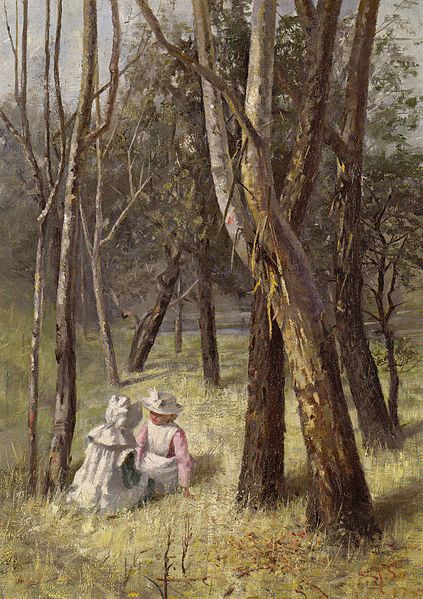
Little Gossips, 1888, Jane Sutherland (1853-1928). Australian.

Real discretion is something I value. So is an ability and willingness to work out misunderstandings and disagreements with open hands, and to let go of grudges. Both of those things are hard to come by in the work world and sometimes even in one’s private life, if there even is such a thing anymore. I believe that these are important ways that each of us can contribute to a more genuine world.

I come back around to Adrienne Rich again, this time as an essayist. In “Women and Honor: Some Notes on Lying” in the collection On Lies, Secrets and Silence, she notes the following:

“Lying is done with words and also with silence.”

“When a woman tells the truth she is creating the possibility for more truth around her.”

“An honorable human relationship—that is, one in which two people have the right to use the word ‘love’—is a process, delicate, violent, often terrifying to both persons involved, a process of refining the truths they can tell each other. It is important to do this because it breaks down human self-delusion and isolation. It is important to do this because in so doing we do justice to our own complexity.” [I would note that any honorable human relationship that is based on respect includes some love, and Rich clearly doesn’t mean only romantic love.]

“The unconscious wants truth. It ceases to speak to those who want something else more than truth.”

“The liar has many [so-called] friends, and leads an existence of great loneliness.”

Even silent stones can speak slander. The Three Gossips rock formations in Arches National Park, Utah. Photo by Tiziano Lombardi.

Oh, Mary, Don’t You Weep

February is Black History Month, and it has me contemplating the meaning and importance of history. History is a story that is re-written over and over again, sometimes to include previously ignored or missed information, sometimes to deceive and cover over shameful events. It’s important for history to celebrate milestones and accomplishments of individuals and cultures, but it is also important for it to record and examine shameful aspects of the past.

Recently, Tea Party representatives in my native state of Tennessee held a news conference demanding that legislators have removed from public school textbooks references to slavery, and especially to the fact that many of the “founding fathers” owned slaves. Texas has already passed legislation that would require textbooks to emphasize a right-wing agenda. And Arizona began destruction of the Tucson Unified School District’s Mexican-American studies program based on a new law that prohibits any academic endeavors that—all in one breath—“promote the overthrow of the United States government,” “promote resentment toward a race or class of people,” or “advocate ethnic solidarity instead of the treatment of pupils as individuals.”

In other words, white oppression may not be mentioned, discussed, acknowledged, or challenged. Next, those loonies who claim the Holocaust never happened will be getting all references to it removed from the world of education. And then who will they come for? No more Take Back the Night rallies? No more St. Paddy’s Day parades? These new laws are attempting to ensure that no story but that of the rich, powerful, and dominant is heard.

There’s also a move on here in Florida to exclude all state university and community college employees from holding office in the state legislature. (These positions pay around $30 K a year, so most who hold them have other employment elsewhere, not that most faculty members would have the time to do both.) The sponsor of this legislation claims educators have an inherent conflict of interest, though there is already a policy to ameliorate any supposed conflict of interest, albeit it doesn’t seem to be working too well. (At the same time, the elements of the state legislature are seeking to privatize prisons and other public functions, a move that would personally enrich a number of them.)

The people behind these legal maneuvers are people who understand fully the power of education, but who wish to use it, at best, as a public relations forum and, at worst, as a brainwashing technique. All the while, they claim that those who have worked so hard to open history to the realities of millions of lives that were for so long ignored are the ones doing the bad deeds. But ethnic studies programs do not preclude the celebration of white achievement. And slavery can be contextualized as a historical phenomenon that does not diminish the other achievements of the early white leaders of the U.S. Erasing reality does just the opposite, but Tea Partiers and other manipulators of history don’t care about that. All they care about is hiding realities that embarrass them and hiding the many accomplishments of groups of people they wish to discriminate against. It is clear that the agenda here is to stop people from examining history honestly and from multiple viewpoints, and to exclude from the political arena any groups that tend to disagree with them.

I really do believe that the devil is loose, and that many good people will find themselves on the chain gangs once again, metaphorically and perhaps literally. These Tea Party types are driving us back toward the evil aspects of the past, not forward into a better, more egalitarian future. That many of them conceive of themselves as righteous Christians is horrifying.

So, I have chosen to share today the old African-American spiritual tune “Oh, Mary Don’t You Weep.” Although it’s a song wherein Jesus instructs Mary not to cry, this is not equivalent to the positivity movement’s denial of feeling or enforcement of cheerfulness. This is a promise of revenge and justice indicating that the evil will eventually drown no matter how powerful they are now.

This song originated in that dark past when rebellion against slavery and white oppression had to be encoded to be shared at all. It has become a shared anthem for many people, black and white (and Native American, as one source notes that 38 Dakota Indians sang it on the way to their execution by hanging in 1862). I hadn’t thought about this song for a long time until last fall when Bruce and I met up with my old high school friend Ruth and her husband, who played a beautiful old-timey version for us. There are many versions available on the web, but I chose to feature the oldest and least fancy of those I could find—to remind me that, yes, all “messages” have an effect, but that some messages are more honest than others. One version of this song contains the lines “When I get to heaven goin’a sing and shout/Ain’t nobody there goin’a turn me out.” There are some places where Tea Partiers can’t recreate history or exclude people.

These are some other great versions with a variety of styles and instrumentation. You could listen to none of them, or one an hour today or one a day for a week. Or just come back and listen to one when you need to remember that change-ups are always in the offing, that “Pharaoh’s army got drownded.”

Pete Seeger

Aretha Franklin

Bruce Springsteen

Inez Andrews

Mike Farris

Silver Hollers with Natalie Merchant

Huntsville Police Department Blue Notes 5

The Will to Happiness is Contra-indicated


Dear Readers,

In my continuing attempt to try new things, I present to you today a guest blog post. A while back, my friend and colleague John King (also one of my most faithful readers and commentators on the blog) emailed me separately a longer series of thoughts he’d had in response to one of my posts. Casually, I said that I should make him a guest blogger, and, lo and behold, he then sent me this erudite little essay.

Don’t worry. I’m not abandoning my responsibilities. The discipline has been too good for me. But I’m hoping to post maybe one guest blog a month to bring more variety to the contemplations here. So here’s to a spirit of experimentation. Let me know what you think.

L

* * *

The Will to Happiness is Contra-indicated

by John King

I am not certain that, as an ad for The Secret proclaims, Shakespeare actually knew “the Secret,” but I am quite sure P. T. Barnum knew the secret behind “the Secret.”

“Smile and the world is yours,” Henry Miller writes in Black Spring. “Smile through the death rattle—it makes it easier for those you leave behind. Smile, damn you! The smile that never comes off!

The Will to Happiness, a.k.a. Positivism, is a willful disengagement with the real world, a form of denial, of censorship. This is precisely the sort of thinking that led the Bush administration to scoff at “the reality-based community” as it planned its war in Iraq. Death toll of the Iraq War: 162,000. This fact would be shameful, if reality is a meaningful entity. But the mainstream media machine, including the mainstream punditry, has never reported the actual death-toll, treating this essential statistic like a psychological tar baby.

This is an affirmation of the unexamined life.

Phobias about negativity, about depression, bad news, agita, and strife, are based on a fear of psychic vampirism, that others will drain you of your vitality, your confidence, your mental health. Schopenhauer believed that the boundaries between others and ourselves is illusory, and in moments of moral clarity, heroes see how contiguous we are with humanity, and behave accordingly. But it takes a profoundly strong person to acknowledge this truth, and there is not always something such a person can do to help others, relieve them of certain brutalities and cruelties of existence.

“Can the world be as sad as it seems?” asks the narrator of Throbbing Gristle’s “The Old Man Smiled.” Marlow loses his mind and his humanity when he sees enslaved Africans in Heart of Darkness. His racism and inability to cope with his experiences begins there and then.

The world of business is systematically skewed towards simplicity and optimism in its communication. According to Kitty O. Locker’s Business and Administrative Communication, business writing should exhibit something called “you-attitude,” a focus only on the immediate concerns of the recipient of a message, without burdening the recipient with any of the sender’s extraneous concerns. And all messages should also feature positive emphasis, whenever possible. On The Simpsons, Mr. Burns re-labels a nuclear meltdown at his power plant as an “un-requested fission surplus.”

The opposite of the Will to Happiness, what we might call Romantic melancholia, is of course also ridiculously out of touch with reality. Shakespeare mocked that self-indulgent impulse in 1602, in Twelfth Night, in the character of Count Orsino, who pleads “If music be the food of love, play on; give me excess of it, that, surfeiting, the appetite may sicken, and so die.” (This is, incidentally, more or less how I feel when I hear nearly anything by Abba.) Unfortunately, unlike Shakespeare, Goethe wasn’t kidding about the Romantic sorrows of young Werther, and today’s goth kids lack the sense not to stew in their own weltschmerz as an actual lifestyle choice.

According to the early twentieth century philosopher Henri Bergson, the most primal laughter is a manifestation of the incongruous knowledge that our minds exist in something like a pure mode of being, godlike, but our minds are, nonetheless, attached to a body that is destined to fail, to decay, to die. This is the foundation of Samuel Beckett’s entire literary and dramatic career. This is the foundation, too, of the mythos of Beckett’s beloved idol, Buster Keaton: the expressive consciousness of his face, juxtaposed with the improbable feats of his body as he strives to contend with the gross, sublime physicality of the world. This philosophy is also the core of the dark, ranting comedy apparatus of Denis Leary’s No Cure for Cancer.

I often find myself drawn to the honesty of cartoons, a genre in which the content is considered culturally debased, and so can afford more satirical gravity than what supposed grown-ups watch. (An inexpensive observation: The Simpsons offers profoundly more reality than Undercover Boss.)

No cartoon I know of has more to say about this subject than that 1990s counter-culture classic, Ren and Stimpy, in particular an episode called “Stimpy’s Invention.” It depicts the terror of the Will to Happiness in a way similar to Henry Miller in Black Spring, but far more disturbingly, in Bergsonian terms. Stimpy, the ever-optimistic and cheerful orange cat, is wracked with empathetic sorrow when his companion, Ren the chihuahua, is not happy. So he builds a helmet that alters Ren’s brainwaves that force Ren’s mind into a happy state. The helmet that never comes off! The pressure of the Will to Happiness escalates.

Ultimately, the ability to voice discontent, pain, and sadness is cathartic. To silence such speech is to deny who and what we are, to deny even the possibility of knowing who and what we are, and so it diminishes who and what we can be.

John King is a creative writer, literary scholar, and journalist. His creative writing has appeared in Turnrow, Palooka, Gargoyle, Pearl, and Painted Bride Quarterly Annual, and is forthcoming from The Newer York. He regularly reviews books for The Literary Review and theater for Shakespeare Bulletin, and is a contributor to Celebrations magazine. He is currently serving as a composition sherpa at the University of Central Florida. His most recent works, a short-short story called “Perfection” and an essay called “The Muse of Florida,” will appear in the new book 15 Views of Orlando.

The Queen of Garbage

Recycling transfer station, Gainesville, FL. Photo by BWingYZ.

I sometimes feel like the Queen of Garbage. Around our house, I’m the one who mostly deals with it. This is not the result of some plot on Bruce’s part— I am the long-term expert at dealing with kitty litter (and, to be honest, kitty vomit), and I am just far more obsessive about garbage than he is. A friend once told me that I reminded her of Andie MacDowell’s character in the film sex, lies, and videotape (directed by Steven Soderberg, 1989) who sat in her therapist’s office worrying about a barge of garbage stuck in the East River. My friend thought this comic.

My first memory of playing this role arises from my early teenage years when my old friend Sharon visited my family one summer. Sharon’s parents and my parents had played bridge together when we still toddled around with pacifiers in our mouths, and we’d stayed friends of the summer-visit variety. When Sharon saw me take a pile of newspapers down to the garage one day and add it to the considerable stash along the far wall, she asked me what was going on.

“The Boy Scouts do a drive every year to recycle the papers,” I told her. “And see here?” I showed her the extra garbage cans we kept for glass and aluminum. “We take these to the K-mart recycling dumpsters, too.”

“Your family is a bunch of fanatics!” she said. “You’re crazy!”

Thirty-five years later, I feel sure that Sharon and her family recycle, too, but even now there are a lot of people who don’t.

Bruce and I purchase a lot of stuff through the mail. Evidently everyone on our street buys a lot of stuff through the mail. As far as I can tell, I am the only one who bothers to break down boxes for recycling. The recycling people will only take the cardboard if it’s flat. We let boxes pile up in the garage for a while, and then I go out with the hunting knife I found when I bought a house years ago and cut them down. Sometimes I think about the new life I gave the once abandoned knife—that’s a kind of recycling, too.

And I spend hours trying to find homes for the stuff we don’t use. Recently I made a trip to Goodwill with a carload of household items—glass cookware we can’t use on the new induction stovetop, extra mugs that overflowed the cabinet long ago, some of the plethora of cloth book bags that we seem to pick up at every conference we attend. I was dismayed to learn that Goodwill won’t take blinds, as I had finally convinced Bruce to give up a large bamboo blind that we have no place for in the house we bought three years ago. I didn’t, however, put it on the curb. Instead, I put it back in the garage and began making a list of things we can give away or sell for cheap through Craig’s list.

I did a lot of this when Bruce and I moved into our house together. We owned two lifetimes of accumulated stuff, and we had to winnow it down. But Bruce laughed at me when I said we should do something with all the boxes. We had a lot of boxes—too many to break down for the recycling truck. Bruce was ready to put them on the curb. Instead, I posted them as “free” on Craig’s list. Bruce said no one would want them, but within an hour, I had six different people offering to come and get them. They were perfectly good boxes.

My grandmother, on the other hand, hoarded. It’s a thrifty habit. And like the genes that change our metabolisms when we try eat less to lose weight, I’m sure the saving gene once had a good purpose, too. But we live in a time of overkill not of scarcity, both with food and with stuff. It’s no wonder that obesity and hoarding both seem to be on the rampant rise these days. At least, I tell myself, I don’t hoard.

Nowadays, I take any peanuts and other plastic-y packaging stuff to our local UPS store, where they are glad to re-use them. Because they don’t pick up office paper curbside, I haul mine to campus. I’ve taken metals to a metal recycling business, and I’ve taken electronics to a business across town that supposedly re-uses parts. (It seemed to me that mostly they were in the process of smashing every part and extracting the metal, too, but at least I tried.) I take my diabetes pump supply cast-offs to the fire station in sharps containers for proper disposal of medical waste. (This is relatively easy here where there’s a fire station program, but for years I had to hunt down ways of getting my medical waste into a proper channel.) And I make frequent trips to the garbage transfer station in our area to drop off the many dead batteries that we have from my insulin pump, blood sugar meter, TV remotes, fake candles, and various computer peripherals like mice. I like the transfer station the way some people like the wrong side of the tracks—it is like a glimpse into another world entirely, with the huge, lumbering trucks and cavernous space filled with the detritus of our lives: scary and all too real.

I do other things, too, to try to be environmentally responsible. I long ago quit buying water in bottles, for instance. Bruce and I have a collection of long-lasting drink bottles, and I drink water out of the public water supply. It is the cleanest and safest in the world, after all, even if it’s not from some “pure” spring in Fiji. It was easy to make this change after I saw the water bottling plant in Bellefonte, Pennsylvania, where I once lived. Bellefonte’s public water supply came from a spring, so a company bottled it and sold it as “spring water.”

Both Bruce and I—and most of the people I know—try to make choices along these lines. Most of us feel that the earth is a ticking time bomb of pollution and poison. I go to a lot of trouble, but I know it’s not enough. I often wonder if the gasoline I’m using to drive stuff around to these various places is worth it, and I’ve had my suspicions that all the stuff that gets picked up curbside is just dumped back in with the rest, a kind of p.r. stunt. I’ve known people who do a lot more than I do—one who gave up cars completely, one who left his job as a philosophy professor to join an organic farming cooperative, others who established careers related to protecting the environment or educating kids about it.

Recently, one of these latter—an old friend who works as an attorney for the EPA—lamented that she believes that recycling has become just a sop to make people feel better. I know she is right, and she made me think about what it means to be environmentally friendly. How is that term defined in a meaningful way? The EPA has, in fact, deemed the term useless in the commercial world due to a lack of clear definition.

For most of us as individuals, it’s very confusing, and I believe that most of us do only what we can see, what is simple, and what is right in front of us. I find it worthwhile to turn off the lights when I leave a room—in fact, I follow Bruce around and turn lights off after him, too. But in more complicated situations, it’s frighteningly hard to tell what’s for the best. When Bruce and I bought our house, we needed to replace miles of hideous, worn and dirty beige carpet. I did hours and hours of internet research about purveyors of wood flooring, looking for a company that had responsible environmental and labor policies. Pretty much all of them claimed they did.

We went through a similar task when we looked for our wedding rings. Mining—both metal and diamonds—is a particularly nasty business that most of us never see. But in my younger days, I’d driven around Copperhill and Ducktown, Tennessee, and I had seen first hand mining’s destruction. Though much of that land has now been reclaimed, it was denuded for better than a hundred years. I wouldn’t want to live there even now. We bought rings made from recycled metal. At least that’s what we were told. We don’t feel any ability to really know the impact of our choice.

All of this raises for me again and again what it means to be genuinely one thing or another. How do we gauge our own intentions? Do I recycle just so I can have the imprimatur of a “good person”? Do the hours I spend sorting garbage and cutting down cardboard boxes mean anything besides just another form of waste? And are my intentions what matter? No doubt they are good, but I may not demonstrate enough follow-through or commitment. Other things distract me, and my carbon footprint no doubt remains too large. At least, I tell myself, I have been doing a few things over many long years. At least I am not a Johnny-come-lately to trying to do my part.

Bruce and I were talking about this the other day, when I was contemplating to what extent I’m just a half-assed person with commitment issues. We started to generate a list of other ways in which he and I each have been unable or unwilling to “go all the way.” Some of these are not so clearly desirable as environmental sustainability and concern, but they share the expectation of purity.

Bruce and I started our list by chuckling over what I have for a long time called “macho yoga.” Just a few days ago, the New York Times featured an article about the dangers of yoga. I was glad to see them finally catching up to reality. Back in State College, Pennsylvania, during my grad school years, I classified the yoga schools and instructors in town into the “gentle” camp and the “macho” camp. My friend Mary, a returning middle-aged college student, alarmed me when she told me that after a month, her college yoga class was doing headstands. I said, “No way. You’re going to hurt yourself.” Sure enough, she herniated a disc. Yet in our town, there was a certain éclat of the macho yoga schools, and they turned up their noses at anyone else. At a party once, I had one of them tell me that I couldn’t be a true yoga devotee unless I did headstands. I already knew that I was never going to do headstands.

Bruce told me about his own discomfort with the proselytizing brand of Christianity that he was inculcated in when he was at Bible college. “I still consider myself a good Christian,” he said, “but I know a lot of people wouldn’t. For me, it’s more of an internal thing.”

Along similar lines, I have found myself uncomfortable with confrontational politics. Off and on over the years, I have made numerous attempts to advocate for candidates I believe are better than worse, to engage in canvassing, to make phone calls as elections neared, and so on. My brother has always been good at debating issues and has long been involved in local politics, but I am terrible at it. I feel that it’s necessary, but it just about gives me heart palpitations and I usually just end up making someone mad. I am much better at writing things down, and I hope that my occasional forays into issues in this blog is a genuine way that I can make a contribution, even if it isn’t protesting in the streets or knocking on doors.

Perhaps most important of all to me right now is the issue of our marriage. It took me 49 years to get married, even after a therapist told me in 1983 that I had commitment issues. Even now, happily married to a great guy, I tell myself at least once a week that it won’t last. I have learned to talk back to myself and say, “Yes, it will,” but I have a fear of disappointing both of us. I often wonder if I am a genuine wife or if I am kidding everyone including myself.

These constitute an array of issues that I feel very differently about—I want to be totally committed to my marriage, I want to be a better environmentalist, but I have accepted my low-level role in politics and I have no desire whatsoever for Bruce to become more evangelical or for me to do more strenuous yoga. Yet it was interesting to compare the ways that definitions of terms define us in each of these arenas.

This is an enormous issue in today’s political world. In an article in the upcoming February 2012 issue of Harper’s, “Killing the Competition,” Barry C. Lynn notes that the powers-that-be “have undermined our language itself” by redefining various terms. “Corporate monopoly? Let’s just call that the ‘free market.’ The political ravages of corporate power? Those could be recast as the essentially benign workings of ‘market forces.’” In another recent article, Rodolfo F. Acuña notes how euphemistic language is being used as a tool for racism. Acuña is a lightning rod in battles in Arizona over a recent law that was passed that made it illegal for “any school program to advocate the overthrow of the government, ‘promote resentment’ toward a group of people or ‘advocate ethnic solidarity.’” Like those three things are necessarily related. In other words, any kind of ethnic studies (except, of course, white) has been shut down in Arizona, where attorney general Tom Horne has re-defined many life-long Americans of color as “separatists.”

I don’t have any final answers to any of these definitional questions. The EPA is right, and we all need to look closely beyond the title of “environmentally friendly.” We all need to look closely behind all the double-speak of politics, and we all need to look at how we define ourselves.

I may not be the best environmentalist in the world, but I will still claim the title of Queen of Garbage around here, and I have every hope that my role will be valued in my life-long marriage.

Martin Luther King, Jr. Day

http://www.youtube.com/watch?v=0k5dptjc3LY&feature=related

At the time of his assassination in Memphis, Tennessee, on April 4, 1968, Martin Luther King, Jr., was widening his scope. He had been the unquestionable leader among many important change-bringers of the Civil Rights Movement, but by 1968 he felt that enough had been accomplished for him to add poverty and war to his agenda.

Some of his fellow African American activists disagreed, just as some had disagreed about King’s devotion to non-violence. For me, both of these moves on King’s part mark his singularity.

In some ways, King’s non-violence was almost too white-friendly. Many believe that his reputation has been co-opted and rendered touchy-feely, even impotent, by the powerful who treat him as though he were not a radical. What many celebrate on MLK Day is this user-friendly Christian MLK.

But King’s inclusion of poverty and war on his agenda mark him as a social reformer of an extraordinary order. In 1968, he was attempting to organize the “Poor People’s Campaign” and had come to believe in a guaranteed income as a way to combat poverty. He stated very clearly that he sought to address issues that created poverty among both black and white. He also believed, as the video above indicates, that the Vietnam War was an enormous moral wrong, and that the powerful of whatever race that promulgated war were wrong. He knew that war was also about money. And he showed that he was a kind of Christian that is all too rare these days: one who was dedicated to justice and fairness and the good of all humans, no matter their station or situation.

Today I’m not here to debate whether there is ever a justifiable war or whether a guaranteed income would have the desired effect, but to note that Martin Luther King, Jr., saw beyond immediate, personal causes. This is so rare as to be a miracle. Just this week, Harper’s magazine, in its often devastating Index (description), noted that 57 (out of 535) members of the U.S. Congress are among the wealthiest 1 percent of Americans (info from the Center for Responsive Politics). I will bet that if you asked after the wealthiest 5 percent, members of Congress would be overwhelmingly members of the club. Most of them, it seems, find it impossible to look beyond their own self-interests in forming policy. And that is the simple and only reason I can see that we are still indulging in tax breaks for those wealthiest of Americans. It has been demonstrated over and over that that stuff does not trickle down. We are not really living in a representative government, but an oligarchy.

I don’t know what Martin Luther King, Jr., would have done in the face of today’s current political scene. He would have turned 83 years old yesterday, and it would be possible that he’d still be alive had he not been assassinated. My bet, however, is that in spite of his all-too-human fondness for silk suits and pretty women, he would have preached for us to set narrow personal interests aside for the sake of the humanity that he loved so much. He was the genuine item, and I pay him all due respect on this day, both as a non-violent activist and a radical reformer.