Category Archives: Culture & Arts

There’s Something Wrong with Aunt Diane

Lately, I’ve been pretty far from my original subject matter of crying. It’s been important for me to explore other kinds of genuine emotional expression, and I’ve enjoyed my thought travels in that regard. Last night, however, simply by accident, I ended up watching the HBO documentary film There’s Something Wrong with Aunt Diane. It’s a truly tragic story that you may remember from original news reports after July 26, 2009, when Diane Schuler drove the wrong way on the Taconic Parkway, causing a horrible traffic accident. She killed herself, her daughter, her three nieces, and the three men in the vehicle her van hit head-on, and injured her son, who was the only survivor in those two vehicles.

The case is indeed one that has no sure answers: There is no denying that Diane Schuler had a blood-alcohol level of 0.19 with more undigested alcohol in her stomach. Her blood also contained THC, indicating that she’d been smoking marijuana. Her family—and the documentary—make the argument fairly convincingly that this was completely unlike her, in fact, unbelievable. Both she and one of her nieces had called her brother from the road and said that something was wrong, that she wasn’t feeling well, and she had stopped, apparently sober, to try to buy some pain relievers that the convenience store didn’t carry. They believe that she must have had some other kind of health emergency first—likely a stroke caused by an abscessed tooth. But her autopsy supposedly ruled that out even before the toxicology results came out.

Watching this film is hard, and there is no uplifting ending, so it made me think not only about suffering but about narrative, and the attractions and pitfalls of nonfiction. It’s instructive to compare the documentary, even with its clear sympathy for Diane Schuler, to the fictionalized version in Law & Order’s episode “Doped.” In that version, the police end up proving that its fictional driver had been doped with alcohol in a smoothie provided by someone else and with propofol, an anesthesia drug, in her asthma inhaler. It turns out that one of her colleagues at a large pharmaceutical company has drugged her because she intends to blow the whistle on a bad product.

The fictional TV show is very straightforwardly satisfying: the mother ends up being entirely faultless, her husband it turns out did know her well in his insistence that she didn’t drink, the bad guys are identified and punished, there is a clear explanation for why these terrible events occurred. At the end of the story, we may have sorrow, but we don’t have any questions. They’ve all been answered.

Of course, that is a TV tradition more than it is a habit of great fiction. And most great fiction leaves us with many unanswered questions. Most great fiction is more like nonfiction than TV episodes are. I need only mention Ford Madox Ford’s The Good Soldier and Emily Brontë’s Wuthering Heights. Think of anything that William Faulkner wrote, especially that ending of Absalom! Absalom! wherein Quentin protests that he doesn’t hate the South and we are left with the same question he is—what his relationship with the South really is and will be. Great fiction doesn’t try to erase the mystery that comprises actual human experience for the sake of a tidy story.

Yet it is true that one of the great difficulties of writing creative nonfiction is that life doesn’t always follow clear paths. The debate in the Schuler case goes back and forth: Are the people who have lost people (Schuler’s brother and his wife, the families of the men killed in the other car) simply looking for a way to file this event in the “explained” file so they can move on? Are they too eager to condemn? Or are her husband and another sister-in-law in denial about what she was capable of? Lawsuits and counter-suits are being filed, and that’s tragic in itself. The whole question of how and why people respond so variously to one event floats in the air as unanswered as the cause of the accident.

For me, when a woman who is not generally much of a drinker and only smokes pot to get to sleep at night is determined to have been smashed and totally stoned at midday with a carful of children she loved, it’s easy to believe that something else was going on. There’s Something Wrong with Aunt Diane demonstrates that she was a woman who might very well be reluctant to ask for help if she was ill and might think that she could just tough it out until she got home. She had been self-medicating her insomnia for years, and she might have self-medicated herself to death if she were in pain.

Having had that extremely painful hemorrhagic stroke in 2011, I can imagine it. I rode the bicycle a mile and a half home with my head pounding as though being repeatedly hit with a nail gun. I didn’t know what else to do, though I had a cell phone and my husband could have called for help. I am very glad that I was not driving a car at the time, and I am a person not averse to medical help, so I can imagine a person like Diane Schuler trying to ignore her situation and carry on.

Having also had more than one serious medical situation that has no clear explanation, I can also believe that something happened to Diane Schuler that her autopsy didn’t detect. If they can’t always get to the bottom of things when you’re alive to tell the tale, it seems to me that with someone dead, there is a lot that’s easily missed in the body. Once the toxicology report came in, there was no interest or motivation in pursuing anything else. Those who wanted one had an explanation, and it was that Schuler was an irresponsible drunk, in spite of all the evidence of her life to the contrary. In some ways that seems to me like a fictionalizing tendency, or I should say, an oversimplifyingly fictional one just as much as the wholesome-mother version on Law & Order.

That doesn’t mean that I am satisfied by There’s Something Wrong with Aunt Diane. It starts out with the same optimistic tone of any whodunit. But by the end its insistence on the unknowability of what happened is appealing at an intellectual level, but devastating at an emotional one. It’s the kind of movie where you don’t know quite what to do with yourself when it’s over. I myself remain unsure whether that’s a flaw in the writing and arranging of the documentary or whether it’s realistic and good. It might feel just a little too much like life. But I know I won’t forget it.

Raised on Promises and Ruby in Paradise

For the New Year, I thought I’d come a little closer to the twenty-first century in my weekly artistic selection. I’m still twenty years away, but, hey, I am progressing. Sam Phillips’ 1991 song “Raised on Promises” is one of my favorite anthems for change and rebellion, born partly out of her own escape from a record label that insisted on marketing her as “the Christian Cyndi Lauper.”

Part of the reason it became that for me too is that it was used as music for Ruby in Paradise, an early Ashley Judd film about a young woman who slams out of her white-trash life in Tennessee and goes to Florida to find her way. When I first saw it, of course, I was living in Pennsylvania and had no idea I might end up in Florida. But I identified with the longing for escape and independence, not to mention the accent. Ashley Judd played the character with a delicate yet stubborn subtlety she’s rarely displayed since.

This artistic pairing has me thinking about new starts and about the promises we make and break (to ourselves and others). These seem like fitting contemplations for the start of 2012.

Curry and Kindness

A 1683 map of Sri Lanka from Geographicus Rare Antique Maps

Yesterday I picked up some friends at the airport after their holiday travels. In all the pre-holiday hub-bub we had not communicated all that well so I was early, and the plane was late, so I went round and round the airport drive too many times in the crisp Florida sun. At first I was listening to disheartening stories on the radio, but then NPR’s Talk of the Nation featured an interview with S. H. “Skiz” Fernando, author of the recently released Rice and Curry: Sri Lankan Home Cooking, and I perked up.

The guy sounded awkward and smooth at the same time, which always fascinates me. And then the show featured a call-in session. At first this annoyed me—each and every one of the callers just wanted to talk about herself. One, who admitted to living in some isolated place like Wyoming, even wanted to talk about the difficulty of obtaining kefir lime leaves, which Mr. Fernando had immediately said are not part of Sri Lankan cuisine. Another said she met Mr. Fernando when he performed in Paris a decade ago—and the radio host interjected to explain that he is also a hip-hop artist. Clearly, Mr. Fernando did not remember the caller at all, though he treated each caller gently.

But then the radio show host read a few emails, including one from a guy, now living in Florida, who wrote that he had fond memories of the Sri Lanka Curry House in Minneapolis from when he’d lived there a couple of decades earlier. He noted that it has since closed, and that it didn’t include “mild” on the menu.

I laughed at the collision of time and place and suddenly found myself more sympathetic to all those who called to display their memories. I too live in Florida now but lived once in the Twin Cities. The Sri Lanka Curry House was a long way from my home in St. Paul and required a car to reach, so I only ate there once. But I remember it, though it was important only because I discovered something bad about myself. I had gone there with a large group of women, some of whom were my friends. I’m not sure of the occasion, but it might have been after a lecture given by Germaine Greer. We had been provided tickets by a friend whose mother had been one of the organizers. So, if my memory is correct, we were a bunch of feminists. Several of our crew were also lesbians.

It’s hard now to even remember how big a deal that was in 1979 or -80. I had some mixed feelings at the time, not so much about how any individual expressed her sexuality, but how the politics played out. Frequently, one of my lesbian housemates had told me that sooner or later I would see the light. Surely, she said, I would evolve. I could accept that she was a lesbian, but she could only accept that I wasn’t as a temporary setback.

The peer pressure was enormous, and with my many man troubles, I sometimes wished that I could at least claim bisexual status. But I have never been one to cave in to peer pressure. Instead, I get stubborn and resentful. Until that dinner at the Sri Lanka Curry House, I hadn’t really felt that consciously.

One of the women at the restaurant that night was named Marcie. I didn’t know her well, as she had repeatedly snubbed me at various house parties due to my retro-hetero status. As the waitresses put together several tables for our group, Marcie strutted up and down, sorting out where to sit. She noted repeatedly how much she loved hot food and how much she looked forward to this. The rest of us shuffled out of her way. Finally, she chose the middle seat on the table’s opposite side from me. I sat near a corner.

From what I recall, the Sri Lanka Curry House did have a “medium” designation on the menu, and they recommended it to all non-Sri Lankans. Most of us acceded to the waitress’ recommendation and ordered our curries as mild as possible. Not Marcie. She insisted that she was a pro with curries and that she loved her food hot. The waitress tried to talk her out of it, but she shook her head for emphasis. “Very hot,” she said.

Soon enough, the food came, steaming cardamom, cinnamon, turmeric, coriander, cloves, cumin, and fennel. I was not knowledgeable enough to smell the hot flavors of the chilis and mustard, and I wondered that the strongest tasting things often don’t have the most identifiable aromas. We oohed and aahed around the table, eager but tentative, taking mostly small bites and passing each other the condiments of coconut flakes and tomato relish.

Marcie lifted her heaped fork to her mouth and dug in. After a moment, her face blanched and sweat popped profusely out of her forehead. I had never seen anything like it. She grabbed for her water glass. “No!” someone yelped, too late. Marcie gulped water and then grabbed her neck as if to strangle herself. “Water is supposed to make it worse,” the helper said.

“It’s fine,” she said, gasping just a little. “Amazingly hot. But I’m okay.” She dragged her fork across the dish and lifted it again, more slowly this time.

Everyone looked at her, then we went back to taking our own small bites of our own super-hot “medium” dishes. I didn’t figure that Marcie would eat all of her dinner, but I found myself not minding. I found myself feeling a little mean.

After a bit of dawdling with her food, Marcie ventured a second bite. As soon as she took it, the sweat began running down her cheeks. She blinked twice, slowly, and pushed the plate away from her. Suddenly, she was face down on the placemat, groaning slightly. “Here,” her neighbor gestured to the waitress. “Bring a lassi. Mango lassi, please, quickly.”

Soon enough, the wise waitress appeared with the sweet, milky drink, and Marcie’s neighbor at the table clapped her on the back and coaxed her to sit up. “Here,” she said, “this will cool you off.” Marcie shook her head no and gasped out that her throat felt burned.

“You’ll feel better,” her helper said. “Really. It will soothe your throat.”

So Marcie alternated between rolling her head side to side on the placemat and sipping the lassi. Eventually she sat up and wiped her face with the cloth napkin, though the sweat continued to pour. Everyone cooed around her, asking if she would be okay, patting her on the back, and reassuring her that the food was “insanely hot” and that she couldn’t have known. Most everyone ordered lassis to keep her company.

I recall growing quieter and quieter as the evening went on. I didn’t order a lassi because I knew it would be too sweet for my diabetes, and no one talked about how great the food was except for the lassis. (The food was great.) One thought kept echoing in my mind: Machismo is dumb whether exhibited by a man or a woman. I had also discovered my own inescapable judgmental nature, and I knew this wasn’t a nice thing about me.

This is something I have struggled with ever since. Judgment is something we all need, but need to temper with kindness. I never would have set Marcie up for such a painful episode, but the fact that I really didn’t feel all that bad for her demonstrated to me my propensity to blame people for their own ills. It might have been easy for me to do that in such a clear-cut case, but most cases of blame are not so clear.

I have always had a hard time making excuses for people of the “you couldn’t have known” variety. And this has made me very hard on myself as well.

Lately, I have been thinking further about the way that language can be shaped to an interpretation. Some of this has come out of my reactions to all the “lucky” and “blessed” labels bestowed on me in recent weeks. But it goes beyond that to thinking about how our interpretations in the world of politics can be so different when reality is presumably the same (or at least close) for all of us. And to thinking about so many self-help endeavors that claim that if you view things positively, you will do better. I want to make more distinctions in all of this about what we can affect this way and what we are lying to ourselves about with euphemisms. I want to be able to tell the difference.

In teaching introductory creative writing, I often do a lesson about denotation and connotation. What, I ask my students, is the difference between red, maroon, scarlet, vermillion, cherry, rust, and cerise, not just in shades of hue, but in implication? What is the difference between wine and claret? Within individual word choices, of course, lies the way to truthfulness and accuracy in our writing. But they can also lead to manipulation.

These days I have been noticing these differences in day-to-day description even more. I am thinking about what the difference is between the opposites that we use for the same situations and things. The weather reports long ago changed from “partly cloudy” to “partly sunny” to try to keep people happier with the newscast. Someone said to me the other day that she wasn’t sure if her holiday had been relaxing or frantic. “I could describe it either way,” she said, “and both would be true.”

There have long been issues like this that are hard to split. In another memory from my college days, I actually remember having a conversation about whether or not all “nice” guys were also necessarily “boring.” Having since been trapped on many a date with a boring man, I can say that I no longer think the two words synonymous. In fact, now I think that the kind of man typically described as “exciting” might be boring in his likely narcissism and avoidance of depth. I wouldn’t use the word “exciting” to describe such a person at all. I would describe my husband both as exciting and as one of the nicest guys on earth.

What, I might ask, is the difference between mild, medium, hot, and very hot?

I am setting as one of my New Year’s resolutions to think about how to make these relationships between words and the world meaningful, and also to at least consider a kind interpretation when I can. Marcie, after all, could never have known how hot “very hot” was, even though I still feel a touch of satisfaction that she found out. Wink.

May we all have spicy kindness in the new year.

Vivian Maier and Art for Art’s Sake

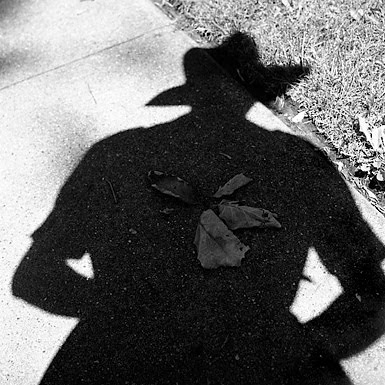
Vivian Maier self portrait from John Maloof's vivianmaier.blogspot.com

Bruce is in the kitchen sharpening our old, dull knives on the electric knife sharpener he got me for Christmas. It was nice that we both got and gave several presents that we will clearly share and share alike. We had a lovely day yesterday—a quiet morning together, an afternoon buffet and more gift opening with family and step-family, and an evening with our friends D and T at their new home, eating a little chicken curry and sharing the results of last week’s baking. We watched a digital fire on the TV screen since it is much too hot in Florida these days to even think of building a real one.

In the afternoon, while we were at Rick and Susie’s, I brought up what was probably my favorite gift this year—a book of photographs by Vivian Maier that Bruce had secretly ordered for me last April. Rick was still experimenting with a new remote device for their TV, and Bruce pulled up a slideshow of Maier’s work while we sat chatting, to test out the slideshow function on the remote and to show everyone what we were talking about. Soon everyone was mesmerized by the images on the screen. There are several portfolios on vivianmaier.com and on vivianmaierprints.com. I find her photos truly stunning.

Maier provides a good bridge for me between the fleeting Christmas holiday and the looming New Year’s one. Though the spreading recognition of her work probably won’t make any of the mass media’s “Top Events of 2011” lists, I consider my learning of her work one of my favorite discoveries of the year.

In fact, it was early in 2011 that I first heard of Vivian Maier and shared on Facebook this news report from WTTW in Chicago. Attention to her work has continued to grow this year, including a more recent report on CBS News (sorry about the unavoidable ad). More details of her life have emerged.

It’s interesting to me that, on the CBS video, gallery owner Howard Greenberg says repeatedly that Vivian Maier was “certainly no amateur.” In fact, what inspired me most about her story last year was that she was entirely an amateur. She took photographs not for any monetary, professional, or reputational gain. She took photographs because this was how she saw the world, because she was an artist and she clearly loved the art.

Amateur status has come to mean to most people an inferior result, but what Vivian Maier gave to me this time last year was a way to see my way forward through a return to working at my art because I love the activity, not because of some elusive potential professional gain. That is the more precise definition of the term “amateur,” and it suits Vivian Maier perfectly. She was an amateur who was also a master, and what she spent her time and effort on was her work, not on self-promotion or networking or salesmanship.

There’s a bit of a tragic element in that, as she died shortly before her work began receiving its due, and we all tend to assume that she would have enjoyed the recognition. But for all artists, it is difficult to sort out the love of the work and the daily practice of the work from the attention-seeking. Where is the right balance? We don’t know whether Maier ever walked into a gallery and showed her prints to a dealer, but it seems highly doubtful. Instead, she emphasized the “10,000 hours” of practice that are necessary for anyone to become a master at something and that Malcolm Gladwell noted in Outliers.

So I have found a new twist on the phrase “art for art’s sake.” In the nineteenth and early twentieth centuries it was used to indicate the opposite of social realism or other art with a moral or instructional purpose and was often used to criticize work like photography that contained an element of social commentary. Today, I have taken to using it to indicate instead the opposite of art with a commercial or professional purpose. Politics was once taken to pollute art, but now it may be the rank commercialism of all forms of it that corrupts it as much as politics does.

Vivian Maier took a lot of photos of poor people. She shows them in positions of vulnerability, their shoes worn, their faces dirty, their bodies thin and damaged. Yet, we see that same sense of vulnerability in the more well-off ladies with their fox fur stoles and businessmen with their white shirts. As an artist, she is a great equalizer, and I do think that her humanitarianism these days takes on political implications. Yet her pictures are never didactic. They simply open us to the world that was. And she never worried about offending or pleasing a patron or buyer. I think that shows in her work. Her devotion to her art, rather than to a career, will inspire me for a long time to come.

Holiday Makeovers

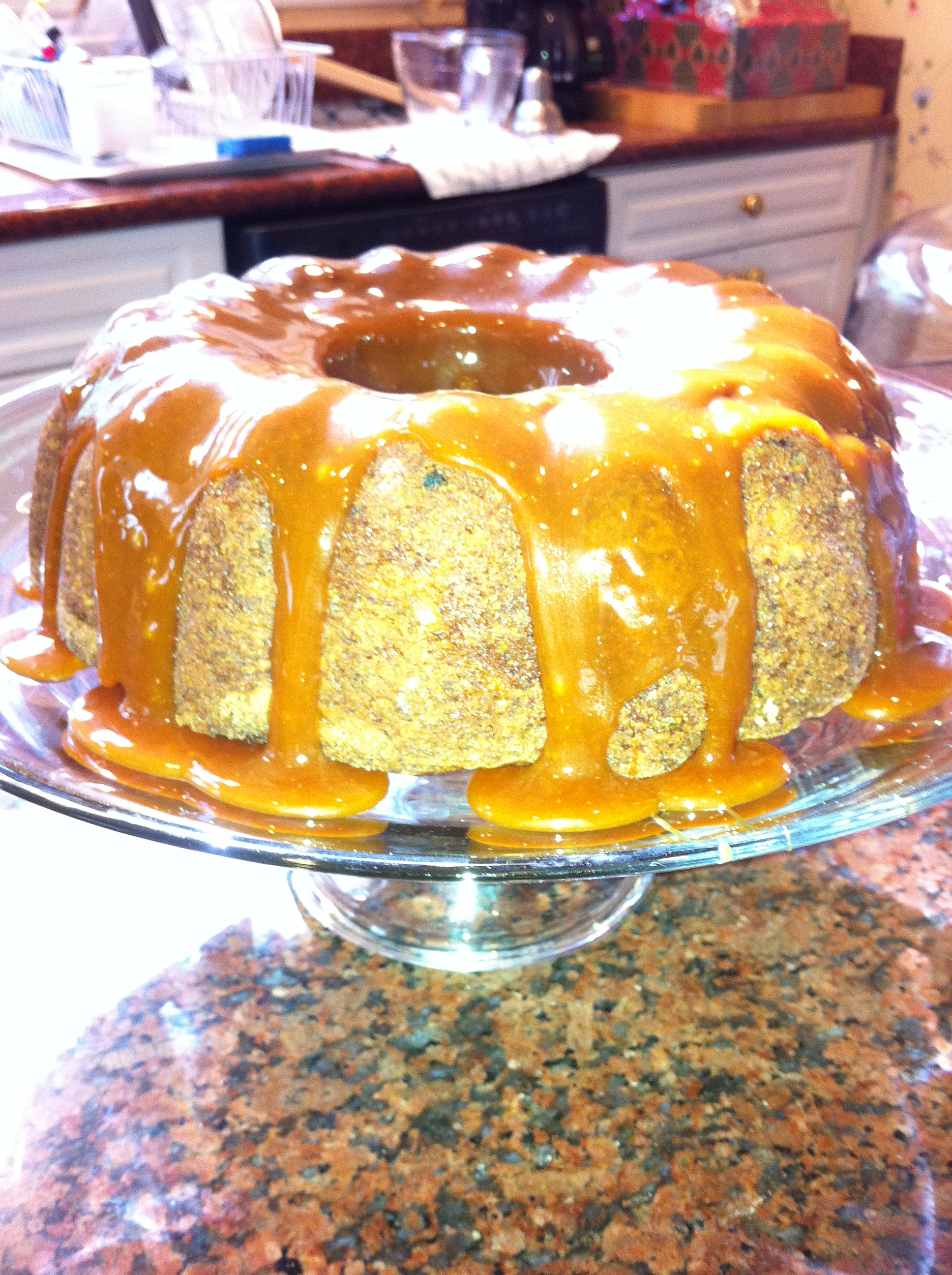
Caramel Spice Cake

Right now, I’m in the midst of making a cake. The icing-glaze is cooling and thickening before I pour it over the cake. My mom and I have stood over the new induction cooktop and the old cast iron skillet, stirring as the sugar, baking powder, buttermilk, and dollop of Karo syrup melt and bubble and foam and turn that magical, golden-brown color. The sound of the spoon scraping the bottom of the pan softened as I pulled up more and more of the browning sugar from the bottom. Finally, when just the right crisp smell arose, I turned the heat off and stirred in the butter. Now it cools.

I love this cake. Over all the holidays, it became my favorite from the numerous yummy things my mother and grandmothers baked. It is the one that I make still—not the amazing amalgamation cake, not the high white coconut cake, not even usually the dried apple stack cake. It is the humble cake that remains my favorite—dark and spicy, complex and serious.

I haven’t mentioned the name of this cake. For many years, it had an image problem. In my youthful days (before my parents divorced), we would throw parties at the holidays—friends would come by and eat well, sit by the fire and laugh, catch up after years apart at college or at new jobs. For years, few would eat this cake. It would sit unmolested while the aforementioned amalgamation, coconut, and apple cakes dwindled. I felt sorry for this cake, and for all the people who missed out on it.

So one year when I was in college, I convinced my mother to change the name. We put out little label cards for each dessert on the buffet. Lo and behold, the cake disappeared that year. Many commented on how delicious it was. It no longer had an image problem. We had changed the name from “prune cake with burnt sugar icing” to “caramel spice cake.” That was all.

Today, we laugh over the story. We feel a little conflicted still about what to call it. We talk about the ladies who created the original recipe, and how honest they were: the caramel glaze is, I am sure, not a genuine caramel as you would find in a box of candy from the Carmelite nuns. It’s a different process. And the prunes are a main ingredient, the fruit that moistens and darkens the cake and gives it that underlying rich flavor. But we faced up to the fact that “burnt” sounds bad and that people associate “prunes” with constipation relief. The latter might be a great thing alongside the overabundant and overly unhealthy food we usually fill up on at holidays, but no one wants to think about it while they indulge.

This is an image makeover that I can live with.

It’s also something that makes me think about the ways in which family traditions, especially around holidays, evolve and how that evolution is a great part of every holiday, even if sometimes we miss the way things were when we were younger. My mother’s most widely adopted holiday innovation was putting orange peel in the toll-house cookies—just the other day, after I’d given out a tin of cookies to our contractor, and he brought the tin back empty, I asked him which was his favorite. “The ones with the orange,” he said. “So good.”

My own adaptation of that standard recipe was using half shortening and half butter. The recipe says “either or,” and most cooks adamantly choose all one or all the other. The butter purists are after the flavor, the shortening folks cite its cheapness and lower saturated fat. I tried going with butter, but my cookies always spread out too much and burned at the edges. So it finally occurred to me I could combine the qualities. Voila! Perfect orange-tinted toll-house cookies.

My brother recently told me that his adaptation has been to the giblet gravy, which I gave up on entirely some years ago. He said the key is to leave out the heart and liver, which have a bitter flavor and which no one seems to want to eat. He still uses the gizzard meat and a hard-boiled egg for that chunky feel.

This year, I’m making another change—to the sweet potatoes. When I was diagnosed with diabetes, my mother took to reducing sugar all around. She immediately got rid of the icky marshmallows and gooey butter and heavy loads of brown sugar in the sweet potatoes, and she sweetened those with orange juice and just a touch of brown sugar. She would whip them up to a light soufflé-like consistency, sometimes with nuts and raisins, and they were great. But now I am married to a man from the northland who likes his regular old white mashed potatoes. So this year I decided that I wanted a different texture in one of the potato versions, and I am going to roast a medley of sweet potatoes, butternut squash, red peppers, and onions with olive oil, thyme, and rosemary.

All of these adaptations and all of this sharing of food is one of my favorite things about the holidays, along with the caramel spice cake. I love to bake, and I do it only once a year because as a chubby diabetic, the last thing I need is a lot of baked goods around the house. At Christmastime, I can give a lot of it away, though more and more people say they have too much. But there are still people who are eager to try the various attempts—the neighbors with a house full of teenagers, a few skinny friends, and others who are seizing the day.

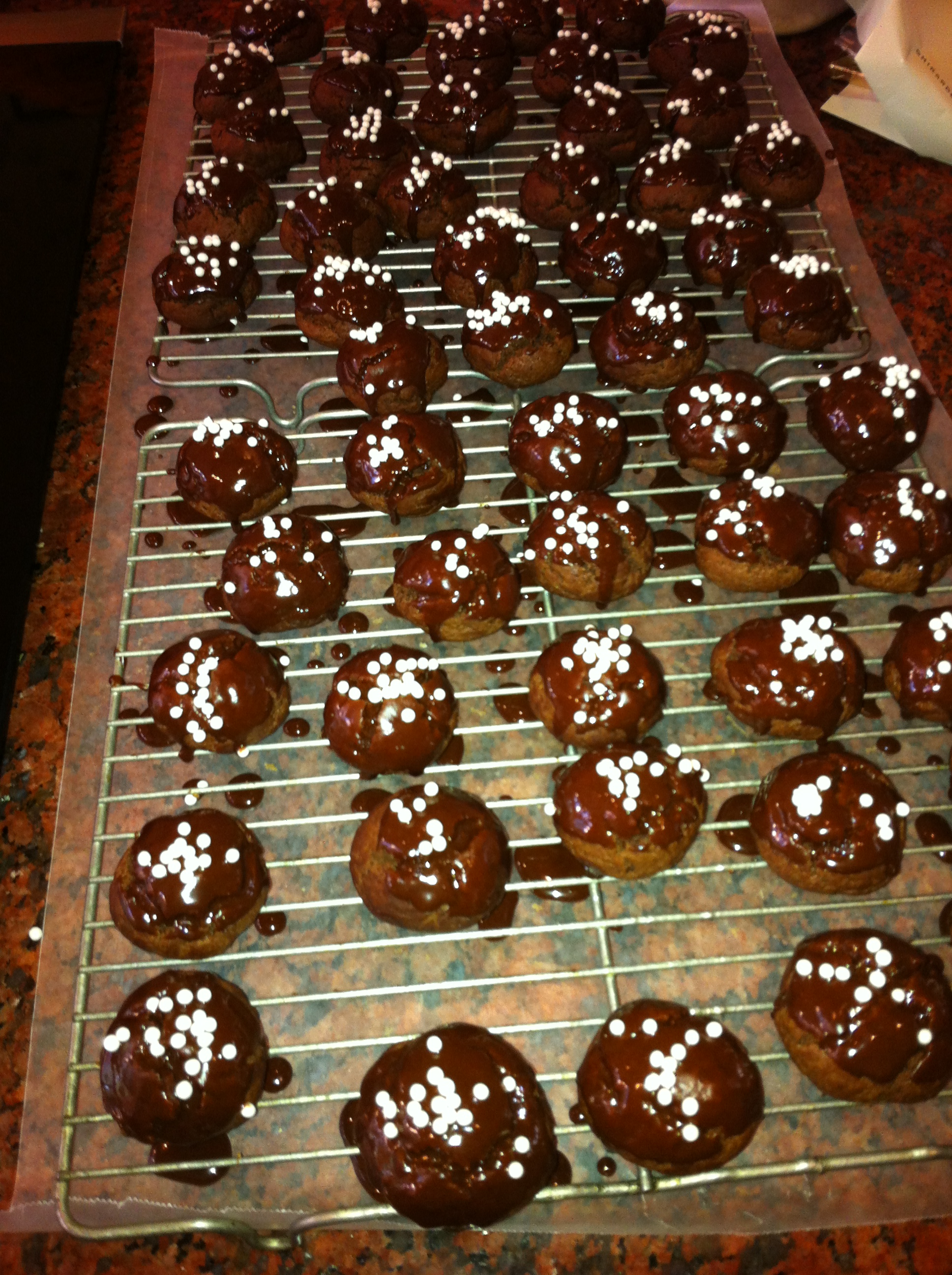
This year, I experimented a lot with cookie recipes, trying to find “healthy” or at least healthier ones. The results were mixed. The ones sweetened with only mashed banana were too soft (so I started calling them oatmeal macaroons), the pineapple-coconut ones spread into flying saucer shapes (so I started calling them scones and served them for breakfast), and I put too much flour in the oatmeal-honey-raisin ones (so I called them biscotti and served them with tea and coffee). The mostaccioli (little Italian chocolate cookies that are only mildly sweet) turned out beautifully, and the blueberry and white chocolate chunk ginger cookies are good as gold (though they need a simpler name). All around I was able to reduce sugar and butter and still have some good things to share.

Mostaccioli Cookies

And so this experimenting and this changing is an integral part of the holiday. Some nostalgia for the “way it was” is part of reminiscing, but I try to remind myself that it’s natural that the recipes change, the relationships change, the faces around the table change. Holidays are eternal, but they shift and modify, too. My wish for everyone this season is that they enjoy both the traditions and the evolutions.

Bon appetit!

Devil Song

Having a blue and jittery day. So I share this haunting Beth Orton tune. (Be forewarned, the lyrics on the otherwise pretty nice fan page are not correct.)

Beth Orton is a contemporary artist, and she’s spoken out about the need for musicians to earn royalties, so if you like it, buy it! (Links on the YouTube site, which may be forced down any day now.) Orton will have a long-awaited new album out in 2012 and will be going on tour … in Australia.

Boogertown Gap


Last month Bruce and I had the opportunity to get together with one of those old friends I’ve become reacquainted with through Facebook. Ruth lived near me in high school, often drove my brother and me (and another neighbor kid) to school in her beige square-back Volkswagen, and always carried her flute or piccolo along. Little did I know that she majored in classical music at the University of Tennessee and that now she and her husband, Keith, have chosen to center their lives on the traditional music of their ancestors in East Tennessee. Their duo is called Boogertown Gap, after a local place of Keith’s childhood, and they perform old-time mountain music in the area and beyond. (The above video is more wonderful but longish, so here‘s an excerpt if you just want a taste.)

Although they have chosen to honor tradition in their lives, however, they are full participants in the 21st century, and I met up with Ruth again via Facebook a year or so ago.

Last month, they came to Central Florida to visit friends and attend a conference, and they invited us to join them one night for some playing and singing. I hadn’t seen Ruthie (she’s still Ruthie to me, though I’m trying to adjust) in close to 30 years. But when she opened the door, she still looked just like herself, and we met Keith and the other friends, and soon music was in the air.

Bruce had brought along his electric bass, and although it wasn’t a natural fit to accompany the guitars, the fiddle, the banjo, and the recorder, everyone welcomed it, and off the musical types went. (If you know me, you know I just watched and listened and tapped my toes on the floor.) Soon enough, Ruth had Bruce playing the spoons. You can see here how good she is at teaching the spoons.

It was a lovely evening, and the toe-tapping music brought everyone together beautifully. We hope to see Ruth and Keith again sometime.

People Connections: Facebook Reprise

Bruce and I recently watched The Social Network. We’d put it off for quite a while because we’d heard that it was full of jerks, and indeed it was. The filmmakers were fascinatingly successful at rendering Mark Zuckerberg sympathetic by making it seem as though the other jerks were worse than he was. Poor little lonely rich guy.

Several things struck me about the movie. One was how much college has changed. My brother graduated from Harvard in 1980, where Facebook got its start 20+ years later, and I attended another “elite” college, though not in the Ivy League. As I watched The Social Network, I couldn’t help thinking about the way money has come to be the vastly dominant value in our culture. I don’t mean to trot out that “when I was your age, we had to walk to school two miles through the snow.” But I have virtually no recollections of talking about plans to get rich when I was in college, and I don’t think my brother had many either. Yes, both of us knew obnoxious rich kids, the silver spoon jock types. It might be an odd thing to celebrate those fellows’ 1970s and 80s obsession with drugs and sex, rather than intellectual learning, but—hey—at least it wasn’t an obsession with reaffirming their privilege and expanding even further their financial advantages in the world. I’m sure financial plotting was there; it just wasn’t so bald in my youth.

It was no doubt more prominent at Harvard than at Carleton—I remember the much stiffer and status-conscious atmosphere from when I visited my brother there, and I remember being amazed that Harvard allowed those dinner clubs to exist in our day and age. In fact, one of the reasons why I had chosen Carleton was that it had absolutely no fraternities or sororities. I believed that such things were a throw-back—like debutante balls and country clubs. How could universities open their doors to women and people of color and different backgrounds, thus asserting that the right to higher education was not a birthright, and then turn around and allow these clubs to perpetuate the discriminatory privileges that their admissions policies no longer supported?

Of course, instead of dying out, secret societies, country clubs, and fraternities and sororities have made a huge comeback. On our recent visit to Knoxville, Bruce and I asked my dad about an enormous new construction project near the UT campus, and he informed us that the university is now pouring money into a project to build sorority houses. “To fix the gender inequity,” he said, and sighed. I find the idea of sorority houses addressing an inequity hilarious. One kind lessened for more of another kind. That they’re now building sorority houses instead of demolishing fraternity houses shocks me.

As we watched The Social Network, I thought a lot about the exclusive origins of Facebook. I recall that when I was first encouraged by friends to sign up for a social networking account, I was told that the Facebook membership was better educated than that of MySpace. I didn’t realize for a long time that Facebook had originated at Harvard, that it had been built on the concept of exclusivity. First it opened to other Ivy League schools, then expanded to university students with “edu” email suffixes, then (I suppose when some of them started graduating) to people at certain companies, and then, finally, to all over the age of 13.

In some ways then, Facebook has been democratized. Yet I wonder if it doesn’t remain tied to a hierarchical system based on rather juvenile standards of interaction and created by a fellow who imbued it with a barely-beyond-high-school sense of social values. I think a lot of us—even those of us who use it enthusiastically—have deep ambivalence about it because of some of these remnants.

On the one hand, I really enjoy Facebook. It’s rather miraculous to be in touch with people I would likely never have heard of again had Facebook not come on the scene. I no longer live in either of my hometowns, and I have never received an invitation to a high school reunion, nor have I ever attended a college one. When you have had the rather peripatetic life that I’ve had, it’s also a miracle to see so many different parts of your life gathered in one spot. Weird sometimes, but cool, too.

There’s my brother, of course, whom I’ve known since birth, but close on his heels is Sharon, whose parents played bridge with my parents when I was a toddler; Lisa, who I met in elementary school and who introduced me over the years to both s’mores and Spin the Bottle at her parties; William, who played basketball with my brother but who was closer to me in age and stayed my good friend and correspondent all through college. There are high school friends mixed in with college friends mixed in with grad school friends mixed in with colleagues and recent friends mixed in with former students. When on Facebook I often miss my friends who don’t use it at all or much. There’s something deeply satisfying in knowing that there are some continuities in my fragmented life, even if it is just that a lot of my friends like cats and dogs.

Facebook was also great immediately after my brain hemorrhage last year—it made things easier for everyone, including me. Hospitals have changed—I can remember when they took everything away from you as soon as you were admitted. Now they leave you with your iPhone in peace. I had music, I had Scrabble, I had email, I had the ability to make calls, but I also had the ability to not have to make calls. I just posted on Facebook, and the messages of concern and affection came rushing in like rain on the windowsill—it was outside, but I knew it was there, warm and life-affirming.

Obviously, these purposes now go beyond the college-student hook-up site that Mark Zuckerberg originally envisioned. Facebook, as we all know, has helped to create entire political movements and to help locate lost teenagers. Wikipedia even reports that in February 2011, a newborn in Egypt was named “Facebook” to honor the role that it played in that country’s revolution.

On the other hand, Facebook in my health crisis situation was a little deceptive because serious illness is a demand, both physical and emotional. Some people in your life are going to meet that kind of demand and others won’t, and there are even some people you shouldn’t ask. Facebook lumps everyone together, though now in response to Google+’s circles it allows for different “lists.” Still, the effect of Facebook is a kind of superficiality—a kind of one-night-stand of support rather than something more sustaining. Three people—one colleague, one former mentor, and one dear friend—rather brutally abandoned me in the immediate aftermath of my brain hemorrhage, and Facebook has made this doubly weird.

It’s not that these betrayals wouldn’t or couldn’t have happened without the brain hemorrhage—at least one of them definitely would have, as the ground for it was laid by my colleague long before her final coup. My brain hemorrhage was in that case used as a convenient excuse for side-lining me, and this extended to the betrayal by my former mentor as well. In both of these cases, I was discredited partly because I was ill and therefore “weak.” This is a common and well-documented reaction to serious illness, outlined long ago by Irving Goffman in his work on stigma. The friend who abandoned me is another matter, and one that I’m at a loss to explain. Explanations and excuses are seldom forthcoming in such situations, and certainly friendships sometimes end without major illness as a factor. But I will say that such abandonments in times of illness seem cruel, far more so than when you’re well.

And it’s not as though these betrayals wouldn’t have happened without Facebook. It’s just that Facebook takes you back to the kind of public rejection that we’re all likely to have had in junior high and high school. One of the people who betrayed me in 2011 also “unfriended” me on Facebook in a good indication of her own guilt and self-loathing, just like the junior high girl who steals someone else’s boy and calls her former friend names.

The other two are still my “friends” on Facebook. One of them is probably completely unaware that I feel betrayed by her; I grant her the benefit of the doubt because I know she was misled by others. We are still polite to one another, but I feel a bit like a teenage girl who thought she was the favorite of the football team captain only to find he’s dropped her for a cheerleader. The one who was my friend simply sits there, just as her image does in my wedding photos, a cypher, like the former close pal whispering with her new buddies at the school lockers.

I feel no particular antipathy toward any of these people, though it is odd to see them on Facebook (and I do see even the one who “unfriended” me because we have numerous “friends” in common). I suppose that’s an indication that my emotional life has matured since high school even if the structure of Facebook shapes us in that h.s. mode. This has all pointed out to me concretely how Facebook is not so much about friendship as it is about something else, the wider social network indeed—or the appearance of community, but not community itself.

We all know this, of course—it’s particularly obvious among writers and academics where so many of us use it as a tool of self-promotion. I do this myself, to the extent I link my blog to it and post publications sometimes. There are those who use this aspect lightly, though, and those who use it heavily. There are those who do so unrelentingly, and there are those whose Facebook pages are strangely unreal, surreal even. Watching The Social Network, I thought it no wonder that Facebook is so commonly used this way, considering its founders and their original intentions of getting ahead.

Being “friends” is, after all, not the same as being friends. I’m pretty sure Mark Zuckerberg has known this from the very beginning since his main motivation for his creation seems to have been revenge and social climbing. In other words, this may be a “duh” moment. But I still think about it a lot, in love as I am with both the simulacrum and the real world and still trying to parse out what differences Facebook makes, positive and negative.

James Agee and “Knoxville: Summer, 1915”

James Agee, NY World Telegram & Sun, Library of Congress.

“We are talking of summer evenings in Knoxville, Tennessee, in the time that I lived there so successfully disguised to myself as a child.” So begins James Agee’s novel A Death in the Family, his semi-autobiographical masterpiece, in the short prelude called “Knoxville: Summer, 1915.”

I have always felt a special connection with Agee, not just because I admire his now-seldom-read maximalist prose, but because he grew up on Highland Avenue in Knoxville, where I lived for a couple of years while my father was in graduate school and where my mother’s mother lived when she was growing up. He goes on to describe the neighborhood: “It was a little bit mixed sort of block, fairly solidly lower middle class, with one or two juts apiece on either side of that. The houses corresponded: middle-sized gracefully fretted wood houses built in the late nineties and early nineteen-hundreds, with small front and side and more spacious back yards, and trees in the yards, and porches.”

By the time my family lived there when I was a child, the neighborhood had gone down and was no longer solidly middle class. My family lived in a five-room cottage that had been built in between some of the larger, older houses. The largest of those “gracefully fretted wood houses” that remained on our block was peeling and listing, and housed a large family that often borrowed money from my father the grad student to pay their heating bill. The kids were always angling for snacks. We did still have a large back yard that sloped down to a gravel alley. Across the alley, though, was a boy named Herschel who lived with his grandmother in what was apparently a muddy trash heap. He once threatened me by swinging the body of a dead cat over his head while he yelled obscenities.

I still have fond memories of living there—playing with the Kellys, who lived across the street and whose Dad grew hens’n’chicks in big pots on their front porch; making forays down to the old-fashioned corner store where we would buy a candy bar on occasion; sailing little bark boats in the puddles in our rutted driveway. One evening a driverless car rammed into the corner of our house, its owner having left off the parking brake on the steep hillside. My brother and I were allowed out in our pajamas to see while my father murmured with the errant car owner and the tow-truck driver. Seldom outside at night, I was fascinated with the sparkling street lights.

My mother also told me that her mother had lived on Highland Avenue as a girl, and when I later became aware of James Agee’s growing up there, I wondered if they had ever met. Agee was a bit younger than my grandmother, and the Avenue is a longish street, so the answer is probably no. But as I read A Death in the Family, I felt certain that the childhood Agee described was very near to the one my grandmother experienced. He mentioned Laurel Avenue, he mentioned Miller’s Department Store—and so had my grandmother. And those places really existed and were still extant during my teenage years.

Miller’s has by now been bought out, and the neighborhood that once housed families has largely been bull-dozed to make way for hospitals, doctors’ offices, businesses, and university buildings. There are a few pockets preserved, but it is a changed landscape.

Agee’s birthday was November 27, and so it seems doubly right to remember him during the week I visited the place that affected both him and me so powerfully. He’s also been recently remembered for his nonfiction work with documentary photographer Walker Evans, Let Us Now Praise Famous Men, and for the original article that Fortune magazine refused to publish, but that will appear in the March 2012 issue of The Baffler. I know I’ll watch for it.

That Agee did not receive unqualified praise himself assures me that he was onto something and in a completely unique way that audiences were not ready for. I wish more writers were “bloated with guilt” instead of fit as fiddles with their own self-satisfaction!

“I know I am making the choice most dangerous to an artist in valuing life above art,” Agee noted. And indeed, he produced a very small body of work before he died at the age of 45. But it is some beautiful stuff. Again, from “Knoxville: Summer, 1915”:

Now is the night one blue dew, my father has drained, he has coiled the hose.
Low on the length of lawns, a frailing of fire who breathes.
Content, silver, like peeps of light, each cricket makes his comment over and over in the drowned grass.
A cold toad thumpily flounders.
Within the edges of damp shadows of side yards are hovering children nearly sick with joy of fear, who watch the unguarding of a telephone pole.
Around white carbon corner lamps bugs of all sizes are lifted elliptic, solar systems. Big hardshells bruise themselves, assailant: he is fallen on his back, legs squiggling.
Parents on porches: rock and rock: From damp strings morning glories: hang their ancient faces.
The dry and exalted noise of the locusts from all the air at once enchants my eardrums.

And he ends this passage: “Sleep, soft smiling, draws me unto her: and those receive me, who quietly treat me, as one familiar and well-beloved in that home: but will not, oh, will not, not now, not ever; but will not ever tell me who I am.”

from Mine the Harvest

In celebration of and consternation with the holiday, here’s a sonnet from Edna St. Vincent Millay’s final collection of poetry, Mine the Harvest, published posthumously in 1954.

Tranquility at length when autumn comes,
Will lie upon the spirit like that haze
Touching far islands on fine autumn days
With tenderest blue, like bloom on purple plums;
Harvest will ring, but not as summer hums,
With noisy enterprise–to broaden, raise,
Proceed, proclaim, establish: autumn stays
The marching year one moment; stills the drums.
Then sits the insistent cricket in the grass;
But on the gravel crawls the chilly bee;
And all is over that could come to pass
Last year; excepting this: the mind is free
One moment, to compute, refute, amass,
catalogue, question, contemplate, and see.