Category Archives: Culture & Arts

Cindy Sherman

A new exhibit recently opened at MoMA—a retrospective of the work of Cindy Sherman, photographer and chameleon extraordinaire. Sherman’s work is about as different as can be from that of Vivian Meier and Elsa Dorfman, two other photographers I’ve admired on this blog. Meier took gritty street portraits, Dorfman takes posed but simple and direct studio ones. Both of them have taken self-portraits, but most of their work depicts others in frank and realistic modes. Sherman, on the other hand, has used herself as a model for decades and has explored the idea of identity with a variety of costumes, wigs, make-up, props, and atmospheres.

Though on the surface a self-portraitist, Sherman doesn’t really consider most of her work self-portraiture. Rather, in her photographs she tries to take on personae and explore stereotypes and images, especially those of women. They are, in other words, fictional self-portraits. Or just fictional portraits with herself as a stand-in for others, though no doubt there is usually an element of herself in them too. Recently, for instance, she has been playing with stereotypes of aging and the various ways in which wealth can distort a woman’s life, both obviously questions that must be close to her as she approaches 60 a very successful artist.

One of the things that interests me the most about Sherman’s work is that, while her work’s intention is to disrupt female stereotypes, many of her photographs remain so sexy. She has indeed done series of works that are disturbing and that examine the nastier side of the human body, but in these she did not use herself as a primary model. This NYT review of the new exhibit at MoMa points out that this work is also largely ignored in the retrospective.

Sherman is clearly capable of extensive use of prosthetics and appearance-altering make-up. But she focuses these efforts on her face. She dresses and poses her body in a variety of ways, but she shops for costumes that fit her naturally thin shape. She is supreme at creating bulbous chins and noses, opulent lips, and even prostheses that augment her breasts, often in disturbing ways. Yet Sherman has never (as far as I know) done much to alter the traditionally attractive profile of her body.

There seems to me a deep irony in the fact that much of the work of this woman whose goal and mission has been to upturn stereotypes of women can still be viewed somewhat pornographically. Yes, it is a pornography that points out the complicit nature of the viewer, and it may therefore be unsettling. But even now that she’s exploring “women of a certain age,” they can be strikingly strong and fit, as is Untitled #466, which MoMA uses as its representative work on its page about the show and which depicts an imposing woman in a flowing aqua gown. Or like Untitled #463, in which Sherman has superimposed four images of herself dressed up as party-going friends with manicured nails and bare-shouldered clubbing outfits (included in this slide show).

That’s one reason I was so interested in the discussion of the evolution toward paunchy of one recent character (starting about 4 minutes into this terrific 20-minute art21 video). I would love it if she would push this even further and do a “fat women” series. It would be fascinating to see how such work would be greeted.

What I have always valued about Sherman’s work is the same in-your-face quality that makes them honest even though they are contrived. Amid all the various rather dumb debates about fiction vs. nonfiction in the writing world, the world of visual art has been playing with the categories often more successfully. Sherman has stood for me as a hinge between the two genres. She is a person who uses fantasy to tell the truth, at least a certain truth, about the women she becomes. There’s an intellectual honesty that can sometimes disappear from written fiction, but a self-awareness and playfulness that sometimes is absent in memoir. And there’s always this fascinating remnant of herself in her pictures, a remnant she uses rather than denies.

Additional imgaes/videos:

Excerpt from documentary on Sherman’s work by Paul Tschinkel, about her early work (about 4 minutes).

Art21 excerpt about her “fashion” photography (about 3 minutes).

The full PBS Art21 interview (about 1 hour).

An amateur video of a visit to the current MoMA show by James Kalm (not a great video, but fun to “be there,” about 16 minutes).

New York Magazine review with a good, short slide show.

Google images of much of Sherman’s work, for a sampling.

Mariella’s Cod Soup

In hard times, it’s important to spend time doing restorative things. Often in my life, I have cooked my way through crises. The beautiful colors and textures and smells of fresh foods; the satisfaction of chopping, stirring, tasting, and adjusting; and the pleasure of turning out a good meal for self and others is all truly restorative for me.

Yesterday, I got out an old recipe—maybe this has to do with a particular desire I have right now to be younger and healthier, but whatever the reason I had a craving for a meal I learned to make from a friend many years ago when I had just graduated from college and was working as a waitress in St. Paul, Minnesota, while I tried to figure out what to do with my life. My future was very uncertain, though in different ways than it is now.

Mariella, Marla for short, was a fellow waitress with me at the Minnesota Museum of American Art restaurant. This had been the closest I could come to a job in the arts, and although it wasn’t what I had in mind I still think more fondly of the experience than of most of the other jobs I’ve had in my life. Soile, the head chef, ran the place with European standards and attitudes, and the food was indeed something to be proud of. Before a shift would begin, Soile would make sure we had all tasted each new dish on offer. And after a long day, Soile would make sure that we all sat down and had a sumptuous meal of our own together. Mariella was a Finnish housewife and friend of Soile’s who sometimes waited tables, and she laughed like no one else I knew.

Once when we were serving a dinner to a large contingent of the Finnish American Society, the patrons kept mistaking blonde, broad-faced me for a Finn and chattering away to me in a language I didn’t understand. I asked Marla what to do, and she said, “Just go and pour more wine! All will be well!” And it was.

This soup, a version of which we sometimes served at the restaurant, reminds me of the little bit I learned about Finland from working with these wonderful women and occasionally serving those banquets to the Finnish American Society. It is healthful and piquant, basic and elegant all at once, friendly but surprising, and light in spirit as well as on the palate.

Here’s to Mariella’s Cod Soup and to the many warm and uproarious laughs we had in the cold, Minnesota air as we walked back to our cars–or in my case, the bus stop–after shifts at the restaurant. I hope she is still such a happy lady today, still sharing the genuine and simple joys with people in her life.

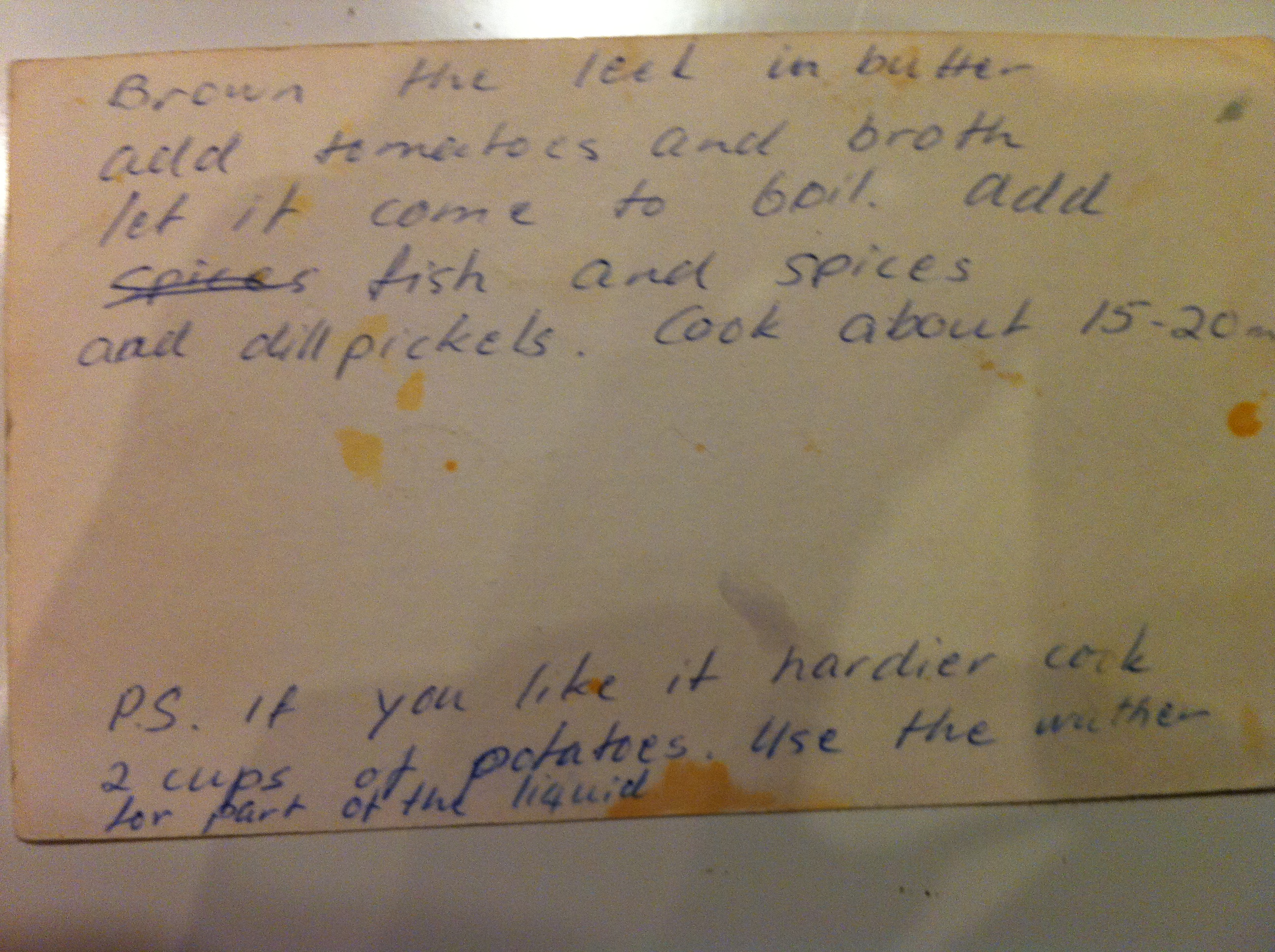
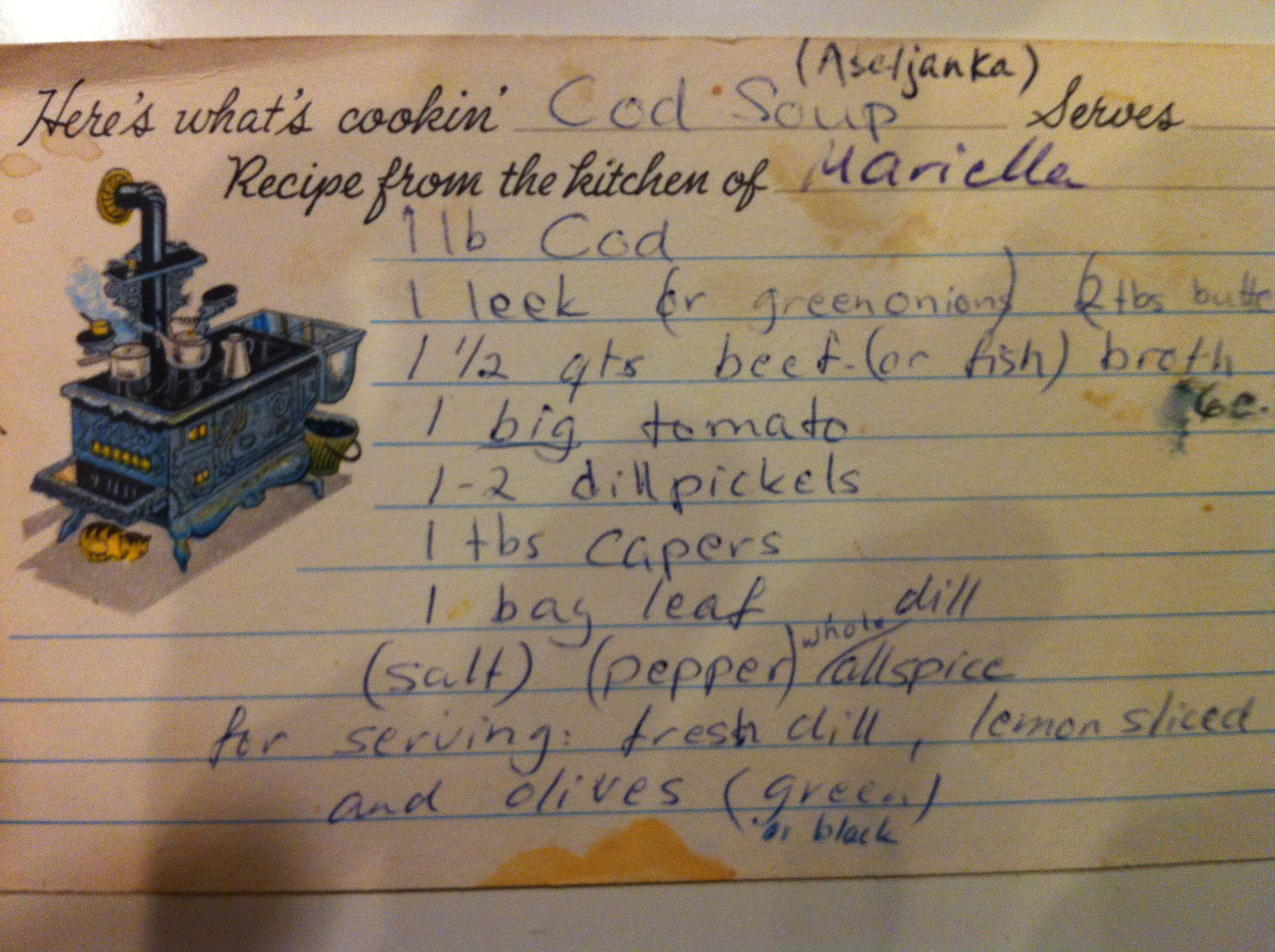
Cod Soup (Aseljanka or Seljanka)

1 lb. cod (fresh if you can get it, but frozen will do)
1 leek, sliced (or equivalent green onions)
2 T. butter (olive oil is fine)
1 1/2 qts. (6 c.) beef or fish broth
1 big tomato, diced
1-2 dill pickles, diced
2 c. diced, boiled potatoes (optional)
1 T. capers
1 bay leaf
dill, whole allspice, salt, and pepper to taste
(if you use canned broth, don’t add any more salt)
For serving–fresh dill, lemon slices, and sliced olives (green or black)

Brown the leek in the butter (or oil). Add tomatoes and broth. Let it come to a boil. Add fish, pickles, and spices. Cook about 15-20 minutes.

If you like it heartier, cook 2 c. diced potatoes separately, and then use the water as part of the liquid. Add with the tomatoes and broth for a total of 6 c. liquid.

(Sprinkle with fresh dill, add some olive slices and lemon slices. I usually also squeeze a quarter of lemon over each bowl for more lemon flavor.)

What Comes After Valentine’s Day

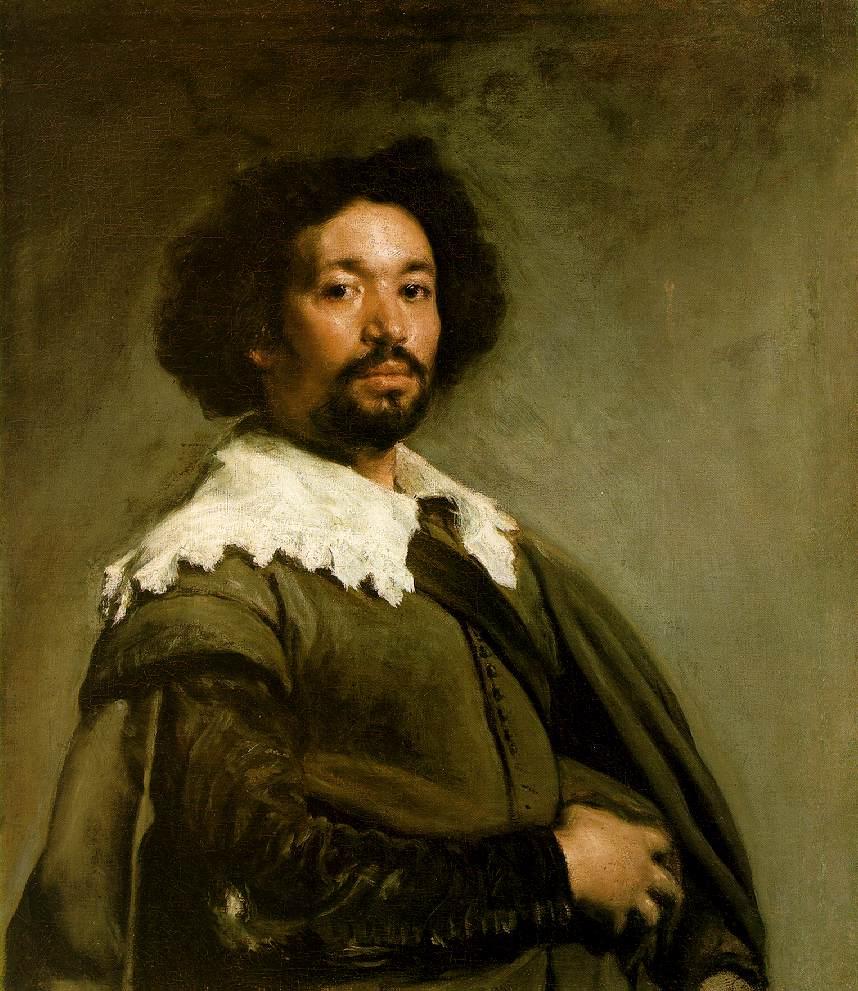
Diego Velázquez’s portrait of Juan de Pareja, c. 1650, in the collection of the Metropolitan Museum of Art, New York.

“Are you ready to make plans for New York now?” Bruce laughs a little hopelessly as he asks.

I feel the panic rise in my throat like a hairball, even though we are lying in bed. He thinks that a trip is in order for me to meet with my new editor at Oxford and with my agent, who has been unwilling to give me the time of day. He thinks my new relationship with Oxford will make her take notice. And last year we missed making our usual annual pilgrimage to see our dear friends there because I’d had a brain hemorrhage.

Bruce loves the city, loves clearing away all travel challenges with his efficient handling, loves touring galleries, sitting in cafes, and walking the bustling streets, hour upon hour. He loves the atmosphere of culture and excitement that we just don’t have in the city where we live, which is a suburb through and through. He loves to fall into step with our friend Craig, their long legs matching in pace and rhythm as they talk about Kant or Hegel while John and I try to keep up behind them. He loves revisiting his favorite painting in the Met, Velázquez’s portrait of Juan de Pareja, and holding my hand while we stand in front of the soulful eyes of a man long since dead whose pain and dignity we can still feel. He and I both love that a slave could hold himself so proudly, undaunted by the injustices of his world.

Last time we flew to New York, however, my feet swelled so badly I had to get a new pair of shoes. Now I have been diagnosed with arthritis in my right foot. Now I have mysterious and as yet undiagnosed damage in the left basal ganglia of my brain. Six months of doctor’s appointments and tests later, and I still feel uncertain in the world. I want to stay close to home.

So I cry and tell Bruce that I can’t do it. Not yet, while I don’t know what the future holds. I tell him angrily because I am afraid. I tell him that I know he wants to travel—he wants to take me to Berlin this summer and to Kenya someday soon—and that he may have gotten a bad deal when he married me just two and a half years ago. It has not been a very romantic time since we got married, especially the past year and a half since the brain hemorrhage—and now all this.

“It’s okay,” he says. “I may just have to travel by myself.”

I know this is his attempt at letting me off the hook, but it makes me cry harder. It makes me angrier.

“Oh, great,” I say. “It’s not like I don’t want to go. Don’t you understand? I can’t physically do it. I can’t pound the concrete with you and Craig. I can’t stand for hours on the hard museum floor. I will be in agony if I try to do that. But being left behind doesn’t sound like that nice of an alternative.”

We lie silent for a few minutes as disability wafts over us in the air from the slowly turning ceiling fan.

It is a couple of days before Valentine’s Day, but the day after I have a lumbar puncture scheduled for an analysis of my cerebrospinal fluid. We have no plans to celebrate the love holiday. We both know that it is a marketing ploy, and we agree with efforts to knock back the Romantic-Industrial Complex. We have also each spent enough Valentines Days alone over the years to have experienced the whole thing as yet another competitive way for some people to feel superior to others—“I’m loved and you’re not. So I’m a better person. Hah.” We are aware of all of that, but we also are just tired and distracted by my health and other depredations of things we hold dear (like our lives’ work in higher education). These things put a damper on the mood.

Bruce is no Newt, but I am also well aware that the divorce rate is higher among couples where one member becomes chronically ill or disabled, and I am well aware that men leave disabled women more often than the other way around. I have also been rejected many times in my life, and I wonder whether Bruce wouldn’t be happier with a spryer partner.

“You may not like this idea,” he says, and I steel myself. “But what about seeing the museum in a wheelchair?”

It is not what I feared, but exactly what I’d been thinking about myself—ways to make things at least somewhat possible. Accommodations, I’d told myself, that’s the key.

“I like it just fine,” I say, and I hear Bruce sigh a little with relief. “I mean, it’s not thrilling, but I have no problem with having a chair to sit in while I look at paintings.”

“We can just take cabs everywhere,” he adds.

“I like it,” I say. “You know, that seems a lot better to me than your leaving me, either on all your travels or completely.”

“That never occurred to me,” he says. Even though this is only one of the reasons I love him, it is a big deal. Maybe one day it will never occur to me either.

Learning to Cry

A few months ago, I shared the viral You Tube video of the woman crying about cats on a dating site. It was a spoof, of course, but it made me wonder how many such videos there are out there. And since my latest post focused on a topic partially related to teenagers, I thought I’d share today what I found when I looked.

This is both hilarious and a little scary, especially, I imagine, if you are a parent of a teenager. Because what I found was a lot of teenagers teaching other teenagers to fake cry. Many of them are aspiring actors and actresses, but many also mention fooling their parents or other adults.

There are dozens of these videos on You Tube alone, almost all of them featuring young people. I featured two that I thought were particularly funny—the goofy boy and the sulky, manipulative girl. But look at more for full effect.

* This girl wins the prize for the fastest fake crying.

* This one recommends the chemical method.

* This one notes that her method is superior since you don’t need any Vicks.

* This fellow recommends exercising the “muscle in your tear duct” so that “even a grown man can cry.”

* The music here gives a yoga feel to crying.

* And this little girl wins the prize for the youngest I could find. She has a really hard time faking, but she is determined.

Because most of these efforts come out of the acting world, there is an underlying ongoing debate about method acting (“think about something sad”) and practical aesthetics or theatrical acting (“exercise the muscle in your tear ducts” and “hold your eyes open til tears build up” or “push” or even “rub Vicks Vap-o-Rub under your eyes”).

Since the goal of most actors, whether method or otherwise, is to create authentic feeling in their audiences, this week I’m going to contemplate the relationship between artifice and authenticity. They are not simple opposites. At least not for everybody.

Oh, Mary, Don’t You Weep

February is Black History Month, and it has me contemplating the meaning and importance of history. History is a story that is re-written over and over again, sometimes to include previously ignored or missed information, sometimes to deceive and cover over shameful events. It’s important for history to celebrate milestones and accomplishments of individuals and cultures, but it is also important for it to record and examine shameful aspects of the past.

Recently, Tea Party representatives in my native state of Tennessee held a news conference demanding that legislators have removed from public school textbooks references to slavery, and especially to the fact that many of the “founding fathers” owned slaves. Texas has already passed legislation that would require textbooks to emphasize a right-wing agenda. And Arizona began destruction of the Tucson Unified School District’s Mexican-American studies program based on a new law that prohibits any academic endeavors that—all in one breath—“promote the overthrow of the United States government,” “promote resentment toward a race or class of people,” or “advocate ethnic solidarity instead of the treatment of pupils as individuals.”

In other words, white oppression may not be mentioned, discussed, acknowledged, or challenged. Next, those loonies who claim the Holocaust never happened will be getting all references to it removed from the world of education. And then who will they come for? No more Take Back the Night rallies? No more St. Paddy’s Day parades? These new laws are attempting to ensure that no story but that of the rich, powerful, and dominant is heard.

There’s also a move on here in Florida to exclude all state university and community college employees from holding office in the state legislature. (These positions pay around $30 K a year, so most who hold them have other employment elsewhere, not that most faculty members would have the time to do both.) The sponsor of this legislation claims educators have an inherent conflict of interest, though there is already a policy to ameliorate any supposed conflict of interest, albeit it doesn’t seem to be working too well. (At the same time, the elements of the state legislature are seeking to privatize prisons and other public functions, a move that would personally enrich a number of them.)

The people behind these legal maneuvers are people who understand fully the power of education, but who wish to use it, at best, as a public relations forum and, at worst, as a brainwashing technique. All the while, they claim that those who have worked so hard to open history to the realities of millions of lives that were for so long ignored are the ones doing the bad deeds. But ethnic studies programs do not preclude the celebration of white achievement. And slavery can be contextualized as a historical phenomenon that does not diminish the other achievements of the early white leaders of the U.S. Erasing reality does just the opposite, but Tea Partiers and other manipulators of history don’t care about that. All they care about is hiding realities that embarrass them and hiding the many accomplishments of groups of people they wish to discriminate against. It is clear that the agenda here is to stop people from examining history honestly and from multiple viewpoints, and to exclude from the political arena any groups that tend to disagree with them.

I really do believe that the devil is loose, and that many good people will find themselves on the chain gangs once again, metaphorically and perhaps literally. These Tea Party types are driving us back toward the evil aspects of the past, not forward into a better, more egalitarian future. That many of them conceive of themselves as righteous Christians is horrifying.

So, I have chosen to share today the old African-American spiritual tune “Oh, Mary Don’t You Weep.” Although it’s a song wherein Jesus instructs Mary not to cry, this is not equivalent to the positivity movement’s denial of feeling or enforcement of cheerfulness. This is a promise of revenge and justice indicating that the evil will eventually drown no matter how powerful they are now.

This song originated in that dark past when rebellion against slavery and white oppression had to be encoded to be shared at all. It has become a shared anthem for many people, black and white (and Native American, as one source notes that 38 Dakota Indians sang it on the way to their execution by hanging in 1862). I hadn’t thought about this song for a long time until last fall when Bruce and I met up with my old high school friend Ruth and her husband, who played a beautiful old-timey version for us. There are many versions available on the web, but I chose to feature the oldest and least fancy of those I could find—to remind me that, yes, all “messages” have an effect, but that some messages are more honest than others. One version of this song contains the lines “When I get to heaven goin’a sing and shout/Ain’t nobody there goin’a turn me out.” There are some places where Tea Partiers can’t recreate history or exclude people.

These are some other great versions with a variety of styles and instrumentation. You could listen to none of them, or one an hour today or one a day for a week. Or just come back and listen to one when you need to remember that change-ups are always in the offing, that “Pharaoh’s army got drownded.”

Pete Seeger

Aretha Franklin

Bruce Springsteen

Inez Andrews

Mike Farris

Silver Hollers with Natalie Merchant

Huntsville Police Department Blue Notes 5

The Will to Happiness is Contra-indicated


Dear Readers,

In my continuing attempt to try new things, I present to you today a guest blog post. A while back, my friend and colleague John King (also one of my most faithful readers and commentators on the blog) emailed me separately a longer series of thoughts he’d had in response to one of my posts. Casually, I said that I should make him a guest blogger, and, lo and behold, he then sent me this erudite little essay.

Don’t worry. I’m not abandoning my responsibilities. The discipline has been too good for me. But I’m hoping to post maybe one guest blog a month to bring more variety to the contemplations here. So here’s to a spirit of experimentation. Let me know what you think.

L

* * *

The Will to Happiness is Contra-indicated

by John King

I am not certain that, as an ad for The Secret proclaims, Shakespeare actually knew “the Secret,” but I am quite sure P. T. Barnum knew the secret behind “the Secret.”

“Smile and the world is yours,” Henry Miller writes in Black Spring. “Smile through the death rattle—it makes it easier for those you leave behind. Smile, damn you! The smile that never comes off!

The Will to Happiness, a.k.a. Positivism, is a willful disengagement with the real world, a form of denial, of censorship. This is precisely the sort of thinking that led the Bush administration to scoff at “the reality-based community” as it planned its war in Iraq. Death toll of the Iraq War: 162,000. This fact would be shameful, if reality is a meaningful entity. But the mainstream media machine, including the mainstream punditry, has never reported the actual death-toll, treating this essential statistic like a psychological tar baby.

This is an affirmation of the unexamined life.

Phobias about negativity, about depression, bad news, agita, and strife, are based on a fear of psychic vampirism, that others will drain you of your vitality, your confidence, your mental health. Schopenhauer believed that the boundaries between others and ourselves is illusory, and in moments of moral clarity, heroes see how contiguous we are with humanity, and behave accordingly. But it takes a profoundly strong person to acknowledge this truth, and there is not always something such a person can do to help others, relieve them of certain brutalities and cruelties of existence.

“Can the world be as sad as it seems?” asks the narrator of Throbbing Gristle’s “The Old Man Smiled.” Marlow loses his mind and his humanity when he sees enslaved Africans in Heart of Darkness. His racism and inability to cope with his experiences begins there and then.

The world of business is systematically skewed towards simplicity and optimism in its communication. According to Kitty O. Locker’s Business and Administrative Communication, business writing should exhibit something called “you-attitude,” a focus only on the immediate concerns of the recipient of a message, without burdening the recipient with any of the sender’s extraneous concerns. And all messages should also feature positive emphasis, whenever possible. On The Simpsons, Mr. Burns re-labels a nuclear meltdown at his power plant as an “un-requested fission surplus.”

The opposite of the Will to Happiness, what we might call Romantic melancholia, is of course also ridiculously out of touch with reality. Shakespeare mocked that self-indulgent impulse in 1602, in Twelfth Night, in the character of Count Orsino, who pleads “If music be the food of love, play on; give me excess of it, that, surfeiting, the appetite may sicken, and so die.” (This is, incidentally, more or less how I feel when I hear nearly anything by Abba.) Unfortunately, unlike Shakespeare, Goethe wasn’t kidding about the Romantic sorrows of young Werther, and today’s goth kids lack the sense not to stew in their own weltschmerz as an actual lifestyle choice.

According to the early twentieth century philosopher Henri Bergson, the most primal laughter is a manifestation of the incongruous knowledge that our minds exist in something like a pure mode of being, godlike, but our minds are, nonetheless, attached to a body that is destined to fail, to decay, to die. This is the foundation of Samuel Beckett’s entire literary and dramatic career. This is the foundation, too, of the mythos of Beckett’s beloved idol, Buster Keaton: the expressive consciousness of his face, juxtaposed with the improbable feats of his body as he strives to contend with the gross, sublime physicality of the world. This philosophy is also the core of the dark, ranting comedy apparatus of Denis Leary’s No Cure for Cancer.

I often find myself drawn to the honesty of cartoons, a genre in which the content is considered culturally debased, and so can afford more satirical gravity than what supposed grown-ups watch. (An inexpensive observation: The Simpsons offers profoundly more reality than Undercover Boss.)

No cartoon I know of has more to say about this subject than that 1990s counter-culture classic, Ren and Stimpy, in particular an episode called “Stimpy’s Invention.” It depicts the terror of the Will to Happiness in a way similar to Henry Miller in Black Spring, but far more disturbingly, in Bergsonian terms. Stimpy, the ever-optimistic and cheerful orange cat, is wracked with empathetic sorrow when his companion, Ren the chihuahua, is not happy. So he builds a helmet that alters Ren’s brainwaves that force Ren’s mind into a happy state. The helmet that never comes off! The pressure of the Will to Happiness escalates.

Ultimately, the ability to voice discontent, pain, and sadness is cathartic. To silence such speech is to deny who and what we are, to deny even the possibility of knowing who and what we are, and so it diminishes who and what we can be.

John King is a creative writer, literary scholar, and journalist. His creative writing has appeared in Turnrow, Palooka, Gargoyle, Pearl, and Painted Bride Quarterly Annual, and is forthcoming from The Newer York. He regularly reviews books for The Literary Review and theater for Shakespeare Bulletin, and is a contributor to Celebrations magazine. He is currently serving as a composition sherpa at the University of Central Florida. His most recent works, a short-short story called “Perfection” and an essay called “The Muse of Florida,” will appear in the new book 15 Views of Orlando.

Angel from Montgomery

This is one of my favorite songs that plays with persona and identity. Serendipitously, my brother reminded me of it this weekend, just when I’d been thinking about how it is that art can transcend identity categories. It’s a beautiful, wistful song, and, as John Prine points out in this video, it’s in the voice of a “47-year-old housewife” even though it was written by him. I might add that it was written by him when he was young enough to think that 47 is old.

Bonnie Raitt, of course, is the person who made it famous. She has a voice like no other and that has transcended genre and made many a convert to country and blues. So, I offer her version, too, even though I put the Prine one first, on the basis of authorship, the lovely video of him on the river, and the way he describes his imaginative process.

Invisible Illness

This month marks the 40th anniversary of my diagnosis with Type 1 diabetes. Other than my trumpeting this fact to a few people (and here on the blog), there will be no fanfare. I find it more seemly that way, even though that doesn’t mean I don’t want to talk about it. And it’s not that diabetes survivors are never honored—the Joslin Clinic in Boston has a program to give certificates at the 25-year mark and medals at the 50-year mark, and last year they celebrated a fellow who had achieved 85 years with diabetes. It’s just that most people who become medalists have to nominate themselves.

Even the term “diabetes survivor” seems funny. We don’t think of it as a terminal disease, even though diabetes kills more than breast cancer and AIDS combined. Most people, in fact, have a lot of misconceptions about diabetes, especially Type 1. I’ve already written about that, years ago, in Sweet Invisible Body. The title of that book comes from the very fact that you can live with diabetes and pass for (and even be) healthy most of the time. Many people never see the disease. I even hesitate to type the word “disease” instead of “condition.”

Some years ago, I faced this issue in a different way. I was doing scholarly work on three writers with serious early-age chronic illness—Katherine Anne Porter (TB), Carson McCullers (rheumatic fever and early strokes), and Flannery O’Connor (lupus). I encountered two distinctly different sets of academic communities that were relevant to my work—one was Medical Humanities (and its sub-set Literature and Medicine, perhaps best represented by the journal of that name) and the other was Disability Studies.

Those titles speak volumes. The Disability Studies community was formed mainly by those with disabilities who desired to be recognized in all their complexity and diversity. The Medical Humanities, on the other hand, focused more on physicians, nurses, and their traumatic encounters with patients’ illnesses or how the humanities might teach humanistic values to numbers-oriented medical personnel. The trouble for me was that I didn’t conceive of myself as disabled, and I wasn’t a health-care provider. I wanted a community of those involved in “Illness Studies” or some such. In spite of the fact that people have been writing literary work about illness for as long as literature has existed, there was no such thing.

Although I have kept an interest in both fields, it’s no surprise that the work in Disability Studies was a lot more directly touching to me. I was closer myself to being disabled than to being a physician, and I was tied to the “patient’s” perspective. So for a number of years I participated in online Disability Studies discussion groups. Of course, these groups did not base membership on whether or not an individual was disabled, but there were sometimes discussions of what counts as disabled. I recall a generous openness in terms of various levels of ability, both physical and mental, and a sense that disability of some sort or another is in most people’s future if not their present. I remember that one person commented to the effect that those who exclude themselves completely from the category are disabled by their own ignorance about it.

In a book called The Wounded Storyteller: Body, Illness, and Ethics (1997), Arthur Frank pointed out that this same logic holds in terms of illness as well as disability. The end of the twentieth century saw an enormous rise in chronic or treatable-but-never-cured illnesses. Diabetes is like this, and cancer has become more this way as treatments have improved. And now, through genetic testing, we even have the ability to diagnose illnesses that aren’t even manifest. Invisible illness has shaded over into virtual or nearly nonexistent illness.

This is why the distinction made by my recent commenter on the “Just Crazy, Not Sexy” post is important. She noted that, though I objected to cancer guru Kris Carr’s “claims to have cured an incurable cancer with self-help and alternative therapies,” Carr “is well aware that she has cancer still” but “believes that her diet is keeping the cancer inactive.”

Remission is indeed distinct from cure, and I should have been more precise, even though I think that the overall impression given by Kris Carr is that of illness banished pretty much entirely. What’s fascinating about Carr is the extent to which it is convenient for her to have cancer with no symptoms and no effects of her illness. In other words, she does indeed have knowledge that she has an underlying condition that could one day affect her health, but right now it doesn’t.

This goes to show that illness does have something to offer: part of the mythology of illness is that it can make one wiser (if it does not make one bitter and therefore evil). Carr claims the wisdom, however, without the pain and suffering that supposedly lead to it. In fact, her claims cut in opposite directions: Carr has the imprimatur of serious illness, but she also has the success of triumphing over that illness and restoring her own health. It’s a powerful combination that attracts many followers even though it is full of contradictions. There aren’t too many people who can stay in that position for long—a couple of years ago I wrote an essay (next to last in this e-book on The Patient) about the “Dying Professor” (Randy Pausch) who stormed the world with his optimistic reaction to a diagnosis of pancreatic cancer, only to succumb the following year. People mostly quit paying attention to him after he was truly ill. (Or they respected his privacy, if you will. Actual illness is ugly and therefore largely hidden.)

I think one reason why someone like Kris Carr has such appeal is that many people still want to think of illness as a temporary situation rather than a permanent situation or marker of identity. In spite of the fact that Frank identified us as living in a “remission society” more than twenty years ago, where illness is almost the norm, there has been no rise in “Illness Studies” and little formalizing of what it means to live as a subject of medical intervention and awareness of the body’s limits for years on end. For many people illness still seems to be short-term—they catch a cold or get a bacterial infection and are definitely ill, but soon enough their good health is restored. That’s the model of our medical world—illness properly treated ending in cure.

In 1999, when I published Sweet Invisible Body, the Guardian published a large (and very negative) article about “malady memoirs” that the author characterized as “malingering” and trivial besides. The author didn’t mention my book, but it was one of about twenty whose covers were reproduced above the article. As an example, the article’s author wrote a satire about an in-grown toenail. That, I thought, is someone who really thinks everything can be cured. That is a healthy person, someone in whose eyes illness is simply an uninteresting transient weakness or something to be hidden. Such reviewers are common, and they judge illness memoirs with a broad brush rather than making distinctions between good writing and bad.

Even many who are ill or who understand the value of examining such experiences prefer the stiff-upper-lip mentality or the “it’s a blessing in disguise” mentality more than something more complex. One of the main reasons they do, I believe, is because they are rewarded for it. It is not the depressed or symptomatic sick person who gets on national TV. Randy Pausch—because of his cheerfulness not because of his illness—gained many privileges, such as visiting with his idol Sting and tossing a football with the Pittsburgh Steelers. Kris Carr—because of her insistence on a can-do attitude not because of her asymptomatic illness—has become a self-help brand-name. The Make-a-Wish thing seems appropriate to me for ailing children, but there is a strong push for a trip to fantasy-land for adults as well, as long as they “deserve” it by being upbeat.

One thing that it’s important to note is that plenty of avowed healthy self-help gurus give us the same basic message that Kris Carr does, only they don’t have the added value of supposedly having overcome cancer (even if in the fine print it’s only “remission”). The cancer’s remission is added “evidence” of the effectiveness of her self-help recommendations.

Why does it matter to me that Kris Carr isn’t symptomatic, that she hasn’t actually experienced much sickness over the years she’s been building her cancer guru empire?

The status of someone in a particular identity category is something we grapple with every day in the field of creative writing. Male writers write women characters, and black writers write white characters, and vice versa. Sometimes fiction writers even use a first-person narrative voice for a character completely unlike him- or herself. We reserve and defend the right to do so. That is what imagination is for, and much good writing takes this kind of imaginative habitation of another life. The best of such efforts, of course, produce great literature suffused with empathy and near clairvoyance.

Yet I believe it does take a sense of responsibility to inhabit a different kind of persona—it is not something to be done in a cavalier fashion. That is why even fiction writers do a lot of research. That is why it’s a perfectly legitimate criticism of certain macho male writers that their female characters are flat and inaccurate. That is why I was so ecstatic and relieved a couple of years ago when one of my students (a young white twenty-first-century male) wrote an honors thesis that was a novel set in the 1930s with an African-American main character, and the African-American historian on his committee said, “I don’t know how you did it, but you really nailed it.” (He did it, I note, by a deep desire to understand, not by a desire to use, usurp, or pretend.)

In memoir writing, this issue is perhaps just as complex and vexed though in different ways. In spite of many naysayers like the Guardian reviewer, memoirs about chronic illness continue to proliferate. I’ve read a lot of them, and sometimes I even sympathize with the Guardian reviewer because a lot of them are poorly written with little insight. In fact, even supposedly literary ones tend to be characterized by a kind of rah-rah boosterism or tried-and-true emotional answers. James Frey’s infamous A Million Little Pieces, which was, after all, essentially a story of overcoming the illness of addiction, turned out to be a false memoir. Some of us suspected it was before the scandal hit—because his story of curing himself of alcoholism seemed way too easy.

As a person who writes fiction as well as nonfiction, I think frequently about identity and identity categories. Certainly, the fact that “it really happened” is never enough to justify a piece of writing. Many in the world of memoir-writing, including me, also support the use of the imagination in writing them. But it’s all too easy for us to ridicule the many slavish readers who thought that Frey offered them hope and a method for overcoming their ills and then became naively furious when he turned out to be a fraud. Yes, they were naïve. Yes, there is often an unfortunate confusion between self-help books and memoirs. But he’s the one who was a fraud. Both fiction and nonfiction should be more truthful than the bull he sold.

So, what is the distinction between imagination and fraud? The two are often closely tied, and many terrific writers are known as frequent fabulists in daily life as well as on the page.

What, in fact, constitutes a truly inspirational story? Do such stories always need to end in triumph?

As a person with a long-lived illness who encounters frequent and ever-increasing symptoms, but who manages to hold death and more severe disabilities at bay for now, I have to answer in a certain way. I have to say that for me Samuel Beckett’s narrator in The Unnameable, sums it up well: “I can’t go on. I’ll go on.” This is the balance of emotional honesty, and it is based on genuine experience, not what sells. It also, it seems to me, reflects a deeper optimism than “I’ll go on” by itself would. I also have to say that imagination is distinct from fraud, and that there is such a thing as emotional honesty in whatever genre.

It’s the difference between a discreet poisoning and a mere threat, between a stomach ache and gold-bricking. It’s the difference between what is there that we can’t see and what isn’t there at all, at least not yet. It is a tricky little devil to put a finger on.

The Queen of Garbage

Recycling transfer station, Gainesville, FL. Photo by BWingYZ.

I sometimes feel like the Queen of Garbage. Around our house, I’m the one who mostly deals with it. This is not the result of some plot on Bruce’s part— I am the long-term expert at dealing with kitty litter (and, to be honest, kitty vomit), and I am just far more obsessive about garbage than he is. A friend once told me that I reminded her of Andie MacDowell’s character in the film sex, lies, and videotape (directed by Steven Soderberg, 1989) who sat in her therapist’s office worrying about a barge of garbage stuck in the East River. My friend thought this comic.

My first memory of playing this role arises from my early teenage years when my old friend Sharon visited my family one summer. Sharon’s parents and my parents had played bridge together when we still toddled around with pacifiers in our mouths, and we’d stayed friends of the summer-visit variety. When Sharon saw me take a pile of newspapers down to the garage one day and add it to the considerable stash along the far wall, she asked me what was going on.

“The Boy Scouts do a drive every year to recycle the papers,” I told her. “And see here?” I showed her the extra garbage cans we kept for glass and aluminum. “We take these to the K-mart recycling dumpsters, too.”

“Your family is a bunch of fanatics!” she said. “You’re crazy!”

Thirty-five years later, I feel sure that Sharon and her family recycle, too, but even now there are a lot of people who don’t.

Bruce and I purchase a lot of stuff through the mail. Evidently everyone on our street buys a lot of stuff through the mail. As far as I can tell, I am the only one who bothers to break down boxes for recycling. The recycling people will only take the cardboard if it’s flat. We let boxes pile up in the garage for a while, and then I go out with the hunting knife I found when I bought a house years ago and cut them down. Sometimes I think about the new life I gave the once abandoned knife—that’s a kind of recycling, too.

And I spend hours trying to find homes for the stuff we don’t use. Recently I made a trip to Goodwill with a carload of household items—glass cookware we can’t use on the new induction stovetop, extra mugs that overflowed the cabinet long ago, some of the plethora of cloth book bags that we seem to pick up at every conference we attend. I was dismayed to learn that Goodwill won’t take blinds, as I had finally convinced Bruce to give up a large bamboo blind that we have no place for in the house we bought three years ago. I didn’t, however, put it on the curb. Instead, I put it back in the garage and began making a list of things we can give away or sell for cheap through Craig’s list.

I did a lot of this when Bruce and I moved into our house together. We owned two lifetimes of accumulated stuff, and we had to winnow it down. But Bruce laughed at me when I said we should do something with all the boxes. We had a lot of boxes—too many to break down for the recycling truck. Bruce was ready to put them on the curb. Instead, I posted them as “free” on Craig’s list. Bruce said no one would want them, but within an hour, I had six different people offering to come and get them. They were perfectly good boxes.

My grandmother, on the other hand, hoarded. It’s a thrifty habit. And like the genes that change our metabolisms when we try eat less to lose weight, I’m sure the saving gene once had a good purpose, too. But we live in a time of overkill not of scarcity, both with food and with stuff. It’s no wonder that obesity and hoarding both seem to be on the rampant rise these days. At least, I tell myself, I don’t hoard.

Nowadays, I take any peanuts and other plastic-y packaging stuff to our local UPS store, where they are glad to re-use them. Because they don’t pick up office paper curbside, I haul mine to campus. I’ve taken metals to a metal recycling business, and I’ve taken electronics to a business across town that supposedly re-uses parts. (It seemed to me that mostly they were in the process of smashing every part and extracting the metal, too, but at least I tried.) I take my diabetes pump supply cast-offs to the fire station in sharps containers for proper disposal of medical waste. (This is relatively easy here where there’s a fire station program, but for years I had to hunt down ways of getting my medical waste into a proper channel.) And I make frequent trips to the garbage transfer station in our area to drop off the many dead batteries that we have from my insulin pump, blood sugar meter, TV remotes, fake candles, and various computer peripherals like mice. I like the transfer station the way some people like the wrong side of the tracks—it is like a glimpse into another world entirely, with the huge, lumbering trucks and cavernous space filled with the detritus of our lives: scary and all too real.

I do other things, too, to try to be environmentally responsible. I long ago quit buying water in bottles, for instance. Bruce and I have a collection of long-lasting drink bottles, and I drink water out of the public water supply. It is the cleanest and safest in the world, after all, even if it’s not from some “pure” spring in Fiji. It was easy to make this change after I saw the water bottling plant in Bellefonte, Pennsylvania, where I once lived. Bellefonte’s public water supply came from a spring, so a company bottled it and sold it as “spring water.”

Both Bruce and I—and most of the people I know—try to make choices along these lines. Most of us feel that the earth is a ticking time bomb of pollution and poison. I go to a lot of trouble, but I know it’s not enough. I often wonder if the gasoline I’m using to drive stuff around to these various places is worth it, and I’ve had my suspicions that all the stuff that gets picked up curbside is just dumped back in with the rest, a kind of p.r. stunt. I’ve known people who do a lot more than I do—one who gave up cars completely, one who left his job as a philosophy professor to join an organic farming cooperative, others who established careers related to protecting the environment or educating kids about it.

Recently, one of these latter—an old friend who works as an attorney for the EPA—lamented that she believes that recycling has become just a sop to make people feel better. I know she is right, and she made me think about what it means to be environmentally friendly. How is that term defined in a meaningful way? The EPA has, in fact, deemed the term useless in the commercial world due to a lack of clear definition.

For most of us as individuals, it’s very confusing, and I believe that most of us do only what we can see, what is simple, and what is right in front of us. I find it worthwhile to turn off the lights when I leave a room—in fact, I follow Bruce around and turn lights off after him, too. But in more complicated situations, it’s frighteningly hard to tell what’s for the best. When Bruce and I bought our house, we needed to replace miles of hideous, worn and dirty beige carpet. I did hours and hours of internet research about purveyors of wood flooring, looking for a company that had responsible environmental and labor policies. Pretty much all of them claimed they did.

We went through a similar task when we looked for our wedding rings. Mining—both metal and diamonds—is a particularly nasty business that most of us never see. But in my younger days, I’d driven around Copperhill and Ducktown, Tennessee, and I had seen first hand mining’s destruction. Though much of that land has now been reclaimed, it was denuded for better than a hundred years. I wouldn’t want to live there even now. We bought rings made from recycled metal. At least that’s what we were told. We don’t feel any ability to really know the impact of our choice.

All of this raises for me again and again what it means to be genuinely one thing or another. How do we gauge our own intentions? Do I recycle just so I can have the imprimatur of a “good person”? Do the hours I spend sorting garbage and cutting down cardboard boxes mean anything besides just another form of waste? And are my intentions what matter? No doubt they are good, but I may not demonstrate enough follow-through or commitment. Other things distract me, and my carbon footprint no doubt remains too large. At least, I tell myself, I have been doing a few things over many long years. At least I am not a Johnny-come-lately to trying to do my part.

Bruce and I were talking about this the other day, when I was contemplating to what extent I’m just a half-assed person with commitment issues. We started to generate a list of other ways in which he and I each have been unable or unwilling to “go all the way.” Some of these are not so clearly desirable as environmental sustainability and concern, but they share the expectation of purity.

Bruce and I started our list by chuckling over what I have for a long time called “macho yoga.” Just a few days ago, the New York Times featured an article about the dangers of yoga. I was glad to see them finally catching up to reality. Back in State College, Pennsylvania, during my grad school years, I classified the yoga schools and instructors in town into the “gentle” camp and the “macho” camp. My friend Mary, a returning middle-aged college student, alarmed me when she told me that after a month, her college yoga class was doing headstands. I said, “No way. You’re going to hurt yourself.” Sure enough, she herniated a disc. Yet in our town, there was a certain éclat of the macho yoga schools, and they turned up their noses at anyone else. At a party once, I had one of them tell me that I couldn’t be a true yoga devotee unless I did headstands. I already knew that I was never going to do headstands.

Bruce told me about his own discomfort with the proselytizing brand of Christianity that he was inculcated in when he was at Bible college. “I still consider myself a good Christian,” he said, “but I know a lot of people wouldn’t. For me, it’s more of an internal thing.”

Along similar lines, I have found myself uncomfortable with confrontational politics. Off and on over the years, I have made numerous attempts to advocate for candidates I believe are better than worse, to engage in canvassing, to make phone calls as elections neared, and so on. My brother has always been good at debating issues and has long been involved in local politics, but I am terrible at it. I feel that it’s necessary, but it just about gives me heart palpitations and I usually just end up making someone mad. I am much better at writing things down, and I hope that my occasional forays into issues in this blog is a genuine way that I can make a contribution, even if it isn’t protesting in the streets or knocking on doors.

Perhaps most important of all to me right now is the issue of our marriage. It took me 49 years to get married, even after a therapist told me in 1983 that I had commitment issues. Even now, happily married to a great guy, I tell myself at least once a week that it won’t last. I have learned to talk back to myself and say, “Yes, it will,” but I have a fear of disappointing both of us. I often wonder if I am a genuine wife or if I am kidding everyone including myself.

These constitute an array of issues that I feel very differently about—I want to be totally committed to my marriage, I want to be a better environmentalist, but I have accepted my low-level role in politics and I have no desire whatsoever for Bruce to become more evangelical or for me to do more strenuous yoga. Yet it was interesting to compare the ways that definitions of terms define us in each of these arenas.

This is an enormous issue in today’s political world. In an article in the upcoming February 2012 issue of Harper’s, “Killing the Competition,” Barry C. Lynn notes that the powers-that-be “have undermined our language itself” by redefining various terms. “Corporate monopoly? Let’s just call that the ‘free market.’ The political ravages of corporate power? Those could be recast as the essentially benign workings of ‘market forces.’” In another recent article, Rodolfo F. Acuña notes how euphemistic language is being used as a tool for racism. Acuña is a lightning rod in battles in Arizona over a recent law that was passed that made it illegal for “any school program to advocate the overthrow of the government, ‘promote resentment’ toward a group of people or ‘advocate ethnic solidarity.’” Like those three things are necessarily related. In other words, any kind of ethnic studies (except, of course, white) has been shut down in Arizona, where attorney general Tom Horne has re-defined many life-long Americans of color as “separatists.”

I don’t have any final answers to any of these definitional questions. The EPA is right, and we all need to look closely beyond the title of “environmentally friendly.” We all need to look closely behind all the double-speak of politics, and we all need to look at how we define ourselves.

I may not be the best environmentalist in the world, but I will still claim the title of Queen of Garbage around here, and I have every hope that my role will be valued in my life-long marriage.

The Sweet Hereafter

Today’s post commemorates Mychael Danna‘s soundtrack music, but also the film it was written for, The Sweet Hereafter, directed by Atom Egoyan, and the novel of the same name by Russell Banks. The novel and the movie, though distinct, both illuminate the aftermath of a tragic accident of a school bus and how it changes the people of a small town.

This is as wintry a tune as can be, and, though we don’t have much in the way of cold weather in Florida, I know that many are going about new semesters at school (or just another work week) in the snow or chilly rain or snappish air today. May this song make us all take a moment to remember to be careful in all our rushing around.

All of us, no matter the weather, suffer the blame game. We give it and we receive it from others and ourselves. At times designating responsibility is perfectly appropriate, but often the anger that goes along with blame masks the emotion that’s more at root and more genuine: sorrow. That old human condition is as tough as it is beautiful.

Here’s the trailer for and review of the film, and a brief interview with Russell Banks about his inspiration for the novel. And here’s an auto playlist for Mychael Danna in case you have more time for peaceful, interesting music in your day or evening.