Category Archives: Culture & Arts

Wislawa Szymborska’s “Slapstick”

Posted on

I try to be careful about copyright here on this site, and I only share an entire work when it’s already available on the web. That seems backwards a little bit–if it’s already available, why do I need to share it? (And it’s no guarantee that the previous poster is not breaking copyright.) But we do follow different strands of the web, so I hope that doing so will bring more people to the work I share. Here is a poem that I value–and that suits my themes–for obvious reasons. But that’s the only thing that’s obvious about the work of the wonderful Polish poet Wisława Szymborska, who died in February.

Slapstick

If there are angels
I doubt they read
our novels
concerning thwarted hopes.

I’m afraid, alas,
they never touch the poems
that bear our grudges against the world.

The rantings and railings
of our plays
must drive them, I suspect,
to distraction.

Off-duty, between angelic-
i.e. inhuman—occupations,
they watch instead
our slapstick
from the age of silent film.

To our dirge wailers,
garment renders,
and teeth gnashers,
they prefer, I suppose,
that poor devil
who grabs the drowning man by his toupee
or, starving, devours his own shoelaces
with gusto.

From the waist up, starch and aspirations;
below, a startled mouse
runs down his trousers.
I’m sure
that’s what they call real entertainment.

A crazy chase in circles
ends up pursuing the pursuer.
The light at the end of the tunnel
turns out to be a tiger’s eye.
A hundred disasters
mean a hundred comic somersaults
turned over a hundred abysses.

If there are angels,
they must, I hope,
find this convincing,
this merriment dangling from terror,
not even crying Save me Save me
since all of this takes place in silence.

I can even imagine
that they clap their wings
and tears run from their eyes
from laughter, if nothing else.

I believe this version was translated by Joanna Trzeciak for the volume The End and the Beginning, published in 1993 and now available as part of Szymborska’s Poems New and Collected (Harcourt, 2000).

T. S. Eliot’s “The Waste Land” and My Garden

Posted on

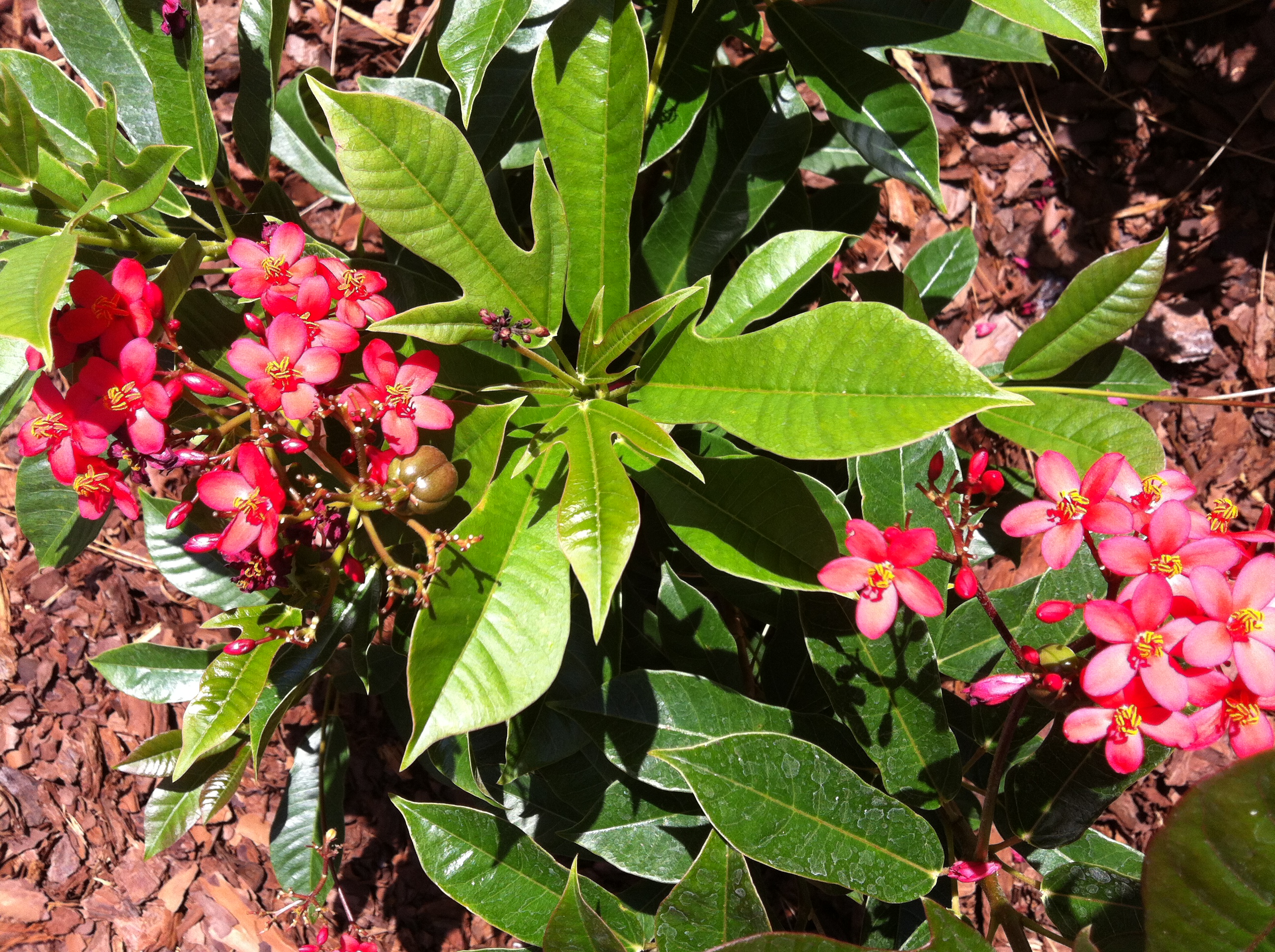
The glories of spicy jatropha contrast with T. S. Eliot's cruelest April.

I’ve had cause the past days and weeks to think a lot about life and death and resurrection. My little old cat marshals on, happy at the same time that she is not perfectly healthy. It’s been a lot of work getting her through her recent crisis, and we don’t know whether she has lymphoma, which will kill her in a matter of weeks, or inflammatory bowel disease, with which she could live on for quite some time. All we can know right now is that for the time being she jumps up on my lap for a cuddle and she rolls around on the patio bricks in the sunshine.

Early spring sunshine in Florida is incomparable. This is the time of year to be here.

With the help of a couple of wonderful gardeners last week, Bruce and I also finally took steps to make the yard beautiful—we replaced the dead grass in the front with shade-loving camellias, crepe myrtle, impatiens, and lorapetalum. We (or rather Lois and Allan) ripped out and relocated (some of) the overgrown ligustrum, put an herb garden in the side yard, and filled in our formerly sunken area by the patio with a butterfly- and hummingbird-friendly rim of firebushes, spicy jatropha (seen above), plumbago, shrimp plants, and tea olives. The confederate jasmine I planted last year is in full, fragrant bloom, and the gardenia that Pat gave us for our wedding three years ago is budding. I have been reveling in it.

And so it is that I was reminded of T. S. Eliot’s most famous line, “April is the cruelest month.” I think that April has this reputation for cruelty for many reasons. I used to always think about it during Pennsylvania Aprils—the alternation of snow and new green plants trying to poke through the muddy ground, the ice that would so often fall from the sky and kill those new green shoots—those were cruel weather days indeed, and days that could easily remind a person of the vicissitudes and unpredictability and fragility of life.

Here in Florida, we don’t really have that kind of cruelty, though, of course, we have the threat of hurricanes half the year (and their occasional massive actual destruction), and we have the suffocating heat and humidity all summer long that create our own upside-down indoor season. The way the flowers blossom so riotously all year round, however, often gives us the delusion down here that life is never-ending.

But we have to remember that the resurrection that so many celebrate at Easter entails death. A former student sent me a message asking if I would like to adopt a stray cat she found. The answer is “not right now,” but the timing points out to me that eventually my old kitties will all be gone, and they will make way for new kitties. The same is true of all of us, even for the Nobel Prize winners such as Eliot, and lately I have been experiencing this fact more concretely than usual. Not because I’m near death, but because I have been enjoying life so much and letting go of my desire to be immortal.

So much of our usual human endeavor (but perhaps especially if we are writers, artists, or intellectuals of some kind) is an attempt to be immortal. This comes in different forms, from having children to making ourselves important or indispensable at work somehow. Sometimes it comes in the form of grasping for fame or notoriety. Sometimes people even see beyond the surface fame to a desire to create something lasting in the way of art. Sometimes we have a desire to change things beyond ourselves, to have a positive effect on a culture that seems unhinged. These efforts sometimes result in good work, and I don’t mean to castigate anyone for making them. Certainly I haven’t entirely stopped myself. I’m just in a different place, at least mentally, right now.

I am finding it enough just to be. I know, cluck, cluck, this should be too simple.

Last night I heard Cameo the cat chirping and mewling low in the dining room. At first I thought this was a symptom—she might be in pain or distress of some sort or about to throw up—and I leapt up to go see what was wrong, as I have so many times in the past few weeks. But as I stood, she came running into the living room and put a small dark object on the rug in front of me. I bent down and poked it, the largest dead spider I had seen in years.

Cameo the cat had been hunting. I couldn’t believe it. She’s never been a big hunter to begin with, and I certainly wouldn’t expect it in her current state of health. But she had made the most of some accidental opportunity, and she’d brought me the proverbial cat gift. I praised her and petted her and apologized for taking the spider away (I certainly didn’t want her to eat it).

I feel silly and trivial for the small, domestic frame of my life these days. I feel retrograde and haus frau–like. Yet it is not that I have forgotten about the larger world or the social, political, and intellectual issues of our day. In fact, when I got out Eliot’s famous poem because of its first line, one of the things that struck me was how prophetic it is. If Eliot thought that the first decades of the twentieth century were fragmented and confusing and grim and showing signs of cultural decline, what would he think of the first decades of the twenty-first century?

What would he think of the strength of our anti-intellectualism, the put-downs of the “reality-based community” that Bruce mentioned in his guest post last week? What would he think of the dominance of the short-short form of fiction and nonfiction (which I adore like everyone else), or the impatience with reading that even writers show so often (which I despair of)? What would he make of the fact that, though I love poetry, I hesitated before taking the time to read his entire long, allusion-filled, complex, five-part poem?

I paused, but I then took the time to read it. Then I listened to it on a compilation of YouTube videos (all of these feature T. S. Eliot reading, except part IV, which is the voice of Ted Hughes). And I don’t mean to blame anyone else who doesn’t take the time. I’m on sabbatical, after all, and taking the time is what it’s for. But even a short dip into listening is a good thing.

I. The Burial of the Dead (with the overall epigram) 5:07 minutes
II. A Game of Chess 5:29 minutes
III. The Fire Sermon 8:05 minutes
IV. Death by Water (read by Ted Hughes) 48 seconds
V. What the Thunder Said 6:30 minutes

Art, I believe, takes time, and that has to be okay. I wish it were as easy to make that claim for politics—that it could get beyond the sound-bite, beyond the knee-jerk, beyond the name-calling, beyond the superficial answers that answer nothing. However, the mass scale of politics is a challenge to any slow unfurling or contemplation. Would that it were not so and that “The Waste Land” were not indeed still so relevant. Would that the call to peace in its last line were more optimistic and less wishful thinking.

Eliot’s poem builds to that end with a reference to Dante’s Arnaut—“I … who weep and go singing; contrite I see my past folly, and joyful I see before me the day I hope for.” Though interpretations of Eliot’s poem vary widely in terms of the lack or presence of hope, I believe it leaves us with the inevitability of both. A grim outlook does not disavow hope. And at least sometimes the greatest activity can be disguised by a quiet and self-contained demeanor, the greatest complexity in paying attention to the smallest things.

In other words, spring will happen with all its implications. I like feeling my eyes open to it as well as my mind. I like hearing T. S. Eliot’s nasal and weary voice—and Ted Hughes’s more gravelly and pleasant one—marching out the syllables. I like observing how unflawed their delivery is—how neither ever trips over a word. You can tell that they have spent a lot of time memorizing and reciting poems. They did that instead of playing Scrabble on the iPhone, no doubt.

Ah, these choices about how we spend our short time.

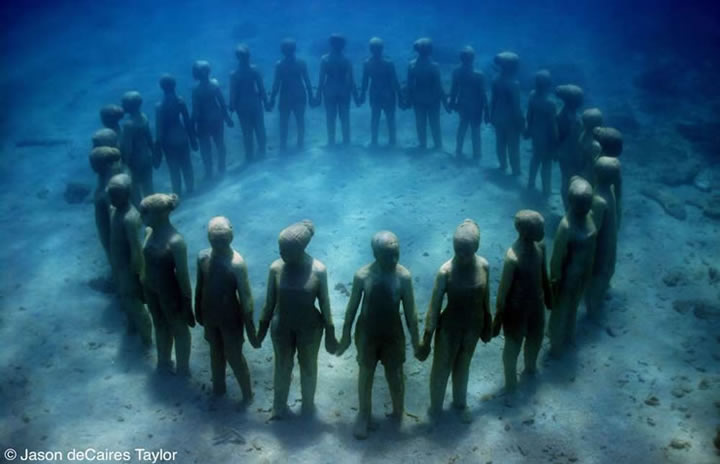
Jason deCaires Taylor

Posted on

Jason deCaires Taylor's underwater sculpture Vicissitudes.

I’m at the age where I have a huge backlog of memories and experiences to draw on. One thing that this means is that usually when I post something here about an artist, a movie, a book, or a poem, I find myself going over and over again to the well of my old favorites.

It’s wonderful, however, to add new favorites, and Jason deCaires Taylor has become a new favorite. A former student of mine recently posted a photo of Vicissitudes on Facebook (thanks, Niah), and I was captured enough from that small image to look up more about his work. Time will tell, not only if he remains a favorite with me, but what will happen to his beautiful and moving underwater sculptures.

Right now, however, I can say that I think a lot about them is really, really great. Visually, even in video rather than on site, the combination of the human figures, the blue waters that surround them, and the living fish and other creatures that move around them is stunning. For another thing, they have a practical purpose—because he is concerned about the endangered status of the world’s coral reefs, Taylor structures his sculptures to foster coral growth and hopes that they will help to form the basis of new reefs. Taylor uses live models to make plaster casts and then concrete figures of great diversity and simplicity. Even a few years after their placement under water, the figures show all kinds of changes, and their impending and ultimate obliteration forms a commentary about the human place in the world. There’s a sense that humans who don’t face up to their own eventual death and the fact of their fleshy nature are very wrong. And yet, the sculptures are gentle and loving as well—they mourn our eventual passage all the while demonstrating its inevitability.

Welcome to a new favorite. There are several wonderful galleries of photos on the website (here’s one on The Silent Evolution, and check out others from the galleries tab), but please don’t skimp on watching the videos. They are very different from the still photos, and the sea flows through them.

Coffee Shop Consequences

Posted on

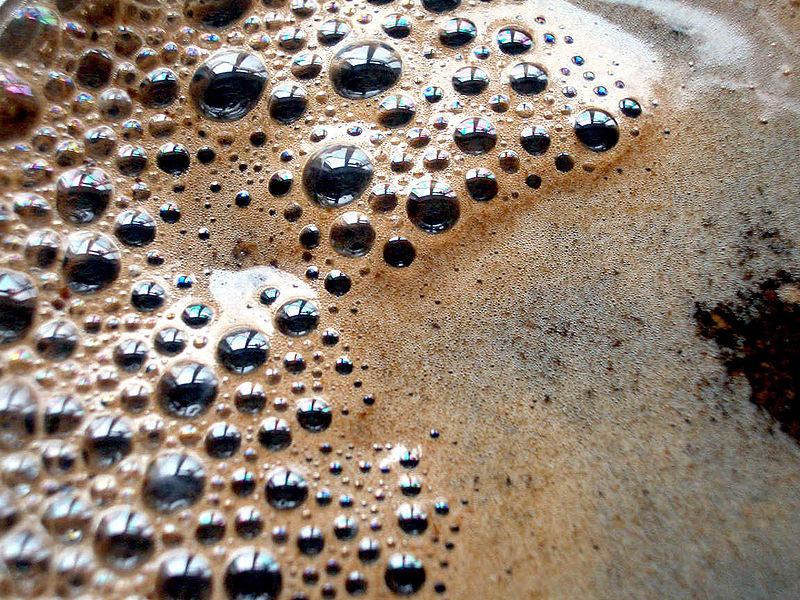
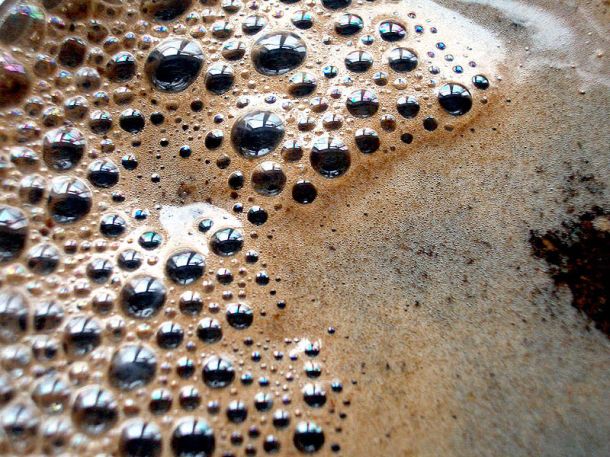
I like my decaf coffee as strong as any caffeine-lover.

I’m about to offend some of you addicts: coffee addicts in particular. I put it this way because what I want to say is that caffeine is a drug, and it’s a drug whose consequences are mightily ignored. I had reason to contemplate this fact yesterday because I went into a coffee shop.

The man behind the counter was about my age—the hair drawn back into a pony tail had grayed, and wrinkles crisscrossed his forehead and cheeks. When I entered through the back door (from the parking lot), he was seated at a large sink washing plates. He looked up sideways at me, but didn’t move. The recognition that passed over his face wasn’t real recognition, just typing. Immediately, I could see he didn’t like me.

Mind you, I had never been in this coffee shop before. I knew of it from my students, who sometimes spoke of its open-mic nights and artsy vibe. The only reason I had stopped there was because it sat directly between the hardware store, where I had gone to buy some plant potting supplies after my haircut appointment, and the hospital medical plaza, where I was due in an hour for an MRI, another MRI.

While I stood waiting, I glanced around the dingy interior. A young man sat behind me at a table, tapping into his laptop, a knit cap pulled down over his head in spite of the 85-degree day. A young couple sat holding hands on one of the sofas in the open area up front, a laptop on the coffee table in front of them, their intensity focused between the three of them. In an upholstered chair, another young man sat with his back to the counter; I couldn’t see his face, but he, too, was young and seemed to be reading, his hair sticking up with gel around his cranium as though very excited about the ideas he encountered. But he slumped in the chair, one leg thrust out as though barely able to hold him up. Bright mid-afternoon light streamed through the front windows, picking up every crumb and smear on the filthy floor. I didn’t mind. I have worked in many a dirty restaurant in the past. All I wanted was a peaceful place to pass half an hour or so, reading the book I’d brought along for this very possibility of a time gap.

Finally, the aging hipster stood up, wiped his hands across his apron and asked me, “What can I get you?”

“A medium decaf latte, with skim if you have it,” I said.

He moved over to the espresso machine. “What size?”

“Medium,” I said. I liked that Austin’s menu board used small, medium, and large instead of the deceptive and silly tall, grande, and venti.

“You said decaf, right?”

“Yes,” I said, and then because the barista response is so predictable, I tried to make light of my request. “You don’t want to see me on caffeine.” I wiggled my fingers in the air.

He did not smile. Sometimes they do and sometimes they don’t. But I was starting to get worried. I mean, I was the brain patient, and my short-term memory seemed better than his.

“What kind of milk do you want? We have whole, half and half, two percent, soy, and skim.”

“Skim is good,” I said.

I tried not to stare as he moved around the space, tamping the coffee and turning the levers, so I looked back out the front window as a kid wheeled off on a bicycle. When I turned back, the guy was putting the whole milk back in the fridge. I decided to let it go.

Then he asked if I wanted whipped cream. A little surprised—since when is whipped cream part of a latte?—I shook my head and said no emphatically. He poured the last of the milk with its top of foam into the cup, then lifted a plastic bottle and squirted Hershey’s chocolate syrup all over the top before I could say a word. Who puts chocolate syrup on a latte? My god, I thought, he must have a lot of those little girl customers to whom coffee drink means sugar drink.

I gave the man my five-dollar bill, then transferred the change into his huge and stuffed tip jar. Briefly I contemplated the ridiculousness of this current coffee fad. We’ve all gotten used to the idea that these large sums are worth it to get exactly what we want in a cup of coffee.

However, I at least seldom get exactly what I want in a cup of coffee at a coffee shop, and I am vowing now to give it up pretty much entirely. If I have to meet someone at a coffee shop, I will order something else. Because I am very tired of baristas giving me caffeinated coffee when I order decaf. And I am tired of the attitude that also sometimes comes with such a request. Still, I would rather have the put-down attitude and get my decaf than have the silent but disobedient person who chuckles as he gives me a drug that my body cannot handle.

One barista even asked me once why I bothered if I was going to have decaf. Usually I am mild in my response—after all, these people have my coffee in their hands—but what I always want to say is, “Can’t you see that the person who orders decaf is the one that really loves coffee? All I want it for is the flavor. You caffeine drinkers are simply using it as a vehicle for your stimulant. Why not just take it in a pill if that’s your motivation for drinking coffee?”

I am a genuine coffee lover. I love the smell of it, I love the taste of it, the darker the better. Unless I drink the occasional latte, I drink it black as I can get it. I seek out French roast or at least Italian when buying it for home use, though it can be hard to find. I virtually never add sugar to it.

Yet, over and over and over and over, these macho little baristas (who are indeed always skinny) turn up their twitchy noses and their stubbled chins at me, and treat me like I’m some sort of inferior being for asking for decaf.

Maybe they find an excuse to treat every mature person this way. I forgive them over and over and over again for being young. I was young once myself, and in my waitressing days, there were numerous times when I would pour a decaf refill from the regular pot. But I only did it in an emergency—when the decaf pot had run dry. True, I didn’t fully understand the importance of the request, but I never sneered. Still, sometimes I tell myself that every time I get a cup of caffeinated coffee it’s just karmic justice. But I’ve paid those dues enough now, and I’m over it. And there’s no excuse for a middle-aged barista acting this way. The coffee world has supposedly opened up in the past decade, and the idea is that there’s a wider variety available and more understanding about coffee.

However, no one wants to hear much about the destructive nature of caffeine or admit it by providing someone a decaf. Smokers love smokers, and caffeine junkies love caffeine junkies. Mind you, I have nothing against caffeine junkies—unlike smokers, their addiction doesn’t waft over into my nostrils. Unlike over-drinkers, they don’t wreck cars and kill people.

Or maybe they do. We’re all familiar with the upside of caffeine consumption—the alertness and fatigue-fighting aspects that seem to apply to both cognition and physical activity. But there are downsides, too. The Mayo Clinic website reports that in addition to the usual side-effects of insomnia, nervousness, restlessness, and irritability, more than 500-600 milligrams of caffeine (about two Starbucks tall coffees) a day can produce stomach problems, fast heartbeat, and muscle tremors. Jack James of the National University of Ireland, Galway, notes (about halfway through this interview) that blood pressure changes from caffeine consumption may be a major factor in cardiovascular disease. A whole host of studies note the bad along with the good in caffeine consumption:

* Good news, bad news
* Fitness benefits and risks
* Be cautious
* Negative may outweigh any positive
* Cognitive impact is mixed

You’ll note that all of these studies rely on an understanding of how much caffeine is consumed, and if you’re curious for yourself, here are some tools for gauging your own intake:

* The Caffeine Database
* Center for Science in the Public Interest caffeine chart
* Starbucks caffeine information

Of course, as with any drug, people’s reactions to caffeine vary enormously based on an individual’s sensitivity. Caffeine is associated with panic attacks, and studies have clearly shown this association, especially for those prone to panic attacks or major depression. But even some in healthy control groups reacted to caffeine with panic attacks or anxiety, whereas none did without caffeine.

And, though not prone to panic attacks or major depression, I’m one of those people who is sensitive to caffeine. Even one cup can make my hands shake and, later, will most assuredly keep me awake all night, no matter how exhausted and strung out I am. This is what happened to me yesterday.

I sat down with my cuppa in Austin’s and opened my book in pleasurable anticipation of my hour of reading. The music blaring from the speakers distracted me a little, but again I felt good-humored about the off-key adenoidal voice, amateurish strumming, and angry-young-man lyrics. “Everyone is interesting but you,” sang the adolescent, who then spat out several expletives. I decided it was the nastiest acoustic music I had ever heard, and it amused me no end that this placid coffee house in one of the wealthiest neighborhoods of Orlando ebbed and flowed with such anger. It went on song after song, and I wondered if the recording featured some local singer, or even the barista himself. It was so bad I had to wonder.

My lack of suitability for this place also flowed over me with the music. I was too old, had no tattoos or body piercings, and was wearing light-colored cotton and sandals. My difference didn’t really matter to me, but soon enough I would think it merited punishment from the coffee tsar. I sat back and turned the pages in my book.

Then my fingers started to feel a little panicky.

Now, an MRI is not an experience to relish. Before yesterday, I’d already had two in the previous 16 months, and I wasn’t really looking forward to another hour in the noise chamber with my head in the tight frame and my eyes shut to prevent claustrophobia, trying to keep my mind busy with thoughts of words, and glasses of wine, and the smell of jasmine on the breeze. So I thought I was just getting nervous about that. Eventually I closed up my book, tossed the cup with its last bit of chocolate syrup and milk foam in the trash, and headed for the hospital, leaving the grunge scene behind.

The MRI was uneventful except inside me. I struggled to hold still as I had never done before. I could feel my fingers and toes wiggle slightly as though they belonged to a different person than me. Half way through, the technician pulled me out of the tube in order to inject me with a contrast dye, and I asked him if I could please please move my hands just a tiny bit.

“As long as you don’t move your head,” he said. It was almost a relief when he pulled my hand over to the side and flexed it back and forth, tied the strip of rubber around my wrist, then slid the needle into the vein above my metacarpals.

During the second set of scans, I found myself holding my breath in order to try to stay still. When I let my breath out, I felt the air rush past my philtrum, tickling me in agonizing fashion. “Be still,” I thought, “and dream of Jean-Dominique Bauby.” It might cause some people panic to think of something like locked-in syndrome when inside an MRI machine, but the experience inevitably makes me think about what I would do if I couldn’t move forever. I try to think about the centrality of my mind to the life I live. I wonder about staying in my mind forever.

Finally, the technician extracted me from the machine. Even after just an hour, I was stiff and took a few minutes to shift around and stand up. I was very happy to get into my regular clothes and walk down the hall and out into the now waning sunshine and to drive home to my dinner.

It wasn’t until midnight that I fully realized the barista had given me caffeinated coffee. In typical fashion, I simply couldn’t unwind and get drowsy. I was tired, exhausted even, from the hour of assaultive noise in the machine and the long day of now-distant work before that. I had watched mind-numbingly dumb TV for two hours, and I expected to sail away into slumber readily. The past three weeks had been some of my best sleep nights in several years. All the work that my husband and I had been doing to help me sleep had been working.

But, no. I tossed, I turned, I played game after game of Scrabble on the iPhone. I turned the phone off and counted backwards from a thousand. I got down to one and started back up, trying to count by threes so some concentration would be required. Bruce sighed and turned over again.

Then it hit me.

“The bastard,” I said out loud.

“Wha?” Bruce roused from his sleep briefly.

“That bastard gave me caffeinated coffee!”

Eventually I got out of bed, took a Tylenol PM, went to the spare bed on the other side of the house so I wouldn’t disturb Bruce any further, cursing the Austin coffee man in one fluid tirade. I felt almost as though I’d been slipped a mickey or doped with rufies.

I gave up caffeine years ago during graduate school because I noticed not only that it kept me from sleeping well, but that it made me irritable and easily annoyed. It made me say things I didn’t mean or that I shouldn’t have said even when I had thought them. Once, at the over-caffeinated end of a long semester, I told a fellow grad student that I hoped I never had another class with her. She’d been characterized by snide asides and had given the most idiotic presentation I’d ever heard in a graduate seminar, but there was no point in me being mean to her. Later, I apologized, but I knew in the immediate aftermath that I had to give up the drug.

All these years later, I wonder if anyone could devise a study that would look into the social cost of caffeine. Sometimes I’m so astounded by the rampant aggression around me—that anger that seems to be bubbling right under the surface so much of the time—that I feel the only rational explanation is that caffeine is making everyone crazy. I think about the Romans and their lead pipes and cooking vessels perhaps being a contributing factor to the downfall of their civilization. While the lead poisoning theory remains unproven and under continuing investigation, I can’t help but think sometimes that I am caught in the midst of a decline in our society that seems to have some chemical basis.

One report in the Washington Times notes that “the rise of coffee parallels the rise of the Internet” and that because of our increasingly connected world and the demands of “economic turmoil in a hypercompetitive global economy,” we “need caffeine… more than ever.” It also notes the increasing concerns about the use of caffeine (usually in the form of soda or energy drinks) in children and adolescents.

What studies show—and, I might add, what just makes sense—is that the combination of this stressful world and the biochemical effects of caffeine is preventing people from getting the sleep they need to be effective and is irritating the heck out of people.

We don’t usually factor in caffeine’s effects when we track causes for auto accidents, though at least one driver recently claimed “caffeine psychosis” for his running over several people. There’s even a growing sense that using a little caffeine to make driving home after drinking a little safer relies on a dangerous myth: drunkenness is simply combined with inappropriate bravado rather than alertness. One trucker comments on Life As a Trucker about “the adverse effects of sleep deprivation and excess intake of caffeine” contributing to road rage. One attorney’s webpage notes that even without alcohol some caffeine-induced symptoms can “dramatically increase the likelihood that a driver will operate his or her vehicle in an aggressive manner or succumb to road rage.”

We don’t factor in caffeine the way we do alcohol and crack when people are arrested for violent crimes. While I agree with the author of this editorial published in the University of South Carolina’s student newspaper—that caffeine intoxication should not usually offer a good insanity defense in criminal cases—the fact that a few people are claiming it indicates that it’s becoming more believable. Most of the cases in which caffeine is correlated with behavioral problems seem to involve the combination of alcohol and caffeine found in some energy drinks and in “monk’s juice.” But in spite of pre-packaged alcoholic energy drinks being banned in 2011 by the FDA, due to numerous college-student deaths and studies that show they break down inhibitions dramatically, the ingredients to make your own are readily available and commonly used. Even energy drinks that don’t contain alcohol are beginning to be linked—in studies and in patterns noted by police forces—to risky and anti-social behavior. A handful of studies are cited on the LiveStrong page about Caffeine & Psychosis, noting that these studies do demonstrate that caffeine can exacerbate certain mental illnesses.

We certainly don’t factor in caffeine when we talk about the ridiculous and verbally violent depths to which our political rhetoric has fallen. Although there seems to be an anecdotal consensus that something has changed in the tone of our national and local politics, the evidence is frequently cited that politics has always contained its share of abuse and conflict. Certainly, as this slide show indicates, politicians have been drinking coffee regularly for quite some time. There is, however, one blog, started in 2011 and partly covering the current presidential campaign, that has been perhaps appropriately titled Caffeinated Politics.

Something else has also shifted: while awareness of caffeine’s two-sided impact, both bad and good, has become more widely understood, it has attracted its own fanatics on both sides of the issue. We have anti-caffeine crusaders and we have pro-caffeine defenders reminiscent of the temperance reformers vs. the anti-prohibitionists in the early twentieth century and creating something like the current hostile divide between Republicans and Democrats.

Let me say very plainly that I’m not a prohibitionist in terms of alcohol or caffeine. I even believe that most drugs that are illegal today should be legalized or at least decriminalized and that our funding should go to treatment of addictions rather than punishments for them. (And I am well aware that decaf coffee is not completely caffeine-free, so I am even indulging in that drug myself in a small way, as well as the occasional drink.)

But I am very tired of being mistaken for a prohibition-like fanatic when I request decaf (or, for that matter, when I don’t spend my entire evening slurping down massive quantities of alcohol). Baristas, bar tenders, and partiers have a tendency to treat me as though I offend their sensibilities. What I offend, of course, is their dedication to their drug, a clear sign of addiction.

This reverse moral opprobrium is fascinating to me. We have gone so far beyond the mentality that drugs are bad that a person who doesn’t partake of them is somehow the one labeled negatively. Although the political parallels eventually break down, there’s still a similarity to the world of extremes.

Of course, what this has to do with is the kind of phenomenon my husband fondly refers to as tribalism. We live in a time when we can’t be sure who we’re with and to what extent they are like us. Even the trivial bond becomes all important. Do you share my love of caffeinated coffee or might you betray me? It’s laughable, really, but it happens all the time.

Bruce has never been a coffee fan. He never drinks it either at home or away. When he walks into a coffee shop, he orders tea and never has to utter the dirty “decaf” word. He is also one of the calmest, most considered, most fair-minded men I know. I won’t give up my beloved decaf French roast in the privacy of my own home, but I am thinking I will adopt Bruce’s habit in the coffee shop world. As a tea-drinker, even an herbal tea-drinker, I may not be a compatriot, but I’m less likely to seem like some caffeine addict’s enemy and find myself secretly drugged.

Christian Marclay’s The Clock

Posted on

In my last post, I mentioned that some things change, but that sometimes and in some ways they don’t change enough. This made me think about, among other things, the nature of time and progress. I believe that one reason why humans have such a desire for progress (as exhibited, for instance, in the exaggerated claims that some people make about cures and longevity and silver bullets of all kinds) is that we hope that our time spent passing through life will make a difference.

We all live, we all die, and we desire some meaning in the pattern, some difference from the ordinary in our own passage.

I can’t wait to see Christian Marclay’s film The Clock. Am I wishing away my time? I don’t know, but I do know that even just reading about this film has made me more conscious about saying that “I can’t wait” for something.

The Clock is a 24-hour pastiche of clips from movies (and a few TV shows), synchronized to an actual 24-hour time period and shown according to the clock. If the show time is 4:00 p.m., the movie starts at 4:00 p.m. It reminds its viewers of the time they are spending watching a film.

It is tied to so many of the themes I’m interested in:

* the nature of pastiche and re-use and when that’s a good thing instead of plagiarism
* the conventions of art and the subversion of those conventions
* the nature of time-wasting, and how often we waste our time with falsity (Alain de Botton comments here.)
* the fluctuation of emotions and how different moods rely on each other for existence
* the meaning of originality (This New Yorker article discusses Marclay’s method of using interns to find relevant film clips, but the responsibility he took for editing the 24-hour film out of those clips.)

So far, The Clock has only been shown in a few art galleries and museums. It has not come to Orlando. But one thing that fascinates me is the idea that the film could play continuously in a movie theater and that one might drop in every now and then to spend an hour or two or four or six, as the New York Times reports has happened at New York’s Paula Cooper Gallery. I know my own physiology would not allow me to watch it for 24 hours straight, and so I think about how I might experience it. One person online even suggested that it would be great to have it streaming into one’s mobile device as a perpetual clock.

Oops. I’m late. I meant to post precisely at 12:04 to coordinate with the excerpt above. But time is a formidable mistress to please. I even like thinking about what it means that my timing is so often imprecise. The Clock has me floating more aware in the medium of time. And I haven’t even seen it yet. I look forward.

Strange Fruit: Trayvon Martin

Posted on

Billie Holiday’s anti-lynching song “Strange Fruit” seems eerily appropriate these days.

If you think we don’t need to worry about lynching anymore, or if you need to bring tears to your cold, dry eyes, just contemplate Trayvon Martin for a second. I have tried in the past days to think of something, anything intelligent to say in the face of this recent episode in the history of racial injustice. But I have been unable to get my head around it.

For one thing, I just keep trying to walk in the shoes of a teenager going to the corner store for a soda and candy only to confront an armed man who stalks and then shoots you dead. I think of myself and the many walks I take around my neighborhood, and I imagine a man swooping down on me, assuming my criminality based on nothing, and then that man attacking me. It boggles my mind. Sanford is just on the other side of the Spring Hammock Preserve from the town where I live.

However, this would never likely happen to me: I am a woman, and I am white. The part of this scenario that I can’t even possibly imagine is what it is like to be a young black man and to carry the fear and mistrust that long years of racism have draped over my life. As Ben Jealous, President of the NAACP, notes (on one of the videos at MSNBC linked below), we are 150 years past the end of slavery, but African American males are still routinely discriminated against, treated as criminals, and disregarded as victims of violence. Here is yet another incidence, and a particularly horrible one.

If there is one thing I have learned from my occasional forays into watching The First 48, it’s that people are killed for really stupid reasons—a moment of drunken pique, fifty bucks (or less), or in a macho stand-off. Many of the people who kill don’t really mean to. Many kill because they are afraid. A lot of them cry and regret it afterward. But the police still send them to jail.

Here in Florida, however, we have a really, really, really bad law. It was passed in 2005, and it’s commonly referred to as the “Stand Your Ground” law, explained here by the Orlando Sentinel. It allows people to shoot others on the street, in public, outside their homes if they “reasonably” feel threatened in any way. Because “feeling threatened” does not mean actually being threatened, and because what is “reasonable” is open to interpretation, this law is a license for anyone to commit murder and go unpunished simply by saying they felt threatened.

Mind you, self-defense has always been a claim that shooters could make, even long before the Stand Your Ground law was in effect. However, most of the time, shooters were responsible for trying to escape a conflict first. There had to be some actual, tangible, inescapable, visible physical threat, or at least the defensive shooting had to happen in a person’s home. Not anymore in Florida or in Alabama, Arizona, Georgia, Idaho, Indiana, Illinois, Kansas, Kentucky, Louisiana, Michigan, Mississippi, Montana, New Hampshire, North Carolina, North Dakota, Oklahoma, Pennsylvania, Rhode Island, South Carolina, South Dakota, Tennessee, Texas, Utah, Washington, or West Virginia. Such legislation is also pending in Alaska, Iowa, Minnesota, and New York, as MSNBC reports.

Perhaps this law was not intended as a license to kill, but the Orlando Sentinel article reports that in just the first five months after the law was passed, here in Central Florida alone there were six men killed and four wounded in this way, only one of whom was armed. Funny that the threatened ones were the ones who were armed. It also notes that in case after case, these shooters have not been prosecuted.

Supporters of the law claim that it is being misused and was never intended to give free passes to those who kill without sufficient cause. But it’s hard to prove that someone wasn’t afraid. Prosecutors may not pursue these cases because they don’t feel they can win them. In this case, however, the chances ought to be better than average. The killer, George Zimmerman, was on the phone with police dispatchers who told him to cease following Trayvon Martin. Zimmerman disobeyed the dispatcher and made a seemingly racist comment about how “these assholes” get away with their crimes. Trayvon was on his own cell phone with his girlfriend when Zimmerman was stalking him, and he is the one who expressed fear. It is clear in this case who was the aggressor, and it was Zimmerman.

Yet, nearly a month has gone by and Zimmerman is still a free man and still retains possession of his gun. He is a man with a criminal history of domestic violence and battery, a failure as a wanna-be cop, and someone who frequently got in altercations with others. He was obsessed wth calling the police. Trayvon Martin, whom Zimmerman accused of being “up to no good,” was a boy who was an A/B student who loved sports and math. His life was over just like that because some moron with a gun was roaming the streets looking for trouble and targeted him because he was black.

Things change, yes, they do, but sometimes and in some ways they don’t change enough.

George Zimmerman should be arrested and prosecuted (whether convicted, I don’t know), the Sanford Police Department procedures should be reviewed, and this law should be changed. Even that is not enough, and we all have to keep working to change the myriad ways in which our world is damaged by the long history of racism.

There is nothing really new I can say in regard to all of this. There are others closer to the situation and wiser than I who have taken up the banner. All I can do—and must do—is add my little voice to the chorus of outrage and grief.

Remnants, or Songs from Fourth Grade

Posted on

Today, I am still keeping my cat alive. She has revived somewhat—her longer-term survival is still much in question, but she is holding her own and, we hope, healing. Because she was so near death this past week, I couldn’t help but think of “El Señor Don Gato,” the traditional children’s song about the cat that dies and then comes back to life at the smell of fish. We’re still hoping we’ll be so lucky around here, but we also know that it’s a brutal song with a tacked-on happy ending that’s not too realistic.

We knew that even in fourth grade, where I first encountered “El Señor Don Gato.” Whenever I think of the song, I also have to think of fourth-grade chorus, unfortunately probably the pinnacle of my musical education. Oh, yes, I took guitar lessons during high school, and I certainly had my ears opened when I went away to college and encountered whole new styles of music—New Wave and punk and so forth and so on.

When I look back now, though, I think fourth grade was a watershed in determining I would never be a musician. It’s something I regret, though it’s not difficult to live with. Both my parents had grown up singing at church and both had been put through the requisite piano lessons. Neither had taken to any of it, and they didn’t want to force my brother or me. We were given lots of lessons outside of school—as soon as my father was out of graduate school and well employed, we had a private French tutor (remembered primarily for his one blue eye and one brown eye), and my mother provided me with tap dance lessons, drama and acting lessons, and those doomed guitar lessons. The arts were poorly covered in our Tennessee public schools. Some things don’t change much.

But in fourth grade, we actually had a class specifically for singing. I always loved it and approached it with gusto. That is, until preparations began for our holiday-season performance. It was at that time when my best friend in class, Karen, informed me that she would not be able to stand beside me in the risers.

“Why?” I asked.

“Because,” she said, hesitating slightly, “you’ll make me sing off-key.”

I, of course, had no idea that I’d been singing off-key. I didn’t really even know what that meant. I had just been enjoying belting out the lyrics.

Karen, on the other hand, had a father who was a music professor at the local university and a mother who was a former opera singer and who gave private music lessons in their home. Immigrants from Germany, they had a certain, shall we say, highly disciplined, old-school approach to life.

I’d spent a good bit of time at Karen’s home, and her mother terrified me with her heavily accented and tremulous voice that could easily rise to a Wagnerian-Brunhilde pitch. I recall one day when Mrs. L gathered Karen and me in the kitchen to help make rhubarb pie. Rhubarb pie was something I’d never had before, and as a newly diagnosed diabetic I wasn’t sure I should be having anything to do with pie, but I tried my best to help. Mrs. L put me in charge of mixing together the dry ingredients for the crust.

Of course, I didn’t get far. As soon as Mrs. L saw me dip the measuring spoon into the sugar tin, she grabbed it out of my hand. “You have to mix the salt with the flour in the bowl before adding the sugar,” she said. “You must follow the order of the ingredients in the list.” I felt terrible that I couldn’t even properly mix together a mere three ingredients.

So, no doubt that Karen was under a great deal of pressure to perform well in the holiday concert at school. Still, it hurt my feelings that Karen refused to stand beside me on the risers, and no doubt I sang less well myself without her strong, well cultivated voice beside me. Now, I wonder at the fact that Karen’s mother never made any gesture to help her daughter’s friend develop better musical skills. In spite of a devotion to music, and in spite of the fact that Mrs. L would sometimes be doing complex vocal exercises or giving a lesson while we played, it wasn’t the kind of house where people sang around the piano together. Probably my mother knew better than to sign me up for formal lessons with her.

At any rate, that was a time in my life when I was encountering the wider world and realizing my own limited place in it. Karen’s German parents were one example, as was my friendship with a girl from India, Sonchita, with whom I played all through second and third grade. In fact, other than my failure as a singer, what I remember the most about my fourth-grade chorus class are the tunes from other cultures—the Spanish origins of “El Señor Don Gato” were explained to us, as were the Scottish ones of another of my favorites, “The Skye Boat Song,” a melancholy tune that might be more akin to my mood these days than the cheerful gato song. “The Skye Boat Song” opened my eyes to the complexity of history. It is a song of survival, but of survival after defeat. It’s a tune I will always love in its making of sorrowful beauty.

Animal Love and Genre Stereotypes

Posted on

It’s been a hard week. One of my cats nearly died. I won’t go into the details, but I will admit that it’s involved trips to three different vets, a lot of poop, and a lot of suffering. I had come to grips with the fact that this morning I would likely need to ask for her euthanasia. But, no, after four and a half days of dire illness, she has rallied. No little kitty will last forever, and her days are numbered, but maybe she will enjoy a little while longer.

When I try to think about writing about my pets and why I love them, I encounter whole layers of prohibition, disrespect, sentimentality, and boredom. Yet they are important enough to me that I feel compelled to include them in my literary world, or at least my communicative world. What I write about them may never achieve anything near the level of art, but I think somehow there must be ways of thinking about them that go beyond “Awww, how cute.”

Perhaps, in fact, my desire to write about animals is something akin to certain others’ devotion to genre fiction. My husband sent me this morning a short example of the frequent flailing of professors of creative writing for discouraging students from writing genre fiction—in this case science fiction. It uses a long quote by Michael Chabon expressing some outrage about how he’d been “limited” by this lack of acceptance of his favored genre in his youth.

This dissing of professors this way is a tired hobbyhorse. Genre fiction was far more disrespected before creative writing was commonly taught in universities, and creative writing professors certainly didn’t create the “limitations” Michael Chabon speaks of. That responsibility would have to lie at the feet of literature professors and literary reviewers and critics, though creative writing professors no doubt have partaken in it in their attempt to get a toehold in the academic world over the past fifty years.

However, it is also undeniably true that much genre writing—and much writing about animals—is pretty uninteresting and awful stuff.

The writing professors that I know (in composition and as well as creative writing) place “limitations” on students in order to try to avoid reading the worst of this kind of thing and to encourage students to shift away from the stereotypical thinking many of them are most familiar with. Most of us have tried a variety of strategies—and it is true that some forbid any genre element (monsters, vampires, magic of any kind, futuristic settings, etc.). Some use prohibitions about “realistic” topics as well—I once knew a composition instructor who forbade all broke-up-with-boyfriend or -girlfriend stories. Another banished all first-love stories for similar reasons. Some try less blanket warnings, like “I suggest you not use a gun in your story unless you are actually familiar with guns and know how they work.” I even knew one teacher who disallowed any student from writing about pets.

Mind you, these are from teachers who may admire Mary Shelley’s Frankenstein. Who may know that Paul Auster wrote Timbuktu very successfully from the point of view of a dog. Who may even think that the Harry Potter books are good. Even those professors who disallow genre elements entirely in their workshops are not unaware of exceptions in the general low quality of certain genre-like or realist-sentimental subjects.

But there’s another, little understood issue, and that is that we try to sort in order to focus our instruction somewhat. This starts, of course, with the more basic use of the word “genre” to distinguish between fiction, poetry, drama, and creative nonfiction (which also is distinguished from journalism). Slicing further, fiction becomes “literary” and “genre,” and then genre is divided further into particular genres like sci-fi, mystery, chick lit, and so on. Those genres are broken down even further: this website, for example, lists ten primary sub-genres of sci-fi.

These designations are seemingly designed to be descriptive, not necessarily evaluative, but, because people develop favorites and antipathies, they become evaluative, too. And, I would argue, also because there are certain goals that differ between those writing for “entertainment” purposes and those who at least aspire to loftier ideals. Whether the latter ever achieve them or not is uncertain, just as entertainment purposes or other ideological pursuits in writing don’t necessarily preclude profundity.

In other words, most creative writing professors that I know combine their aversion to the worst possibilities of genre fiction in their classes with an aversion to trying to teach everything in one course rather than any blanket condemnation of genre. How many different sub-genres must we be asked to examine in one semester? How many different conventions and their upending must students be asked to critique in each others’ manuscripts all mixed in together? At my university we actually offer a course on science-fiction writing, separate from the other fiction workshops that focus on literary realist fiction. No one who teaches fiction here disses genre—a couple of them even write and promote it. This may be a new development, distinct from the experience of someone like Michael Chabon from a tonier universe. We live in an era when literary realism is getting harder and harder to publish (at least in book form) and in which there’s an emphasis on the acceptability (even, perhaps, desirability) of hybrids and mash-ups. Genre elements creep in all over the place, and an array of examples are emerging of how to use them without being dominated by clichés and formulas. (One name for this is post-modernism, I suppose.)

Nowhere, though, does anyone talk about the less macho, might I say the less sexy issue of how to approach more domestic subjects without sentimentality. Science-fiction, fantasy, and horror have made inroads in academic creative writing circles. But the fiction world has cast the romance into the world of memoir and has dissed it one genre-definition level up: there are many fiction writers and critics who now claim that memoir (or even all of nonfiction) is inherently inferior as an entire genre to any and all fiction. In literary circles, in other words, it’s now more common for memoir to be dissed as unworthy than it is for sci-fi and fantasy to be.

Which reconnects to my own desire to occasionally write about my pets or about other animals and issues regarding them. A few years ago, I wrote an essay about an elderly neighbor of mine who was feeding strays and my efforts to help him and find real homes for these cats. (One of them became a permanent resident in my home, and I placed six others in good homes and got the one feral one spayed before she escaped capture and disappeared.) It was a great compliment to me when one of my writer-friends, who at that time was not an animal lover (though she has since become one) said to me that I had “managed to make the inner lives of cats interesting,” something, she said, she had not thought possible. Yet I still have not managed to publish this essay. I believe it’s a good essay, and I believe it’s a shame that “cats” are off-limits in most of the literary world.

Still, I have to acknowledge that this is not without reason—people react to the plethora of sentimental schlock about pets, and I can’t blame them even though I’m trying to do something different and even though I believe editors (and professors) might be able to take a little more responsibility for distinguishing value rather than dismissing entire subjects in their entirety. In fact, for a number of years, I have refused to place proscriptions on what subjects my students write about; on the rare occasion when I teach fiction, I suggest very heartily that if they would like to write something with genre elements, they need to make sure they do it in a non-formulaic way and that they toe to literary standards of character development. Few of them try it, but on at least a couple of occasions students have produced great stuff. So, I’m personally not into the proscriptions even though I find about 90% of the well-published sci-fi and crime/mystery stuff I’ve ever read to fall into the dreck category. Still, I believe it would be silly of me to attack lit mag editors for their antipathy toward cat stories.

Similarly, I believe that the genre-fiction aficionados lashing out at the literary realist world are wrong-headed. What they might more usefully do is examine what’s closer to home and begin to make real and substantial distinctions about what has merit within the realms of their specific genres.

In the usual sense of the word, of course, genre fiction refers to the kind of simplistic, poorly written, stereotypical character–filled, predictably plotted kind of stuff that creative writing professors disparage. That doesn’t mean that there isn’t terrific fiction that shares certain features of science fiction, fantasy, horror, romance, action, crime, or mystery. The many torrid memoirs don’t mean that there don’t also exist memoirs of the finest order. Whether we speak of any of this work as solidly ensconced in its specific genre or of it “transcending” its genre status doesn’t really matter to me. What matters is that we understand and make distinctions about what is art and what is on the borderland or what falls completely into the category we might call dreck.

Some people are capable of this. Jonathan Lethem, for instance. I just read his essay “You Don’t Know Dick,” in which he examines both the variable career of Philip K. Dick and his own youthful obsession with it. He notes more than once the “disastrous unevenness of his [Dick’s] prose.” Now, this is an intelligent examination of how a writer can fascinate us while we also see his flaws. I wish the same strategy could be applied more commonly to genres as a whole instead of the simplistic valorization of underappreciated genres or the alternate demonization of them.

There will always be contention in terms of the issue of quality in areas where it’s hard to pin down. Math is “easy” in this regard: either you get the right answer or you don’t. Engineering in this regard is “easy”: either the building or bridge stands up or it doesn’t. In both of those arenas, it may be difficult to master the correct answer, but you at least can identify it.

In many walks of life, however, there is no hard and fast answer. A book, for instance, may be good in a million different ways or bad in a million different ways. It can even be good in some ways and bad in others, or good and bad at the same time to different people in different circumstances. For instance, when I criticized Kris Carr and her Crazy, Sexy Cancer empire, one of my former students noted that she could see what I meant, but that Carr had been important to her in dealing with a chronic illness because it gave her a sense that she could still enjoy much of her life. I think Kris Carr is a hideous fake and her writing is awful, but I can’t and won’t try to deny that someone might find her bromides useful at times. In fact, she probably doesn’t even consider what she does “art,” and so is perhaps not the best example. But think of Ayn Rand’s The Fountainhead, think of Jack Kerouac’s On the Road, think of Harriet Beecher Stowe’s Uncle Tom’s Cabin, think Robert Pirsig’s Zen and the Art of Motorcycle Maintenance. All of these books have formed important cultural commentaries on their times, and all have inspired numerous readers to think in new ways. That doesn’t mean they are all well written or even particularly intelligent.

Well, I’ve already gone on way too long about this today. I’ll just have to revisit it later. This post will be a true rough, rough draft. There’s a place in the world for that, just as there is for laser guns and green slime creatures and murders on the orient express. Just as there is for the basic, accepting love between human and animal. Now I am off to retrieve my cat from the vet so that she may scratch out another day if not my eyes. She is not a particularly sweet cat.

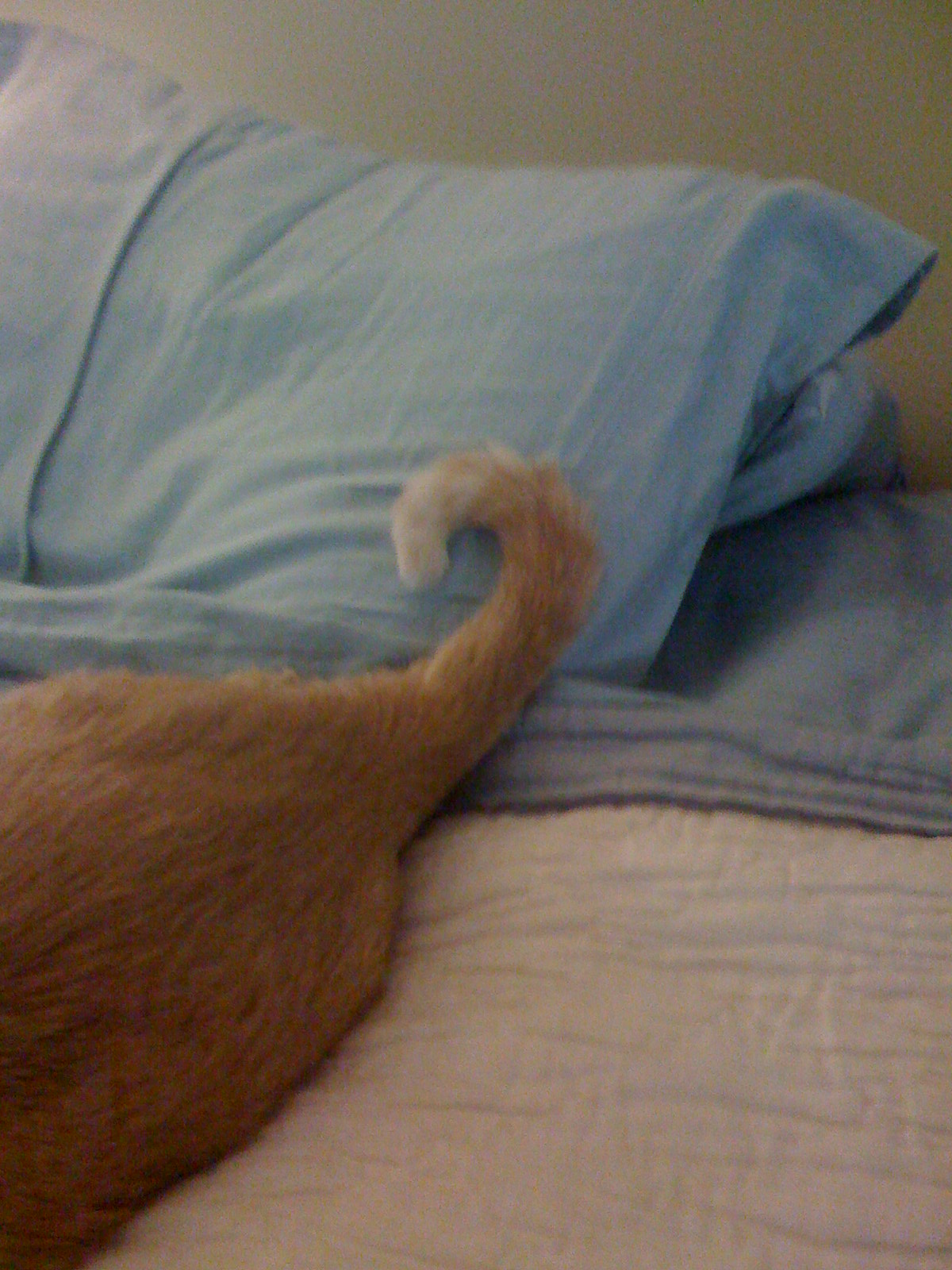
Ironically, when I adopted her, her shelter name was Candy. The only remnant of that is in the sound of her name, Cameo, and in the fact that we sometimes call her Candycane Tail because she is so uptight that she never uncurls her tail. Except, I should say, when she’s very, very sick. A limp tail is a terrible thing.

P.S. I really loved this discussion of “The Top 40 Bad Books” (It’s a PDF, so works only if you search the title or paste the URL into your browser: http://americanbookreview.org/PDF/Top40BadBooks.pdf). What variety! What disagreement! It takes a village to ferret out insights about what’s good and bad.

It’s My Party

Posted on

Today is my birthday, and on this occasion I’ve been thinking about my long struggle to be myself. It was on my birthday half my lifetime ago that my mother characterized me as having been “born seven pounds of resistance to the earth.” This blog demonstrates, I think, that the same trait still prevails in my personality. Why? No one knows. All the psychological explanations in the world fall a bit short of defining us, clarifying us, making us all make sense to ourselves and to each other.

I think that’s one reason why I have always been drawn to narrative over theory, as much as I see the usefulness in theoretical approaches and have flirted many times with various theories and their smacking smart practitioners. But, narrative, thank god, doesn’t quite have to make sense in the tidy way that theory does. Narrative accepts a lot of mystery, as Flannery O’Connor would put it. “Your beliefs will be the light by which you see,” she notes in Mystery and Manners, “but they will not be what you see and they will not be a substitute for seeing.”

Narrative is about seeing, and my blog obsession with a full range of emotions (rather than an enforced uniform positivity) is about seeing what is there, not just what we wish was there.

So, today I picked Bryan Ferry’s cover of “It’s My Party (I’ll Cry if I Want to).” It’s an anthem of defiance of social expectations, and it reminds me of my own perverse habit of pointing out the less-than-perfect in the world. I like its bald self-assertion—because, truly, denial of the self is desirable in only a very narrow range of circumstances. Most of the time, if we acknowledge ourselves and our own vulnerabilities, we can do the same for others as well. On my birthday, I like thinking about all these various paths we are each on and the ways they intersect and sometimes collide. A life, is, after all, an individualized journey, and I celebrate the unique natures of my friends and enemies alike (the latter at least in theory and narrative, if not in daily experience). Vive la différence.

The song was written by John Gluck, Wally Gold, and Herb Weiner and was most famously recorded by Lesley Gore in 1963. Her It’s My Party album has crying as its theme and includes the luck-and-love-have-shifted song “Judy’s Turn to Cry.” But Bryan Ferry’s cover is the version I remember, and when you start wishing that you could stop passing through more birthdays, retrospection seems to be built in. We also have the perspective that allows us to roll our eyes, especially at our previous youthful selves that put on relationships and discarded them like dirty clothes. And to laugh a little at our tears of yore.

Imitation Isn’t Always the Sincerest Form of Flattery

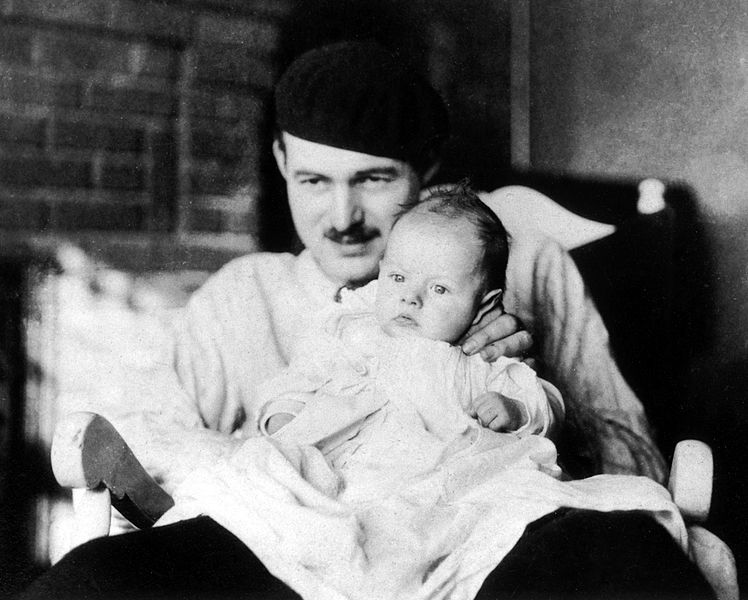
Ernest Hemingway with his son John Hadley Nicanor (Bumby), 1927.

One semester I had a student who turned in a story that I believed was plagiarized from Hemingway. The student had frequently spoken of his admiration of the minimalist master, and the story he turned in had the tell-tale traits, at least superficially. I had seen (even assigned) emulations before, but usually they were ham-fisted, amateurish, and identifiable as copies. Usually my students couldn’t keep their own personalities from peeping through. I had also seen completely plagiarized stories—once a student had turned in an entire Stephen King story with even the title intact. So I began searching for this Hemingway story.

I couldn’t find it. And I had to admit that if I couldn’t find it, the student probably hadn’t found it anywhere either. Creative writing students seldom plagiarize, and in my experience they never do so with enough leisure to hide their trails. The story, I decided, also didn’t quite have the Hemingway attitude toward women. I finally came to the conclusion that this student had just written a very good stylistic emulation of Hemingway. The following year I had him in another class, and by then he had begun to write like himself.

This is the usual trajectory for writers. But it might be different for a talented painting student.

At any rate, the production of fake manuscripts by dead famous authors is not a big business. It’s been known to happen, but the difficulties seem to surmount the temptation. Even though the Antiques Roadshow estimates that the lost suitcase of a pile of Hemingway’s manuscripts might reap $3 to 4 million if it was ever found, no one has tried to fake it. Instead, literary hoaxes tend to be more of the James Frey variety, with an author claiming a realm or set of experiences themselves that are false. These are the cases that seem to most common in accounts like Melissa Katsoulis’s Telling Tales: A History of Literary Hoaxes.

However, in the world of the visual arts, this kind of forgery is not at all uncommon. It’s one of the fundamental differences between the various arts, and it is based on the reproducible nature of the written word and music. Original manuscripts and scores may be valuable, but the real money is in an original artwork like a painting. A literary work may be experienced a million times over with the same power even from a cheap paperback copy, and the power of music lies in the details of its performance, but the original painting can only be experienced first-hand, in person, in the flesh. Even rough, imperfect, one-of-a-kind preliminary sketches made in preparation for prints can take on more value than the prints that were their ultimate end.

The New York Times covered such interesting happenings in the art world this week, with a different kind of retrospective from that of Cindy Sherman—an account of what is evidently a fraud perpetrated on the art world for nearly twenty years. A small-time art dealer, Glafira Rosales, is now tangled in legal troubles for numerous paintings she sold as works by some of the best-known Modernists—Rothko, Motherwell, Diebenkorn, de Kooning, and Pollock. Ann Freedman, former president at the famous Knoedler gallery, was evidently drawn into the fraud, bought several of the paintings herself, and helped to sell others for millions of dollars. Now Knoedler has closed and many of the paintings’ purchasers are suing for their money back.

And yet, the case points out the extent to which artists can be imitated, just as writers can. Pastiche, in fact, frequently forms part of an artist’s tutelage, and sometimes people are very good at it. What is viewed as a helpful learning practice becomes criminal, however, if someone gets too very good at it. And in the art world large profits can be had in this way.

In the recent case reported by the Times, there is no conclusion. No forger has been revealed, and some still claim that these paintings might, somehow, be authentic, even though some of the paints used in them were not available commercially at the dates they were claimed to have been painted. But I am compelled to think about that forger or those forgers and how he or she or they decided to produce these masterful paintings and put masterful names on them. These are paintings that fooled some of the world’s experts, and someone decided that money and the satisfaction of skill and cleverness would prevail over someone’s performance of his or her or their own talents. Well, being able to fool the experts is, I suppose, a talent of its own.

I can see the appeal, actually, of working for a fame in someone else’s name.

Of sticking it to an art world where fame and income are restricted to a very select few even though many have talent to spare.

Of playing a trick on a universe where work that is done out of deep, self-motivated reaches of the imagination is then commodified and traded like so much chattel.

And yet…

There is such a hateful despair in the theft involved. It’s hard for me to see one artist doing this to another or to herself or himself.

These cases seem to me to illuminate the chasm between the two channels of art: the need to communicate through whatever medium, on the one hand, and the business of buying and selling and making contacts and fostering fame on the other. It’s not a new conundrum, and different writers and artists and musicians have answered it differently over the centuries.

For myself, it is true that I would love to sell another book sometime, to be paid for my labor. But that isn’t why I do it. I watch so many of my cohort desperately scratching at the door, and I both admire their business sense and wonder what their work would be like without it. Obviously, balance is in order—I would not have all my writer friends starving and homeless, and I would enjoy a world where expertise and skill in the arts were respected far more than they are these days. I know that a lot of writers, musicians, and artists do what they think they have to do to survive and thrive. But I would not have us all pretending to be Motherwell or Rothko or Hemingway, in either name or fame. And I have a sneaking suspicion that the artist who engages with the world without constantly grasping at fame—whether in his or her own name or that of another—is all the more free to pursue the ragged path of art.