Category Archives: Culture & Arts

Does It Matter Whether a Smile Is Real?

Posted on

The relationship of our happiness to our willingness to fake it has been the topic of debate for a long time, and many a bromide supports the idea that it’s a good thing to fake it if need be. Consider these:

Fake it til you make it.

Go through the motions, and the motives will follow.

Keep smiling—it will make people wonder what you’ve been up to.

Keep your chin up!

If you can’t be with the one you love, love the one you’re with.

If life deals you lemons, make lemonade.

Put on a happy face! (my video selection above, from the film Bye, Bye, Birdie, 1963)

Of course, there are many sources that repeat this general idea endlessly. But there are also sources that report on the nuances and limitations of such ideas, that qualify the findings of all this research that supposedly demands smiling even if you have to fake it.

Follow with me a kind of trajectory:

First, there’s this kind of thing that notes we have plenty of reasons to smile even when we don’t feel like it. Even when you go to a more professional psychology source that cites particular studies, there’s a kind of silly gloss on it all that bugs me. Take the final study noted on the PSYBLOG—the report here ignores the fact that causation has not been established, only the barest correlation. Photos of baseball players over the years show that the ones that smiled more lived longer. What this most likely proves is not that if you smile more, you will live longer, but that if you are healthy, you will smile more.

I get purely annoyed by this kind of thing. Partly because few of these sources even acknowledge that there is also plenty of research that shows the opposite—the fact that faking happiness can in itself have a negative impact. Here, a study notes that fake smiles can deepen depression, and here that faking happiness at work over time has negative health consequences.

As an aside, I think that the questionable research about smiling at work and the increased productiveness of employees in a good mood is particularly dangerous. While the Wall Street Journal here gives a well-balanced sense that it’s not a matter of axing the less cheerful, but of businesses actually taking some responsibility to provide resources for good cheer, all too often we see imperatives that become dictatorial and inhumane, as in the situation described here of the enforced-smile McDonald’s counter clerk. Not to mention those hideous hiring tests that seek to classify personalities and refuse jobs to those who aren’t as perky as others, no matter their competence.

All of the articles that I read about negative consequences of faking or that call into question the assertions about the benefits of positivity, of course, have to mention those positivity assertions. There’s an odd unevenness in this regard. The sane side has to acknowledge the overly simplified positivity side, but the positivity side feels no compunction whatsoever to mention the nuances and limitations of this body of research.

In a recent example, Jane Brody wrote a column for the New York Times, “A Richer Life by Seeing the Glass Half Full.” If you read the comments, you will note that there are many who leap to agree and many who bare their teeth and attack the Brody bromides. Yet, when Brody followed up about the responses she received, she acknowledged only the “hundreds of comments from readers who testified to the value of living life as a glass half full.” She doesn’t deign to even acknowledge the other kinds of responses she received.

Don’t we have to know that something is terribly, terribly wrong when professional science journalists won’t even acknowledge that the science is mixed at best on these matters and that there are people who hold different perspectives? It taxes my credulity, especially when even an undergraduate college student can summarize the research so clearly in such a short paper as this one. The student clearly acknowledges there’s only a minor correlation, but even she has wrongly concluded that “smiling can never hurt, so go ahead and try it out!”

And let me observe that people have been trying to prove a stronger correlation and causation since Darwin’s time. They have been unable to demonstrate the facial feedback theory in all these years in spite of overwhelming resources spent toward that end.

However, you can go on to find scientists who are laboring to truly understand emotions in a complex and useful way—and one that won’t be used to hammer people over the head uselessly and cruelly or dismissively. One of these I’ll discuss in my next blog post, but, for now, I invite you to head over to the BBC Spot the Fake Smile test.

If we’re going to be constantly interacting with people who believe that faking their smiles will actually make them happier and that it will earn them our trust, forgiveness, sexual interest, and a whole host of other benefits, then perhaps we want to be more savvy about these fake smiles. I scored 19/20 right, which is evidently quite unusual. Maybe I should publish a paper about the benefits of skepticism: it helps you spot one of those fake cheery people from a mile away. And run like hell away from them and their agendas.

Schizoid About Pets

Posted on

Cat Comedy

In my ongoing contemplations of why it is that I am compelled to write about my pets and other animals, even while trying to avoid the slime of sentimentality, I present you with two stories ripped from the headlines and a couple of anecdotes from my own past, plus a question I wish someone could answer.

I had intended to be purely jovial. Rare, I know, but there are genuine moments of silliness and they bear exploring just as much as the tears. At any rate, I heard on NPR’s Marketplace yesterday that the Walker Art Center in Minneapolis is putting on a cat video festival. You can submit a nomination from the official site.

And, of course, video is not the only medium: cats do very well in still photos through such sites as I Can Has Cheezburger? Thus, I chose “The Internet Is Made of Cats” for today’s song, which was suggested by Minnesota Public Radio’s coverage of the upcoming event.

In the Marketplace discussion I first heard about the video festival, Jack Shepherd of Buzzfeed was queried about why cat videos are so popular, especially for people as breaks during a workday at the office. Shepherd notes, “It’s aspirational. You’re sitting at work and what you really want to be doing is at home lying in a sunbeam. And cats have got that figured out.”

I agree, but would like to also add another reason: I believe that the easy home video has finally given people an effective way to share how great cats are. Cat relationships tend to be much more private than dog ones. Dogs go out on walks, car rides, to visit friends, to romp on the beach, and so forth. They generally enjoy being out in the world, and people long have used them as conversation objects in parks and on sidewalks. We have showed off our love of dogs easily and eagerly.

But cats are different. Many of even the cutest and most loving cats hide when strangers come into the house, and few enjoy the spectacle of a walk on a leash in a public place. (Granted, there are some notable exceptions, but few.) It may have taken the internet video for us to get a real, culture-wide understanding of the delights of cat companionship.

Cat videos are, then, a great example of a paradigm change fostered by a particular technology. In this case, I think it’s a wonderful paradigm shift, as I’m all for a wider understanding of the beauty, humor, and wonderfulness of cats.

Dog Tragedy

Unfortunately, news this week had a tragic downside, too, in the pet world. Lennox the dog was executed in Belfast, Ireland, after a long, but unsuccessful legal battle by his family to keep him alive. By all accounts, this is one of the stupidest instances of animal cruelty I’ve ever heard of, and I’ve heard of plenty. The Belfast City Council and its “animal services” staff clearly had some dictatorial ego problem and continued to insist this dog was a danger in spite of much evidence to the contrary and in spite of offers from both of the Animal Planet dog behavioral show experts Cesar Milan and Victoria Stilwell to rehome the dog in the U.S.

The Council’s continued insistence that Lennox was “dangerous” and “unpredictable,” in fact, is so unbelievable as to call into question the integrity of any process it oversees. All the numerous photos of Lennox with the Council dog handler and even this one video in which they try to elicit aggressive behavior show a well-behaved dog. They have continued a policy of secrecy and have never released any video or evidence of Lennox behaving aggressively, which means there likely is none. I mean, if they could have released a video showing this dog being aggressive for five seconds, it would have instantly quieted the furor.

Dogs, of course, are put to death all the time, and pit bulls, who are often trained to fight and bred for that purpose, are some of the most common. I understand this—and I even agree that death is better than them suffering a fighting life. I understand that even though many of these dogs might be re-trained and salvaged, animal rescue organizations don’t have the necessary resources to do so. I also fully understand that dogs who are actually aggressive and pose a threat should be destroyed.

However, Lennox was a family pet, who had lived for five years without ever showing any signs of aggression to anyone. He was seized because Northern Ireland has a law against the existence of “pit-bull type” breeds. The Dog Wardens Department had measured him and deemed him a “pit-bull type,” though later DNA testing would demonstrate that he had no pit bull genes at all, but was rather an American Bulldog-Labrador mix. The dog had been previously neutered, licensed, vaccinated, and microchipped and was kept in a secure fenced enclosure with two other dogs with whom he lived peacefully.

He was taken from his family (including a young girl with health problems, whose reaction is discussed here) and incarcerated in a small, concrete, windowless cage. It must have been like arriving in hell. The family was not allowed to see him, not even to say good-bye. One of the photos accompanying this article shows major hair loss indicating the poor health of Lennox after months in confinement and suggests that the dog was in such bad condition that these official and legal animal abusers feared the consequences of the dog being seen before they killed it. Perhaps the so-called responsible apparatchiks who had “cared” for this dog had even driven it to aggressive behavior in order to justify themselves or had actually killed it long ago.

If I lived in Belfast, I would be calling for a major overturning of government. Yes, based on the case of a dog and what has apparently been the Belfast City Council’s flagrant lying, callousness, and cruelty in dealing both with the dog and the humans that loved it.

This story breaks my heart, and it outrages me near to violence. Animal and child abuse are the only things that ever really get at me in that way, but they do.

Stella at the poison house, right where I would later threaten to punch the landlord in the face, 1988.

My Own Love and Rage

I recall my own physical rage when, years ago, my landlord flooded my apartment with paint remover. It was sheer chance that my cats, Cassie and Stella, survived. I had not been warned that the man was having the paint removed from the bricks on the front of the house, but I happened to be home on that weekday morning, preparing to leave on a trip. As I packed my bag, what I thought was water began streaming down the walls under the window wells in my half-basement apartment. I thought someone was washing those windows. But when I ran out to tell them they were causing flooding, I found a man in a space suit with a high-powered hose.

Another man, who would later explain he was the space man’s assistant, ran forward and warned me back. He told me that the substance would take the skin off my bare feet. When I told him that the substance was flooding my apartment, he admitted to me that legally my landlord was required to notify me, but said that since they were almost finished they would just go ahead and complete their job.

I ran back around the house to my rear door, grabbed up my cats, and put them in their carriers as far from the mess as I could. My next act was to put on my shoes because, by then, the brute petrochemical smell of the paint remover made its unhealthiness clear and it was pouring across my floors as well as down my walls. The removal assistant came around and began helping me move furniture and other belongings out of its path, though it was too late for one desk of papers and numerous pots and pans hanging on the wall in my kitchen.

Then I called my landlord. He refused over the phone to interrupt his workday, but soon enough he stood angrily at my back door to inform me how selfish I was to bother him.

I am pretty sure that I have never at any other time in my life been so angry. I got right up in front of this man, who was several inches taller than me, and told him that if he didn’t get out of my face I would punch him. Though not much of a fighter, I had my right fist clenched tight. He left.

Soon enough, my boyfriend arrived to take me to the airport. I explained to him that he would have to keep Cassie and Stella for the weekend at his apartment. Fortunately, he was glad to do so, and off we went. I would have to deal with the mess when I returned, but at least my cats would be safe. I trembled at what might have happened had the timing been a little different. I loved these cats so much, and they had brought so much joy to my life.

Cassie happy on her new porch, 1992.

Schizoid and Sociopathic Human Behavior

The accumulation of these stories suggests to me something very odd about the human psyche, and that’s the lack of empathy that so many people have.

My idiotic landlord had a cat himself, but couldn’t understand why I would be upset that he’d nearly poisoned mine. Certainly at least some members of the Belfast City Council have pets. And yet, they have no sympathy for pets that they do not know. In fact, they have no sympathy for even the humans who love pets besides their own. The Belfast City Council insists that it acts to protect people when, in fact, it harms people as well as animals in its myopic behavior.

There are also many people who just claim not to like animals. I have often wondered at the cavalier running down of dogs or cats by some supposedly perfectly responsible people. One of my worst moments as a teacher came once when a student in a creative writing class noted that his father hated cats and would often attempt to hit them when driving in his car. I told the student that his father was clearly an asshole, and that we weren’t going to consider him in our conversation. But maybe we should have because there’s an enormous issue here.

If his father hated cats or just didn’t care about the animals he might run over, that’s bad enough, but clearly he didn’t even care about the people who do care about the animals. That is human-aggressive and sociopathic behavior.

Why, I ask you, do we find it so acceptable to live with these people? And how many of them are the same people who circulate cat videos from youtube, never making a connection between the two unreconcilable contradictions in their behavior? How can such love for animals and such hate for them co-exist so close together? Are humans expressing their emotions for each other through these innocent animals? Or is it about something else? Why? Not only why cat videos? But why dog murder? What do these two phenomena have to do with each other?

Josh Tillman/Father John Misty

Posted on

Most of the songs I post here are old favorites, but every now and then I try to reach forward into the present. I have never been good at following particular musicians or ferreting out new stuff, and I always used to rely on friends for recommendations. I don’t get much of that any more, but, fortunately, I have some former students who are friends on Facebook, and I lurk around their comments about music looking for new sounds. A couple of weeks ago, I picked up on a reference to Father John Misty’s new album Fear Fun.

I’ve also been in the process of adjusting to the idea of my sabbatical being over. I know, big violins, right? Sabbatical has been a miraculous, year-long, hard-working, peaceful, and re-prioritizing time for me. It is hard to see it go, and I’ve been trying to figure out strategies for holding on to some of the peace and humanity that I’ve found this year.

So it was with delight that I found these two songs—the first one, “Year in the Kingdom,” from the J. Tillman album of the same name, reflects a bit of how I have felt about this year, even my sorrow at its passing.

However, Josh Tillman has more recently been recording under the pseudonym Father John Misty. Evidently, with a move from Seattle to Laurel Canyon and a departure from his association with the band Fleet Foxes, he’s come out of a long period of melancholy. His new album has been praised for its variety of mood as well as its musical sophistication in the folk vein, though its lyrics are frequently still dark in tone.

The song below, “I’m Writing a Novel,” with its hallucinogenic sense of humor, points me in a good direction for the coming year. I chose the version to embed because of its bouncy instrumentation. Plus it’s cute to watch the funny dancing. But I also really enjoyed this guitar-only version at the Guardian for its dead-pan delivery of a whacky set-up story about the song’s evolution, and because, if you watch carefully, there’s a little bug that falls out of his hair and crawls across his shoulder in the first seconds (about 42-44 seconds in) of the video. I like these reminders about perspective.

Franz Liszt’s Orpheus & Travels in Time

Posted on

While Bruce and I were in Berlin, I had planned a few posts that I intended to go up while we were away. Alas, my technical understanding was lacking, and they didn’t get posted. One of them was a follow-up to my piece about squabbling over the arts, which I’d illustrated with two depictions of Orpheus before and after he met his untimely death in spite of the beauty of his art. Today I give you the song that I intended to run that same week—this poignant symphonic poem by Franz Liszt on the subject of Orpheus, Part I above and Part II below.

I had also selected this piece because Liszt wrote it while he was living and working in Germany—Weimar to be exact—and in one of those funny coincidences, Bruce and I, much to our surprise, ended up spending a day and a half in Weimar last week. We drove over from Berlin with Bruce’s old friend Kai, who happened to be slated to play in a tennis tournament there. While he played, we toured the ancient city and walked in the footsteps of Liszt, as well as Goethe, Schiller, Bach, Richard Strauss, Hans Christian Andersen, Wassily Kandinsky, Paul Klee, Walter Gropius, Oskar Schlemmer, and many other artists, writers, and musicians.

Goethe’s garden house in Weimar, Germany.

It’s hard to imagine as you walk the cobblestone streets of beautiful Weimar and stroll through the park along the Ilm River to Goethe’s garden house that just eight kilometers away, the Nazis built the Buchenwald concentration camp, or that after the liberation of the concentration camps Allies forced the citizens of Weimar to tour the remains of Buchenwald on foot. Scenes from that episode in Weimar’s history were recorded and can be seen at the end of Billy Wilder’s Death Mills, a 1945 anti-German post-war propagation film, available in its full 20-minute form here at the Holocaust Museum website. (Warning: this film is largely composed of clips of dead and dying concentration camp victims. It is brutal.)

It’s also difficult to imagine Weimar as an East Germany city. It retains its old-world charm because many of its buildings and monuments were spared from bombing during World War II. However, on the outskirts we found numerous of those concrete-slab high-rise apartment buildings, some of them fallen into decrepitude, typical of the cheap, radically modernist efforts of post-war Socialist architects and builders. They seemed particularly odd in the bucolic hills around Weimar.

We did not visit Buchenwald—time was short, and Kai was more eager to get back to his family in Berlin. But one thing that is true in Germany is that history peeks through everywhere. The Topography of Terror memorial site sits on the location of the former Gestapo and SS headquarters, but is also rimmed by a remnant of the Berlin Wall. Even as I enjoyed the quiet, clean, and plentiful trains that made getting around Berlin so easy and pleasant, I couldn’t help but think how this train system was used and perfected in the transportation of humans to their terrible deaths.

Bruce said that as he walked around Berlin he was constantly wondering, “What happened here? In this exact spot?” It’s a good question for any one of us to ask any day and in any spot. You can bet something happened wherever you are, even if it’s been covered over or obliterated by the passage of time. When I take a moment to let that reverberate in my mind and body, I am enlivened and reminded to choose carefully (and to the extent I can) which kind of path toward the future I might participate in.

Gratuitous Violence About Fiction

Posted on

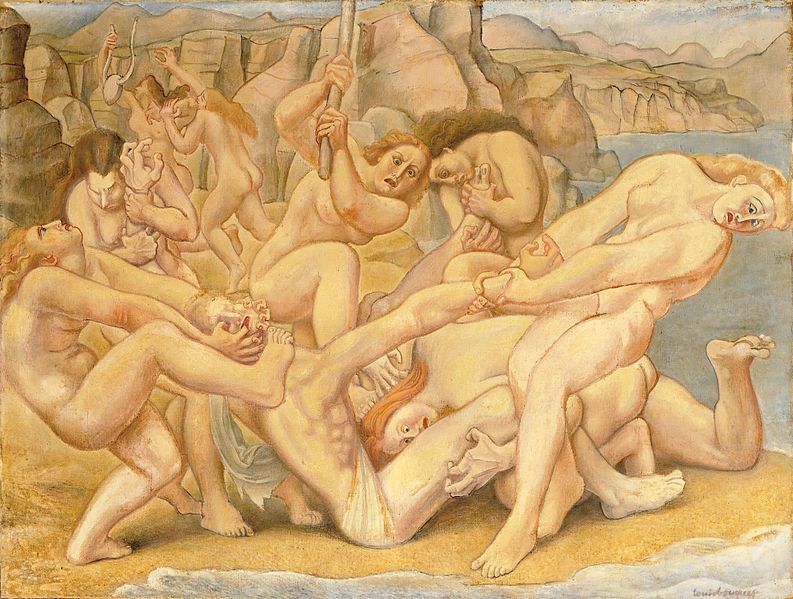
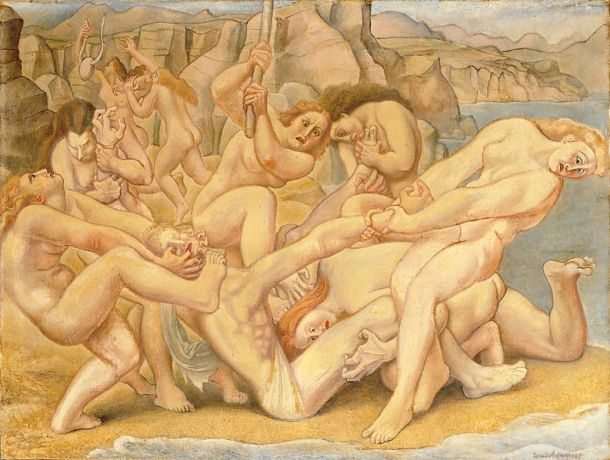
Louis Bouquet, La Mort d’Orphee, 1925-1939. Orpheus, torn to shreds by the Bacchantes, a sad symbol of what havoc jealousies and distractions can wreak on artists.

My apologies, readers: I had scheduled my next three posts to automatically appear while Bruce and I were visiting Germany, but, alas, something went wrong with my understanding of WordPress. I’ll try to catch up over the next few days. Maybe by now you all can bear another long post about clubby creative writing battles. I hope it doesn’t bore my non-writer readers. As this indicates, I am bored too, but my OCD side compels me to speak when readers of the New York Times have devolved into this kind of bickering. Friend Harold made me realize in a comment about last week’s manifesto about not restricting myself to creative writing that I nonetheless often do focus on these narrow issues. I promise to get away from this again soon, but it’s been an artsy month for me.

The New York Times is following in the footsteps of the tabloids, attempting to ratchet up controversy to get readers, at least that’s how it seems in this instance. The Times recently published a collection of articles in its Room for Debate series under the collective heading of “Is Fiction Changing, for Better or Worse?” Six very short articles then assaulted us with their inevitably epigrammatic brevity in attempting to answer the headline question.

The writers of these answers—six men and one woman in the finest discriminatory tradition of the major publications—can’t possibly win. Answering this question in the 300 words each was apparently given is an impossibility. But they try, mostly intelligently with perhaps one or two notable exceptions that I’ll save for last. One or two of them even make interesting points, bless them.

Still, the entire atmosphere around these mini-essays is one of contention and rivalry, with a plethora of nastiness directed all over the place, including at the poor authors themselves. Here’s a sampling of the befuddling attacks and counter-attacks in their mini-essays and mostly in the online comments that follow [with my observations in brackets]:

Comments on Jane Smiley’s “An Exercise in Empathy”

“While the quantity of books has increased there is certainly a decrease in the percentage of great novels being written.” Chris Wilson, Boston [Um, has he read them all? How does he know this with such certainty? Did this comment have anything to do with what Smiley said? Um, no.]

In response to a commentator who noted (albeit incorrectly) the overwhelmingly white and male composition of the panel of writers, this diatribe: “Get over it… no wonder there is racism. Because people like you insert it into every possible situation, whether it belongs or not, which in this case it most certainly does not.” Kafen ebell, Los Angeles [Again, I marvel at this person’s prescience, in this case the ability to know whether or not racism influences this situation. It certainly seems to have influenced this remark.]

“Fiction creates empathy in a way that nonfiction cannot. It places the reader in the head of someone else, feeling their feelings.” Anniken Davenport, Harrisburg [What an odd way to characterize the supposed superiority of fiction—by attacking just the quality that memoir is known for.]

“Truth is, our present-day writers, most of them urban liberals, have effectively repelled the sort of readers who used to admire Steinbeck, Wolfe, Faulkner, Algren, et. al. Really, could anything be more objectionable than, for example, the sort of Manhattan-approved good thinker who confesses that while Iowa might be all right (barely) for children, yet it remains so horribly provincial, don’t you know, for more elevated souls.” Tito Perdue reactionary novelist, ‘Bama [Huh? Talk about a comment that comes not from the article but from a predetermined, always-present agenda. This is prime.]

Comments on Robin Sloan’s “Welcome ‘The Sopranos’ and Twitter”

“I checked out the excerpt from Mr. Sloan’s novel, and it expresses everything one needs to know about the current strain of reductive techno-cheerleading infesting our culture. I highly recommend he stick to ‘inventing media,’ whatever that might mean.” Ilya Leybovich, Brooklyn, NY [While I agree that I was not sucked into Mr. Sloan’s opening page, I’m not sure that Ilya’s position represents anything but some vague resentment at techies, even though he seems to be a news editor for an online PR magazine, hardly the purest or most art-obsessed role in life. Perhaps he is also a frustrated novelist.]

“Today’s ‘novel’ has become the pointless snippets people post of their daily lives on social networking sites.” Evan Lockport, IL [All of them?]

“Such slapdoodle, the very kind of thinking these superficial media encourage.” An Ordinary American, Prague [I don’t disagree with this person, just perhaps with his/her harshness. But I had to include this one because of the use of the wonderful word “slapdoodle” and because of the combination of “an ordinary American” and the location of Prague, where all ordinary Americans no doubt hang out.]

Comments on Matt de la Peña’s “Novels Have Become an Escape”

De la Peña’s piece is an anti-positive psychology note in itself, and was my favorite of the six for that very fact. Perhaps for that reason, he received by far the most commentary on his article. But, of course, the comments became an argument between those who insist life is indeed sad and those who insist it isn’t. Of course, it is both, and some commenters acknowledged that well, but I quote here some of the deniers and other nasties, my point being that discussions on the internet so often devolve into this oppositional absurdity.

“why are multiple posters quoting this same kafka phrase/ did the nytimes include a quote in their assignment? is this high school English class?” j, LIC, NY

“So far, the only living American novelist with anything to say is Corum McCarthy [whoever that is, or, I mean, sic]. The rest is filtered out by the agent-seeking-money people and the bean-counters-seeking-money from the publisher’s financial group headquarters. Most of your commenters sound like they recently got theit [sic] writing MFA which teaches lots about technique to those with not much to relate.” anonymot, CT [Another MFA basher, and I hope he/she does have something to say since there’s no expressed need here to say it well or to even give any evidence for claims. Some people just have to get the MFA-blame into whatever they say.]

“Although I disagree with Mr. de la Peña, I can forgive an intelligent young man who has enough intelligent-young-man arrogance to think his [sic] has enough perspective to judge his own time against what came before.” J, R [Funny, he never really says what he disagrees about per se. Oh, well, a put-down is always effective, right? The condescension blew me away.]

“only in genre fiction can the half-stereotypes we all rely on be explored safely, because lit fiction, which is supposed to be addressing these, is only interested in one side” John, Brooklyn, NY [I’m pretty sure this is not what Mr. de la Peña meant. In other words, John is always looking for an opportunity to say what is already on his mind, no matter what.]

“I think you mistake a few elites for an entire ‘audience.’ Jane Austin [sic] and Shakespeare and Hemingway and Oscar Wilde and others were popular because they were entertaining not because they were literary.” ro, nyc [Etc. etc. with “ro” and “anonymot” dissing the “elite” “decision-makers” who unfortunately promote “serious” writing. Totally incoherent, really, but the readers and writers of junk fiction are always aggrieved, by golly. They get all the money in wide sales, but that’s not enough for them. They want also the literary recognition that they trash so much.]

“A session with current fiction, even an extended one, turning thinly-worded [sic] post-modern pages requires that we reach for the next while the current one is coming to a close. They’re pills in paper back.” mm, albuquerque [Again, I think that the commenter is blaming books that de la Peña doesn’t mean to blame.]

“Life is not sad. It is what you make of it…. Yes, we are all going to die but that is not what is important here. What’s important is living a life that serves each one of us.” Susannah, France [I’m glad she knows what’s important for all of us.]

“People do care. They are not always hiding. I think this is a good thing and invite you into a positive world.” Jack R. Williams, Atlantic Beach, NC [Because, of course, this very successful young writer must be in a bad way just because he points out the contemporary aversion to life’s hard side. This private citizen would like to give him advice about his life. Does that seem fitting to anyone?]

“What a load of waffle.” TV, CT

“Agree that intellectual challenge has downshifted, but strongly disagree regarding sadness and self reflection, the preoccupation with which seems to have become pandemic. Also, the memoir, an exaltation of self if ever there was one, may be supplanting the novel as a popular idyll.” marymary, Washington, DC [OMG, let’s beat up the memoir again. Who cares that the subject here is the novel, some people just have to bash the memoir.]

“as a person who suffers from clinical depression, the idea that bouts of melancholy can be ‘beneficial’ makes me want to throw my laptop through the window. Where does the Times find these people?” gobot90, new york [De la Peña distinguished what he was talking about from clinical depression, but this person just missed it, I guess.]

“The idea that the novel should be ‘serious’ is a 20th century invention, as James Gunn points out. Mr. de la Peña needs to study his literary history.” gobot90, new york [Above, he notes that the Times gets unqualified people to write these, but only after he has here cited one of the other panelists—with far fewer credentials as a writer—as a better expert. In other words, the popular fiction folks are angry again. I can just never figure out why.]

Comments on Thomas Glave’s “Stories and Readers Change Together”

This piece garnered only 3 comments, all rather disconnected from what he wrote.

“A well crafted novel has the potential to tell far more truth than non-fiction and, in an aesthetic manner. Art goes farther than imitating life—it can capture its essence.” David Chowes, New York City [Another hobbyhorse inserted willy-nilly: the superiority of fiction over non-fiction. Boring, boring, boring.]

The next two articles I found in themselves objectionable. As scholar-critics rather than writers, they felt a need to pass judgments that seemed to me ill-founded.

Objectionable quotes from William Deresiewicz’s “New Forms, but People Will Always Read”

* “As for political fiction, Sozhenitsyn and Steinbeck were important figures, but they weren’t necessarily good novelists.” [At least he talks about specific novels, but this is ill-advised in a column where you have no space to define exactly what you mean.]

* “’The Jungle’ may have sparked reform, but I daresay ‘Mrs. Dalloway has changed more people’s lives.” [Unfounded speculation.]

* “Stunted attention spans, Internet cacophony, consolidation and collapse in the publishing industry, the professionalization of the arts and the questionable influence of the writing programs, the long shadow of modernist greats: the novel’s facing headwinds, as it surely always has.” [Deresiewicz is, of course, a former literature professor at Yale and Columbia, now turned essayist, but basically a scholar and critic, so, of course, he has to slip in that the influence of writing programs is “questionable.” The MFA canard again.]

Comments on Deresiewicz

“To suggest that Mrs. Dalloway ‘changed more lives’ than The Jungle is wishful thinking at best. The Jungle resulted in reform that affected millions of people over decades whereas if Mrs. Dalloway was read even by 20,000 people I would be surprised. The market for Lit Fic is miniscule and supported mostly by libraries without which, the ‘genre’ of Lit Fic would collapse. ECW, Forreston, IL [The scholars hate the creative writers, even those of a literary bent, but the popular fiction aficionados hate both the scholars and the literary writers. Go figure.]

“[H]is conclusion is pure evidence-avoiding pollyanna.” Dudley, Saunders [I don’t disagree, but, still, the invective.]

“In the cities, on public transportation, in parks and restaurants, people can read what they really like without the fear of public censure once they abandon the lurid covers of conventional publishing and enjoy the anonymity of e-readers. Unless one is right on top of the e-reader, they can read whatever crap they want without having to suffer the smirk of social critics. On the other hand, it’s hard to attract that special someone on the bus when they can’t see the pretentious tome you are pretending to read.” richard kopperdahl, new york city [This one wins the award for a paranoid sense of aggrievement. I mean, really, since when did people hide their popular fiction? Really, it’s a funny thought.]

Objectionable quotes from James Gunn’s “Look to the Fringes of Fiction”

Another critic, who must pass judgment, but this time it’s a former English professor who no doubt felt that his research on science fiction wasn’t taken seriously enough in the academy. So he founded and directs the Center for the Study of Science Fiction. He has a huge axe to grind. I should just paste his whole little diatribe here, but I will select only a portion.

* “A century ago H. G. Wells had a public debate with Henry James about the uses of the novel. Wells, ever the pragmatist, thought the novel was a device to make an emphatic point about life or society or human nature. James, ever the esthete, maintained that the only purpose of the novel was aesthetic. James prevailed, according to the critics, and the literary novel has been judged ever since on aesthetic grounds…. Wells is still read…; James, not so much.” [Of course, he has to set this up in oppositional fashion, and he has to base his entire argument on something he can’t prove. The greatest novels, of course, both make a point about “life or society or human nature” and also pay attention to aesthetic issues. It’s not as though The Turn of the Screw says nothing about human nature. Yeesh.]

* “[T]he literary novel has never been a place to look for social or political protest, and the writers who dealt in such matters—Dickens, Sinclair, Wells, Stowe, Zola, Orwell—were never considered ‘serious’ writers in their own times.” [Really? And what about Morrison, Baldwin, Ellison, Wright, Faulkner, Dos Passos, Gaskell, etc. etc.?]

* “The most effective social documents these days are genre novels—crime novels, for instance, but particularly science-fiction novels.” [I know the stupid 300-word form creates a tendency for the unsupported generalization, but isn’t this just an example of self-justification? It’s just so easy to trot out numerous counter-examples on every side of this issue—“serious literary” fiction that does take up social issues and science-fiction that doesn’t question the status quo at all. Just another angry devotee of popular fiction, wanting what he ostensibly despises.]

Comments on Gunn

Thus ensued in the comments a debate about the relative merits of Wells and James more than anything else, with the added current of “science-fiction is underappreciated.” Um-hm, yup, that’s why so many people read it and almost all university English departments teach it. Um-hm.

I couldn’t agree more with one commenter on Gunn’s post who referred to the entire endeavor this way:

“So wrongheaded! But what can one expect? These Room for Debate features seem to parade ‘experts’ who have bizarrely random claims to the title—you’d want to say they therefore spoke for an interestingly random sampling of views if they didn’t mostly seem to have some very particular axe to grind. – So this guy was chosen as the pro-sci-fi, non-canonical view? But why should that view be helpful or interesting (especially when he makes such blatantly incorrect factual assertions, as if James has been relegated to the dustheap while Wells has become widely embraced and beloved)? The topics for these Debates are so large, and the response pieces so frustratingly narrow, brief, and thin (based on opinion or assertion rather than fact), that the whole thing just becomes an exercise in head scratching rather than debate.” sd, ct
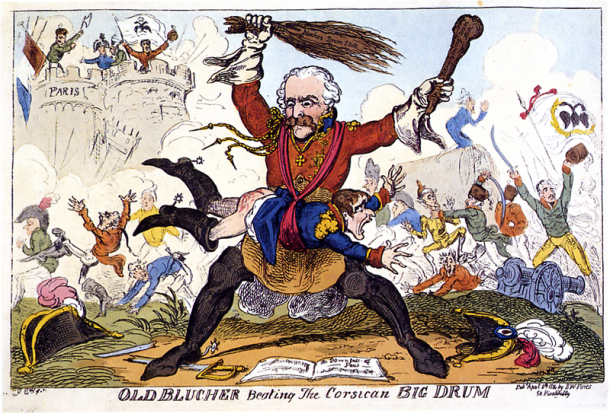
George Cruikshank, Old Blucher Beating the Corsican Big Drum, 1814. Gebhard von Blucher, a Prussian field marshal, carried an irrational degree of hatred for the French and over and over again flogged the populace and its leaders to go to war.

In fact, I find that these four childish battles are a large part of what’s wrong with writing and reading these days:

* MFA vs. no academic support for writers

* popular and genre fiction vs. literary fiction

* entertainment vs. “serious” fiction

* fiction vs. non-fiction, especially memoir

These are indeed shibboleths and hackneyed distractions, and I am sick of them. I wish we could move our discussions of literature and writing beyond them. Surely, there is something more interesting about what we do than these hobbyhorses that repeat themselves ad infinitum in the press. In spite of the fact that bifurcation is almost never a smart way of thinking, people keep these oppositions alive, perhaps because they are easy and draw “controversy.”

I hereby declare that there is no controversy on these topics. In spite of the continuing echoes of irrationality, the jury is in:

* The MFA does not harm writers. It has its pros and its cons, and it is not all things to all people. But it helps some writers find a way, and it supports many others. This is a good thing. That so many people want to study writing is also our best hope for a continuing culture of reading and writing and our best hope against an illiterate society.

* Neither the genre aficionados nor the literary aficionados should trash the other. There should be room for both in the world. That the publishing industry is shutting off the oxygen to literary writers is true, and I decry this, but other opportunities in small press publishing and inexpensive online literary venues are going to keep the literary alive. The fucking genre people have no complaint, and they need to give up feeling discriminated against. Once upon a time they might have had a legitimate issue, having been subject to the disdain of critics, but they don’t any more, and truly great work in science-fiction and other genres regularly is attended to with literary awe. People read it, too, and its popularity is secure. So, what’s the problem?

* Serious fiction, however, is indeed different from a lot of popular fiction. Some of us are even “entertained” by something more serious than formulaic fare. But there is no hard and fast line between them. We need to get used to this and debate only the merits of individual texts, not entire categories. The categories do not serve writers, and barely serve readers—they are largely enforced by the publishing companies, bookstores, reviewers, and critics, who are all classifiers at heart. Their classifications are convenient for all of us sometimes, but they are not sacrosanct.

* Likewise with the ridiculous claim that fiction is always and necessarily superior to non-fiction and that memoir is a degraded form. This is just patently false and almost always asserted out of self-promotion or some other slightly less obvious self-serving belief. There are bad novels just as there are bad memoirs. And there are good in both genres. If you want to start a tally list and go through all of literature to demonstrate otherwise in any convincing way, then, as my mother used to say, “Go ahead, gourd head.”

Would that the squabblers would hear my song.
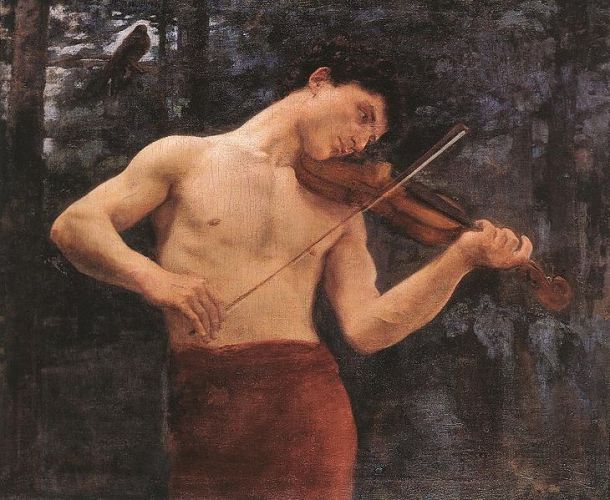
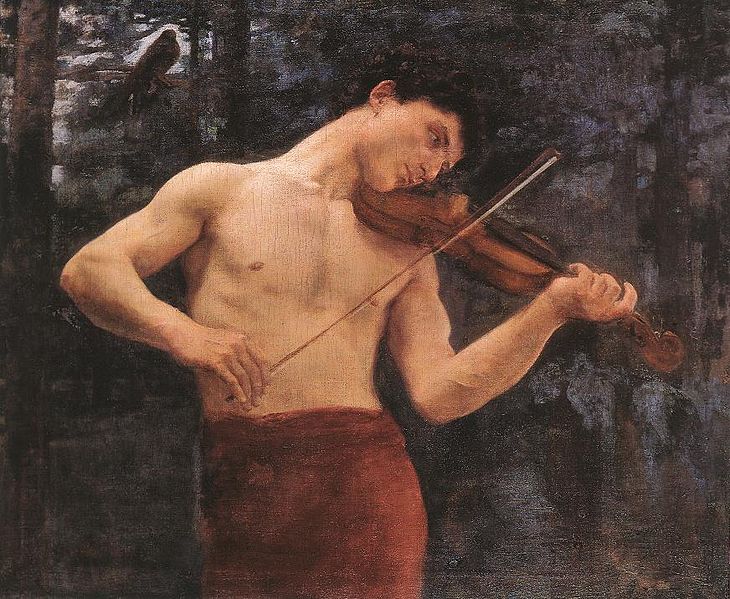
Karoly Ferenczy, Orpheus, 1894. Orpheus before everyone started fighting over him. Better days, no doubt.

A Year in the Blogosphere

Posted on

Joyous Crybaby has readied me to keep my eyes on that horizon while I plow that soil. (Photo by Lisa Wild for the Geograph Project [http://www.geograph.org.uk/].)

Actually, it’s more like 13 months in the blogosphere now, and I’ve been thinking since I passed the one-year anniversary that I should post another reflection on this endeavor. Thinking about it at the six-month mark helped me further define my purposes and bask in an admittedly self-satisfied glow that I had kept it up that long.

In the next few months, I’ll be facing new challenges as a blogger—the end of sabbatical, a return to full-time teaching, and deadlines for a major book project. I remain uncertain of the continuing viability of Joyous Crybaby, even though the reasons are shifting and even though I feel all the more devoted to her. I still feel as though she’s doing me good.

She’s not a work project, though, and I am employed in a demanding field where I’m not supposed to spend much time doing anything but what will further my career. Academia more and more is judged by business models, and this involves an increasing obsession with quantifiable results and quantifiable justifications. Every year, we are required to turn in the dreaded document called a Faculty Annual Report, and each department chair is required to turn in the larger version that supposedly proves quality and intellectual achievement by the number of grant dollars, publications, and “seats in butts” (or student credit hours) that we have produced, collectively and individually. Our departmental budgets and our individual merit raises are determined by such numbers (not that the raises offset the pay cuts we are experiencing via means such as lower retirement contributions). Whether institutions with such a myriad of purposes and such a myriad of considerations is best served by this constant quantification is debatable, of course, but it’s a fact of almost any academic’s life these days. Here’s one great write-up of a blogging academic who kept track of his work time.

Therefore, every week, day, half-day, or hour I spend writing a blog post—and finding supporting resources, references, and appropriate copyright-free illustrations, and then formatting and linking everything on the blog itself—I wonder what the heck I am doing spending so much time on it.

I’ve also had occasion to wonder why I didn’t at least focus my blog on creative writing—my area of professional expertise. There are many academics who do gain some credit for their profession-related blogs and who at least spread the word that they are experts in their fields by narrowly focusing on a professional sensibility in a more or less narrow field. In other words, though they may practice a more general-reader style, their blog personas directly reflect their professorial research. Mostly they are not very personal. There are indeed many such blogs in the world of creative writing—almost all literary magazines these days have a large web presence, many literary magazines are fully online and function as community blogs with selection requirements, and there are dozens if not hundreds of blogs about the writing life, craft, “how I became a writer,” publishing tips and advice at both magazine and book level, finding an agent, various genres and styles of writing, and so on. Some of these blogs and online literary venues are fabulous, and I read a lot of them avidly if not regularly.

Maybe the sheer plethora of existing creative writing blogs made me choose instead a wider focus and one rooted in issues in another field entirely (my starting point of my negative reaction to positive psychology bromides). However, as the year has passed, I’ve had to justify this choice to myself.

There are many reasons I’ve thought about, but perhaps the most important is that I wanted to engage with the wider world.

Another characteristic of a life in academia is a great deal of specialization. You’re not just a chemical engineer, you are a chemical engineer specializing in air pollution modeling and incineration. You’re not just a professor of Italian, but you specialize in Italian travel and immigration literature with a focus on Giuseppe Antonio Borgese, Mario Soldali, and Emilio Cecchi. (Two real examples from the UCF website.)

I have already bucked this trend to a certain degree by working across the creative writing v. scholarly writing divide and by writing in not just one creative genre, but in fiction, nonfiction, and poetry. (And my undergraduate degree was in studio art.) This has had its downside, and it may be true that I am a master of none of these forms. So, I understand why my peers in academia often focus much more narrowly than I do in their work. It’s a habit that is rewarded in the system, and it suits some people just fine.

I believe, however, that writers do have a responsibility to respond to the world beyond the confines of narrow specialties. It’s a different point than the one that I criticized Marjorie Perloff for making about academia rendering writers’ work repetitive and mediocre, though it is related. (It’s also a point that I would apply to all those in academia, even more so to many scholars compared to many of the creative writers.)

This all leads me to another influence on my blog choices—that we live in a time when being a “professional” writer often seems to involve more time tending to the business of writing than to writing itself. At six months, I mentioned how I felt a need to get back to my own roots as a writer exploring the world rather than as a writer being an expert. I needed to find my way back to “beginner’s mind,” as the Zen Buddhists call it. As Zen master Shunryu Suzuki is often quoted as saying, “In the beginner’s mind there are many possibilities, but in the expert’s there are few.”

And I do have to admit some boredom with a lot of creative writing blogs. It’s not because the content isn’t often useful, even insightful. What in a professional sense is no doubt seen as “focus” or “coherence,” however, frequently becomes too self-reflexive and insular for my taste. Even though some creative writing blogs go beyond the purpose of promoting a given writer’s publications, reviews, and lectures to include discussion of issues in the field, they all seem to me cut off from the rest of the world. These blogs remind me of the kind of creative writing workshops where a focus on “craft” does not include any concern with intelligence, personality, or soul (admittedly difficult things to “teach” and touchy to even discuss). Even though I have a passionate interest in many of the issues they raise, I need to embrace a wider horizon.

Is that a strong enough statement to be considered a manifesto? I’m not sure, but I mean it as one. Graduate school for me opened new universes, but over the past few years in the academic grind, I have been engaged in a battle for my own soul and self—to keep from becoming what I consider too narrowed by academia. For a long time, I was losing that battle, shriveling, becoming bitter, obsessing daily about fundamentally trivial things, wearying of it all. Though I had gained tenure and a wonderful husband, I had lost involvement in politics, gardening, cooking, animal rescue, friendships, family relationships, the great outdoors, exercise, and my own health.

Joyous Crybaby has been part of a multi-faceted process that I hope will help me face the next academic year and my return to the classroom with a sense that maybe I can keep my eyes up even as I labor with my fingers in the dirt of the academic field. As an alter ego, she provides me with a reminder that I need: that no profession—and no other person—defines me. All too often, we forget even ourselves beyond the surface judgments, caught up as we are in what others think of us. JC has been a great lesson in character beyond stereotype. It seems to me that this sense of mystery about what comprises human beings is vital to the writing endeavor, not to mention the endeavor of being a decent human being.

Little Murders

Posted on

I happened to mention to someone yesterday that I had written my previous post about dog poop, and that person exclaimed, “Oh, like Elliott Gould in Little Murders. He plays a photographer who has made dog poop his subject.”

I had never seen Little Murders, a 1971 satirical film directed by Alan Arkin and adapted by Jules Feiffer from his original play. The movie featured cameos for Donald Sutherland and Alan Arkin and starred Elliott Gould and Marcia Rodd as Alfred and Patsy, a pair of mis-matched lovers. When I looked it up, I just had to watch the whole thing, and it’s all available on YouTube, albeit in 16 installments.

The installment I’ve included above occurs early on in the film and features Albert meeting Patsy’s family and explaining his career choice to them. It’s a great little mini-commentary on the commercial art world. It also distills the main conflict of the first half of the movie—the fact that Alfred is a devoted “apatheist,” whereas Patsy wants to inspire him to feel again and to “fight” against a world gone sour. It’s a classic “optimist” vs. “pessimist” argument, and makes fun of both extremes. It is striking, however, that, at least for the first half of the film, Alfred, though the pessimist, seems more at peace and more sanguine than the passionate, smiling Patsy, who spends a lot of time yelling and pushing at him.

Little Murders is set in the time it was made—the early nineteen-seventies—when New York really seemed to be at low ebb. The dark atmosphere that can’t keep Patsy from waking up with a smile is filled with random murders (including that of one of her brothers), assaults in the street (Alfred is regularly beat up), power black-outs, frequent threatening anonymous phone calls, and the constant wailing of sirens. Patsy has to take Alfred out to the country to teach him to have fun.

But it’s also a time of social upheaval. When Patsy and Alfred decide to marry, they have to cast about to find a minister who will agree not to mention God in the ceremony, and it ends up taking place in a broken-down shell of a church with sitar music as accompaniment and the “outing” of Patsy’s brother, Kenny, as gay. Donald Sutherland, as the minister, delivers a hilarious talk about marriage, which I include below to honor my recent anniversary.

After that, the film takes a darker turn. It becomes the kind of comedy that doesn’t make you laugh. It’s funny, but painfully so. I won’t include any spoilers, but the latter part of the film (segment 14) includes a speech by Patsy’s father that seems more relevant today than ever, at least because of the contrast between how it must have been received then and how we live now. It’s a speech about how crazy the world has gotten and how he wants his freedom back—through the use of video surveillance and a system of fences around the block and IDs required for passage in and out (we didn’t really have the term “gated communities” back then). At the time, I’m sure that struck everyone as hilarious—to invoke security measures as a return to freedom—so it struck me now that now we actually live in that very state. We have given up our privacy for our safety and can no longer think of the possibility as humorous and far-fetched. It’s reality.

No doubt that’s a sad trade. Little Murders, however, notes other trades we’ve been willing to make. The characters in the film in the end are all corrupted by the violence around them, and the satire points to the absurdity of “fighting” in order to be happy, perhaps even of a certain kind of limited happiness (as expressed by Patsy’s mother at the very end). It doesn’t provide any easy answers to the conundrum, and this is one reason why it is such a fine piece of satire, which, in spite of its obvious time-limitations, still has a lot to offer.

Three Stories About Poop

Posted on

From an 1899 edition of The Emperor’s New Clothes, illustrated by Helen Stratton.

Today, I take a turn from the sacred and beautiful (kd lang, Leonard Cohen, Maya Lin, Pablo Neruda) to the profane and silly. It is time for a summer change of mood.

I have always loved Hans Christian Andersen’s The Emperor’s New Clothes. In my younger years, I identified with the child who cried out, when no one else would, that the Emperor was “wearing nothing at all.” Now that I am older, I sometimes still identify with the child who finds the b.s. absurd and sometimes with the naked Emperor—if only the world could see my finery even though it exists mostly in my mind, if only I didn’t wish to believe in a more wonderful version of things than what is true.

As a writer, I am always fascinated by the vagaries of human behavior, and the way that expectations interact with interpretations often rises to the top of the list. Saturday, when Bruce and I drove around Orlando doing errands, we stumbled into a set of humorously-themed reminiscences about this very thing and had a good laugh.

* * *

Much can be disguised with chocolate.

When I was growing up, we fortunately had lots of books around the house, and one story from one of these books came back to me when I was broken-hearted by a hapless fellow during grad school. I recalled the story from one of Willie Morris’s memoirs about growing up in Yazoo, Mississippi—probably his first, North Toward Home. Morris would later become well-known for his book and the subsequent movie My Dog, Skip, but even earlier he was fond of tales of rambunctious shenanigans from an earlier era. He particularly loved dog stories.

The vignette involved a schoolteacher or some other figure of authority who had punished Morris as a boy. He struck upon a perfect revenge, and wrapped up a beautiful package that he sent as a gift through the mail: he filled the pretty little box with dog shit from his faithful companion pet. Appropriate hilarity ensued.

I never acted on my own desire for revenge—such pranks are no longer considered harmless—but I spent a good bit of time fantasizing about taking cat turds out of the litter box with toothpicks, slicing them up, and dipping them in melted chocolate so they would look like fine homemade candies. I just knew that if I left a pretty box of these bon-bons on my ex-boyfriend’s front porch, he and his housemates would dig right in. This household of men-boys had several female “friends” who would leave homemade goodies and farm produce for them in a hippie-cool people-alternative culture version of the age-old adage that a way to a man’s heart is through his stomach.

Over and over, I imagined the horrified surprise on the faces of those guys—the way they would smugly accept the anonymous gift, thinking it their fine lot in life to have such offerings at their doorstep, how whoever found it would show it to the others and they would gather around for the greedy unwrapping, how they would ooh and ahh, and then one would reach out with his long fingers and pop a candy in his mouth. I even thought that perhaps I could make the turd bits small enough that it would take a few bites for reality to dawn.

Sometimes, even I, all Miss Genuine though I generally am, see the advantages in creating mistaken perceptions. This little idea made me laugh enough to get me through a tough time.

* * *

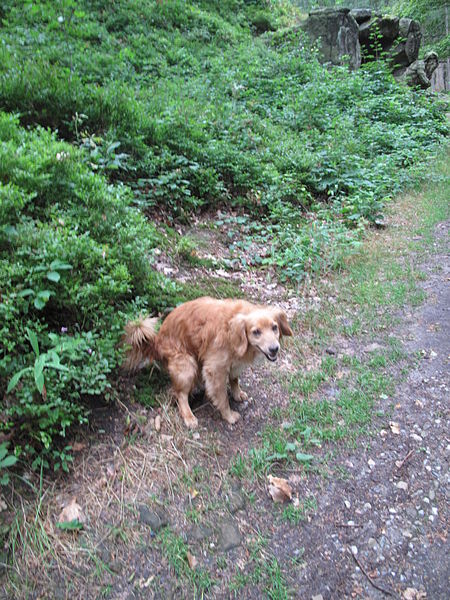
“It’s too big to be a dog’s.”

My step-granny’s face expressed genuine horror one morning when she returned from a short walk before breakfast. One summer week in the sleepy year before I finished high school and went off to college, Billie and my granddad were visiting from Middle Tennessee. She stood in the kitchen with her mouth open in disbelief.

“What’s wrong?” my father asked her.

It was as if she had lost the ability to speak. She started and stopped a few times. Finally, she shook her head, and said, “Well, I don’t know how to say this. But apparently someone—some person—has taken a crap right out in the middle of the street in front of the mailbox. It’s too big to be a dog’s. Who would do such a thing?”

“What on earth?” My father frowned and looked at my brother and me, as though we would know. Shocked horror went around the table. My brother and I were “good kids,” and we’d grown up in suburbia, not a Willie Morris small town.

“I didn’t know what to think,” Granny Billie said, her pretty mouth pursed. “I’ve never seen anything like that.” She shook her head. Since Billie was a nurse, we knew she had seen her fair share of human excrement and should be a good judge.

After breakfast, my father went out with a spade and bag to clean it up. He eventually returned to the house as stunned as Billie. “It looked as though someone just dropped it right there,” he told my mother in hushed tones.

The incident haunted us all for several days—a tiny bit like having a cross burned in your yard, I thought at the time. Who could hate us so much? Since we didn’t have any real candidates on a list of enemies that bitter, we speculated that someone else had been out walking and just had an overwhelming urge, barely getting their trousers down in time. But we couldn’t imagine that they’d leave it there or not at least dash behind some shrubbery. Billie quit taking morning walks, and we all stayed just a little closer to home, the mystery hanging in the air as thickly as any smell.

A few days later, however, we learned the truth—our neighbors the Griegers had just gotten a new German Shepherd after the death a few weeks earlier of old Blitz. The dog evidently was adjusting to a new diet with prolific poops and was still oriented toward using a paved kennel-floor for his business rather than woods and leafy ground.

The question remained, of course, why the Griegers, perfectly respectable folks who we knew quite well, had left it there. I have to say that we always wondered. I still do.

* * *

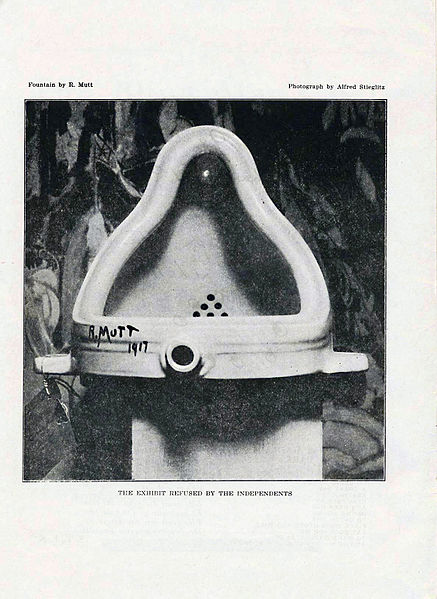
Since Marcel Duchamp’s 1917 Fountain, it’s hard to determine the bounds of art.


One semester when Bruce was living in New York city on a sabbatical from Augustana College where he taught, his friend Keith visited him from Alberta. They embarked on a tour of numerous art galleries, painting being Keith’s profession, and gallery walks being one of their favorite city activities.

At one point, they stepped into a vast, echoing gallery space and began walking around. No one seemed to be there—not a gallery clerk in sight—but a large pile of what was apparently dog poop sat neatly in the middle of the floor, still seemingly steaming.

Bruce looked at Keith, and Keith looked at Bruce, and they both looked at the pile. There were several sculptures scattered about the room, and they looked to see if any of the others had kinetic properties such as steam or smell. They leaned over the pile to see if it might be made of anything but the real stuff.

Was it dog poop or was it art? They didn’t feel quite sure and laughed over the conundrum.

Soon enough, the gallery host returned to the room and came toward them with the usual slightly officious style. As he crossed the expanse of floor toward Bruce and Keith, his eyes encountered the pile, and he jumped back with a gasp.

“Oh, my,” he said, “how awful.” He ran to the back for a roll of paper towels and a mop.

* * *
Sometimes, I try to remember that even mis-apprehension can be productive, as long as it makes us wonder about the world around us. This week, I’m going to remember these stories and try to take a closer look around. Even though I am a devotee of something called “the genuine,” it is good to remember that it’s a wonderful and often hilarious part of life that things are not always what they seem to be.

Hallelujah

Posted on

A beautiful song for the third anniversary of my marriage to Bruce. This “Hallelujah” was written by Leonard Cohen, whom I posted about just the other day, and is sung here by kd lang, who Bruce and I saw in concert here in Orlando last Sunday.

So many thoughts—

One reason why this song is perfect for today is that Bruce, like lang and Cohen, is a Canadian. “Canadian content” is one of our short-hand phrases for pointing that out—the distance from which we came together.

Another reason is that the love of people our age is complicated. Just this morning, I woke up with a low blood sugar and burst into tears over anxiety about our upcoming trip to Berlin—all my fears of not being able to keep up because of the arthritis in my foot and needing to rummage around in his friends’ kitchen for low-blood-sugar juice in the middle of the night and of my stomach getting upset over unfamiliar foods… Bruce and I had to talk it all out, and I told him after I realized what day it is that maybe I should wish him an unhappy anniversary. But, no, he loves me—and I love him—in spite of all the flaws of our human condition. “All the perfect and broken Hallelujahs have an equal value,” Cohen is quoted as saying about the song, and that seems appropriate today, even though I would not call my love a cold or broken hallelujah. Quite the contrary.

But even the kd lang concert the other night gave me much food for thought. Beyond the beauty of lang’s voice and the sheer pleasure of the concert, I have to note that it was not particularly well attended. Bruce and I—and no telling how many others—had gotten free tickets in a last-minute promotion, which was no doubt inspired by poor ticket sales. The Hard Rock Café concert space was even so only about 2/3 full, and I felt bad about this. Lang gave a terrific performance, and I know that non-sellout shows must be a standard feature of the musician’s life, but it was hard for me to believe that someone as distinguished as kd lang hadn’t filled the place up.

Bruce noted that there’s really no great way to keep up with events going on in Orlando, and several friends commented later that they, alas, had not realized she would be here. We ourselves had missed a John Prine concert just a few days earlier in spite of the fact that I’m his fan on Facebook and would have loved to be there. (I first saw him in concert in about 1977, and perhaps we should label him with “Appalachian content” to also indicate the different roots Bruce and I have.) It’s just hard to keep up, and we are distracted from our “entertainment” options, even the profound ones, by our work.

Such is the unpredictable and accidental nature of fame, art, love, and human life. Today, I am grateful to be experiencing all that together with him.