Author Archives: Lisa Roney

Boogertown Gap


Last month Bruce and I had the opportunity to get together with one of those old friends I’ve become reacquainted with through Facebook. Ruth lived near me in high school, often drove my brother and me (and another neighbor kid) to school in her beige square-back Volkswagen, and always carried her flute or piccolo along. Little did I know that she majored in classical music at the University of Tennessee and that now she and her husband, Keith, have chosen to center their lives on the traditional music of their ancestors in East Tennessee. Their duo is called Boogertown Gap, after a local place of Keith’s childhood, and they perform old-time mountain music in the area and beyond. (The above video is more wonderful but longish, so here‘s an excerpt if you just want a taste.)

Although they have chosen to honor tradition in their lives, however, they are full participants in the 21st century, and I met up with Ruth again via Facebook a year or so ago.

Last month, they came to Central Florida to visit friends and attend a conference, and they invited us to join them one night for some playing and singing. I hadn’t seen Ruthie (she’s still Ruthie to me, though I’m trying to adjust) in close to 30 years. But when she opened the door, she still looked just like herself, and we met Keith and the other friends, and soon music was in the air.

Bruce had brought along his electric bass, and although it wasn’t a natural fit to accompany the guitars, the fiddle, the banjo, and the recorder, everyone welcomed it, and off the musical types went. (If you know me, you know I just watched and listened and tapped my toes on the floor.) Soon enough, Ruth had Bruce playing the spoons. You can see here how good she is at teaching the spoons.

It was a lovely evening, and the toe-tapping music brought everyone together beautifully. We hope to see Ruth and Keith again sometime.

People Connections: Facebook Reprise

Bruce and I recently watched The Social Network. We’d put it off for quite a while because we’d heard that it was full of jerks, and indeed it was. The filmmakers were fascinatingly successful at rendering Mark Zuckerberg sympathetic by making it seem as though the other jerks were worse than he was. Poor little lonely rich guy.

Several things struck me about the movie. One was how much college has changed. My brother graduated from Harvard in 1980, where Facebook got its start 20+ years later, and I attended another “elite” college, though not in the Ivy League. As I watched The Social Network, I couldn’t help thinking about the way money has come to be the vastly dominant value in our culture. I don’t mean to trot out that “when I was your age, we had to walk to school two miles through the snow.” But I have virtually no recollections of talking about plans to get rich when I was in college, and I don’t think my brother had many either. Yes, both of us knew obnoxious rich kids, the silver spoon jock types. It might be an odd thing to celebrate those fellows’ 1970s and 80s obsession with drugs and sex, rather than intellectual learning, but—hey—at least it wasn’t an obsession with reaffirming their privilege and expanding even further their financial advantages in the world. I’m sure financial plotting was there; it just wasn’t so bald in my youth.

It was no doubt more prominent at Harvard than at Carleton—I remember the much stiffer and status-conscious atmosphere from when I visited my brother there, and I remember being amazed that Harvard allowed those dinner clubs to exist in our day and age. In fact, one of the reasons why I had chosen Carleton was that it had absolutely no fraternities or sororities. I believed that such things were a throw-back—like debutante balls and country clubs. How could universities open their doors to women and people of color and different backgrounds, thus asserting that the right to higher education was not a birthright, and then turn around and allow these clubs to perpetuate the discriminatory privileges that their admissions policies no longer supported?

Of course, instead of dying out, secret societies, country clubs, and fraternities and sororities have made a huge comeback. On our recent visit to Knoxville, Bruce and I asked my dad about an enormous new construction project near the UT campus, and he informed us that the university is now pouring money into a project to build sorority houses. “To fix the gender inequity,” he said, and sighed. I find the idea of sorority houses addressing an inequity hilarious. One kind lessened for more of another kind. That they’re now building sorority houses instead of demolishing fraternity houses shocks me.

As we watched The Social Network, I thought a lot about the exclusive origins of Facebook. I recall that when I was first encouraged by friends to sign up for a social networking account, I was told that the Facebook membership was better educated than that of MySpace. I didn’t realize for a long time that Facebook had originated at Harvard, that it had been built on the concept of exclusivity. First it opened to other Ivy League schools, then expanded to university students with “edu” email suffixes, then (I suppose when some of them started graduating) to people at certain companies, and then, finally, to all over the age of 13.

In some ways then, Facebook has been democratized. Yet I wonder if it doesn’t remain tied to a hierarchical system based on rather juvenile standards of interaction and created by a fellow who imbued it with a barely-beyond-high-school sense of social values. I think a lot of us—even those of us who use it enthusiastically—have deep ambivalence about it because of some of these remnants.

On the one hand, I really enjoy Facebook. It’s rather miraculous to be in touch with people I would likely never have heard of again had Facebook not come on the scene. I no longer live in either of my hometowns, and I have never received an invitation to a high school reunion, nor have I ever attended a college one. When you have had the rather peripatetic life that I’ve had, it’s also a miracle to see so many different parts of your life gathered in one spot. Weird sometimes, but cool, too.

There’s my brother, of course, whom I’ve known since birth, but close on his heels is Sharon, whose parents played bridge with my parents when I was a toddler; Lisa, who I met in elementary school and who introduced me over the years to both s’mores and Spin the Bottle at her parties; William, who played basketball with my brother but who was closer to me in age and stayed my good friend and correspondent all through college. There are high school friends mixed in with college friends mixed in with grad school friends mixed in with colleagues and recent friends mixed in with former students. When on Facebook I often miss my friends who don’t use it at all or much. There’s something deeply satisfying in knowing that there are some continuities in my fragmented life, even if it is just that a lot of my friends like cats and dogs.

Facebook was also great immediately after my brain hemorrhage last year—it made things easier for everyone, including me. Hospitals have changed—I can remember when they took everything away from you as soon as you were admitted. Now they leave you with your iPhone in peace. I had music, I had Scrabble, I had email, I had the ability to make calls, but I also had the ability to not have to make calls. I just posted on Facebook, and the messages of concern and affection came rushing in like rain on the windowsill—it was outside, but I knew it was there, warm and life-affirming.

Obviously, these purposes now go beyond the college-student hook-up site that Mark Zuckerberg originally envisioned. Facebook, as we all know, has helped to create entire political movements and to help locate lost teenagers. Wikipedia even reports that in February 2011, a newborn in Egypt was named “Facebook” to honor the role that it played in that country’s revolution.

On the other hand, Facebook in my health crisis situation was a little deceptive because serious illness is a demand, both physical and emotional. Some people in your life are going to meet that kind of demand and others won’t, and there are even some people you shouldn’t ask. Facebook lumps everyone together, though now in response to Google+’s circles it allows for different “lists.” Still, the effect of Facebook is a kind of superficiality—a kind of one-night-stand of support rather than something more sustaining. Three people—one colleague, one former mentor, and one dear friend—rather brutally abandoned me in the immediate aftermath of my brain hemorrhage, and Facebook has made this doubly weird.

It’s not that these betrayals wouldn’t or couldn’t have happened without the brain hemorrhage—at least one of them definitely would have, as the ground for it was laid by my colleague long before her final coup. My brain hemorrhage was in that case used as a convenient excuse for side-lining me, and this extended to the betrayal by my former mentor as well. In both of these cases, I was discredited partly because I was ill and therefore “weak.” This is a common and well-documented reaction to serious illness, outlined long ago by Irving Goffman in his work on stigma. The friend who abandoned me is another matter, and one that I’m at a loss to explain. Explanations and excuses are seldom forthcoming in such situations, and certainly friendships sometimes end without major illness as a factor. But I will say that such abandonments in times of illness seem cruel, far more so than when you’re well.

And it’s not as though these betrayals wouldn’t have happened without Facebook. It’s just that Facebook takes you back to the kind of public rejection that we’re all likely to have had in junior high and high school. One of the people who betrayed me in 2011 also “unfriended” me on Facebook in a good indication of her own guilt and self-loathing, just like the junior high girl who steals someone else’s boy and calls her former friend names.

The other two are still my “friends” on Facebook. One of them is probably completely unaware that I feel betrayed by her; I grant her the benefit of the doubt because I know she was misled by others. We are still polite to one another, but I feel a bit like a teenage girl who thought she was the favorite of the football team captain only to find he’s dropped her for a cheerleader. The one who was my friend simply sits there, just as her image does in my wedding photos, a cypher, like the former close pal whispering with her new buddies at the school lockers.

I feel no particular antipathy toward any of these people, though it is odd to see them on Facebook (and I do see even the one who “unfriended” me because we have numerous “friends” in common). I suppose that’s an indication that my emotional life has matured since high school even if the structure of Facebook shapes us in that h.s. mode. This has all pointed out to me concretely how Facebook is not so much about friendship as it is about something else, the wider social network indeed—or the appearance of community, but not community itself.

We all know this, of course—it’s particularly obvious among writers and academics where so many of us use it as a tool of self-promotion. I do this myself, to the extent I link my blog to it and post publications sometimes. There are those who use this aspect lightly, though, and those who use it heavily. There are those who do so unrelentingly, and there are those whose Facebook pages are strangely unreal, surreal even. Watching The Social Network, I thought it no wonder that Facebook is so commonly used this way, considering its founders and their original intentions of getting ahead.

Being “friends” is, after all, not the same as being friends. I’m pretty sure Mark Zuckerberg has known this from the very beginning since his main motivation for his creation seems to have been revenge and social climbing. In other words, this may be a “duh” moment. But I still think about it a lot, in love as I am with both the simulacrum and the real world and still trying to parse out what differences Facebook makes, positive and negative.

James Agee and “Knoxville: Summer, 1915”

James Agee, NY World Telegram & Sun, Library of Congress.

“We are talking of summer evenings in Knoxville, Tennessee, in the time that I lived there so successfully disguised to myself as a child.” So begins James Agee’s novel A Death in the Family, his semi-autobiographical masterpiece, in the short prelude called “Knoxville: Summer, 1915.”

I have always felt a special connection with Agee, not just because I admire his now-seldom-read maximalist prose, but because he grew up on Highland Avenue in Knoxville, where I lived for a couple of years while my father was in graduate school and where my mother’s mother lived when she was growing up. He goes on to describe the neighborhood: “It was a little bit mixed sort of block, fairly solidly lower middle class, with one or two juts apiece on either side of that. The houses corresponded: middle-sized gracefully fretted wood houses built in the late nineties and early nineteen-hundreds, with small front and side and more spacious back yards, and trees in the yards, and porches.”

By the time my family lived there when I was a child, the neighborhood had gone down and was no longer solidly middle class. My family lived in a five-room cottage that had been built in between some of the larger, older houses. The largest of those “gracefully fretted wood houses” that remained on our block was peeling and listing, and housed a large family that often borrowed money from my father the grad student to pay their heating bill. The kids were always angling for snacks. We did still have a large back yard that sloped down to a gravel alley. Across the alley, though, was a boy named Herschel who lived with his grandmother in what was apparently a muddy trash heap. He once threatened me by swinging the body of a dead cat over his head while he yelled obscenities.

I still have fond memories of living there—playing with the Kellys, who lived across the street and whose Dad grew hens’n’chicks in big pots on their front porch; making forays down to the old-fashioned corner store where we would buy a candy bar on occasion; sailing little bark boats in the puddles in our rutted driveway. One evening a driverless car rammed into the corner of our house, its owner having left off the parking brake on the steep hillside. My brother and I were allowed out in our pajamas to see while my father murmured with the errant car owner and the tow-truck driver. Seldom outside at night, I was fascinated with the sparkling street lights.

My mother also told me that her mother had lived on Highland Avenue as a girl, and when I later became aware of James Agee’s growing up there, I wondered if they had ever met. Agee was a bit younger than my grandmother, and the Avenue is a longish street, so the answer is probably no. But as I read A Death in the Family, I felt certain that the childhood Agee described was very near to the one my grandmother experienced. He mentioned Laurel Avenue, he mentioned Miller’s Department Store—and so had my grandmother. And those places really existed and were still extant during my teenage years.

Miller’s has by now been bought out, and the neighborhood that once housed families has largely been bull-dozed to make way for hospitals, doctors’ offices, businesses, and university buildings. There are a few pockets preserved, but it is a changed landscape.

Agee’s birthday was November 27, and so it seems doubly right to remember him during the week I visited the place that affected both him and me so powerfully. He’s also been recently remembered for his nonfiction work with documentary photographer Walker Evans, Let Us Now Praise Famous Men, and for the original article that Fortune magazine refused to publish, but that will appear in the March 2012 issue of The Baffler. I know I’ll watch for it.

That Agee did not receive unqualified praise himself assures me that he was onto something and in a completely unique way that audiences were not ready for. I wish more writers were “bloated with guilt” instead of fit as fiddles with their own self-satisfaction!

“I know I am making the choice most dangerous to an artist in valuing life above art,” Agee noted. And indeed, he produced a very small body of work before he died at the age of 45. But it is some beautiful stuff. Again, from “Knoxville: Summer, 1915”:

Now is the night one blue dew, my father has drained, he has coiled the hose.
Low on the length of lawns, a frailing of fire who breathes.
Content, silver, like peeps of light, each cricket makes his comment over and over in the drowned grass.
A cold toad thumpily flounders.
Within the edges of damp shadows of side yards are hovering children nearly sick with joy of fear, who watch the unguarding of a telephone pole.
Around white carbon corner lamps bugs of all sizes are lifted elliptic, solar systems. Big hardshells bruise themselves, assailant: he is fallen on his back, legs squiggling.
Parents on porches: rock and rock: From damp strings morning glories: hang their ancient faces.
The dry and exalted noise of the locusts from all the air at once enchants my eardrums.

And he ends this passage: “Sleep, soft smiling, draws me unto her: and those receive me, who quietly treat me, as one familiar and well-beloved in that home: but will not, oh, will not, not now, not ever; but will not ever tell me who I am.”

Place Connections

The sign at the top of the Schoolhouse Gap trail, where we hiked this weekend.

Whenever Bruce and I return home from a trip out of town, he says, “I miss everywhere but Orlando.” I usually bristle when he says this, wishing somehow that we should be loyal to the city where we live. I try to emphasize in my mind the comfort of our home, the pleasant view of pines and palms and palmettos out the wall of sliding glass doors across the back, the presence of my sweet kitties, the large live oaks that line the streets of our neighborhood and trail Spanish moss like so many dream clouds. There is a lot to like about where we live and how we live.

Yet it’s true that I haven’t found a sense of home here, and I am reminded of that every time I go back to East Tennessee, as I did over Thanksgiving weekend to visit my dad and his wife. I have that creeping middle-aged feeling that it was a good place to live, though I couldn’t wait to get away from it when I was young. There was, after all, a whole world to explore. Surely in all that world, I thought, there must be some perfect place.

Now, when I go back to Sequoyah Hills, where my family lived for three years during the late 1960s, and where my father has lived the past fourteen years, I think it might be the most perfect place. I feel at home in my body there, and in the nearby Great Smoky Mountains, even though my connections to both places and to East Tennessee in general might seem tenuous.

One thing I always notice when I’m back in East Tennessee is just how nice everyone is. On this trip, Bruce and I stopped off at a convenience store for drinks, trail mix, and a pack of sandwich cookies to take on a short hike in the mountains. In spite of the fact that the stretch of Alcoa Highway we were driving along is not doing too well—numerous storefronts papered over and a few buildings bulldozed—the clerk was cheerful. She rang us up promptly and politely asked if we wanted a bag. As I put my wallet back in my purse, she actually said, “Y’all come back soon!” I laughed and told her we were just visiting so it wasn’t likely, and then I felt stupid, as though this might be rude. So I added, “But next time!” and she grinned at me and waved as we pushed through the door.

This always happens when I am in East Tennessee. Always. It’s not that I never encounter a grumpy person there, but such are greatly overshadowed by nice people, friendly people, people willing to chat, people who treat you like you are another human being. I don’t realize I miss it until it’s there in front of me again.

I wonder about it, too. For a long time, I wondered if it meant that people were dumbly accepting of their “place” in life. I mean, shouldn’t clerks in convenience stores, working the Saturday after Thanksgiving, be somewhat resentful of those of us cavorting in the woods on vacation? Doesn’t their cheerfulness let me off the hook too easily in my middle-class life? I mean, no revolution is going to come from that attitude!

There was always a kind of acceptance exhibited by people in East Tennessee that my restless soul never felt, even when I lived there. My family was more about ambition and less about community, though years later my mother gave me a T-shirt that says, “If you’re lucky enough to be in the mountains, you’re lucky enough.” Even though I readily acknowledge the down side of too much acceptance of the status quo, I also think I would have done well myself to learn better the importance of commitment to community and of a sense of self-worth that is rooted in something other than achievement.

There is, in fact, something in kindly behavior that asserts (better than resentment) that we are all fellow travelers and that we all deserve each others’ respect. There is a lack of shame in a habit of friendliness, a democratic sense that we each play an important role in life unfolding. I find again and again that in East Tennessee, there’s less adherence to a corporate script and more ad libbing.

My dad used to tell a joke about this. It involved Air France opening an office in Knoxville and a young local woman who got a job there making airline reservations on the phone. The manager from France worked very hard to train the young woman to answer the phone properly with a sophisticated tone, but on her first day on the job, the young woman picked up her first call and said, “Air France” [with the trained lofty accent]. Kin I hep ye?”

Even more than this native kindness, though, I feel a connection to East Tennessee simply through my senses. I feel it through the easy adjustment of my body as the car curves along the hilly roadways. My lungs seem to expand and my nostrils open wider in the pine-scented air with the right amount of moisture. The light creates halos around people and objects in its brightness that is seldom harsh. Even the sound of dogs barking in the evening is resonant and pleasant, deep and cushioned by the hills and trees, and so unlike the shrill, neurotic sound of dogs in Orlando.

But, of course, there’s also a lack of complication that I’m suspicious of in my view. Going “home” is like being a tourist in my own past—there were indeed fewer complications when I was a kid. Even the difficulties I recall are blunted with distance. No doubt I had sharp emotions then as I do now, but in retrospect, they fade and the familiarity of the place feels only good. I wonder if nostalgia can ever be a genuine emotion.

It sure feels real.

from Mine the Harvest

In celebration of and consternation with the holiday, here’s a sonnet from Edna St. Vincent Millay’s final collection of poetry, Mine the Harvest, published posthumously in 1954.

Tranquility at length when autumn comes,
Will lie upon the spirit like that haze
Touching far islands on fine autumn days
With tenderest blue, like bloom on purple plums;
Harvest will ring, but not as summer hums,
With noisy enterprise–to broaden, raise,
Proceed, proclaim, establish: autumn stays
The marching year one moment; stills the drums.
Then sits the insistent cricket in the grass;
But on the gravel crawls the chilly bee;
And all is over that could come to pass
Last year; excepting this: the mind is free
One moment, to compute, refute, amass,
catalogue, question, contemplate, and see.

Sandusky and the Democratic Need to Speak Out

You might not think that the Penn State child abuse scandal and Occupy Wall Street have much in common. But maybe I can explain why I will celebrate OWS every day until they are smashed completely by those who don’t want to hear it. It’s not just because they have a point, but also that they are willing to make it.

I spent 14 years in State College, Pennsylvania, first working at Penn State and then earning two graduate degrees there. I never met Jerry Sandusky, met Joe Paterno only once briefly, and only met Graham Spanier a handful of times, though I worked for his wife as a research assistant for a year and sometimes filed papers in their presidential home.

In spite of many claims circulating these days, a devotion to football is not required for membership in the Penn State community. I attended one football game in all my years there, and I left at half time, though I was sitting on the fifty-yard line in the company of a member of the Board of Trustees who was much older and more important than me. This latter was a situation chock full of a low-level sexual harassment that I managed to deflect, but I remember how it felt to say no to a person vastly more powerful than me. Maybe those connections cause me to want to comment on the recent scandal, or maybe it’s just my status as a human being.

Certainly the internet has been lit up with outrage about Jerry Sandusky’s behavior and about possible cover-ups that occurred in the Penn State football program and beyond. I participate fully in some of this outrage—we should assuredly feel it when any child (or adult, for that matter) is sexually assaulted —much less numerous ones over years. Certainly we should expect that all people who witness such a situation, directly or indirectly, should find it worth their trouble to do all in their power to stop it.

But when we expect the latter, we are hoping for people to break an ingrained habit that we usually approve of and take for granted in other situations, a habit that is generally rewarded. Granted, a crime, particularly of a heinous nature, should call for the setting aside of politeness and self-interest. But why is it that so often it doesn’t?

When, in fact, was the last time that you or I looked the other way and didn’t speak up in the face of an injustice, wrong, or lie? Probably yesterday if not today. So I agree that much with neoconservative columnist David Brooks’s recent opinion. I don’t, however, believe it’s because we’re all just inevitably sinful. As Daily Kos blogger Frederick Clarkson pointed out, that’s a dodge. Instead, I believe that, especially in many of our places of employment, we are trained in an anti-democratic obedience that is a hard habit to break. It takes a lot to rehabilitate Pitt bulls that are trained to fight; most humane associations euthanize them rather than ever expect them to recover. Like Pitt bulls trained to fight, people trained to be yes-men and yes-women have a hard time overcoming the pattern.

I also agree with much of what Michael Berube said recently in the New York Times about the Paternos’ academic heritage remaining intact. I wonder, however, whether greater faculty involvement in the governance of Penn State would have made a huge difference, as he claims. Faculty are not fundamentally different from anyone else, and they are no strangers to politics that favor yes-men and yes-women. Faculty are no strangers to pumping up numbers for the image of a program when the reality is not so keen. Faculty are no strangers to unfair practices, and many faculty have never spoken out about even the less drastic (and less risky-to-reveal) wrongs they might witness in their daily work. What Berube suggests would only help this kind of situation if it were one in which faculty themselves did not have to fear repercussions from those more powerful than they.

This is by no means exclusive to universities with football programs. Even though laws that protect them somewhat have been on the rise since the late 1980s, whistleblowers from all walks of life report the high price they often have to pay for their honesty, even when the behavior they report is criminal. (Just type “whistleblowers pay a price” into Google for 2,960,000 hits. Or read this other New York Times column by Alina Tugend who traces psychological research into why this is.) People lose their jobs, entire careers, their marriages, their homes, sometimes even end up on welfare waiting for cases to be resolved. Even in a best case scenario, people who blow the whistle look forward to years of punishment.

There’s another complication here as well, and I finally figured this one out after reading Sara Ganim’s Patriot-News account of conflicting testimony about reported incidents with Sandusky. The article does a great job of laying out all the different indications there were that something seriously wrong was going on. Yet, I didn’t quite agree with its last statement that, “everyone cannot be telling the truth.”

What the litany of reports reminded me of was the Space Shuttle Challenger disaster in 1986 and the reports by the Rogers Commission that came out afterward analyzing how on earth NASA could have launched a mission with a combination of factors almost certain to bring the ship down and kill its seven crew members.

When I was a graduate teaching assistant at Penn State, in fact, we used the Space Shuttle Challenger as a prime example in composition classes of why clear and honest communication is important. We used it as a case study of how communication can go wrong. Engineers knew that the Challenger was likely to fail, but the authoritarian culture of NASA and the media pressure due to the inclusion of schoolteacher Christa McAuliffe on the flight made those engineers afraid to assert what they knew in no uncertain terms. As the warnings went up the chain of command, they were repeatedly weakened until they became completely vague euphemisms that did not indicate the extent of the danger. Thus, the fatal decision to launch in spite of low temperatures for which the O-rings had never been tested and were unable to hold.

Here’s how the evolution happened at Penn State, as well laid out by the Patriot-News article:

McQueary: anal rape.
Paterno: something of a sexual nature.
Schultz: inappropriately grabbing of the young boy’s genitals.
Curley: inappropriate conduct or horsing around.
Spanier: conduct that made someone uncomfortable.
Raykovitz: a ban on bringing kids to the locker room.

It’s like a game of Telephone, only the scrambling isn’t random; rather, the message remains coherent, just weaker and weaker.

It is also, Tracy Clark-Flory notes on Alternet (originally Salon), very common for child sexual abuse to be overlooked, ignored, or covered up. By no means are McQueary, Curley, Schultz, Paterno, and Spanier alone in their inability or unwillingness to face up to what was going on.

None of that excuses what happened at Penn State, either the abuse perpetrated by Sandusky or the failure to stop it by others. It does, however, make surprise about it somewhat disingenuous.

And, in spite of my disagreement with David Brooks’s “original sin” kind of thinking, it also means that one of the many places we should look in the aftermath is within ourselves. We can hope that each of us would have the decency to stop and report far and wide such events and suffer the counter-accusations, the damage or complete destruction of our own careers, and the necessarily long, perhaps public, involvement in attempts to rectify something dirty and disturbing. I hope for myself personally that I would have the nerve, and I think I would. Still, while most of us may not be sick or criminal in the vein of Sandusky, we are a lot more like the others than we would like to admit.

So it disturbs me that most of the “attempts to heal” that I’ve seen focus on this false question, “How could it happen?” rather than “How can I prepare myself never to fail in this way?” Externalizing all the blame is inappropriate. We need instead to create different habits in ourselves: habits of telling the truth and speaking out.

Even when we have perfectly good reasons for speaking out, we may be discouraged from doing so. There are kinds of damage less than losing an entire career. There is damage that isn’t even as clear as pepper spray in the face of a protester.

I myself was told by an administrator at my university that in order to make my way in the face of certain manipulative and back-stabbing behavior I just need to get more “strategic” myself. I told him I would rather fail completely than become devious and dishonest. And there’s a very good chance that I will fail by a certain set of standards. In some ways I already have.

Recently a colleague of mine in another place has been sidelined from a program she developed precisely because she criticized the performance of a senior-level administrator for some serious errors. Now an additional faculty member has been added to help further the program and, now that there’s potentially someone else to run it, that senior administrator is saying that she won’t approve of the next phase (investing the resources to create an international center likely to have some renown) unless my colleague be excluded from having anything to do with the program she created. All because the administrator doesn’t like this person.

I also have an acquaintance who was sexually assaulted by an employee of the college where she worked. Because there was no “proof” the institution refused to act on her complaint, and her colleagues wanted her to shut up about it so as not to damage the institution’s reputation. She became—in my eyes, undeservedly—a pariah and eventually left for another, lesser job.

None of these situations is as clear as the issue of speaking out about a child being raped, of course. But I do believe that those of us who are in the habit of speaking out about lesser wrongs are more likely to speak out about greater wrongs. We know how to bear the anger. Some know how to withstand the pepper spray and tear gas.

The trouble is, of course, that it’s very hard to tell the difference between a truth-teller and a mere trouble-maker or even an asshole. For those of us who are not complete corporate or university sell-outs—yes-men and -women who have consciously prioritized getting ahead—the main quandary is how to create the habits in ourselves of telling the truth without becoming simply obnoxious.

We all know the types that everyone avoids, whose sense of what is wrong in the world may be paranoid or self-serving or just plain crazy. We know the ones who are just angry all the time and who will lash out at anyone with an accusation.

In order to try to prevent my own corruption in this regard, I have to always remember that other people see things differently and have a perfect right to do so, that I should say what I think but be ready for the (sometimes legitimate) push-back, and that I will never, ever be popular. Even accepting all that is no guarantee I won’t end up either fudging the truth sometime to get ahead or obsessing about something others see differently. All of us can only try to remain aware.

Beyond myself, I grieve a societal structure that is based to such an extent on a false meritocracy. The belief that greatness necessarily rises to the top poisons a lot of our professional interactions. This, too, is a difficult issue for me. As a teacher, I do indeed want my students to grant me the respect and authority accorded by my education and experience. Fundamentally, though, I don’t want anyone to think they are ultimately inferior or superior to me. I squirm within a university hierarchy in which individuals are expected to show constant deference to those in higher positions and where any questioning, no matter how polite, is considered disrespectful.

Hierarchies are based in the idea that some people are superior to others. This should be in a limited and role-based way at best. But too often, the skinny woman just thinks she’s a better person than the fat one. Too often, people believe that the wealthy deserve it. Too often, the boss sees himself as having a God-ordained entitlement. And in situations like the one in which Michael McQueary witnessed his “superior” doing something terrible, he responded with the assumption that others were in charge, others were responsible, others knew better than he did. We are asked to respond this way almost all the time.

On the other hand, I have in my mind’s eye an image of Myles Horton, one of the co-founders of the Highlander Folk School in East Tennessee that became a training ground for labor and Civil Rights leaders in the 1940s and continues social justice work today. Horton came to speak at my undergrad institution in Minnesota one spring in the early 1980s, an old man who still had a lot to say. I was dating a boy who was interested in Horton’s politics, but I went to see him partly because I was homesick for the gentle rising East Tennessee spring while I sat in a snowbound Minnesota April. He kindly spoke to me about the mud and the unfurling of the bright green, baby leaves and the redbud blossoms, and then he turned to the larger audience and announced, “Democracy is not efficient.”

There is a way of thinking about democracy that means “equal opportunity” to scramble to the “top” with those at the top necessarily defined as deserving. And there is another way to think about democracy, which is that no matter where on the ladder one is, one is an equal as a human being and has rights. Though there is no party or political persuasion that is without its spin, euphemism, power dynamics, even sexual misconduct, I lean left because I think the left’s vision of democracy is closer to the latter than the former definition.

No, democracy is not efficient. If all the managers, administrators, and bosses in the world had to listen and respect others, it might be a boatload of extra work for them. I watch, in fact, as my husband tries to chair a department this way, and it’s hard. He comes home exhausted by the sometimes heated arguments of his department members. I always tell him that they are truly better off because people are willing to put it out there, in contrast to my own department, where it is all under the surface and uglier for it. So, that’s not an easy prospect. But deep and abiding democratic values, practiced daily, might be the best bet against silences that harm and kill.
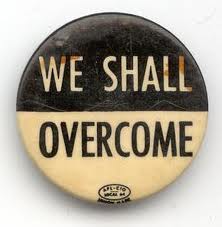
The Civil Rights anthem "We Shall Overcome" was first popularized at the Highlander Folk School.

Elsa Dorfman

Ten Minutes Left to My 67th Birthday, April 26, 2004 by Elsa Dorfman. With permission of the artist.

I’ve been on a kick about truth-telling lately, and we usually think of truth-telling as involving situations where the truth is ugly and difficult, as in the witnessing of atrocity or political injustice. However, there are those whose truth-telling is of a more joyful and humorous kind, and portrait photographer Elsa Dorfman is one of these.

On her talent for getting people to relax in front of the camera, Dorfman says in an interview, “maybe because I do so many self-portraits i exude confidence cause i don’t ask anyone to do something i havent done to myself. that is stand in front of the camera and accept my extra weight. imperfect haircut. mismatched wardrobe which i happen to approve, as in gudren clothes” (The F Blog).

As Lisa Surati notes on photo.net, “Elsa’s portraits do not illuminate or glamorize her clients; rather, Elsa presents her clients in an extraordinary way, as themselves.”

I remember how striking this was to me when I was a young woman negotiating the meaning of my own imperfect body. I was working as an editorial assistant for the Woman’s Art Journal in the early 1980s when we published an article about women’s nude self-portraits, including one of Dorfman’s that I recently found on artnet. (Please do open this link so you’ll understand!) Of all the wonderful work that the magazine featured over the years that I was associated with it, Dorfman’s is the work that I remember best.

The reason is twofold: one is that these portraits were the most honest depiction of ordinary female physicality I had ever seen. Another was that they were presented with simplicity and an understated sense of good-humored self-acceptance that I longed to inhabit then and still do. There’s no self-pity there, and no shame for not being a beauty queen.

Re-encountering Dorfman’s photography in general, and her self-portraits (both nude and not) in particular, has me thinking anew about the value of written memoir as well. My creative nonfiction students often talk about the “bravery” of their classmates who write about certain tough topics in their lives. I often raise with them the issue of how “bravery” isn’t enough, how the shaping of the trauma into a story that reaches beyond the self is necessary for any work that aspires to art.

And yet, I think about the utmost appearance of simplicity in Dorfman’s self-portraits. In The F Blog interview, she notes, “i can’t tell you how hard i work to make it seem effortless.” Yet she embraces the imperfect and the straightforward in her subjects, including herself. This is artistry in the service of the genuine, art that asserts that little truths are perhaps as important as so-called big ones. Perhaps, indeed, memoir has an affinity with this kind of documentary photography that doesn’t use dissolving filters. The person who puts experience down on paper, whether in writing or in photographic image, works hard, but there is a respect for the experience itself.

This is a kind of truth-telling that understands compassion is based on frankness and honesty, not fantasy and pretense. I like it. I’m glad that both Elsa Dorfman and the Woman’s Art Journal are still going strong.

Thank You, I’m Alive!


Today is the one-year anniversary of my brain hemorrhage. It was not my day to die last November 14. Like Old Lodge Skins, I ended up getting up and going home. Unlike Old Lodge Skins, however, I had not set out that day to die, and, in fact, one of the things I realized after my unexpected brain hemorrhage was that I did not consider it a good day to die.

It may seem obvious that we don’t usually consider any given day a good day to die. But, as I was trundled on the gurney out to the helicopter for the flight from Altamonte to Florida Hospital South, I thought about that line from Little Big Man. It is a line that indicates a life that could be let go, even immediately, with satisfaction in having lived well. As great as much of my life was and is, I didn’t feel that way about it. I’ve spent the last year contemplating how my life (external and internal) might change so that if I do drop dead the next time, I will be sorry to go but not regretful.

One of the things that I know I would want to do is to thank the people who have helped me so much in the past year. In spite of the fact that I escaped relatively unscathed, their support has been crucial as I’ve sorted out the meaning of this event in my life and struggled to get my full strength and vitality back.

First comes Bruce, who was with me the whole way. The pain of this hemorrhage was so bad that I did reach a certain readiness for death—not out of acceptance but out of desperation. At the moment when I thought, “I can’t stand this another second,” the fear in Bruce’s eyes let me know how much he loved me. I’m glad his fear didn’t last more than a few hours, but I’m also glad it let me know that I had good reasons to withstand the pain.

I also want to thank my beautiful family of origin. We have many flaws, but they all pitched in when needed and made a huge difference in the crisis. My mother was here from Virginia in less than 24 hours, and stayed the entire ten days I was in the hospital, helping a shell-shocked Bruce and laying in the meals that we would eat for weeks after, as well as sitting with me in neuro intensive care. My father and brother put their heads together when they heard that Bruce might cancel his trip to Africa (the culmination of a year’s worth of work), and they volunteered to come and stay with me for alternating weeks after I got out of the hospital so he could go and complete this major project. My dad’s wife, Jane, was considerate enough to send along with my dad a new pair of comfy pajamas for me to wear during my weeks on the sofa.

I want to thank my friend and colleague Terry, who stepped right in and took over my most onerous class and who arranged for others to fill in for my other classes. I appreciate all who helped with my abandoned teaching duties and grading for the end of term, but especially Terry, who made all the arrangements, ran materials back and forth, and added a boatload of work to her already heavy responsibilities. Terry and her husband, Don, came to the hospital and told the nurses they were relatives so they could check on me. I thank them for their genuine involvement and caring.

I thank all those who sent well wishes and little gifts in the days I was in the hospital, the students who sent me a box of chocolate, and all those who called to get the story. I thank my many friends and other relatives from all over the country and beyond who have checked in from time to time and asked after me.

Most especially I thank my dear friends Susan, Gigi, Holly, Ivonne, and Anna (and Terry), who have been in touch even more frequently than usual to talk over the shifting meanings of our lives. They say that in a crisis you find out who your friends really are, and you do. These are people who understand the reasonable and the unreasonable in both me and the universe. These are people who overcome the fear in themselves evoked by all serious illness in others and who don’t discredit you for it. As Adrienne Rich notes, “we can count on so few people to go that hard way with us,” but the generosity of these friends has been plenty for me. They have all been through “things” themselves, and they have been great companions on my journey back.

I am blessed by the presence of all these people in my life, my life that goes joyfully on. I may not think that even today is a good day to die, but I would die with much less regret today than a year ago.

“A Good Day to Die”–Or Not


Little Big Man (1970) is a very funny tragedy. One of the most repeated lines in the history of movies is, of course, when Old Lodge Skins (played by Chief Dan George) proclaims that “It is a good day to die.” He does this first when he sets out to fight the white man, and he says it again in this scene when he realizes that the white man cannot be defeated.

I guess race and the questioning of assumptions about it is my theme this week. I’m sure there are plenty of racial inaccuracies in this movie. Chief Dan George was himself a member of a coastal tribe from Vancouver, not from a Plains tribe, for instance, and there are no doubt elements of the depictions of Native Americans here that are questionable. The dialogue at the end of this scene might not be a “flattering” depiction, albeit it is designed to be absurdly comic.

But the film was one of the very first Westerns to center the sympathy and character development on the Native American characters. These Native Americans are not “noble savages” much less “ignoble” ones. The narrator and main character, Jack Crabb (played by Dustin Hoffman), a white man adopted as a child by the Native Americans, is a full-fledged liar, so some of this is even made light of on the surface. The movie doesn’t presume to provide a Native American first-person point of view, and Crabb’s stories have other purposes than accuracy, but his heart is in the right place, as was that of his adopted grandfather, Old Lodge Skins.

Old Lodge Skins and his people refer to white people as “white people” and only to their tribesmen and –women—as “human beings.” When I first saw this movie, I was delighted and surprised by this reversal of the Manifest Destiny junk about whites being more human than other races of people. It was one of the first things that got me thinking about the importance of perspective.

In this scene, Old Lodge Skins finds that it is not yet his day to die after all.

Rock ‘n’ Roll N


Warning! Late-night language.

I think that the only time I’ve ever uttered the “n-word” out loud is in singing along with this song. I still can’t bring myself to type it or speak it in any other context, but the thing is that Patti Smith turns the meaning of the word on its head. She turns a terrible word into a liberating word, or as close to that as possible. She refers to a whole varied raft of people, inlcuding herself, “grandma,” Jackson Pollock, Jimi Hendrix, and Jesus Christ as “n”s. By doing so, she transforms the “n-word” into a commentary on the collective of all those “outside of society” and of the implied negative costs of conformity of whatever type. Fitting in is not a desirable trait here.

Whether this song works for you or is just too shocking and repulsive in its language, there’s an attempt to recognize a commonality and a solidarity. Certainly, I’ve never been the kind of hellion that Patti Smith once was, but I grew to love the way she examines what it means to be different from the norm. The album Easter came out in 1978, and for me it was the beginning of awareness that there are people who celebrate their differences.

It took me a long time to be able to listen to this song, and I was reminded of why when I read recently that the Memphis and Shelby County public school systems are in the process of merging, a process that is re-sparking some earlier racial tensions. It was perhaps in the context of busing for school desegregation (federally mandated in 1973) that I heard the n-word most often and most hideously. More than half the city’s white students’ parents sent them to private schools instead of cooperating, a process they justified in openly racist ways. My parents chose not to participate in white flight, and I was called an n-lover on numerous occasions.

So when, just a few years on, I first heard “Rock ‘N’ Roll N” I just couldn’t bear it. Its defiance, however, kept coming back to me. “Let’s redefine things,” it seemed to say. And I agreed that was a good idea. I had been put down as a woman, as a Southerner, and as an aspiring artist enough times already in my young life to feel a connection to the sensation of debasement, and I eventually embraced the song as a manifesto of sorts.

Patti Smith still has a habit of not accepting the usual definition of things. A.O Scott, in a recent interview, notes:

When I brought up the persistence of grief in her songs, Smith laughed — it was certaintly not the first time an interviewer had raised the subject — and gently corrected me. “I think it’s less about grief than remembrance,” she said. “Grief starts to become indulgent, and it doesn’t serve anyone, and it’s painful. But if you transform it into remembrance, then you’re magnifying the person you lost and also giving something of that person to other people, so they can experience something of that person. That’s why when I’m traveling with my camera, I’ll often take pictures of, you know, Keats’s bed, Shelley’s grave or Victor Hugo’s desk. It has something of them. If I’m taking a picture of Brancusi’s grave, I know that there’s something of him, of his mortal remains, beneath my feet, and there’s something beautiful about that.”

Smith is an artist who has gone through numerous transformations and phases, and I like that. She may not be as angry now as she was then, but she’s still questioning surface interpretations and emotions.