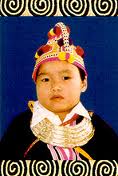
Lia Lee at age 4, from the cover of Anne Fadiman’s The Spirit Catches You and You Fall Down.
The news reached me over the weekend that Lia Lee has passed away. I responded, as I’m sure many others did, with mixed feelings. Lia Lee had been in a vegetative state since 1986, and the bulk of the tragedy associated with her was in some ways already long over. Yet, as this Sacramento Bee obituary notes, her mother nonetheless wept and expressed sorrow over her absence since her death on August 31.
Lia Lee and her family are best known for forcing a radical re-thinking of the value of severely disabled people’s lives and the need for Western medical personnel to deal better with other cultural beliefs during treatment. Hmong immigrants from Laos, the Lees brought with them to the U.S. different ways of thinking both about the epilepsy that led to Lia’s brain-death and about family responsibilities and love. They considered Lia a full-fledged human being even after Western medicine had pronounced her gone.
If you don’t know about Lia Lee, then right now you should take the steps to get ahold of Anne Fadiman’s wonderful book about her, The Spirit Catches You and You Fall Down. I remember reading it shortly after it was published in 1997, and the amazement with which I turned the pages. Fadiman tells the tale of the Lee family’s desperate flight from Laos, their sense of abandonment by the U.S. government after the Hmong had helped out against the Viet-Cong in the “Secret War” during the 1970s, and their bewilderment at the treatment Lia received for her epilepsy at hospitals in their adopted California.
In fact, one small facet of this book has long affected how I teach creative writing. Early on in the book, Fadiman describes how one of Lia’s older sisters had written in elementary school a chronicle of her family’s escape from Laos—swimming across the Mekong River under attack by the Viet-Cong, even losing the life of one family member, enduring squalid refugee camps before finally managing to reach the U.S.—and the teacher’s comments along the lines of “What an interesting life you have led! Watch for proper comma use.” I decided right then and there that I would never trivialize what my students wrote about—that I would always emphasize that the details of writing are not about correctness in itself but about being able to better express the truth of the story you want to tell. I would always treat them as human beings first and writers second. Even this small lesson has served me well.
But The Spirit Catches You and You Fall Down taught so many other important lessons. The impact of Fadiman’s book really cannot be well summarized, even though this New York Times article tries to do so. It’s a book characterized by an unusual depth of research, but also of feeling. There are too few books written with this kind of attention to detail and this kind of sensitivity. Fadiman cared enough to get it right, though even she stands corrected on a few matters. I read a lot of books these days that are superficial or sloppy—and, in spite of some imperfections, Fadiman’s book , even after all these years, puts them all to shame. It is a story that endures even though what it teaches to medical personnel about cultural sensitivity has become close to standard (albeit still too seldom acted on) by now.
May the spirit of Lia Lee live on, and may we remember her as well as her family took care of her.
 Lisa Roney
 Joyous Crybaby
Thanks, Lisa, for this memory of one of my all time favorite books. It was not just groundbreaking, but also full of the personal details that makes creative nonfiction such a great way to reach understanding of hard issues.
Dear Lisa Roney,
I am changing careers from being an anthropology professor to high school English teacher. This year, I am in a master’s of education program and I am starting to think about books as literature, books as ways of teaching writing, rather than as purveyors of cultural lessons and information.
As I think about “The Spirit Catches You and You Fall Down” from the perspective of an English teacher, I’ve started to look on-line to see how others use and think about this book pedagogically. This has been such a transformative book for me as a person and as a teacher, and I was glad to find your post in which this seems to be true for you, as well.
I remember exactly the passage that you describe about Lia’s sister’s essay. Since I, as the reader, knew more about the life experiences behind that short essay (the deaths of siblings in the camps, the harrowing escape from Laos), I remember just cringing to read the teacher’s glib note. How can a comma matter when your student is telling you about being a refugee? I say that with all due respect to teaching grammar and punctuation. It just seems like there is a time and a place for teaching commas, and a time and a place for responding to the IDEAS of a paper.
One thing that I have learned from teaching medical anthropology is that there are many more poignant stories out there than we think. We don’t have to be Hmong to have had cross-cultural communication issues with doctors or nurses. I have often assigned students to write a short essay about a personal experience with a health issue and/or the American medical system that they are willing to share. I compile a list of the topics and read the topics to the class in an anonymous way. There is something magical that happens when 45 people look around and realize that virtually everyone in the room has been deeply marked by their health or healthcare-related experiences. In a room in which everyone may look healthy and may look like they do not know much about pain or suffering, there are people who are taking care of veteran fathers in wheelchairs, who are living with lupus, who go to the hospital ten times a year because of asthma, who lost the ability to have children because of a benign tumor, whose brother has Down’s Syndrome… and the list always goes on. Black, brown, and white, rich and poor, we face each other as full humans after that exercise.
As I transition to teaching about writing and reading in a high school classroom, I will try to take this lesson from Lia Lee’s sister with me. Writing is, first of all, about communication between real human beings. In my classroom, two of those humans are the student and me. I hope I will remember to honor that first and always, before diving into things like commas. Ultimately, learning about those commas is supposed to help students learn how to write in ways that can garner larger audiences. But if their first audiences do not care about what they are communicating, why would they even seek out a larger audience later?